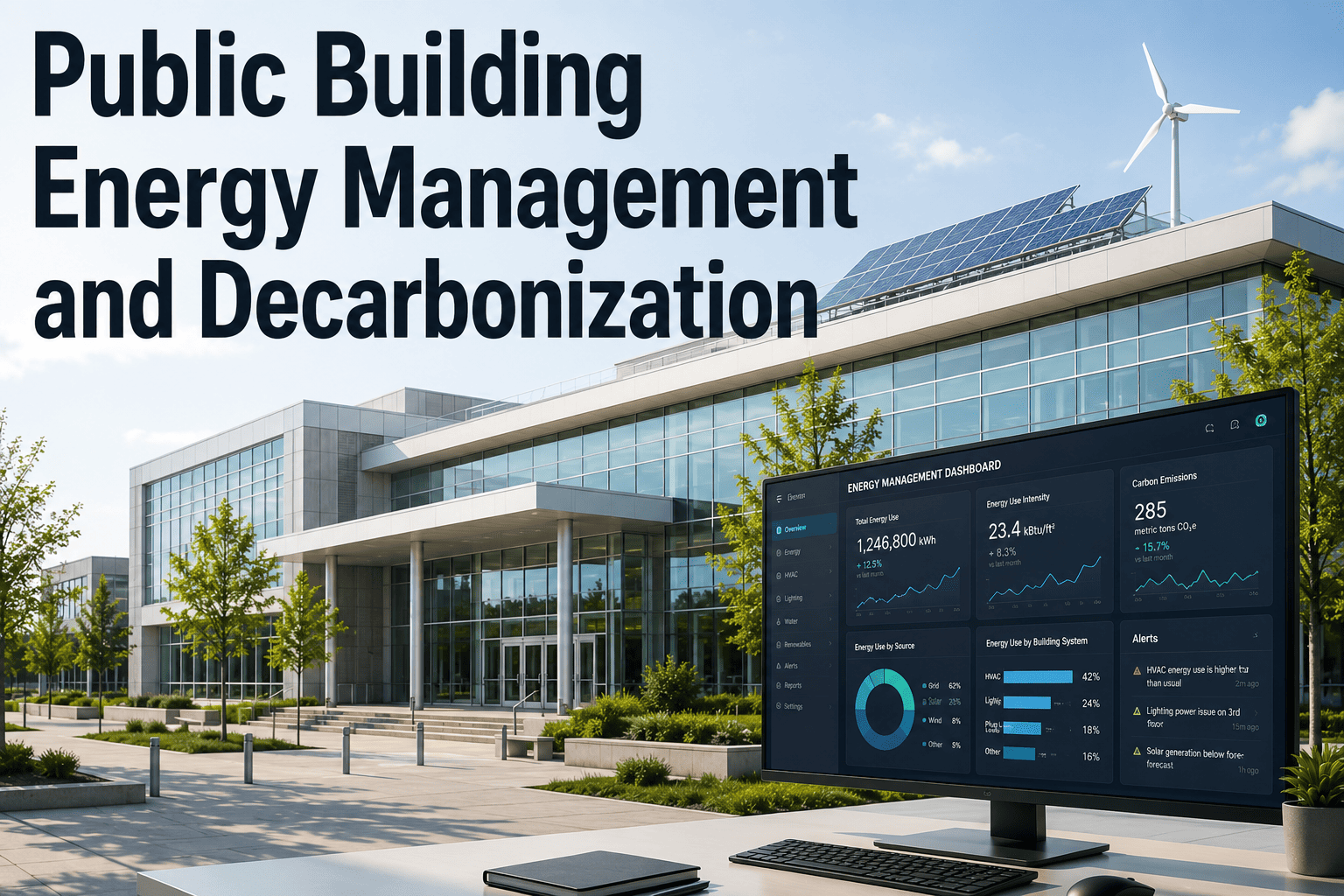
Federal agencies face a statutory deadline to reduce building energy intensity 30% by 2030 under the Energy Policy Act and Executive Order 14057 — while state and municipal governments face their own escalating efficiency mandates tied to building permit renewals, federal grant eligibility, and net-zero carbon commitments. Yet most public agencies still track energy consumption through utility bill spreadsheets, with no connection between energy performance data and the maintenance work orders that actually drive efficiency gains or losses. A deferred HVAC coil cleaning, a failed economizer damper, and an un-calibrated BAS setpoint collectively account for 18 to 35% of avoidable energy waste in government buildings — and none of them appear in an energy dashboard that reads only meter data. Book a demo to see how Oxmaint connects building maintenance operations to energy performance tracking and federal compliance reporting.
Government building energy management is the structured program for monitoring energy consumption, scheduling energy-impacting maintenance (HVAC coil cleaning, economizer calibration, lighting controls, BAS setpoints), and reporting progress toward federal and state efficiency mandates — from a platform that connects energy meter data to the maintenance work orders that drive actual performance. Oxmaint's energy dashboard, federal compliance tracking, and sustainability reporting modules link energy performance directly to asset condition and PM scheduling across the full government building portfolio.
Why Meter-Only Energy Dashboards Fail Government Buildings
Energy management software that reads utility meters but has no connection to the CMMS that schedules HVAC maintenance is measuring symptoms, not causes. When a courthouse shows a 12% energy intensity increase over the prior year, a meter dashboard tells you consumption went up — it cannot tell you that the chiller condenser coils were last cleaned 26 months ago, the economizer damper actuator failed 4 months ago and was never corrected, and three air handling unit filter changeouts were deferred across the building. Oxmaint connects the maintenance work order record to the energy performance trend — so facilities directors can see exactly which deferred PM tasks are driving efficiency losses, and close them before the next federal reporting period. Book a demo to see how Oxmaint links energy performance data to maintenance work order history in your building portfolio.
Dirty condenser coils increase chiller energy draw by 10 to 15%. Failed economizer dampers eliminate free cooling and force mechanical cooling in conditions where it is unnecessary. Both are PM failures, not equipment failures — and neither appears in a meter-only energy dashboard.
EISA Section 432, Executive Order 14057, and state green building mandates require documented maintenance and energy efficiency measure records as evidence of progress toward statutory targets. Spreadsheet-based tracking produces incomplete audit trails that fail IG reviews and delay grant disbursements.
Building automation system setpoints drift over time without scheduled calibration. A 2-degree setpoint error across a 200,000 square foot campus costs $18,000 to $45,000 per year in unnecessary energy spend — yet BAS calibration rarely appears on a PM schedule unless it is explicitly built into the CMMS asset record.
Federal agency sustainability reports, state green building compliance submissions, and LEED O+M recertification packages require maintenance records, energy data, and equipment documentation assembled from multiple disconnected systems — a process that consumes 40 to 80 analyst-hours per reporting cycle at most agencies.
Connect Building Maintenance to Energy Performance — One Platform
Oxmaint links HVAC PM schedules, BAS integration, energy meter data, and federal compliance documentation in a single platform — giving facilities directors the operational and evidence-based reporting capability that federal and state energy mandates require. Book a demo to see the energy management dashboard for your building portfolio.
Oxmaint Energy Management for Government Buildings
Oxmaint's energy dashboard displays building-level and portfolio-level energy intensity trends alongside the maintenance work order history for every energy-impacting asset — HVAC systems, chillers, boilers, BAS controllers, and lighting controls. When energy intensity spikes, facilities directors see which PM tasks were overdue at the time of the increase. Energy performance and maintenance compliance are visible on the same screen, not in disconnected platforms. Book a demo to see the energy-maintenance correlation dashboard for your building portfolio.
Energy-impacting PM tasks — chiller condenser coil cleaning, cooling tower maintenance, economizer calibration, BAS setpoint verification, air handling unit filter replacement, and lighting control programming — are scheduled automatically per asset with escalating alerts before deadlines. PM compliance on energy systems reaches 91% within two quarters of deployment, directly reducing the avoidable energy waste that meter-only platforms cannot identify. No manual tracking across multi-building portfolios.
Oxmaint tracks progress toward EISA Section 432 energy and water intensity reduction targets, Executive Order 14057 federal sustainability commitments, and Energy Savings Performance Contract milestone documentation — with timestamped maintenance and energy measure records exportable as federal compliance packages. IG audit readiness for DOE, GSA, and OMB facility sustainability reviews without manual document assembly. Book a demo to review federal compliance documentation output for your agency's reporting framework.
State green building compliance reports, LEED Operations and Maintenance recertification packages, ENERGY STAR certification documentation, and municipal net-zero progress reports are generated from Oxmaint's sustainability reporting module — pulling maintenance records, energy data, and equipment documentation from the same platform used for daily PM operations. Reporting cycle preparation reduced from 40 to 80 analyst-hours to under 4 hours of automated export and review.
Energy-Impacting Asset Coverage by Building System
Every asset class below is registered in Oxmaint's asset hierarchy with energy-performance-specific PM templates, consumption tracking fields, and federal compliance documentation intervals. Asset condition data and energy performance data share the same record — eliminating the gap between what the meter shows and what maintenance has been completed on the equipment driving those numbers.
Condenser coil cleaning, refrigerant charge verification, and efficiency testing on scheduled intervals. Dirty coils increase energy draw 10 to 15%. PM compliance tracked per chiller with kW consumption trending against maintenance history.
Filter replacement, coil cleaning, economizer damper calibration, and actuator testing on automated PM schedules. Failed economizers eliminate free cooling opportunities — each lost economizer day costs $400 to $1,200 in unnecessary mechanical cooling on a large AHU.
Combustion efficiency testing, burner calibration, heat exchanger cleaning, and controls verification on seasonal PM schedules. 1% combustion efficiency improvement on a 1,000 MBH boiler saves $3,000 to $8,000 annually in fuel costs at government buildings.
BAS controller calibration, setpoint verification, scheduling optimization, and sensor accuracy testing on structured PM intervals. BAS calibration PM is the highest-ROI single energy task in government buildings — setpoint drift elimination saves $18,000 to $45,000 per year on a 200,000 square foot campus.
Occupancy sensor calibration, daylight harvesting programming, and fixture efficiency verification tracked in Oxmaint PM templates. Lighting control PM compliance directly supports EISA Section 432 lighting efficiency documentation requirements.
Generator load bank testing, solar array inspection and cleaning, and battery storage system maintenance — with energy production and demand data linked to asset PM records for federal sustainability reporting and grant compliance documentation.
Federal and State Energy Mandate Compliance Coverage
| Mandate or Framework | Agency or Jurisdiction | Oxmaint Documentation Coverage |
|---|---|---|
| EISA Section 432 | Federal agencies — energy and water intensity reduction, benchmarking, and covered facility assessments | Energy intensity tracking per building, covered facility assessment records, energy efficiency measure documentation with timestamps |
| Executive Order 14057 | Federal agencies — net-zero emissions, 100% clean electricity, sustainable buildings by 2030 | Progress tracking toward EO 14057 targets, maintenance measure records, sustainability reporting exports for OMB and CEQ submissions |
| Energy Savings Performance Contracts | Federal and state agencies — guaranteed savings milestone documentation and M&V reporting | ESPC maintenance measure work order records, measurement and verification support documentation, milestone compliance audit trails |
| State Green Building Mandates | State and local governments — building performance standards, benchmarking, and penalty avoidance programs | ENERGY STAR Portfolio Manager data integration, state BPS compliance documentation, maintenance records for penalty exemption applications |
| LEED Operations and Maintenance | Government buildings seeking LEED O+M certification or recertification | Energy and atmosphere prerequisite maintenance records, green cleaning program documentation, building performance data exports for LEED recertification |
| BIL and IRA Grant Reporting | State and local governments receiving federal infrastructure and energy grants | Grant-eligible energy improvement documentation, progress reporting packages, maintenance record evidence for DOE and EPA grant compliance reviews |
Federal Energy Compliance Documentation — Ready in Under 4 Hours
EISA 432, EO 14057, ESPC milestones, and state BPS compliance — all documented from the same platform your maintenance team uses for daily PM scheduling. No post-processing, no manual assembly across disconnected systems. Book a demo to review compliance documentation output for your agency's reporting framework.
Energy Management KPI Benchmarks — Government Buildings
Energy Outcomes — Oxmaint-Deployed Government Buildings
Frequently Asked Questions
Continue Reading
Connect Building Maintenance to Energy Compliance — Meet Federal Mandates Without Manual Assembly
Oxmaint links HVAC PM, BAS calibration, energy performance data, and federal compliance documentation in one platform — delivering the 18% average energy intensity reduction and audit-ready sustainability reports that federal and state mandates require. Live in 3 to 5 weeks, no IT project, no consultant fees.