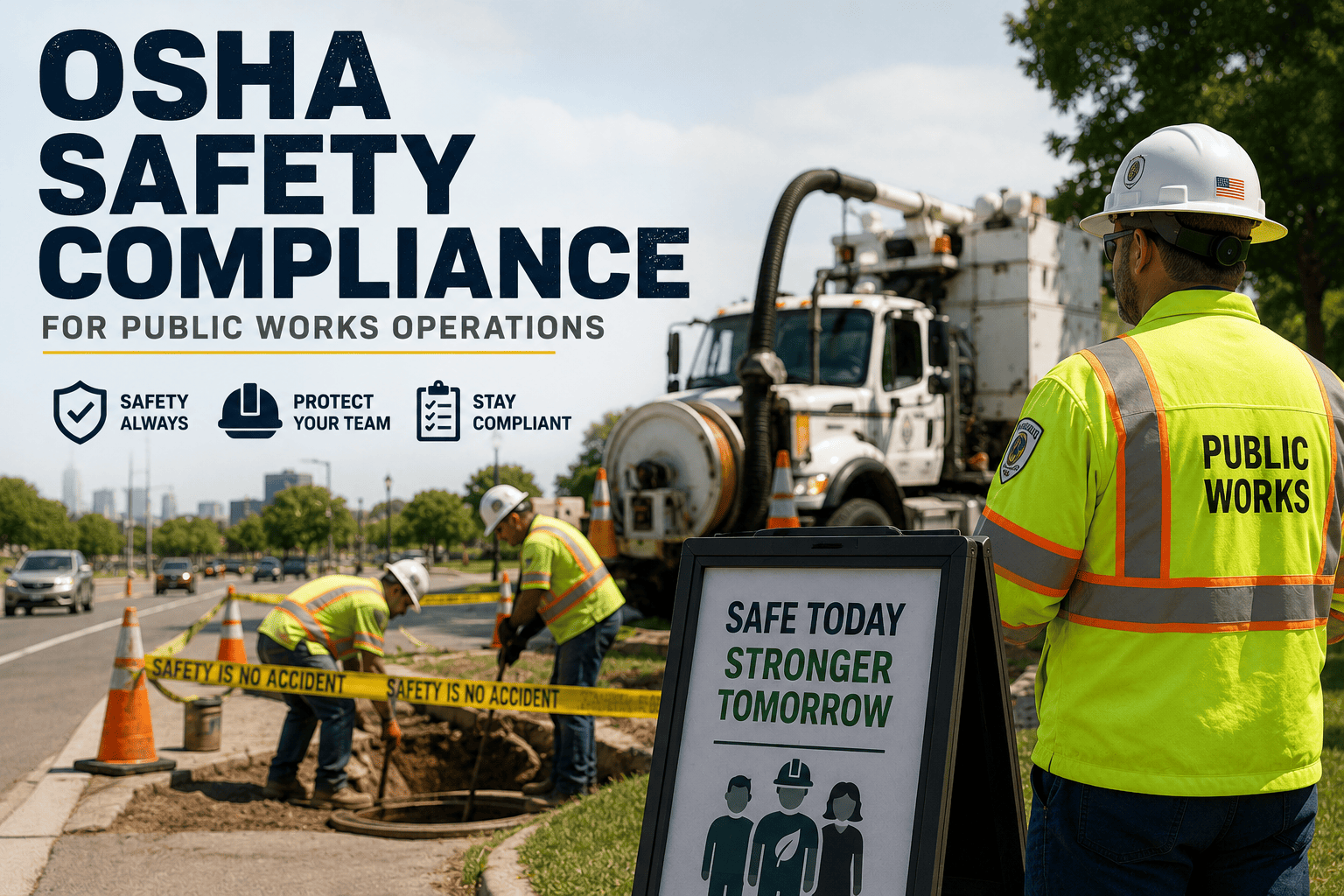
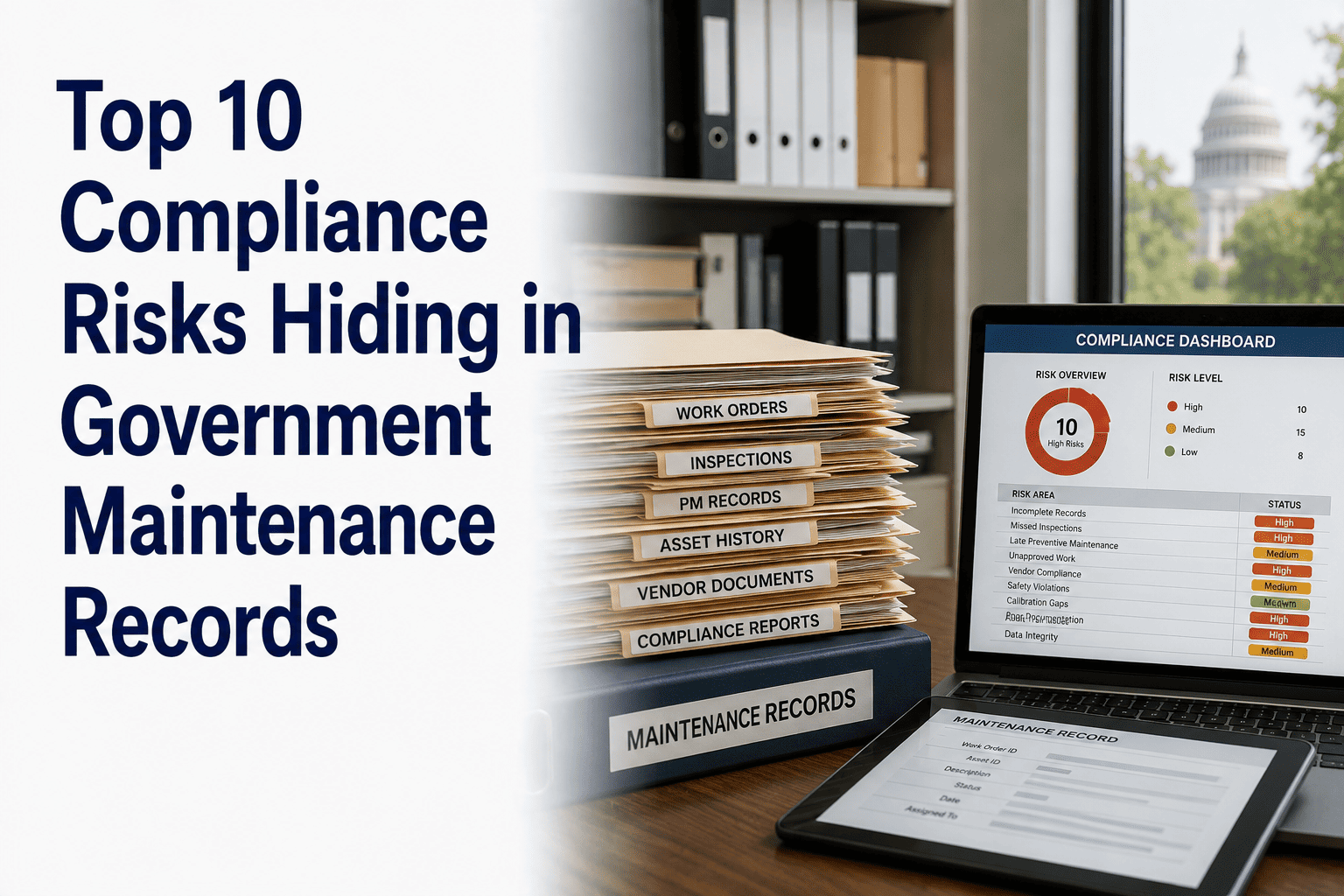
When a public works crew member suffers a trench collapse or a wastewater technician is exposed to hydrogen sulfide without proper monitoring, it's not just a workplace accident—it's a preventable tragedy that devastates families and exposes municipalities to catastrophic liability. Safety gaps in government operations put employees, contractors, and citizens at unacceptable risk. For operations directors watching their budgets drained by workers' compensation claims and OSHA penalties, the question isn't whether to formalize safety compliance—it's how quickly you can implement programs that ensure total workforce protection and regulatory readiness.
Government workplace safety and rigorous compliance management are inseparable. Outdated training records, inconsistent hazard assessments, and reactive incident response create a vulnerability gap that ad-hoc safety efforts cannot close. Forward-thinking municipalities are now deploying integrated CMMS platforms with safety workflow automation, digital training tracking, and real-time incident documentation to coordinate preventive safety measures and respond instantly to hazards—transforming operations from reactive compliance to proactive protection culture.
This guide provides actionable strategies for municipal safety teams to implement comprehensive OSHA-compliant programs while capturing significant efficiency gains. Agencies ready to protect their workforce can start their safety optimization journey today.
Government workplace safety is a zero-tolerance environment. An uninspected confined space or an expired lockout/tagout procedure isn't just an oversight; it endangers every worker who enters that space. Executing safety protocols without a digital compliance plan invites injuries and OSHA citations. A training gap that goes undetected for months leaves entire crews exposed and can cost hundreds of thousands in penalties, medical expenses, and lost productivity.
65%
Reduction in recordable incidents with formalized safety programs
$42K
Average cost per lost-time injury including medical, legal, and productivity losses
100%
OSHA audit readiness with digital training records and inspection documentation
3x
Faster incident investigation and corrective action with digital workflows
Municipal governments manage diverse high-hazard operations across multiple departments. Focusing compliance efforts on these core program elements delivers maximum workforce protection and regulatory defensibility.
Priority Components for Safety Compliance
Hazard Identification & Assessment
OSHA Ref:29 CFR 1910 / 1926
Plan For:JHAs, site inspections, risk scoring
Typical Gain:70% of hazards identified before injury
Training & Competency Tracking
OSHA Ref:Multiple standards require training
Plan For:Certifications, refreshers, new-hire onboarding
Typical Gain:Zero expired certifications in the field
Incident Investigation & CAPA
OSHA Ref:29 CFR 1904 Recordkeeping
Plan For:Root cause analysis, corrective actions
Typical Gain:85% reduction in repeat incidents
Emergency Action & Response Plans
OSHA Ref:29 CFR 1910.38 / .39
Plan For:Evacuation drills, AED checks, rescue plans
Typical Gain:Documented readiness for any emergency
Ad-hoc safety checks rely on memory and paper logs, leaving gaps that OSHA inspectors will find. Digital safety workflows enforce inspection protocols, verify training completion, and ensure immediate corrective action on identified hazards—standardizing protection across all municipal departments and work sites.
| Approach |
Injury Prevention |
OSHA Readiness |
Liability Exposure |
Incident Response |
| Ad-Hoc / Reactive |
Poor |
Poor |
Highest |
Unpredictable |
| Paper-Based Programs |
Fair |
Fair |
Moderate |
Standard |
| Digital CMMS-Integrated |
Excellent |
Excellent |
Lowest |
Optimized |
Quick-Win Safety Compliance Strategies
1
Mobile Hazard Reporting
Empower every employee to report unsafe conditions—trip hazards, missing guards, chemical spills—via mobile app, automatically generating high-priority corrective work orders.
Result: Immediate hazard identification and closure
2
Automated Training Expiration Alerts
Track every employee certification—confined space, HAZWOPER, forklift, first aid—with automatic 30/60/90-day renewal alerts that prevent expired credentials from reaching the field.
Result: Zero workers deployed with expired certifications
3
Digital Pre-Task Safety Checklists
Require crews to complete Job Hazard Analyses (JHAs) and PPE verification digitally before work begins, with GPS-stamped timestamps proving compliance.
Result: Verified safety compliance at every job site
4
Near-Miss Capture & Trending
Create a frictionless near-miss reporting system that captures close calls, identifies recurring patterns, and drives preventive action before injuries occur.
Result: Predictive hazard prevention from trend data
Ready to Build a Compliant Safety Program?
Oxmaint CMMS integrates digital safety workflows, training tracking, incident management, and inspection checklists specifically designed for government operations.
Join municipal safety teams protecting public workers nationwide
Municipalities managing multiple departments and work sites face the challenge of maintaining consistent OSHA compliance across diverse operations—from water treatment plants to road construction zones. In the event of an inspection or incident, the compliance documentation trail is your primary defense. Manual logs create gaps that expose agencies to massive citations and liability exposure.
Digital Compliance Protection Advantages
✓
Training Verification
Prove every worker completed required safety training with digital timestamps, signatures, and test scores linked to personnel records
✓
Inspection Documentation
Capture GPS-stamped before/after photos of corrected hazards proving immediate remediation of identified safety concerns
✓
Defensible Audit Trail
Complete history of every safety inspection, training session, incident investigation, and corrective action linked to the compliance record
✓
OSHA 300 Log Automation
Digitally generate OSHA 300/300A/301 logs, incident reports, and compliance summaries for inspectors instantly on demand
Safety departments need a phased implementation that ensures protection levels improve immediately while new compliance systems are adopted across all departments and work crews.
90-Day Safety Program Implementation Roadmap
Days 1-30
Foundation & High-Risk Operations
→ Audit all safety training records for completeness and currency
→ Digitize confined space, LOTO, and excavation permit workflows
→ Train supervisors on mobile hazard reporting and incident documentation
Milestone: All high-hazard operations on digital safety workflows
Days 31-60
Department-Wide Expansion
→ Deploy JHA templates for all routine and non-routine task categories
→ Configure automated training expiration alerts for all certifications
→ Integrate near-miss reporting and safety observation programs
Milestone: 100% of field crews using digital pre-task safety checklists
Days 61-90
Full Compliance Integration
→ Roll out to all satellite facilities, contractor teams, and seasonal workers
→ Generate OSHA compliance dashboards for leadership and risk management
→ Establish KPI benchmarks and monthly safety performance reviews
Milestone: Total municipality-wide safety compliance tracking and reporting
Safety Directors need clear metrics to justify program investments, demonstrate risk reduction to elected officials, and prove regulatory compliance to OSHA inspectors and insurance carriers.
Prevention
Total Recordable Incident Rate
Target: Below industry avg (4.0)
Primary OSHA benchmark measuring overall safety program effectiveness
Training
Certification Currency Rate
Target: 100%
Ensures no worker is deployed with expired safety certifications or training
Compliance
Inspection Completion Rate
Target: 100%
Proves all scheduled safety inspections and audits are actually performed
Response
Corrective Action Close Time
Target: < 72 Hours
Measures speed of hazard elimination after identification or incident
Municipal governments implementing digital safety compliance programs report measurable improvements across injury prevention, efficiency, and regulatory readiness:
65%
Fewer recordable injuries
With proactive safety programs
100%
OSHA Audit Readiness
Documentation on demand
$465K
Annual Risk Avoidance
Per municipality average
ZERO
Expired certifications
With automated tracking
See How Oxmaint Optimizes Safety Compliance
Schedule a personalized demo showing exactly how digital safety workflows, training tracking, and incident management improve protection and OSHA readiness for your municipality.
Trusted by public works and safety departments nationwide
Workplace safety and operational efficiency are no longer separate priorities—they are interdependent challenges that modern CMMS platforms address simultaneously. Every skipped inspection or expired training certificate creates a vulnerability, risking lives and exposing the municipality to devastating liability. Every inefficient compliance process consumes budget that could fund critical safety improvements.
The municipalities making this transition now report measurable wins: 65% injury reductions, 100% OSHA audit readiness, and significantly lower workers' compensation costs. These aren't aspirational goals—they're documented outcomes from safety teams that deployed digital compliance management and proactive hazard prevention strategies.
Your aging safety programs won't modernize themselves. Your regulatory obligations won't decrease without intervention. But the tools to address these challenges exist today. For a personalized assessment of your municipality's safety compliance potential, request a government safety CMMS consultation from specialists who understand municipal and public works operations.
How does a digital safety workflow improve response during a workplace incident?
Digital workflows provide instant access to emergency action plans, safety data sheets, and incident documentation forms. When an injury occurs, supervisors can immediately document the event with GPS-stamped photos, initiate root cause investigation, notify risk management, and trigger corrective action work orders—all from a mobile device. This cuts investigation time dramatically compared to paper-based methods and ensures OSHA reporting deadlines are met automatically.
Can the system help prepare for OSHA inspections and audits?
Yes. In any OSHA inspection, the ability to produce a complete digital record showing exactly when safety training was completed, when inspections were conducted, when hazards were corrected, and that all protocols were followed is invaluable. Oxmaint provides a tamper-proof audit trail that proves due diligence—OSHA 300 logs, training records, inspection histories, and corrective action documentation are all available instantly on demand.
What happens if field crews are working in areas without cellular coverage?
Modern CMMS apps like Oxmaint include full offline capability. Field workers can complete safety checklists, JHAs, incident reports, and inspection forms without connectivity. All data including photos and GPS coordinates is stored securely on the device and automatically syncs when signal returns—ensuring no safety documentation is lost regardless of work location.
How does the system track training compliance across multiple departments?
The platform maintains a centralized training matrix linking every employee to their required certifications based on job role, department, and task assignments. Automatic expiration alerts notify both the employee and their supervisor 30, 60, and 90 days before any certification expires. Dashboard views show compliance status across the entire organization—by department, by certification type, or by individual worker—making it impossible for expired credentials to go unnoticed.
Is the platform secure enough for sensitive government safety and personnel data?
Yes, enterprise-grade CMMS platforms prioritize data security. With features like role-based access control (RBAC), AES-256 encryption at rest and in transit, multi-factor authentication, and single sign-on (SSO), you ensure that only authorized personnel can view sensitive incident reports, medical documentation, and employee safety records. Full audit logging meets government records retention requirements.