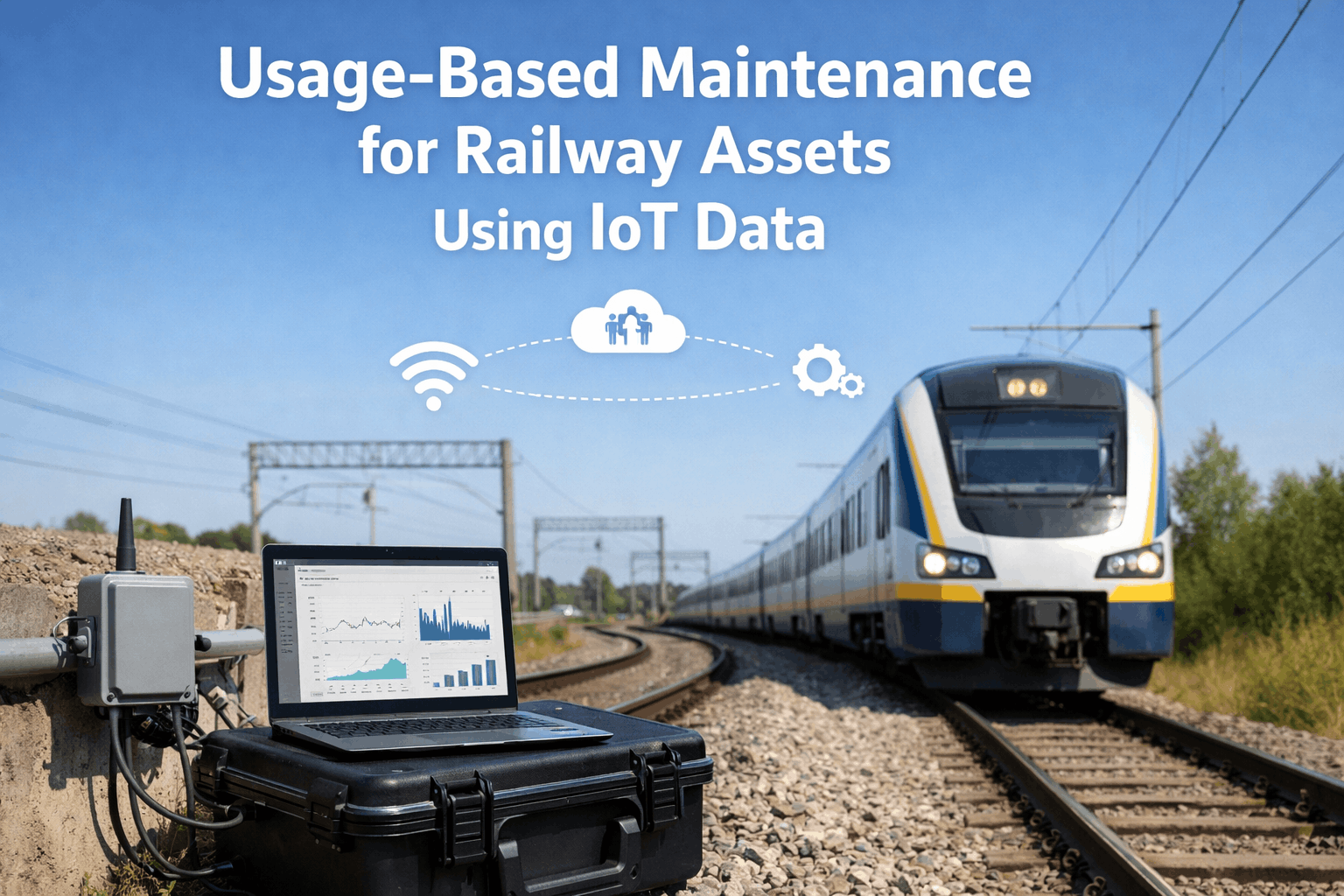
A passenger train is halted mid-route because a section of track buckled under extreme summer heat—a condition that developed gradually over several days. The resulting delay causes cascading schedule disruptions, requires emergency dispatch of a manual inspection crew, and costs the transit authority thousands in passenger refunds and overtime pay. Meanwhile, a preventative maintenance work order for that exact track segment is sittingin a dispatcher's inbox, scheduled for next week. This is railway maintenance operating on legacy systems—reactive, delayed, and vulnerable. Talk to our team about deploying IoT and LoRaWAN for railways monitoring and maintenance to ensure real-time anomaly detection and keep citizens safe.
Smart Public Infrastructure — 2026 Edition
IoT and LoRaWAN for Railways Monitoring and Maintenance
Integrate drones, robots, and IoT sensors to automate inspections, reduce downtime, and drive predictive maintenance for public works and government infrastructure.
24/7
Real time anomaly detection
100%
CMMS work order automation
IoT
LoRaWAN condition thresholds
AI
Analytics on asset health dashboard
Why Traditional Railways Maintenance Is Failing
Public transit authorities manage thousands of miles of track, overhead lines, and signaling equipment. Traditional railways maintenance relies on scheduled manual patrols and visual inspections. These methods are dangerously slow, labor-intensive, and inherently reactive. By the time a human inspector identifies track geometry degradation or a malfunctioning switch, the asset is already nearing failure. With increasing ridership and regulatory demands, public works agencies need an asset management strategy that leverages continuous IoT sensor ingestion to enable true predictive maintenance. Book a Demo.
The Critical Gaps in Manual Track Inspection
Reactive Responses
High Cost
Relying on scheduled visual patrols means defects are often found after they disrupt service, causing expensive emergency repairs.
Worker Safety
Extreme Risk
Dispatching crews to active tracks for manual inspection exposes public works employees to severe hazards from moving trains and high voltage.
Data Silos
Disconnected
Paper-based reports and disparate systems prevent a unified view on the asset health dashboard, hindering effective asset management.
Limited Coverage
Incomplete
Manual patrols cannot continuously monitor thermal expansion, vibration, or structural stress across vast railway networks.
Inefficient Workflows
Manual
Without CMMS integration, turning an identified defect into an executed work order takes days instead of seconds.
No Digital Twin
Blind Spots
Without a digital twin, forecasting capital expenditures for government infrastructure is based on guesswork rather than data.
The IoT / LoRaWAN Monitoring Lifecycle
Implementing IoT and LoRaWAN for railways monitoring transforms public infrastructure. Sensors mounted on tracks and trains continuously collect data, transmitting it over long-range, low-power LoRaWAN networks. This feeds directly into an AI-powered CMMS to automate inspections and trigger work orders before failures occur.
7-Stage Predictive Maintenance Pipeline
From IoT sensor ingestion to work order automation
Install IoT sensors for vibration, temperature, and strain on tracks and switch points.
Setup
›
Establish LoRaWAN gateways to ensure reliable data transmission across remote track miles.
Connectivity
›
Continuous stream of telemetry data flows into the central asset management platform.
Real-Time
›
Set baseline metrics. Define precise condition thresholds and alerts for temperature and vibration.
Configuration
›
Oxmaint AI processes data for real time anomaly detection, feeding the digital twin model.
Analysis
›
Deploy drone inspection or robot inspection units to visually verify anomalies flagged by IoT sensors.
Verification
›
CMMS integration instantly generates predictive maintenance work orders based on verified alerts.
Execution
Automate Your Railways Maintenance
Oxmaint AI integrates IoT monitoring, drone inspections, and AI analytics to automate work orders and provide a comprehensive asset health dashboard. Keep citizens safe and trains running on time.
Maintenance Tiers: Keeping the Network Running
Railways maintenance requires a multi-tiered approach. By leveraging IoT and LoRaWAN for railways monitoring and maintenance, public works departments can categorize alerts and automate responses, ensuring that critical infrastructure issues are addressed immediately while routine wear is scheduled efficiently through CMMS integration.
Predictive Maintenance Alert Tiers
Trigger: Severe thermal expansion / Track buckling risk
Temperature threshold exceeded
Abnormal switch point friction
Immediate geometry shift detected
Real time anomaly detection triggers emergency work order automation. Dispatch robot inspection immediately. Stop traffic if necessary.
Trigger: Excessive vibration / Impending component failure
Loosening fasteners detected
Corrosion thresholds rising
Overhead line tension drop
Condition thresholds and alerts log to the asset health dashboard. Schedule preventative maintenance within 48 hours via CMMS integration.
Trigger: Gradual wear patterns identified via AI analytics
Micro-fracture propagation
Gradual ballast degradation
Vegetation encroachment (Drone)
Digital twin flags asset for upcoming service cycle. Dispatch drone inspection for visual confirmation during routine patrols.
Trigger: Normal scheduled asset management lifecycle
Sensor battery check (LoRaWAN)
Routine lubrication schedules
Standard visual patrol logging
IoT sensor ingestion confirms normal status. Routine maintenance generated automatically by the CMMS without manual intervention.
IoT vs. Traditional Maintenance: The Complete Comparison
The comparison between IoT/LoRaWAN monitoring and traditional manual inspection reveals overwhelming advantages in cost, safety, and reliability. Public works agencies deploying Oxmaint AI transition from costly, disruptive emergency repairs to streamlined, data-driven predictive maintenance.
Build Your Asset Health Dashboard
Oxmaint automatically assembles IoT sensor ingestion data and drone inspection findings into a comprehensive digital twin. Stop relying on paper logs—manage your public infrastructure with real-time AI analytics.
Expert Perspective: The Safety Imperative
"
We manage hundreds of miles of public infrastructure. Before integrating IoT and LoRaWAN for railways monitoring and maintenance, we experienced at least two major service disruptions annually due to undetected track geometry issues. Our crews were walking the lines, but human eyes can't measure continuous thermal stress. By deploying an array of sensors utilizing LoRaWAN condition thresholds and alerts, and pairing that with drone inspections, we achieved real time anomaly detection. The Oxmaint AI analytics now feed our asset health dashboard, driving automated work orders. We haven't had an unplanned buckling event in three years. This is the definition of predictive maintenance for government infrastructure.
— Chief Engineer, Regional Transit Authority
100%
Elimination of manual track-walking risk
24/7
Continuous IoT sensor ingestion
Zero
Unplanned downtime events
Government agencies responsible for public works can no longer afford the risk and inefficiency of traditional track patrols. IoT monitoring paired with AI analytics and CMMS platforms like Oxmaint delivers the predictive maintenance capabilities modern public infrastructure demands. The technology is proven, the ROI is substantial, and keeping citizens safe is paramount. Start your free trial today and build a smart, data-driven railways maintenance program.
Secure Your Public Infrastructure
Oxmaint provides the complete digital backbone for government railways maintenance—tracking IoT monitoring data, drone inspections, and executing work order automation through a powerful asset health dashboard.
Frequently Asked Questions
What is LoRaWAN, and why is it used for railways monitoring?
LoRaWAN (Long Range Wide Area Network) is a low-power, wide-area networking protocol designed to connect battery-operated IoT sensors wirelessly to the internet over long distances. It is ideal for IoT and LoRaWAN for railways monitoring and maintenance because it can cover vast stretches of track in remote areas where cellular coverage is poor, enabling continuous IoT sensor ingestion for vibration, temperature, and strain data.
How does AI analytics improve anomaly detection?
AI analytics process the massive volumes of data generated by sensors and drone inspection imagery. The AI establishes normal operational baselines and performs real time anomaly detection when data deviates from these baselines (e.g., unusual vibration patterns indicating a loose fastener). This allows public works teams to shift from scheduled patrols to true predictive maintenance.
What is an asset health dashboard in the context of CMMS integration?
An asset health dashboard is a centralized digital interface within a CMMS (like Oxmaint) that visualizes the real-time status of all public infrastructure assets. It utilizes data from IoT monitoring and a digital twin model to display current conditions, trigger condition thresholds and alerts, and track the status of automated work orders, simplifying overall asset management.
How do robots and drones complement IoT sensors in railways maintenance?
While IoT sensors provide continuous telemetry regarding stress or temperature, a drone inspection or robot inspection provides high-resolution visual and spatial data. If an IoT sensor triggers an alert, an autonomous drone can be dispatched to that exact GPS coordinate to visually confirm a broken rail or encroaching vegetation, keeping human crews safely off the tracks until repair is verified as necessary.
How does work order automation reduce downtime?
Work order automation leverages CMMS integration to instantly generate a repair ticket the moment AI analytics identify a critical issue via IoT monitoring. Instead of waiting for a manual inspector to file a report, the system immediately assigns the task to a maintenance crew with precise location data and defect details, drastically reducing the time between fault detection and repair execution in government infrastructure.