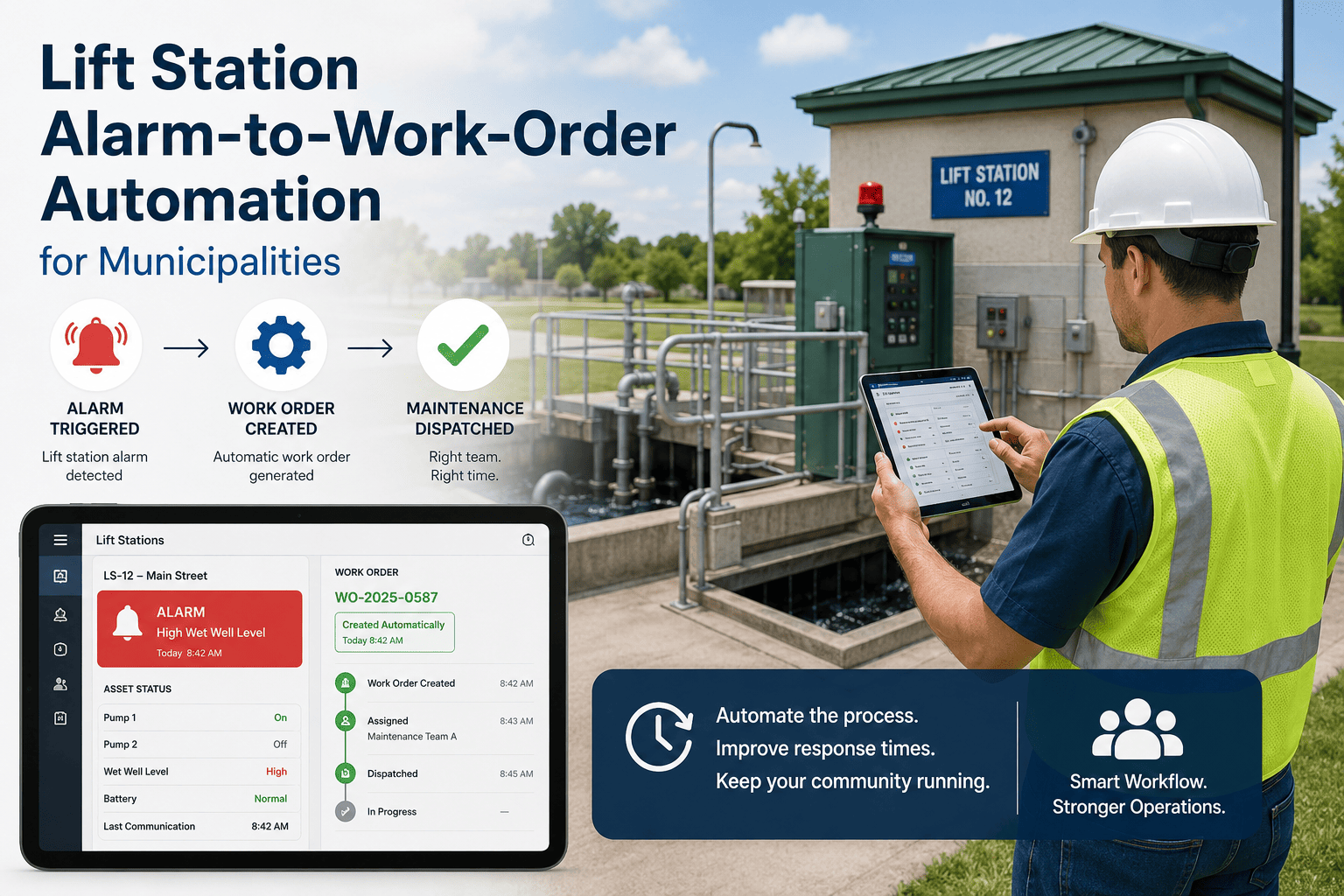
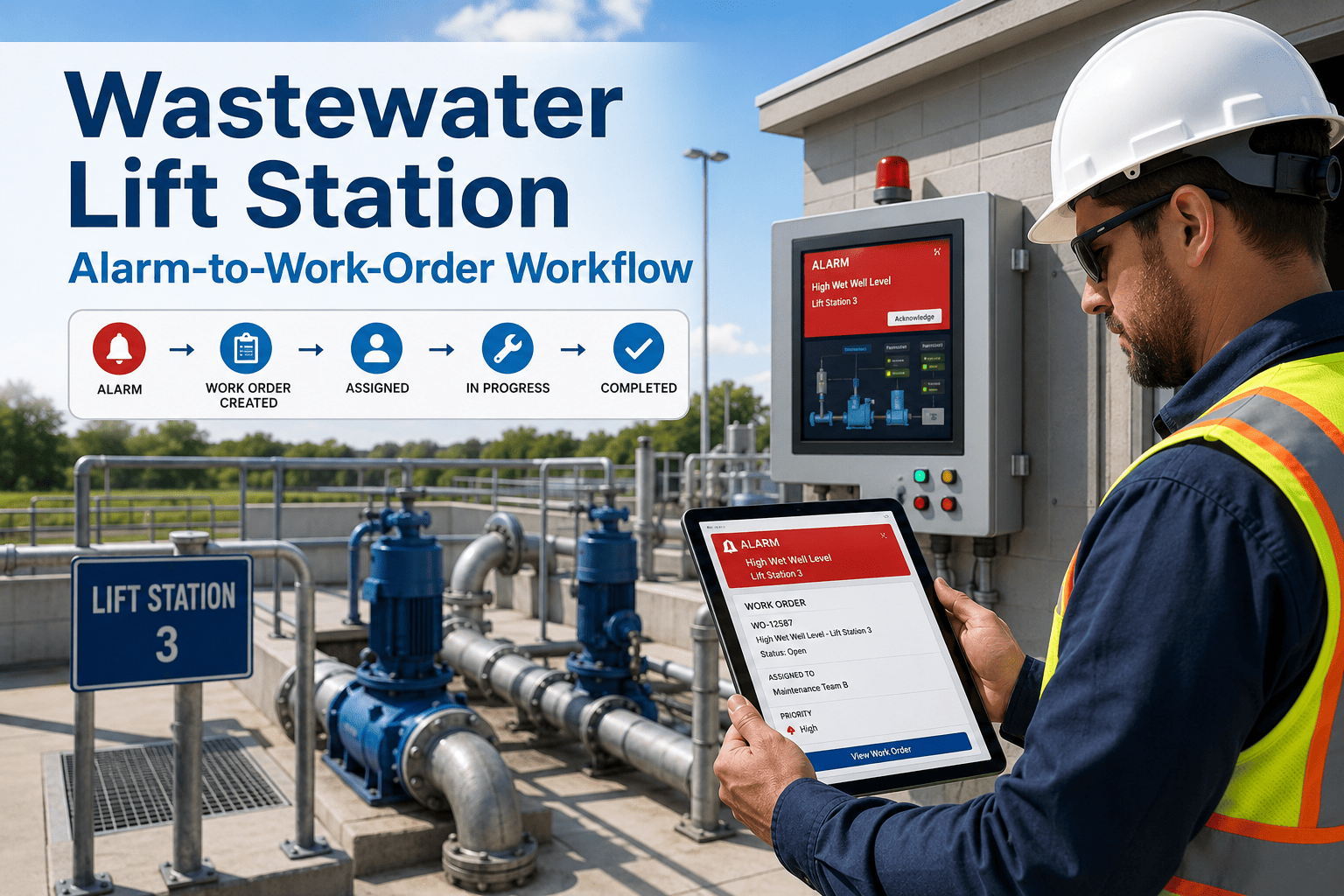
A lift station alarm that fires at 2 AM on a Sunday does not care whether your on-call operator is already responding to another overflow event. Municipalities operating dozens to hundreds of lift stations face the same structural problem every day: SCADA alarms generate data continuously, but the gap between an alarm firing and a structured work order reaching the right technician is filled entirely by manual steps — someone reads the dashboard, picks up a radio, calls a crew, and writes a log entry. When those manual steps slip, the result is a sanitary sewer overflow event with EPA enforcement, public notification obligations, and fines that dwarf the cost of a decade of preventive maintenance. OxMaint connects directly to your SCADA system and converts every lift station alarm into a structured, assigned work order in under 60 seconds — with pump history, wet well trend data, and technician routing pre-populated before the crew leaves the yard. The U.S. water utility sector faces an estimated $110 billion infrastructure funding gap, making automation of alarm response not a luxury but the only realistic path to reliability. Book a 30-minute demo to see how OxMaint eliminates the manual gap between your SCADA alarms and field work order execution.
$25K
per day
Maximum EPA fine per SSO event — avoidable with faster alarm-to-work-order response
47%
of alarms
Go uninvestigated within 24 hours in utilities running manual alarm response processes
60 sec
average
OxMaint converts a SCADA alarm into an assigned, structured work order with full asset context
$69K
saved
In EPA fines and cleanup costs avoided by one Florida municipality after implementing alarm automation
The Alarm Response Gap — What Happens Between SCADA Alert and Field Action
T+0 min
SCADA Alarm Fires
High wet well level, pump failure signal, or power loss event triggers in the SCADA dashboard. The alarm is visible — to whoever is watching the screen.
Risk: Night shift, storm response, or high-alarm-volume periods leave screens unwatched.
T+15–90 min
Manual Acknowledgement
An operator spots the alarm, calls or radios a field technician, relays the fault verbally. No structured brief, no asset history, no prior maintenance context.
Risk: Verbal relay loses fault codes. Technician arrives without pump cycle history or previous repair context.
T+2–6 hrs
Field Visit — Undocumented
Technician arrives at the lift station, diagnoses the fault, performs a repair. Paper log or verbal update is the only record of what was found and what was done.
Risk: No root cause captured. No link between SCADA alarm and repair action in the asset record.
T+6–8 weeks
Same Alarm Fires Again
Without documented root cause or corrective action in the asset record, the same pump generates the same alarm. The cycle repeats — until an SSO event forces an emergency response.
Outcome: Repeat fault rate climbs. EPA compliance exposure grows with every undocumented incident.
How OxMaint Closes the Alarm-to-Work-Order Gap — In 60 Seconds
01
SCADA Event Captured
OxMaint reads SCADA alarms via REST API, OPC-UA, or Modbus without modifying or replacing your existing SCADA system. Fault codes, alarm severity, wet well level data, and pump cycle status are captured automatically from the event stream.
02
Asset Context Assembled
OxMaint pulls the lift station's full maintenance history — last pump service date, previous alarm events, bearing inspection records, and any open work orders — and attaches the complete context to the new work order automatically.
03
Work Order Created and Assigned
A structured work order is generated with the exact SCADA fault code, station location, asset history, and priority tier — and assigned to the correct technician based on coverage zone and skill level. Mobile notification fires immediately.
04
Root Cause Documented on Closure
When the technician closes the work order on mobile, root cause, repair action, and post-repair condition are captured in structured fields. The complete event chain — SCADA alarm, dispatch, repair, outcome — is permanently in the asset record for SSO documentation.
OxMaint · Water Utilities · Alarm Automation
Stop the gap between SCADA alarm and field work order. OxMaint converts every lift station alarm into a structured, assigned WO in 60 seconds — with full asset context, zero manual steps, and EPA-ready documentation.
What OxMaint Monitors and Automates Across Your Lift Station Network
Alarm Type
SCADA Signal
OxMaint Response
SSO Risk Reduction
Pump Failure
Current draw dropout, run-status loss, VFD fault code
Immediate WO with pump service history and bearing inspection records attached
4–8 week early warning window for bearing faults — prevents wet well overflow
High Wet Well
Level sensor threshold breach, float switch activation
Priority-1 WO dispatched with wet well level trend graph and pump cycle count history
Crew dispatched with context — average response time cut from 90 min to under 20 min
Power Loss
Panel power monitoring, telemetry dropout, generator start signal
Generator check WO auto-created with station backup power test history and fuel level log
No overflow during Hurricane Helene — automated response enabled zero-overtime resolution
Pump Cycling Anomaly
Short-cycle detection, excessive starts per hour, runtime deviation
Predictive WO with cycle count baseline comparison and recommended diagnostic steps
Identifies bearing wear 4–8 weeks before failure — converts reactive to predictive
I/I Infiltration Event
Flow rate spike during rain events, abnormal wet-weather pump runtime
Infiltration investigation WO with historical wet-weather flow comparison and site map attached
Systematic I/I documentation builds the compliance record for capital program justification
Manual Alarm Response vs. OxMaint Automated Work Order Generation
| Dimension |
Manual Alarm Response |
OxMaint Automation |
| Alarm-to-WO time |
15 minutes to 6+ hours — depends on who sees the screen |
Under 60 seconds — no human step required |
| Asset context in WO |
None — technician dispatched without maintenance history |
Full pump history, last service, prior alarms pre-attached |
| Fault code capture |
Verbally relayed — accuracy degrades through chain |
Exact SCADA fault code embedded from event stream |
| After-hours coverage |
Depends on on-call attention — high failure rate during storms |
24/7 automatic — no human acknowledgement step |
| Root cause documentation |
Paper log or verbal — rarely complete, difficult to retrieve |
Mandatory structured closure — in asset record permanently |
| SSO audit readiness |
Reconstructed under audit pressure — gaps common |
Complete timestamped evidence chain exportable on demand |
Operations Perspective
Sandra Mitchell, P.E. — Director of Wastewater Operations, Regional Utility, 18 years
The regulatory exposure from a single SSO event — fines, public notification, consent order risk, and reputational damage with your regulatory agency — far exceeds the entire annual cost of a predictive monitoring and work order automation program. The math is not complicated. What changes with OxMaint is that the alarm creates the work order. The work order reaches the technician with context. The technician closes the loop with a root cause on record. That is the audit trail EPA reviewers are looking for, and it is generated automatically — not reconstructed under pressure the morning an inspector arrives.
Frequently Asked Questions
Does OxMaint replace our existing SCADA system or require changes to it?
OxMaint integrates with your existing SCADA system via REST API, OPC-UA, or Modbus — reading alarm events and operational data from your SCADA historian without modifying, replacing, or affecting any SCADA configuration. The SCADA system continues to operate exactly as before; OxMaint acts as a downstream work order automation layer.
Book a demo to confirm compatibility with your SCADA platform and discuss integration scope.
Can OxMaint handle alarm routing across a network of 50 to 200 lift stations?
Yes. OxMaint supports unlimited lift stations within a single utility account, each with independently configured alarm routing rules, asset registers, and technician assignments. Portfolio-level dashboards show all alarm-triggered work orders across every station, filterable by station, fault type, or priority tier. Individual crews only see work orders assigned to their coverage zones.
Sign in to OxMaint to configure your lift station network and alarm routing rules.
How does OxMaint support EPA and NPDES SSO documentation requirements?
Every OxMaint work order triggered by a SCADA alarm carries a complete, timestamped evidence chain — alarm event, technician assignment, field response, root cause, and repair action — all permanently linked to the lift station asset record. This documentation structure directly supports the NPDES permit reviewer requirements for SSO prevention program adequacy, including who was notified, when response occurred, and what corrective action was taken.
Book a demo to see the SSO documentation export workflow.
Can OxMaint filter low-priority alarms to avoid alert fatigue in high-alarm-volume utilities?
Yes. OxMaint's alarm routing engine allows you to define minimum alarm priority thresholds, repeat-alarm suppression windows, time-of-day filters, and asset criticality tiers that control which SCADA events generate immediate work orders versus entering a review queue. Critical alarms always generate immediate WOs; informational or nuisance alarms are logged without dispatch.
Sign in to OxMaint to configure alarm routing thresholds for your station network.
How quickly can OxMaint be deployed across a municipal lift station network?
Most municipal utilities complete SCADA integration, asset register configuration, and first work order automation in under three weeks. OxMaint does not require hardware installation at lift stations — integration is software-only via your existing SCADA historian or telemetry platform. Technician mobile onboarding typically completes in a single afternoon session.
Book a demo to review the deployment timeline for your utility size and SCADA environment.
OxMaint · SCADA Integration · Water Utilities · SSO Prevention
Your SCADA already detects every pump failure, wet well spike, and power loss. OxMaint makes sure each one becomes a structured work order — with asset history, technician routing, and SSO-ready documentation — in 60 seconds, automatically.
SCADA · OPC-UA · Modbus · REST API · SSO Documentation · EPA Compliance · Multi-Station