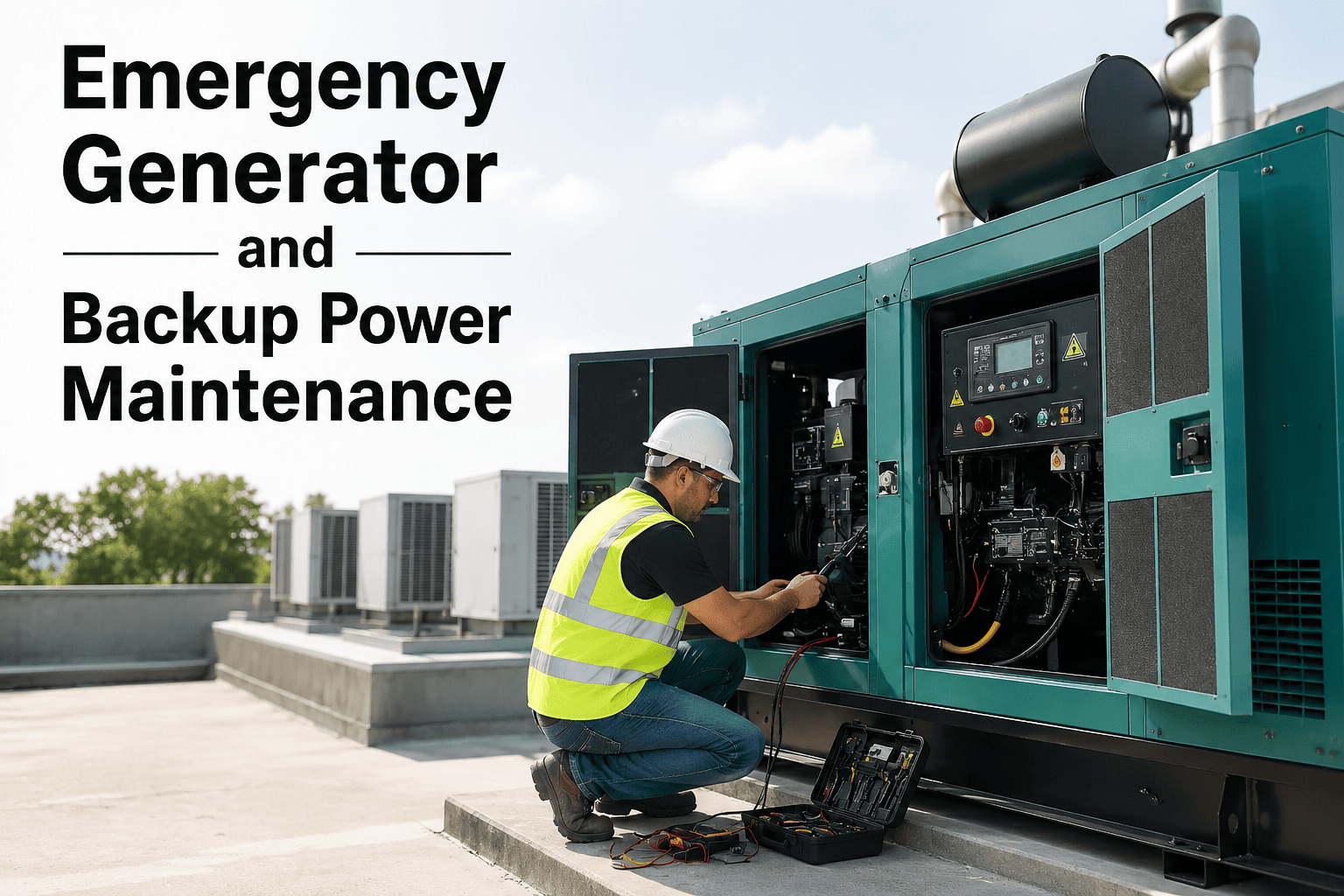
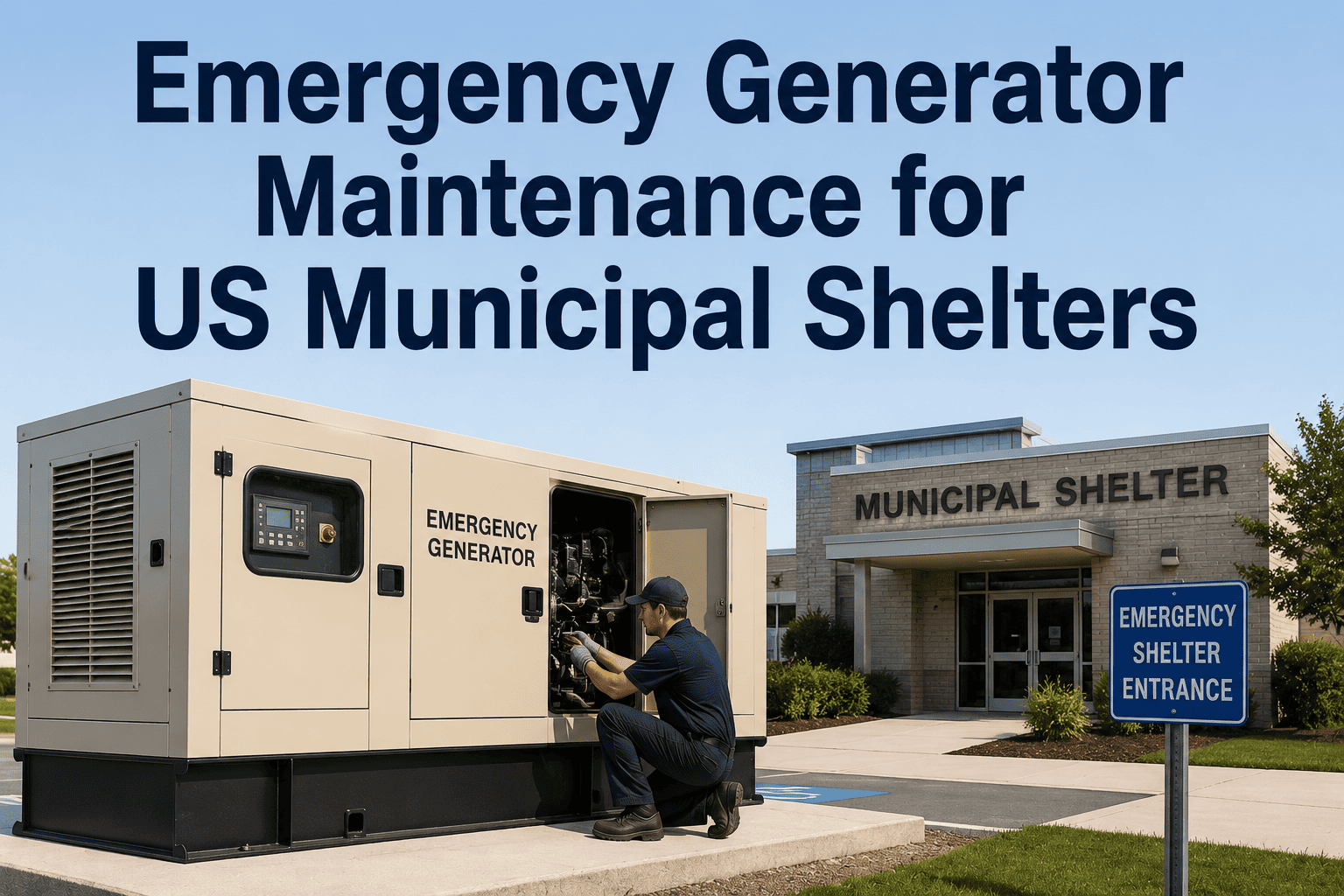
A Municipal Facilities Director discovered they were spending $1.2M annually on emergency generator maintenance across 84 critical facilities—yet couldn't answer basic questions when the City Council asked: "Which generators failed during the last power outage?" "Are preventive tasks actually preventing failures?" "What's our generator readiness rate?" Their maintenance request data existed in scattered spreadsheets, and service was scheduled by calendar, not condition.
Municipal governments manage extensive backup power infrastructure: emergency generators at fire stations, police precincts, water treatment plants, city halls, emergency operations centers, and traffic management facilities. Without integrated maintenance request workflows and performance tracking, generator failures during emergencies expose communities to catastrophic consequences.
Modern municipal generator operations require streamlined maintenance request workflows, condition-based preventive maintenance, and automated performance tracking with documented accountability. Digital CMMS platforms for government infrastructure transform reactive maintenance into data-driven reliability. Start Free Trial.
78%
Municipalities
Cannot produce real-time generator readiness status across all facilities
$340K
Average Annual Waste
From emergency repairs and missed preventive maintenance
67%
Service Requests
Processed via phone calls or emails without tracking
94%
Readiness Rate
Achieved with digital maintenance request workflows
Core Issue: Maintenance requests and generator management operate in silos. Integrated workflows reveal failure patterns and service gaps invisible in manual tracking systems.
Municipal generator teams handle requests from dozens of facilities across fire, police, water, administration, and emergency services. Standardized workflows enable consistent response and documentation:
Digital Submission Rate
10%
Mobile/web requests / Total requests
Request Completeness
10%
Complete info / Total submitted
Photo Documentation
5%
Requests with photos / Total requests
Acknowledgment Time
15%
Avg time to acknowledge emergency requests
Dispatch Efficiency
10%
Dispatched within SLA / Total emergency
Priority Accuracy
10%
Correctly prioritized / Total triaged
First-Time Fix Rate
15%
Fixed first visit / Total service calls
SLA Compliance
10%
Within SLA / Total requests
Requester Satisfaction
5%
Positive feedback / Total rated
Work Order Completion
5%
Fully documented / Total completed
Parts & Labor Tracking
5%
Cost captured / Total work orders
Request Priority Classification
| Priority Level |
Response Time |
Facility Type |
Example Scenarios |
| P1 - Critical |
<1 Hour |
Emergency Services, Hospitals |
Generator failure during outage, fuel leak, fire alarm |
| P2 - Urgent |
<4 Hours |
Water Treatment, 911 Centers |
Transfer switch malfunction, battery failure, coolant leak |
| P3 - Standard |
<24 Hours |
City Hall, Public Works |
Warning light active, minor oil leak, scheduled PM due |
| P4 - Routine |
<72 Hours |
Parks, Libraries, Admin |
Cosmetic issues, documentation updates, non-critical repairs |
| P5 - Scheduled |
Planned Window |
All Facilities |
Annual service, load bank testing, fuel polishing |
Workflow Template
Download Municipal Generator Request Workflow Template
Pre-configured workflow template with priority classification, SLA timers, and escalation rules for municipal generator maintenance. Includes mobile request forms and dispatch protocols.
Real-time generator monitoring automatically creates maintenance requests when issues are detected, eliminating reliance on manual reporting:
Fire Stations & EMS Facilities
Monitoring Points: Engine block temperature, battery voltage, fuel level, coolant temperature, oil pressure, run hours
Auto-Generated Requests:
- Battery voltage <12.4V → P2 request: "Battery replacement needed"
- Fuel level <25% → P3 request: "Fuel delivery required"
- Block heater failure → P2 request: "Block heater service"
- Weekly test failure → P1 request: "Generator failed auto-test"
Impact: Fire station achieved 100% generator readiness by eliminating manual inspection gaps
Water & Wastewater Facilities
Monitoring Points: Transfer switch status, load percentage, exhaust temperature, vibration levels, fuel quality sensors
Auto-Generated Requests:
- Transfer switch fault → P1 request: "ATS malfunction - manual transfer may be required"
- Abnormal vibration detected → P2 request: "Vibration analysis needed"
- Fuel contamination alert → P2 request: "Fuel polishing required"
- Load imbalance >10% → P3 request: "Load balancing service needed"
Impact: Water treatment plant prevented pump station failure with 72-hour advance warning
Emergency Operations Centers
Monitoring Points: Dual-generator sync status, UPS integration, fuel day tank levels, environmental controls
Auto-Generated Requests:
- Generator sync failure → P1 request: "Paralleling system fault"
- UPS battery degradation → P2 request: "UPS battery string replacement"
- Day tank transfer failure → P2 request: "Fuel transfer pump service"
- Generator room temp >95°F → P2 request: "Ventilation system check"
Impact: EOC maintained 99.97% uptime during hurricane season with predictive alerts
Traffic Management Systems
Monitoring Points: Portable generator fuel, signal cabinet power, intersection battery backup status
Auto-Generated Requests:
- Portable generator low fuel → P2 request: "Intersection generator refuel"
- Cabinet battery <50% → P3 request: "Traffic signal battery replacement"
- Generator runtime exceeds threshold → P3 request: "Oil change due"
- Start failure detected → P1 request: "Generator no-start condition"
Impact: Traffic management reduced intersection blackouts by 89% during storm events
Real-Time Generator Fleet Dashboard
Total Generators
84 Units
All Monitored
Fleet Readiness
94.2%
↑ 12% vs last year
Open Requests
12 Active
3 P1/P2 Priority
Fire & EMS (18 units)
100% Ready
18/18
Operational
Water/Wastewater (24 units)
95.8% Ready
23/24
1 In Service
Police & Courts (12 units)
91.7% Ready
11/12
1 P2 Request
Administration (30 units)
93.3% Ready
28/30
2 Scheduled PM
Traditional generator maintenance schedules by calendar (monthly, quarterly, annually) wastes resources on units that don't need service and misses generators degrading faster than expected. Condition-based workflows use monitoring data to trigger requests:
Method: Service requests generated on fixed schedule regardless of condition
❌ Over-maintains low-use generators (wasted budget)
❌ Under-maintains high-use generators (failures occur)
❌ No data on actual generator condition
❌ Cannot optimize service intervals
Example: All 84 generators get quarterly oil changes, even those with only 2 runtime hours
Method: Requests triggered by actual generator condition from sensors
✓ Service only generators that need it
✓ Prevent failures through early detection
✓ Data reveals failure patterns by facility type
✓ Service intervals optimize automatically
Example: Oil change requests generated when oil analysis shows degradation OR runtime reaches 250 hours, whichever comes first
Condition-Based Request Triggers
Engine & Fuel System
Sensors: Oil pressure, coolant temp, fuel level, fuel quality, exhaust temp
Request Triggers:
- Oil pressure drops 15% from baseline → P2 request for oil analysis
- Coolant temp exceeds 210°F → P1 request for cooling system service
- Fuel quality sensor detects water → P2 request for fuel polishing
- Runtime hours reach 250 → P4 request for scheduled oil change
Electrical System
Sensors: Battery voltage, charger output, alternator output, transfer switch status
Request Triggers:
- Battery voltage <12.4V for 24hrs → P2 request for battery service
- Charger output variance >10% → P3 request for charger inspection
- Transfer switch response >12 sec → P2 request for ATS service
- Weekly test shows low voltage → P2 request for alternator check
Environmental & Controls
Sensors: Room temperature, humidity, exhaust backpressure, controller diagnostics
Request Triggers:
- Generator room >95°F → P2 request for ventilation service
- Humidity >80% → P3 request for dehumidifier check
- Exhaust backpressure high → P3 request for exhaust inspection
- Controller fault code → Priority based on code severity
Challenge
Managing generator maintenance across 62 facilities with no centralized request system. Requests came via phone calls, emails, and sticky notes. Three generators failed during a major ice storm because maintenance requests were lost in email. City Council demanded accountability after $180K in emergency repairs and public safety concerns at affected fire stations.
Solution
• Deployed digital maintenance request workflow with mobile app for all facility managers
• Installed remote monitoring on all 84 generators with auto-generated requests
• Implemented priority-based dispatch with SLA tracking
• Created real-time readiness dashboard for emergency management
• Established condition-based PM triggers replacing calendar schedules
Implementation
Phase 1 (Months 1-2):
Request workflow deployment, mobile app rollout to 62 facility managers, priority classification setup
Phase 2 (Months 3-4):
Remote monitoring installation on all generators, auto-request triggers configured
Phase 3 (Months 5-6):
Condition-based PM activation, readiness dashboard deployment, SLA enforcement
Results (Year 1)
Generator Readiness
94%
Up from 71% before implementation
Emergency Failures
Zero
No failures during 4 power outage events
Request Response
96%
P1/P2 requests resolved within SLA
Cost Reduction
$287K
24% savings from optimized maintenance
Key Discoveries
Fire Station #7: Generator battery replaced 3 times in 18 months. Root cause analysis through request history revealed failed battery charger. $2,400 charger replacement prevented $8,100 in future battery costs.
Water Treatment Plant: Fuel quality requests appearing every 60 days. Investigation found underground tank water intrusion. $45K tank repair prevented potential $180K generator damage.
Police HQ: Transfer switch taking 18 seconds (spec: 10 seconds). Condition monitoring caught degradation before failure. Replaced during scheduled window vs. emergency during outage.
City Hall Complex: Generators over-maintained by 40% based on runtime data. Shifted to condition-based scheduling saved $34K annually in unnecessary service.
"When the ice storm hit, I pulled up the dashboard and saw 84 green lights. Every generator ready. That's never happened before. The request workflow means nothing falls through the cracks, and the monitoring means we know about problems before facility managers do."
— Facilities Maintenance Director, Metro City Government
Phase 1: Workflow Foundation
Months 1-2
□ Configure priority classifications
□ Set SLA timers by priority level
□ Create request intake forms
□ Define escalation rules
□ Train facility managers (2 hrs)
□ Train maintenance technicians (4 hrs)
□ Deploy mobile apps
□ Create quick-reference guides
Deliverable: All facilities submitting digital requests with priority tracking
Phase 2: Monitoring Integration
Months 3-4
□ Install monitoring on critical facilities first
□ Configure auto-request triggers
□ Set alert thresholds
□ Test automated workflows
□ Build fleet readiness dashboard
□ Create facility manager views
□ Configure executive reports
□ Enable mobile dashboard access
Deliverable: Real-time visibility with automated issue detection
Phase 3: Optimization
Months 5-6
□ Analyze historical request patterns
□ Define condition triggers
□ Replace calendar schedules
□ Validate PM effectiveness
□ Establish KPI baselines
□ Create monthly reporting
□ Document ROI achieved
□ Plan continuous improvement
Deliverable: Fully optimized workflow with documented savings
Municipal governments managing dozens of generators across critical facilities cannot ensure reliability without integrated maintenance request workflows. Phone calls, emails, and spreadsheets create information gaps that result in generator failures when communities need them most.
The combination of digital request intake, condition-based monitoring, priority-based dispatch, and automated documentation creates a system where generator readiness is continuous, measurable, and accountable to the public.
Modern CMMS platforms designed for municipal government provide the infrastructure for integrated maintenance workflows and generator fleet management. Move from reactive to reliable operations.
For Municipal Facilities Directors: Free generator fleet assessment included with platform demo
How do facility managers submit maintenance requests?
Multiple channels: mobile app (iOS/Android), web portal, or scanning QR code on the generator. The system guides them through required information including photos, symptoms, and urgency level. Average request takes 90 seconds to submit with complete documentation.
Book a demo.
What's the typical ROI timeline for this implementation?
Most municipalities achieve positive ROI within 12-18 months. Monitoring hardware costs $400-800 per generator. Typical savings: 20-30% reduction in emergency repairs, 15-25% PM optimization, plus avoided costs from prevented failures. Mid-size city with $1M generator budget sees $200-280K annual savings for $80K system investment.
Can the system integrate with our existing work order software?
Yes—Oxmaint provides API integrations with major municipal ERP and work order systems including Tyler Munis, Cityworks, Lucity, and others. Requests can flow into existing systems, or you can use Oxmaint's built-in work order management. Most integrations complete within 2-3 weeks.
How do you handle after-hours emergency requests?
P1 emergency requests trigger immediate notifications via SMS, push notification, and email to on-call technicians. Escalation rules ensure someone responds within the SLA window. The system tracks acknowledgment time and escalates to supervisors if not acknowledged within defined timeframes.
What about generators in facilities without internet connectivity?
Remote monitoring units include cellular connectivity with battery backup. For truly remote locations, we offer satellite connectivity options. Mobile app works completely offline—technicians complete inspections and requests queue until connectivity returns. Data syncs automatically.
How do we justify this to City Council or budget committees?
Build business case showing current emergency repair costs, generator failure incidents, and staff time spent on manual tracking. Reference peer municipality case studies with documented ROI. Frame as risk mitigation for critical infrastructure—the cost of one generator failure at a fire station during an emergency far exceeds system investment. We provide ROI calculators and presentation templates.