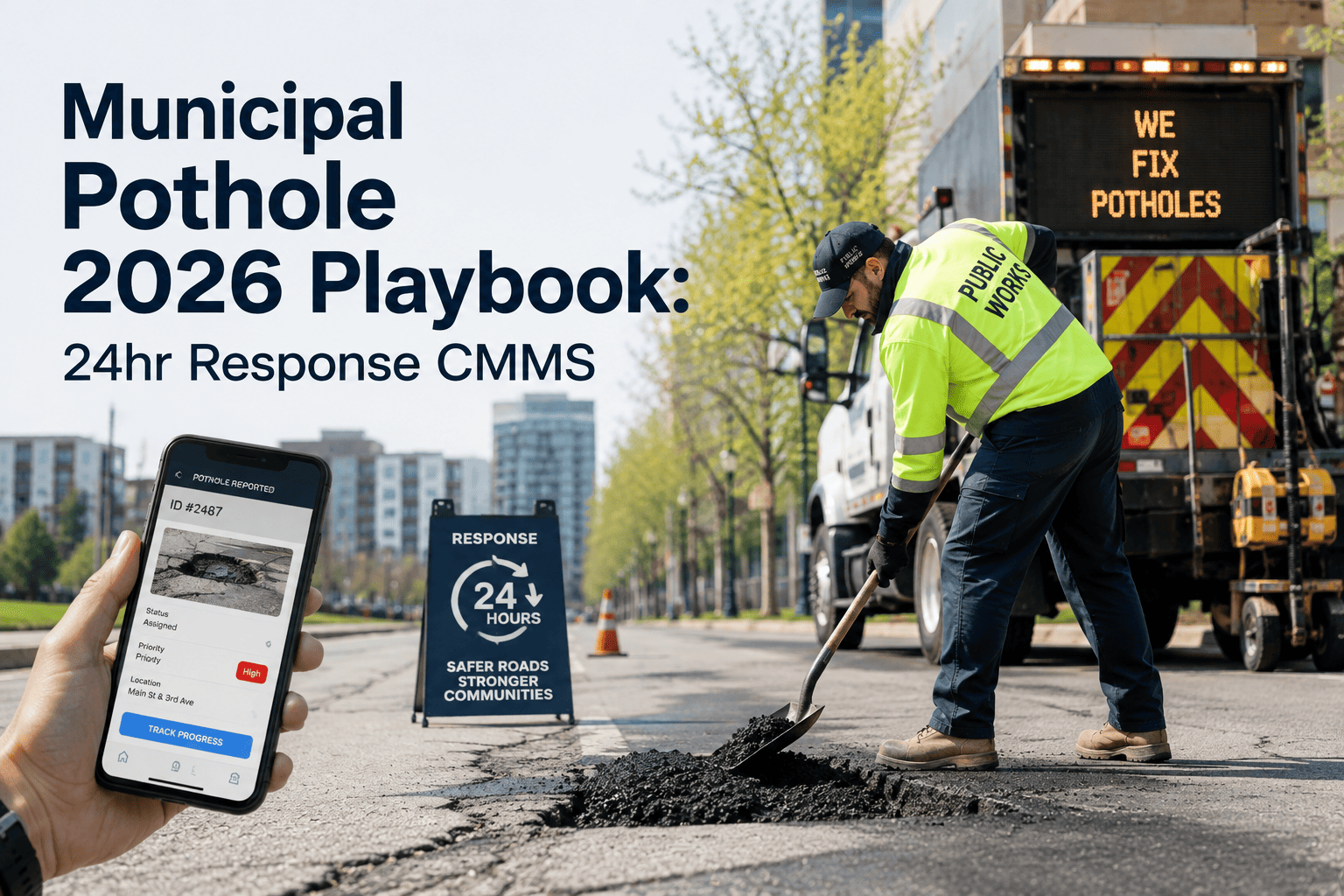
When a resident's front tire drops into a foot-deep pothole on a collector street, what happens in the next hour decides whether it becomes a routine patch or a six-figure liability claim against the city. A pothole logged through 311 that sits unassigned for eleven days, a work order with no before-and-after photo when a damage claim lands on the city attorney's desk, or a crew patching the same intersection for the third time this year because nobody flagged it as a repeat failure — none of these are maintenance failures, they are documentation failures. Most public works departments promise to patch reported potholes within a few business days, and several run round-the-clock hotlines for hazards that cannot wait that long, but the promise only holds when every report, dispatch, and closure is timestamped the moment it happens, not reconstructed from memory after a claim arrives. This playbook gives your public works team a complete 2026 pothole response framework — covering AI-assisted detection, priority-tiered response windows, crew dispatch, and closure verification — built to run inside the OxMaint CMMS platform so every pothole is tracked from first report to verified repair.
Municipal Pothole 2026 Playbook: The 24-Hour Response Framework
A free, field-ready pothole playbook covering AI severity detection, four-tier priority scoring, crew dispatch, and 311 closure — plus the CMMS template that runs this exact workflow across every ward, ranked route, and repeat-complaint hotspot in your city.
The Life Of A Pothole Complaint, In Five Stages
Detection & Reporting Channels
A pothole that a citizen sees, swerves around, and never reports is a claim waiting to happen the moment a second driver hits it without swerving in time. A modern pothole program does not wait for the phone to ring — it pulls reports from every channel a resident or a crew member might use, and it geotags each one automatically so the exact defect location is never left to a street name and a rough description.
Priority Scoring & Dispatch Rules
Not every pothole deserves the same clock. A shallow depression on a quiet cul-de-sac and a wheel-swallowing hole on a bus route in front of a school are not the same risk, and treating them the same either wastes crew hours on low-risk repairs or leaves a genuine hazard sitting open. Scoring has to happen the moment a report lands, automatically, so the queue is always sorted by real risk rather than by the order reports arrived.
A public works department that cannot show when a pothole was reported, when it was scored, and when a crew was dispatched has no defence when a damage claim reaches the city attorney's desk. OxMaint timestamps every stage automatically, scores severity the moment a report lands, and escalates overdue tickets before they become the next council meeting headline.
Repair Crew Workflow & Field Documentation
The repair itself takes minutes. The documentation that proves it happened, on the date it happened, using the material the specification requires, is what actually protects the city when a resident disputes the repair quality or files a claim for damage that occurred before the patch went in. Crews should never leave a pothole site without that documentation captured.
Closure Loop — 311 Notification & Repeat-Site Tracking
A repair that is never confirmed back to the person who reported it looks, from the resident's side, like a complaint that was ignored — even when the crew patched it the same afternoon. Closing the loop is what turns a one-time reporter into someone who keeps reporting, and tracking which locations reopen repeatedly is what turns a patch program into a resurfacing priority list.
Liability & Claims Defense
Most jurisdictions do not owe a driver compensation for pothole damage simply because a pothole existed — the standard usually turns on whether the city knew about the defect and had a reasonable amount of time to fix it before the damage occurred, a legal threshold one Los Angeles report described as the city being allowed "sufficient time" to repair a known pothole before liability attaches. That is precisely why response-time discipline matters as much as repair quality: Portland's risk office has found that historically fewer than 10% of pothole damage claims are paid out because the city followed its reporting and repair protocols, and a claim review can take up to 45 days to gather the repair history needed to decide it. Departments that already have that history logged, timestamped, and photo-backed close claims faster and defend far more of them.
These are published city standards, not a benchmark to copy line for line — but they confirm the same pattern this playbook is built around: fast, tiered response windows backed by a record that proves the department met them.
Six Metrics That Prove Your Pothole Program Is Working
| Metric | How To Measure | Target | Frequency |
|---|---|---|---|
| Report-to-Dispatch Time | Hours from report intake to crew assignment | <2 hours | Daily |
| P1/P2 SLA Compliance | Emergency and high-priority repairs closed within window | >95% | Weekly |
| Photo Documentation Rate | Work orders with before and after photos / Total closed | 100% | Daily |
| Repeat-Site Rate | Locations patched 3+ times in 12 months / Total patched | Trending downward | Monthly |
| Claims Denial Rate | Claims denied with supporting record / Total claims filed | Trending upward | Quarterly |
| Closure Notification Rate | Reporters notified at closure / Total repairs completed | 100% | Daily |
Frequently Asked Questions
What is a reasonable pothole repair response time for a city?
Standards vary, but a common pattern is 24–48 hours for hazards on major routes and about three business days for routine residential reports. Washington D.C.'s DDOT targets three business days from report to repair, while Rochester, NY commits to 24–48 hours on city-maintained streets. Learn how to build tiered targets on OxMaint.
How do cities avoid paying pothole damage claims?
Liability usually depends on whether the city knew about the defect and had reasonable time to fix it before damage occurred. Portland's risk office reports fewer than 10% of pothole claims are historically paid because documented response protocols were followed.
Does weather affect how fast potholes get repaired?
Significantly. Chicago's transportation department notes crews can fill several thousand potholes on a dry day, but falling snow or freezing rain severely limits both crew output and how well patch material compacts. Weather-adjusted crew targets keep SLA reporting realistic.
What separates an emergency pothole from a routine one?
Depth alone is not the deciding factor — road classification and traffic volume matter just as much. A shallow defect on an arterial school route can outrank a deeper hole on a quiet residential street once severity scoring weighs location risk.
How quickly can a city deploy a pothole tracking system?
Most mid-sized public works departments can be running a digital intake, dispatch, and closure workflow within about two weeks once crews have the mobile app and SLA rules are configured. Book a walkthrough at OxMaint to see a rollout plan sized to your ward map.
Every Report Scored. Every Repair Photographed. Every Claim Defensible.
OxMaint turns this playbook into a working CMMS template — 311 intake, AI severity scoring, crew dispatch, and closure notifications in one system, so the next damage claim meets a complete repair record instead of a gap in the file.