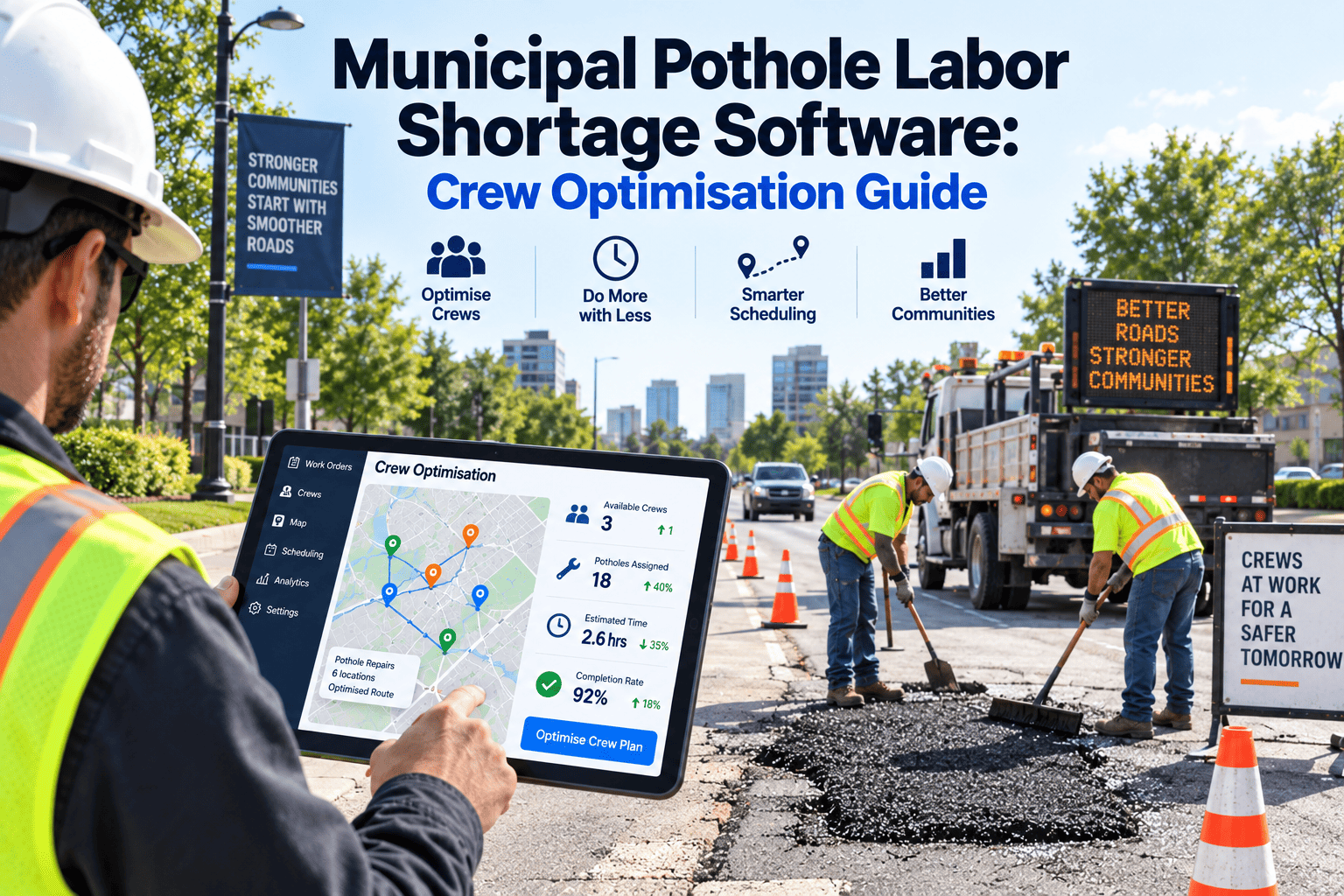
Public works departments across the United States are running pothole repair programs with fewer skilled crew members than they had five years ago, even as lane-mile totals keep growing and every freeze-thaw cycle opens new damage across the network. Retirements are outpacing new hires, seasonal laborers are harder to recruit at competitive wages, and the technicians who remain are pulled between patching, sign repair, and storm response with no system telling a supervisor who is available today, who is certified for hot-mix application, or which route wastes the most drive time between work orders. Departments that once ran four two-person patching crews are now running two, yet resident complaint volume and 311 pothole tickets have not gone down and the response deadlines written into state DOT agreements have not moved either. Closing that gap is rarely about working longer hours; it is about knowing exactly who is free, what they are qualified to do, and which streets to hit first. Cities pairing lean crews with a scheduling and routing platform like OxMaint are cutting backlog age without adding a single new position.
Fewer Hands on the Truck Shouldn't Mean Slower Pothole Response
When crew headcount shrinks, the departments that stay on top of repair backlogs are the ones that stop guessing who is free and start routing work based on real skills, real location, and real daily capacity. OxMaint turns a stretched-thin crew into a coordinated one.
Why Municipal Pothole Crews Are Stretched Thin
The labor shortage in municipal street maintenance is not a single problem with a single fix. It shows up as four separate pressures stacking on top of each other, and most public works departments are absorbing all four at once without any tool that shows the combined effect on daily repair capacity.
Retirement Wave Outpacing Recruitment
Veteran equipment operators and hot-mix technicians are retiring faster than apprenticeship pipelines can replace them, leaving crews with fewer people qualified to run pavers, rollers, and infrared repair units.
Seasonal Labor Is Harder to Fill
Temporary summer hires that used to backfill patching crews are choosing private contracting or warehouse work with better pay, leaving supervisors to run peak pothole season with permanent staff only.
Skill Gaps Inside a Smaller Crew
A four-person crew covering hot-mix patching, cold-patch emergency fill, and crack sealing needs different certifications for each task, and supervisors rarely have a live view of who holds which qualification.
Route Planning Still Done From Memory
Without a routing system, dispatchers sequence work orders by instinct or by call order rather than by proximity, burning paid labor hours in transit instead of on the shovel.
Reactive Dispatch vs Optimized Crew Routing
The difference between a department that feels perpetually behind and one that closes its backlog every week usually is not headcount. It is whether dispatch decisions are made reactively, ticket by ticket, or against a live model of crew skills, location, and remaining daily capacity.
Crew Capacity and Pothole Response Benchmarks
Most state DOT agreements and resident service standards set expected response windows for pothole complaints. Use this reference to see how a lean crew, when routed well, compares to the informal benchmarks public works departments are usually held to.
| Crew Configuration | Typical Daily Output | Response Window Target |
|---|---|---|
| Two-Person Crew, Unrouted Dispatch | 8 to 12 potholes per shift | 5 to 7 business days |
| Two-Person Crew, Geo-Clustered Routing | 16 to 22 potholes per shift | 2 to 3 business days |
| Three-Person Crew, Cross-Trained | 22 to 28 potholes per shift | 1 to 2 business days |
| Emergency Cold-Patch Response Unit | Same-day for safety-hazard tickets | Within 24 hours |
| Seasonal Peak Coverage (Spring Thaw) | Requires cross-district crew sharing | 3 to 5 business days |
| Backlog Recovery Sprint | 30 to 40 percent faster clearance with routing | Backlog under 10 days within one quarter |
Give a Smaller Crew the Output of a Bigger One
OxMaint clusters pothole work orders by location, matches assignments to verified skills, and gives dispatchers a live view of daily crew capacity. Departments running lean are clearing backlogs faster without adding headcount or overtime spend.
Three Warning Signs Your Crew Model Is Breaking Down
A labor shortage does not announce itself all at once. It shows up first in small operational symptoms that are easy to dismiss individually but, together, mean the current staffing model has reached its limit.
Backlog Age Keeps Climbing Despite Full Crews
If every crew is fully staffed and working full shifts but the average age of an open pothole ticket keeps rising, the bottleneck is routing and sequencing, not raw labor hours. Map ticket density against crew travel patterns to find where time is leaking.
One or Two Technicians Hold Every Critical Certification
When hot-mix or infrared repair qualification sits with only one or two people, a single sick day or vacation stalls an entire crew type. Cross-training a wider bench is cheaper than overtime and protects against single points of failure.
Overtime Spend Rises While Ticket Closure Rate Falls
Rising overtime combined with a falling closure rate signals crews are being pushed harder without being routed smarter. Track hours against completed work orders weekly, not just at the end of the budget cycle, to catch this before it compounds.
Municipal Crew Labor Shortage: Frequently Asked Questions
Can routing software really replace the need for more hires?
How does OxMaint track which technicians are certified for hot-mix work?
Does the platform help with seasonal spring-thaw surges?
What does it take to get a small public works team started?
Can it track overtime exposure before payroll closes the pay period?
How OxMaint Supports a Lean Public Works Crew
OxMaint was built around the reality that most municipal street maintenance teams are not adding headcount this year. The platform focuses on getting more verified output from the crew already on payroll.
Geo-Clustered Work Order Assignment
Open pothole tickets automatically group by street corridor and district, so a two-person crew clears a full route in one pass instead of criss-crossing the same neighborhood across separate calls.
Certification and Equipment Tracking
Every technician profile holds current certifications, expiry dates, and equipment training records, so dispatch only offers assignments to staff who are actually qualified to complete them.
Live Daily Capacity Dashboard
Supervisors see remaining hours per crew throughout the shift, making it possible to reassign tickets before overtime is triggered instead of discovering the overrun during payroll reconciliation.
Backlog Age and Response Time Reporting
Automated reporting shows average ticket age by district, letting department heads demonstrate compliance with state response-time agreements without compiling manual spreadsheets every month.
Case Study: Mid-Size City Cuts Backlog by 38 Percent With the Same Crew
A public works department serving roughly 90,000 residents lost two of its six pothole patching positions to retirement over eighteen months, with no approved budget to backfill them before the next fiscal year.
We went into spring thaw with four fewer hands than the plan we built the route schedule around three years ago. Our backlog hit almost 600 open tickets and residents were calling council members directly. We started using OxMaint to cluster work orders by corridor instead of assigning them in the order calls came in, and we tied hot-mix assignments to who actually held current certification instead of guessing. Within one quarter our average response time dropped from nine days to under four, and our backlog is down 38 percent with the exact same crew we started with. We are still short-staffed, but for the first time it does not feel like we are losing ground every week.
Street Maintenance Supervisor, Midwest Public Works Department
Run a Leaner Crew Without Losing Ground
OxMaint clusters routes by geography, matches assignments to verified certifications, and gives supervisors a live read on daily crew capacity. Schedule a demo to see how a stretched-thin crew can still close its pothole backlog on time.