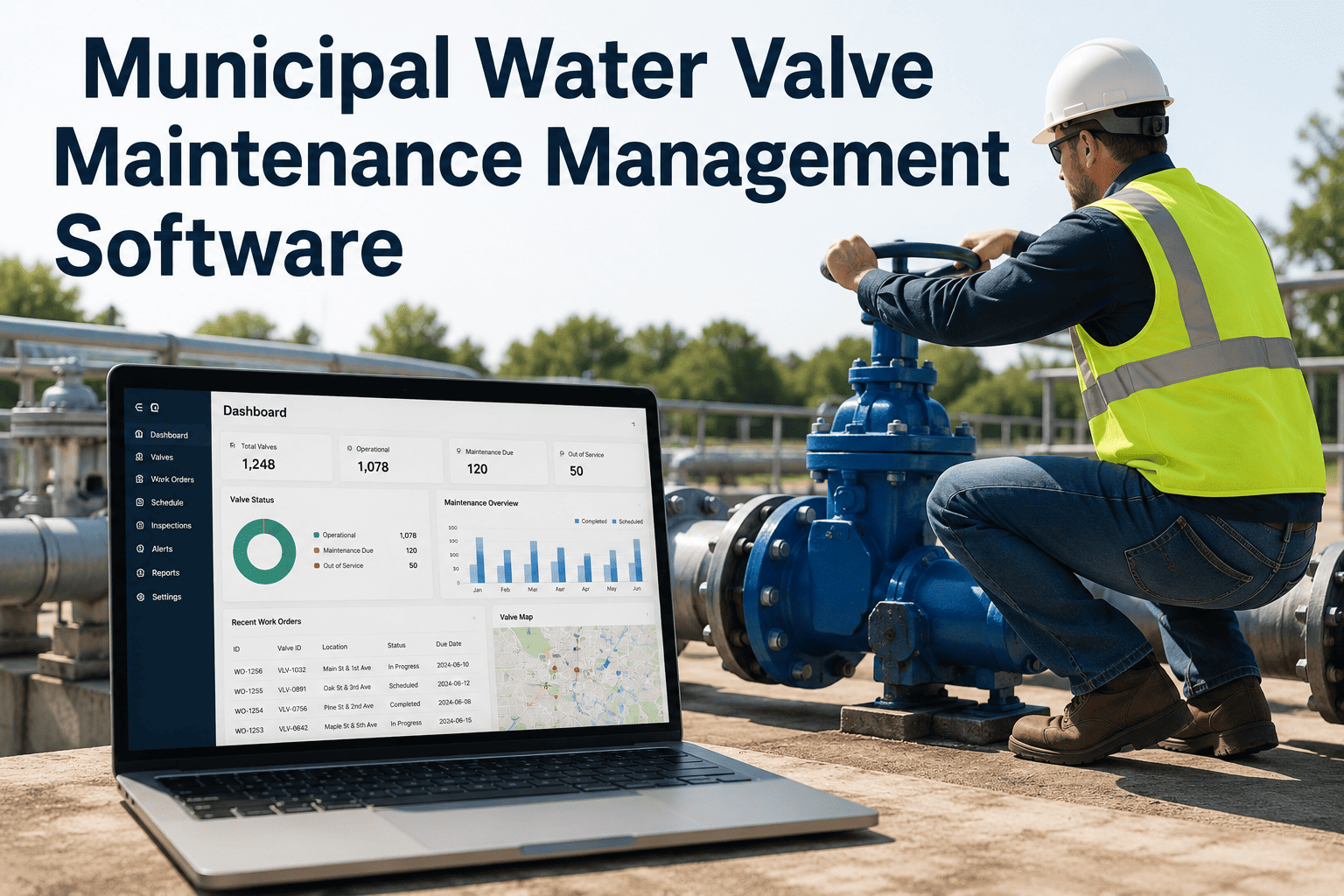
Municipal Water Valve Maintenance Management Software

By James Smith on June 20, 2026

municipal-water-valve-maintenance-management-software

A water utility with 8,000 valves in the ground and a state mandate to exercise each one every one to three years is running a compliance program that most spreadsheets were never built to handle. Add in valves that haven't been located since the 1990s, work orders scribbled on paper route sheets, and a council audit asking for proof of last exercise date, and the gap between "we have a valve maintenance program" and "we can prove it" becomes the actual liability. Municipal water valve maintenance management software closes that gap by tying every valve to a GPS location, an exercise history, and a work order trail that survives staff turnover. Start tracking your valve inventory in Oxmaint free and turn your next state audit into a five-minute report instead of a week of file digging.

Municipal Water Valve Maintenance Management Software

Locate every valve, schedule exercise cycles automatically, and prove compliance with a complete history attached to each asset — not a spreadsheet that lives on one employee's desktop.

Gate Valves
Butterfly Valves
Check Valves
Air Release Valves
Fire Hydrant Valves
The Backlog

Why Most Valve Exercising Programs Fall Behind Schedule

A typical mid-size utility falls behind on roughly one in three required valve exercises every cycle — not from lack of effort, but because the location, schedule, and record of every valve are rarely kept in one connected system.

Valves nobody can find
Older valves were mapped on paper plats that don't match what's actually buried, costing crews hours per location just to confirm a valve exists where the record says it does.
Exercise cycles tracked by memory
Without an automated schedule, valves get exercised when someone remembers, not on the interval the state requires — and the gap only becomes visible during an audit.
No record of stuck or failed valves
A valve that won't fully close during exercise is a critical finding for emergency shutoff planning, yet that result often never makes it past the field crew's notebook.
What Changes

Manual Valve Tracking vs Oxmaint

Valve Maintenance TaskManual Process TodayWith Oxmaint
Finding the valve in the fieldPaper plat, tribal knowledgeQR tag + GPS pin on a mobile map
Scheduling the next exerciseSpreadsheet reminder, often missedAuto-generated work order on a fixed cycle
Logging exercise resultsPaper route sheet, filed awayMobile form with photo and condition code
Flagging a stuck or failed valveVerbal report to supervisorAuto-flagged work order with priority level
Proving compliance to an auditorDays of file and spreadsheet diggingOne exportable report per valve or zone
Scroll horizontally on smaller screens to view all columns

Turn your next audit into a five-minute report

Every valve in Oxmaint carries its location, exercise history, and condition record — exportable by zone, by date range, or by valve type the moment a regulator asks.

Compliance

What Auditors Actually Ask For — and How Each Item Gets Answered

Proof of last exercise date per valve, matched against the required state cycle
A list of valves currently overdue, with days outstanding and assigned crew
A record of any valve that failed to fully open or close during exercise
A GPS-verified asset inventory matching the utility's GIS system
Outcomes

What Utilities See in the First Operating Year

94%

Of required valves exercised on schedule

6.2x

Faster valve location time in the field

38%

More stuck or failed valves identified before an emergency

5 min

Typical time to generate an audit-ready compliance report
Expert Review
Valve exercising programs fail less often from neglect and more often from poor record continuity — a program that lives in one supervisor's notebook doesn't survive that person's retirement. The utilities that stay ahead of their compliance cycle are the ones that moved the schedule and the history into a system the whole crew can see and update from the field.
Reviewed by Oxmaint's Public Works Advisory Team
FAQ

Frequently Asked Questions

Can we import our existing GIS valve data into Oxmaint?
Yes. Existing GIS shapefiles and valve inventory spreadsheets can be imported directly, with each valve assigned a QR tag and exercise schedule during setup. Book a demo to walk through your current data format.
How does Oxmaint handle valves we haven't physically located yet?
Unlocated valves can be flagged as a separate work order type, routing crews to confirm and GPS-pin them during the next scheduled exercise pass through that zone.
Does the mobile app work without cell signal in the field?
Yes. Field crews can log exercise results and photos offline, with the record syncing automatically once the device reconnects to a network.
Can we set different exercise cycles for different valve types?
Yes. Gate valves, butterfly valves, and air release valves can each carry their own required interval, matching whatever cycle your state regulation specifies.
What does a compliance report actually include?
Each report lists every valve in scope, its last exercise date, condition result, and current schedule status, exportable by zone, date range, or valve type. Start free to generate a sample report on your own data.

Know where every valve is, and prove it works

Oxmaint connects valve location, exercise schedule, and condition history into one record your whole crew can trust — and your next auditor can verify in minutes.



Share This Story, Choose Your Platform!