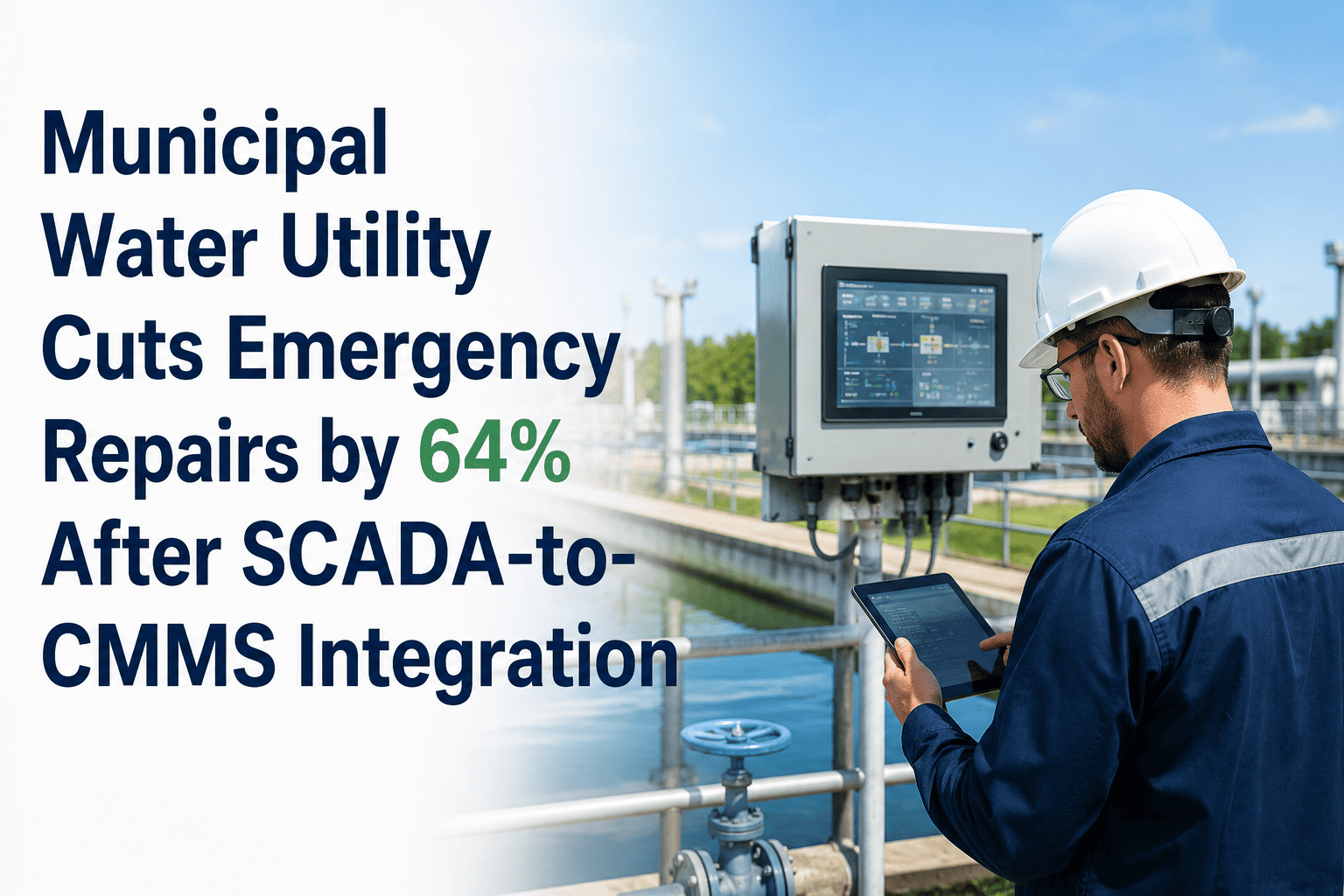
At 3:47 AM on a Thursday, the high-service pump at a municipal water treatment facility in Ohio began showing elevated bearing temperatures that nobody noticed. By Friday afternoon, the pump had seized. By Saturday morning, the plant was operating on backup capacity, emergency parts procurement was underway, and the operations manager was explaining to city council why 47,000 residents experienced low water pressure during peak summer demand. The parts they needed? A $340 mechanical seal and $890 bearing set that should have been on the shelf—but weren't tracked in any system.
This scenario plays out across American water treatment facilities more often than utility directors want to admit. Pumps are the cardiovascular system of every treatment operation, yet parts inventory remains dangerously under-managed in an industry where equipment failure directly impacts public health and regulatory compliance.
Here's the reality: pump failures account for approximately 35% of all unplanned downtime in water treatment facilities. When a critical process pump fails and the required seal kit isn't in stock, a $500 planned repair transforms into a $15,000 emergency procurement plus overtime labor plus potential permit violations. The mathematics of proactive parts management versus reactive scrambling has never been more compelling.
This playbook delivers the exact implementation framework that progressive water utilities are using to eliminate parts-related pump failures. From inventory optimization to automated reorder workflows, you'll find actionable specifications that translate directly to your treatment plant floor. Explore how digital parts management transforms water treatment operations →
The water treatment industry operates under regulatory requirements that leave zero tolerance for equipment surprises. When a raw water intake pump fails mid-treatment, you're not just losing the repair cost—you're risking permit violations, public health advisories, and the community trust that takes decades to build. Industry benchmarks indicate that utilities implementing systematic parts workflows see a 45% reduction in emergency procurements and 28% decrease in pump-related downtime.
Consider the cascade effect: a seized pump bearing doesn't just stop one piece of equipment. It halts the treatment train it supports, creates bypass situations that stress other equipment, and may compromise water quality already in process. The $2,000-$8,000 cost of emergency pump parts represents only the visible portion of the financial impact when regulatory fines and emergency staffing enter the equation.
Understanding Critical Pump Components in Water Treatment
Every pump in your treatment facility contains wear components with predictable service lives. When those components aren't tracked and stocked, maintenance shifts from planned interventions to emergency scrambles. Understanding component criticality transforms parts management from guesswork into precision inventory engineering.
Water treatment pumps present specific inventory challenges that differ from general industrial applications. The combination of corrosive water chemistry, variable flow demands, and the critical importance of continuous operation creates an inventory context that demands specialized approaches. Schedule a consultation to assess your current parts management capabilities →
The power of systematic parts management lies in its predictive capability. Pump components don't fail instantaneously; they degrade through identifiable stages that produce progressively stronger warning signs. Early-stage seal leakage indicates replacement need within weeks. Bearing temperature trending upward signals 4-12 weeks remaining service life. Declining pump curves reveal impeller wear months before efficiency becomes unacceptable. Tracking these indicators against parts availability transforms emergency repairs into planned maintenance events.
Step-by-Step Parts Workflow Implementation Playbook
Implementing systematic parts management in a water treatment environment requires structured planning that accounts for the unique operational characteristics of utility infrastructure. The following framework provides a systematic approach that scales from small community systems to regional treatment authorities.
The implementation timeline above represents a methodical approach that balances speed-to-value with thorough system configuration. Rushing through inventory establishment or reorder configuration typically results in either excess stock tying up budget or continued stockouts that undermine confidence in the system. Start building your parts management foundation today →
Critical Pump Parts Inventory by Treatment Process
Not all pumps carry equal risk in water treatment operations. Strategic inventory deployment focuses resources on pumps where failure consequences are highest and where parts lead times create the greatest vulnerability.
| Pump Type | Failure Impact | Critical Parts | Inventory Priority | Recommended Stock |
|---|---|---|---|---|
| Raw Water Intake Pumps | Complete treatment plant shutdown, permit violations | Mechanical seals, bearings, impellers, coupling elements | Critical | Full rebuild kit plus individual seal/bearing spares |
| High-Service Distribution Pumps | System pressure loss, public health risk, boil advisories | Mechanical seals, bearings, wear rings, motor components | Critical | Complete spare pump or full parts kit per unit |
| Filter Backwash Pumps | Treatment quality degradation, extended filter runs | Seals, bearings, impeller wear rings | High | Seal kit and bearing set per pump type |
| Chemical Feed Pumps | Disinfection failure, treatment compliance issues | Diaphragms, check valves, injection quills, tubing | High | Diaphragm kits and valve sets for each chemical system |
| Sludge Transfer Pumps | Solids handling backup, process delays | Wear plates, seals, impellers | Medium | Wear parts kit, seal spares |
| Plant Utility Pumps | Service water interruption, washdown delays | Standard seals, bearings | Medium | Common seal and bearing sizes in general stock |
The priority matrix reflects the reality that not every pump justifies the same inventory investment. High-criticality pumps warrant complete rebuild kits and dedicated spare components, while lower-priority equipment can be effectively managed through common parts pooling and longer acceptable lead times.
Parts Lifecycle: From Procurement to Installation
Understanding how parts flow through your organization enables maintenance teams to intervene at the optimal point: ensuring availability when needed while avoiding excess inventory that ties up limited budgets.
Parts requirements identified through scheduled PM work orders, predictive maintenance alerts, or inventory falling below minimum threshold. CMMS automatically generates requisition.
Approved requisitions convert to purchase orders. Vendor selection based on contract pricing, lead time, and historical performance. Emergency orders follow expedited approval path.
Parts received, inspected for damage and specification compliance, entered into inventory system with location codes. Quality issues documented and vendor notified.
Parts issued to work order, installed by technician, completion documented with actual parts used. Warranty information and installation date recorded for lifecycle tracking.
The financial advantage of systematic parts management becomes clear when viewing this lifecycle. Catching a low-stock condition before it becomes a stockout means planned procurement at contract pricing. Waiting until emergency need means premium expediting charges, potential equipment damage from extended operation with failing components, and the cascade effects that multiply costs exponentially.
CMMS Integration: Connecting Parts to Maintenance Workflows
Parts inventory without work order integration creates cost without value. The critical connection links available parts to scheduled maintenance, ensuring that planned repairs actually execute on schedule rather than being deferred due to parts unavailability. Request a walkthrough of parts-to-work-order integration →
The integration architecture above represents the closed-loop system that transforms parts management from a warehouse function into a proactive maintenance enabler. When scheduled PM generates a work order, the system automatically checks parts availability, reserves required components, and alerts procurement if stock is insufficient—all before the maintenance window arrives.
Measurable KPIs for Water Utility Parts Management
Tracking the right metrics validates program effectiveness and identifies optimization opportunities. The following KPI framework provides benchmarks specific to water treatment operations.
These metrics provide the foundation for continuous improvement conversations with utility management and regulatory oversight. When parts management investment comes under scrutiny, documented improvements in stockout rates, emergency procurement reduction, and work order completion rates provide the quantitative justification that budgets require. Track your utility's parts performance with built-in analytics →
Expert Perspective on Water Utility Parts Management
The water utility industry has reached a maturity point where operational excellence increasingly determines both regulatory compliance and financial sustainability. AWWA research indicates that utilities with systematic parts management programs experience 45% fewer emergency procurements and 28% reduction in pump-related downtime compared to facilities relying on reactive approaches.
For water treatment facilities specifically, the mathematics of parts availability creates a compelling case. When a $500 seal kit stockout results in a $15,000 emergency procurement, overtime labor, and potential permit violation fines, the 30:1 cost multiplier makes the inventory investment calculation straightforward. Industry research indicates that 85% of utilities implementing integrated CMMS-inventory systems report improved equipment reliability, with average payback periods of 8-14 months.
The technology accessibility barrier has largely disappeared. Cloud-based CMMS platforms with integrated inventory modules, mobile checkout capabilities, and automated procurement workflows that would have required six-figure investments a decade ago now fall within reach of utilities serving 10,000 connections. The question for water treatment operators is no longer whether parts management makes sense, but how quickly they can implement it before aging infrastructure and shrinking workforces make reactive approaches unsustainable.
Conclusion: From Reactive to Proactive Parts Management
The transition from reactive to systematic parts management represents more than a warehouse upgrade; it fundamentally changes the relationship between water treatment operations and equipment reliability. Rather than responding to stockouts after they delay repairs, integrated parts workflows ensure availability when maintenance windows arrive.
The implementation framework outlined in this playbook provides a systematic path from initial pump assessment through full work order integration. The critical success factors remain consistent across utility sizes: start with highest-criticality pumps, establish accurate baseline inventory before setting reorder triggers, and ensure that parts availability connects to maintenance scheduling systems that drive actual repair execution.
For utilities operating under regulatory requirements where equipment reliability directly impacts public health and community trust, systematic parts management has transitioned from competitive advantage to operational necessity. The technology is accessible, the ROI is documented, and the implementation pathway is clear.