When a 60-year-old water main ruptures beneath a four-lane arterial at 6:47 AM on a Monday, it's not just a maintenance failure—it's a $340,000 emergency that shuts down a commercial corridor, floods a parking garage, and triggers a boil-water advisory affecting 12,000 residents. The public works director knew the pipe was aging, but without data models connecting soil conditions, pressure fluctuations, break history, and material degradation rates, "aging" was just an adjective—not a prediction with a timeline and a probability score. Three blocks away, an identical pipe segment that predictive analytics flagged 14 months earlier was rehabilitated during a scheduled road resurfacing for $28,000. Same pipe material, same age, same soil—different outcome entirely because one decision was data-driven.
Predictive analytics transforms municipal infrastructure management from reactive firefighting to calculated prevention. Machine learning algorithms analyze decades of maintenance records, sensor data, environmental conditions, and asset characteristics to forecast which assets will fail, when they'll fail, and what intervention delivers the best return per dollar invested. Municipalities deploying these capabilities report 30-50% reductions in emergency repairs while extending infrastructure life by 15-25%—turning maintenance budgets from cost centers into strategic investment portfolios.
This guide provides public works directors and municipal leaders with actionable implementation strategies for deploying predictive analytics across infrastructure networks. Departments ready to transform their operations can start building their predictive maintenance foundation today.
Public works departments generate massive volumes of operational data daily—work orders, inspection reports, sensor readings, GIS records, and financial transactions. Yet 85% of municipalities use less than 10% of this data for decision-making. Predictive analytics closes this gap by converting raw operational data into failure probabilities, optimal maintenance windows, and budget allocation recommendations that maximize infrastructure life per dollar spent.
40%
Reduction in unplanned infrastructure failures with predictive models
$2.8M
Average annual savings for mid-size municipalities using predictive maintenance
85%
Prediction accuracy achievable with 3+ years of digital maintenance history
5-8x
ROI on predictive analytics investment within 36 months of deployment
Predictive algorithms are only as powerful as the data feeding them. Municipal infrastructure prediction requires integrating four categories of data—asset characteristics, maintenance history, environmental factors, and real-time sensor feeds—to build models that forecast failure with actionable precision.
Essential Data Inputs for Infrastructure Prediction
Asset Attribute Data
Sources:GIS, asset registry, CMMS
Key Fields:Age, material, size, location
Prediction Role:Base failure probability curves
Maintenance History
Sources:Work orders, inspection logs
Key Fields:Repair frequency, cost, type
Prediction Role:Degradation trend analysis
Environmental Factors
Sources:Soil surveys, weather, traffic
Key Fields:Soil corrosivity, frost, load
Prediction Role:External stress multipliers
Real-Time Sensor Data
Sources:IoT sensors, SCADA, telematics
Key Fields:Pressure, vibration, flow, temp
Prediction Role:Imminent failure detection
Not all predictive analytics are created equal. Municipal infrastructure requires different analytical methods depending on data maturity, asset type, and budget. Understanding the spectrum—from simple statistical models to advanced machine learning—allows departments to start where they are and scale capabilities as data quality improves.
| Approach |
Data Required |
Accuracy |
Implementation |
Best For |
| Age-Based Models |
Asset age + material |
Moderate |
Simple |
Starting point |
| Statistical Regression |
3+ years history |
Good |
Moderate |
Trend analysis |
| Machine Learning (ML) |
5+ years + sensors |
Excellent |
Complex |
Multi-factor prediction |
Quick-Win Predictive Analytics Strategies
1
Water Main Break Prediction
Combine pipe age, material, soil type, and break history to rank every segment by failure probability. Target the top 5% for proactive replacement during scheduled road work.
Result: 35-50% reduction in emergency main breaks
2
Pavement Deterioration Forecasting
Use PCI scores, traffic counts, and climate data to predict which road segments will drop below acceptable condition within 12-36 months—scheduling overlays before costly reconstruction is needed.
Result: 25% longer pavement life through optimized timing
3
Fleet Failure Anticipation
Analyze engine hours, oil analysis trends, brake wear rates, and repair frequency to predict component failures 30-60 days before breakdown—scheduling repairs during planned downtime.
Result: 60% fewer roadside breakdowns, 3-year life extension
4
Sewer System Risk Scoring
Integrate CCTV inspection data, age, material, and infiltration measurements to prioritize rehabilitation on the segments most likely to collapse or cause sanitary sewer overflows.
Result: 40% reduction in SSOs, optimized CIPP spending
Ready to Predict Infrastructure Failures Before They Happen?
Oxmaint CMMS captures the maintenance history, sensor data, and asset intelligence that powers predictive models—giving your department the foundation for data-driven infrastructure management.
Join municipalities transforming reactive maintenance into predictive operations
Machine learning models require clean, structured, historical data to generate accurate predictions. The single most important investment a municipality can make toward predictive analytics is digitizing maintenance operations through a CMMS—every work order, inspection, and repair logged digitally becomes training data for future prediction models. Departments that start capturing structured data today build the 3-5 year history needed for high-accuracy ML predictions.
CMMS Data Points That Power Prediction
✓
Work Order Intelligence
Every repair, inspection, and PM logged with asset ID, failure mode, labor hours, parts used, and root cause—creating the training dataset ML models need
✓
Condition Scoring History
Systematic condition assessments over time create degradation curves showing exactly how fast each asset class deteriorates under local conditions
✓
Cost-Per-Asset Tracking
Lifetime maintenance cost accumulation reveals which assets are approaching the repair-vs-replace crossover point—the most valuable predictive threshold
✓
Sensor Integration Layer
IoT sensor feeds connected to asset records create real-time condition data streams that trigger predictive alerts when anomalies are detected
Predictive analytics implementation follows a crawl-walk-run methodology. Municipalities attempting to jump directly to machine learning without building the data foundation waste budget and credibility. This phased roadmap ensures each stage delivers measurable value while building toward advanced predictive capabilities.
12-Month Predictive Analytics Implementation Roadmap
Months 1-4
Data Foundation (Crawl)
→ Deploy CMMS and digitize all work orders with structured failure mode coding
→ Complete asset inventory with age, material, location, and condition baseline
→ Establish data quality protocols—mandatory fields, validation rules, supervisor review
Milestone: 100% of maintenance activity captured digitally with structured data
Months 5-8
Statistical Analysis (Walk)
→ Generate age-based failure curves for top 5 asset classes (pipes, roads, fleet, signals, pumps)
→ Build repair-vs-replace models using accumulated cost-per-asset data
→ Deploy IoT sensors on 20-30 highest-criticality assets for real-time condition monitoring
Milestone: First predictive work orders generated from statistical models
Months 9-12
Machine Learning (Run)
→ Train ML models combining maintenance history, environmental data, and sensor feeds
→ Generate risk-ranked asset priority lists updated monthly for capital planning
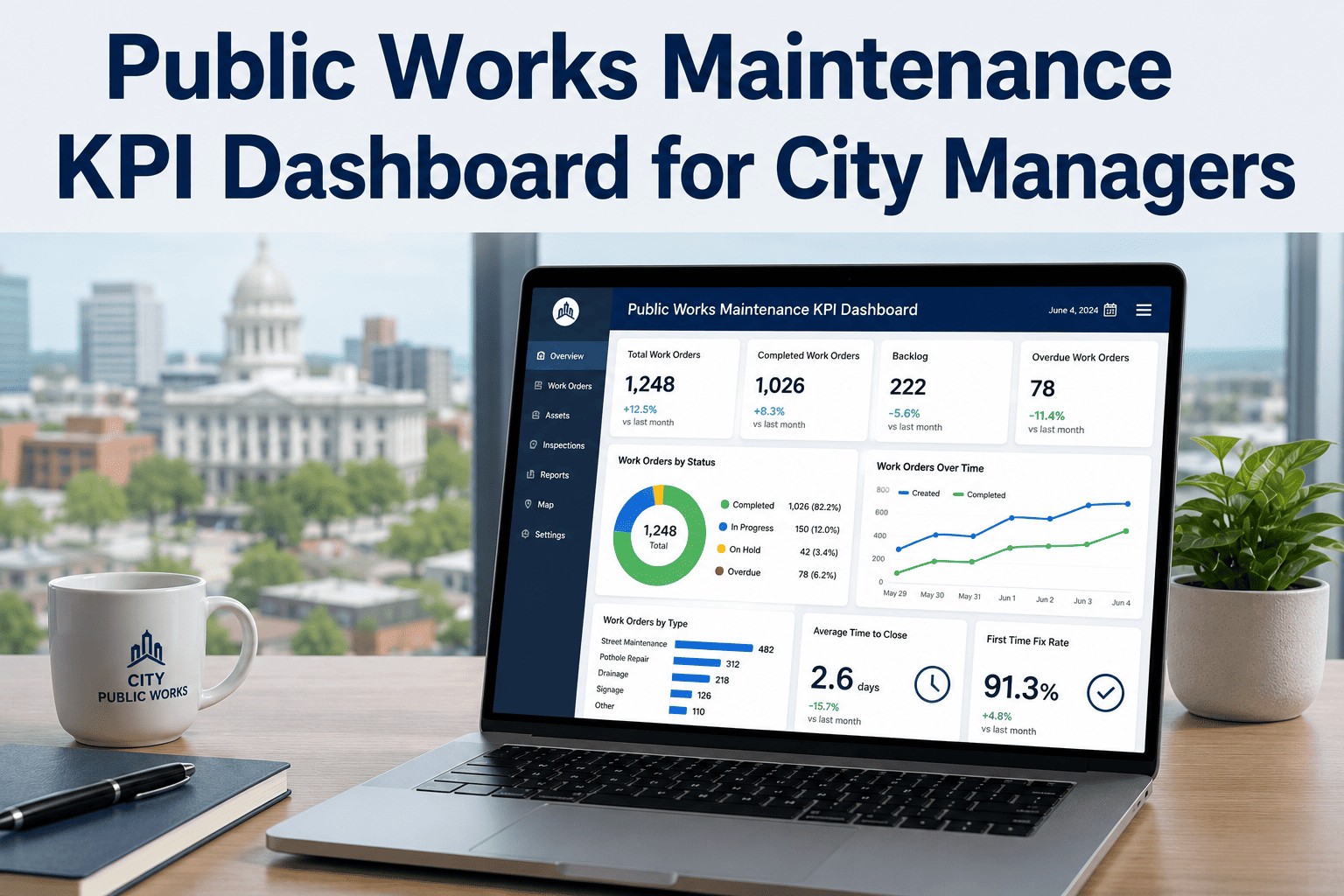
→ Present predictive ROI dashboard to council showing prevented failures and cost avoidance
Milestone: Predictive models driving 30%+ of maintenance scheduling decisions
Predictive analytics must prove its value through measurable KPIs that demonstrate both operational improvement and financial return. These metrics translate technical capabilities into the language of council chambers and budget committees.
Prevention
Planned vs. Reactive Ratio
Target: 70:30
Shift from 20:80 reactive baseline proves predictive models are driving proactive intervention
Accuracy
Prediction Hit Rate
Target: 80-85%
Percentage of predicted failures that actually occurred within the forecast window
Financial
Emergency Cost Avoidance
Target: $500K+/yr
Documented savings from failures prevented by predictive intervention vs. estimated emergency cost
Infrastructure
Asset Life Extension
Target: 15-25%
Average useful life gained through optimized maintenance timing across asset portfolio
Municipalities deploying predictive analytics through integrated CMMS platforms report measurable improvements across prevention, efficiency, and infrastructure longevity:
45%
Fewer emergency repairs
Year-over-year reduction
85%
Prediction accuracy
After 3 years of data
$2.8M
Annual cost avoidance
For mid-size agencies
22%
Infrastructure life gain
Across asset portfolio
See Predictive Analytics in Action
Schedule a personalized demo showing exactly how Oxmaint captures structured maintenance data, integrates sensor feeds, and builds the foundation for infrastructure failure prediction.
Trusted by forward-thinking public works departments nationwide
Municipal infrastructure is aging faster than budgets can replace it. The American Society of Civil Engineers estimates $4.6 trillion in deferred infrastructure investment nationally. Predictive analytics doesn't eliminate the funding gap—but it maximizes the impact of every dollar by targeting investment where data proves it will prevent the costliest failures. A municipality that replaces a pipe segment six months before predicted failure saves 80% compared to emergency response after rupture.
The path from reactive to predictive isn't a technology purchase—it's a data strategy. Every work order logged in a CMMS today becomes training data for tomorrow's prediction models. Every sensor installed on a critical asset feeds real-time condition intelligence into algorithms that learn and improve. The municipalities building these data foundations now will have 3-5 year analytical advantages over those that delay.
Your infrastructure won't stop aging. Your failure rates won't decrease without intervention. But the tools to predict and prevent those failures exist today. For a personalized assessment of your department's predictive analytics readiness, schedule a consultation with specialists who understand municipal operations data.
How much historical data do we need before predictive models are useful?
Simple age-based failure models work immediately using asset inventory data alone—just knowing pipe material, age, and break history provides actionable risk ranking. Statistical regression models become reliable with 3+ years of structured digital work order data. Advanced machine learning models deliver peak accuracy (80-85%) with 5+ years of history combined with environmental and sensor data. The key is starting data collection now—every month of digital maintenance records increases future model accuracy.
Can small municipalities afford predictive analytics?
Yes. The foundation of predictive analytics is a well-implemented CMMS capturing structured data—which small municipalities need regardless. Cloud-based CMMS platforms cost $3,000-$15,000 annually for small departments, and the age-based and statistical models that deliver 60-70% of predictive value require no additional software investment. Advanced ML capabilities can be added later as data matures. The ROI is proportional: even preventing one emergency water main break ($50K-$200K) exceeds the annual CMMS cost multiple times over.
What infrastructure types benefit most from predictive analytics?
Underground utilities (water, sewer, stormwater) deliver the highest ROI because failures are invisible until catastrophic and emergency repairs are 3-8x more expensive than planned rehabilitation. Pavement management ranks second—predictive models optimize the timing of overlays and reconstruction to maximize lifecycle value. Fleet maintenance is third, with oil analysis, vibration monitoring, and component wear tracking enabling 30-60 day failure forecasts. Traffic signals and pump stations benefit from IoT sensor-driven real-time prediction.
How do predictive models handle assets with no failure history?
Models use "transfer learning"—applying failure patterns from similar assets in the network or from industry-wide datasets. A cast iron pipe installed in 1965 with no recorded breaks still carries predictable risk based on material degradation curves, soil corrosivity at its location, and failure rates of similar pipes in the same system. As the asset accumulates inspection and condition data in the CMMS, the model refines its prediction from population-level estimates to asset-specific forecasts.
How do we present predictive analytics value to city council?
Present three data points: (1) Cost of recent emergencies that predictive models would have flagged—show the specific pipe, road, or equipment failure with emergency cost vs. estimated planned repair cost. (2) Current risk map showing the top 20 assets most likely to fail in the next 12 months with estimated emergency cost exposure. (3) ROI projection showing predictive maintenance investment vs. documented emergency cost reduction. Councils respond to "we predicted this failure and prevented a $200,000 emergency for $15,000" far more than technical descriptions of algorithms.