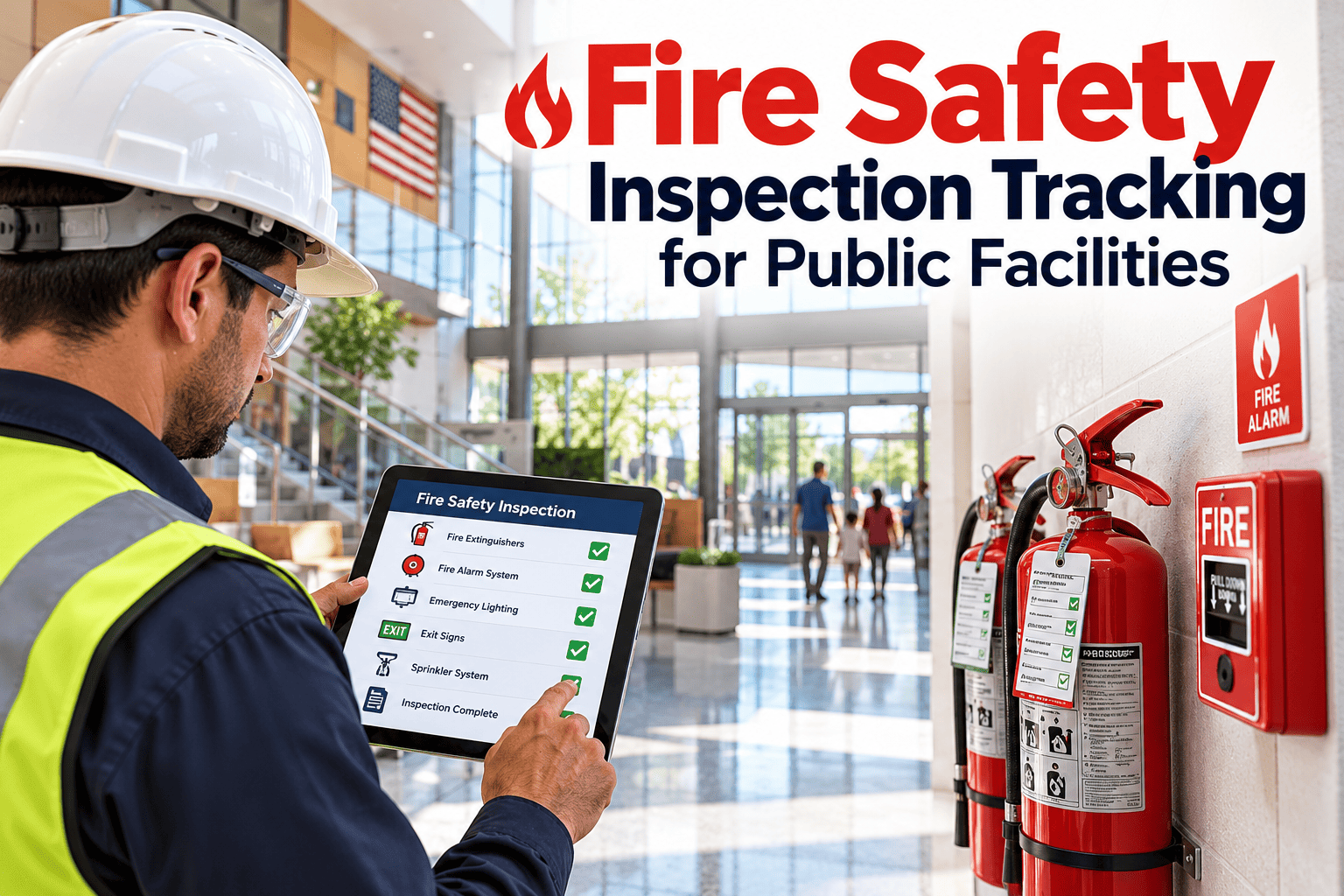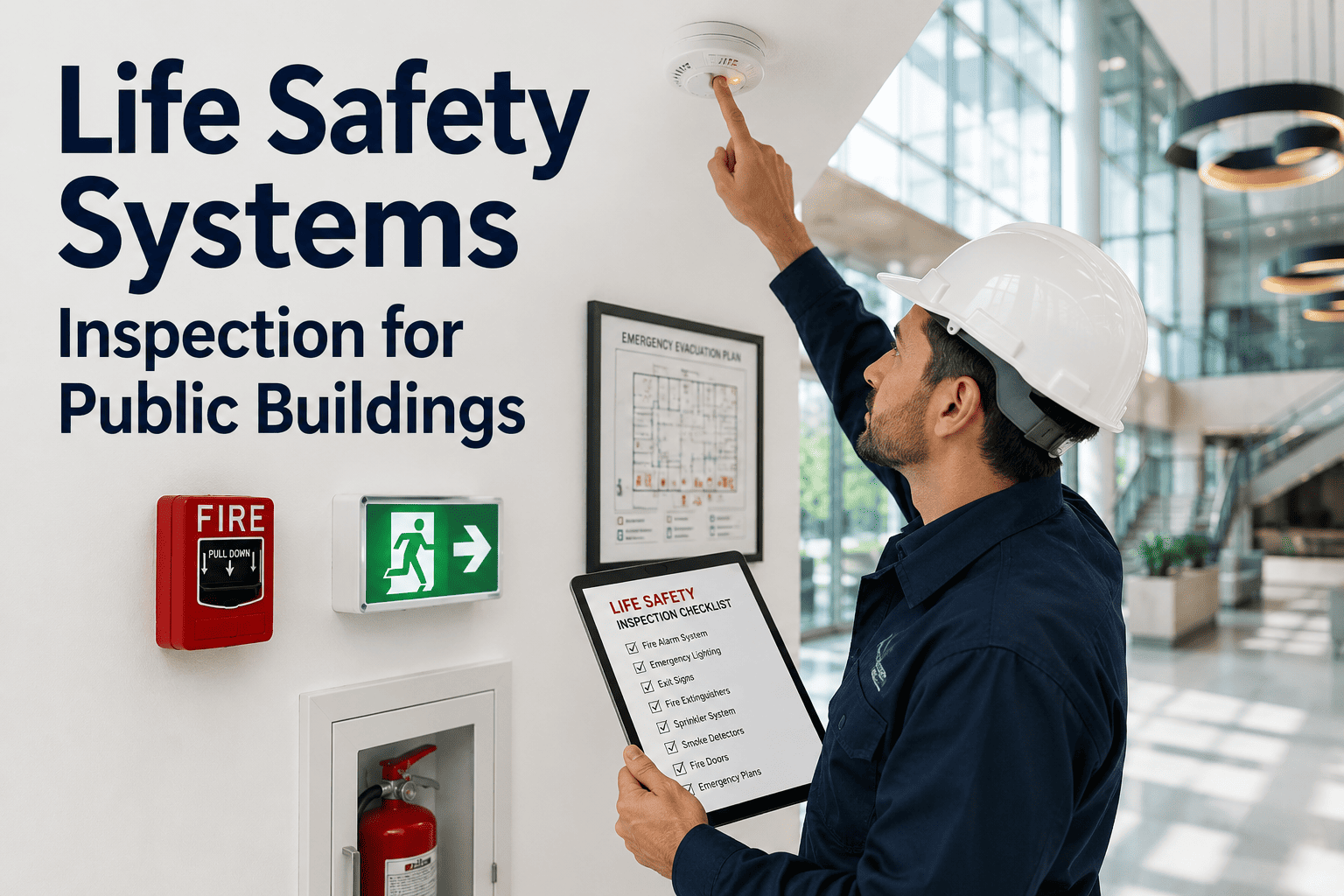
Life safety systems in public buildings — fire alarms, sprinkler networks, emergency lighting, and means of egress — are the operational backbone that keeps thousands of daily occupants protected, yet many facilities teams manage them through paper logs and siloed vendor reports that make NFPA compliance nearly impossible to prove on demand. A single missed quarterly test on a fire alarm control panel or an undocumented sprinkler deficiency can trigger citations, insurance penalties, and worst of all, occupant risk during an actual event. Building a CMMS-driven inspection program around NFPA 25, NFPA 72, and NFPA 101 transforms scattered maintenance records into a defensible audit trail. Start your free trial at Start Free Trial to centralize every life safety test, deficiency, and corrective work order in one system.
Can your building prove full life safety compliance in the next 72 hours?
Most public facilities manage fire alarm, sprinkler, and egress systems across disconnected vendor reports and binders — leaving gaps that surface only during an AHJ audit or a real emergency. A CMMS-driven inspection program closes every gap before inspectors arrive.
That single overdue test — often a smoke detector sensitivity check or a sprinkler quarterly — is the difference between a clean Authority Having Jurisdiction (AHJ) walk-through and a written notice of violation that costs time, budget, and public trust.
The three standards that govern every public building life safety inspection
Public facilities live under a layered compliance regime. NFPA 25, NFPA 72, and NFPA 101 each own a different slice of the life safety stack — and missing any one layer invalidates the whole program during an audit.
Water-Based Sprinkler Systems
Quarterly flow tests, annual full-system sprinkler inspections, 5-year internal pipe assessments, and backflow preventer testing. Governs standpipes, hose stations, and fire pumps.
- Quarterly: sprinkler control valve test
- Annual: full sprinkler head + piping check
- 5-year: internal pipe & fitting obstruction exam
Fire Alarm & Detection
Semi-annual fire alarm panel testing, annual smoke detector sensitivity, annual heat detector functional test, and 10-year replacement of smoke detectors on most systems.
- Semi-annual: FACP functional + annunciator
- Annual: detector sensitivity & battery load
- 10-year: smoke detector replacement cycle
Means of Egress & Emergency Lighting
Monthly emergency lighting and exit sign tests (90-second load), annual 90-minute full discharge, and continuous egress path compliance including door hardware and clear widths.
- Monthly: exit sign + egress light 30-sec test
- Annual: 90-minute battery full discharge
- Continuous: clear egress width & door hardware
Tiered life safety inspection checklist for public buildings
Build the inspection plan from the testing interval, not the asset list. These four tiers — monthly, quarterly, semi-annual, annual — cover roughly 95% of the code-required tasks an AHJ will ask to see documented.
- Emergency lighting 30-second load test on every fixture
- Exit sign illumination visual + battery indicator check
- Fire extinguisher visual inspection (tagged + accessible)
- Fire alarm panel trouble signal review + log entry
- Egress path obstruction walk (doors, corridors, exits)
- Sprinkler system control valve function test
- Standpipe hose connection + pressure gauge check
- Fire alarm device 10% random functional test
- Suppression system inspection (kitchen / special hazard)
- Full fire alarm control panel functional test
- Battery load test on alarm backup power supply
- Smoke detector random sampling — 10% of zones
- Duct smoke detector functional + airflow verification
- Full sprinkler head + piping inspection (NFPA 25)
- Smoke detector sensitivity test — 100% coverage
- Emergency lighting 90-minute full discharge
- Fire pump annual flow test + churn pressure
- Backflow preventer forward flow test
- Complete egress capacity + door hardware audit
| Inspection task | NFPA ref | Interval | Typical duration | Common deficiency |
|---|---|---|---|---|
| Sprinkler control valve test | NFPA 25 | Quarterly | 20–40 min | Valve partially closed (impairment) |
| Fire alarm panel functional | NFPA 72 | Semi-annual | 2–4 hrs | Ground fault or battery under load |
| Smoke detector sensitivity | NFPA 72 | Annual | 4–8 hrs (per zone) | Drift beyond ±3% obscuration |
| Emergency light discharge | NFPA 101 | Annual (90 min) | 90 min + recharge | Battery fails under 90-min load |
| Fire pump flow test | NFPA 25 | Annual | 1–2 hrs | Churn pressure below rated curve |
| Backflow preventer forward flow | NFPA 25 | Annual | 30–60 min | Reduced flow rate / stuck check |
How a CMMS converts scattered logs into a defensible life safety program
A maintenance-connected CMMS replaces paper binders with structured, time-stamped records that an AHJ can audit on the spot. The shift typically cuts deficiency closure time by 60% and eliminates "lost test report" gaps entirely.
Asset & system registry
Every life safety device — from the main FACP down to a single hallway exit sign — is logged with manufacturer, model, install date, location, and assigned NFPA code classification.
Automated inspection scheduling
Recurring work orders generate automatically at the correct interval — monthly, quarterly, semi-annual, annual, 5-year — with checklists pre-attached so no task is missed or duplicated.
Field test capture
Technicians complete tests on mobile devices, recording pass/fail, readings, photos, and digital signatures directly against the asset record — no paper, no transcription lag.
Deficiency → corrective work order
A failed test auto-generates a deficiency-tagged work order with priority, due date, and parts list — closing the loop between inspection and repair within hours instead of weeks.
Audit-ready reporting
One click produces a complete compliance packet — every test, every signature, every deficiency and its resolution — filterable by system, building, or date range for any AHJ request.
A 240,000 sq ft municipal complex — city hall, courts, and a public library under one facilities team — was spending roughly $48,000/yr on third-party life safety inspections but still received a notice of violation after an AHJ audit found 11 overdue sprinkler quarterly tests and 3 undocumented fire alarm deficiencies. By migrating to a CMMS-driven program, the team scheduled all 600+ life safety assets on automated cycles, captured every test digitally, and cut average deficiency closure from 38 days to 9 days. At the following year's audit, the AHJ accepted the digital compliance packet in under 90 minutes — zero violations.
Closing the gap: from failed test to documented repair
Industry data suggests roughly 1 in 4 life safety inspections reveals at least one deficiency — yet nearly half of those deficiencies remain open beyond their code-required remediation window because they are trapped in vendor PDFs instead of an active work-order system.
What a defensible life safety file actually looks like
An AHJ does not just want to know the test was done — they want to know who did it, when, with what result, and what happened to any failure. A defensible file answers all four questions in under five minutes.
Test record per asset
Every inspection result — pass, fail, or reading — is permanently bound to the specific asset ID, not a general building-level log.
Technician identity & signature
Each test is attributed to a named technician or vendor with a digital signature and certification number for full accountability.
Date & time stamp
System-generated timestamps prevent backdating and prove the test occurred within the code-required window — not just "sometime that quarter."
Deficiency → resolution chain
Every failed test links directly to its corrective work order — with parts, labor, closure date, and re-test result — forming an unbroken audit chain.
Stop gambling with paper-based life safety records
Every day without a CMMS-driven inspection program is a day your building is one AHJ visit away from a violation. Centralize every life safety test, deficiency, and corrective action in a single defensible system.
Life safety inspection questions, answered
What is the minimum life safety inspection frequency for a public building?
The baseline is monthly emergency lighting and exit sign tests, quarterly sprinkler control valve tests, semi-annual fire alarm panel functional tests, and annual full-system inspections across sprinkler, alarm, and egress systems. The 5-year internal pipe obstruction assessment and 10-year smoke detector replacement cycle are the two most commonly missed long-interval requirements. A CMMS automates all of these on the correct cycle so nothing drifts.
Who is responsible for life safety compliance in a government building?
Responsibility typically sits with the facilities director or building operations manager, though the AHJ (fire marshal or code official) enforces compliance. The facilities team must maintain test records, remediate deficiencies within code windows, and produce documentation on demand. Using a platform like the one you can explore when you Book a Demo gives that team a single source of truth across every system and vendor.
What happens if a life safety deficiency is found during an inspection?
The deficiency must be documented, tagged, and remediated within the code-required window — which can be as short as 4 hours for an impaired sprinkler valve or as long as 45 days for a smoke detector sensitivity drift. Critical impairments often require a fire watch until the system is restored. The CMMS auto-generates a corrective work order the moment a test fails, so the clock starts immediately and the resolution is fully documented.
Can a CMMS replace third-party life safety inspection vendors?
A CMMS does not replace the licensed vendor where code requires a NICET-certified tester — but it does replace the paper and PDF reports that vendor delivers. The vendor performs the test and records results directly in the CMMS via mobile, so the building owner owns the data in real time rather than waiting weeks for a binder. This cuts administrative overhead by roughly 40% and eliminates lost-report risk. You can see the vendor-management workflow when you Start Free Trial.
How long must life safety inspection records be retained?
Most jurisdictions require life safety test records to be retained for a minimum of 3 to 5 years, with some AHJs asking for the full life-of-system history during major audits. A CMMS retains records indefinitely in a searchable digital archive, so an inspector asking for "the last three years of sprinkler quarterly tests on Building C" gets a filtered report in seconds rather than a binder search that takes hours.
Build a defensible life safety program before the next inspection
Centralize every fire alarm, sprinkler, and egress inspection in one CMMS — automated scheduling, digital test capture, deficiency-to-work-order closure, and audit-ready reporting on demand.
Free 14-day trial · No credit card