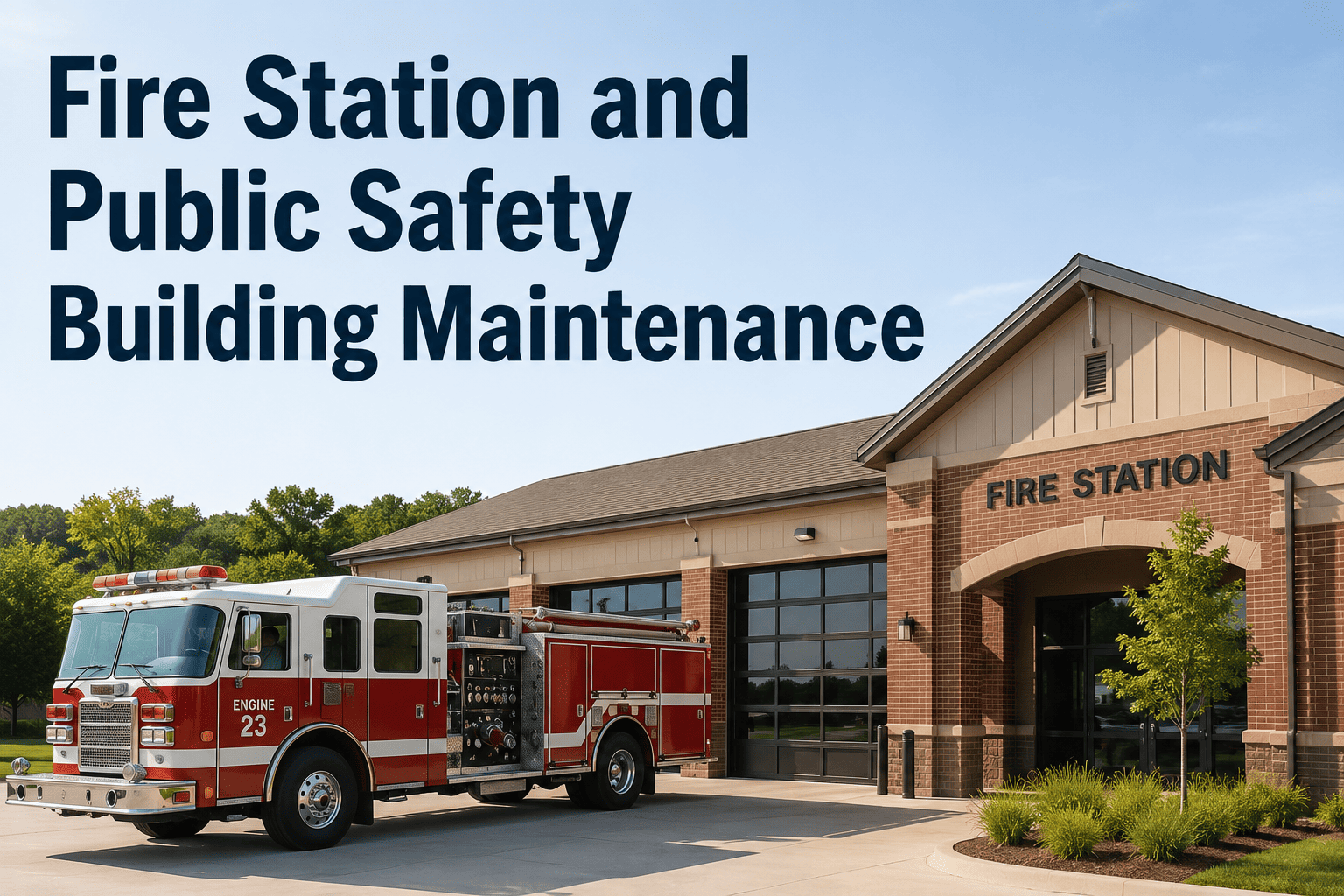
Fire stations and public safety buildings run every minute of every day, and the moment a bay door fails or the backup generator does not cycle, readiness collapses. Facilities that house apparatus, sleeping crews, dispatch, and public-facing lobby functions in one structure carry maintenance loads that no ordinary commercial building approaches. A disciplined, CMMS-driven program protects the 8 to 14 million dollar apparatus fleet, the 24/7 life-safety systems, and the crews who live inside the envelope. The teams that move from reactive scrambling to preventive scheduling typically cut unplanned downtime by 30 to 50 percent within the first annual cycle. You can Start Free Trial today or read on to see how a modern program is assembled.
Can your station answer a call at 3:14 a.m. — with every door, every rig, and every system ready?
Most public safety buildings fail during the third shift, when staffing is lean and a single deferred task cascades into an out-of-service apparatus. A CMMS-driven maintenance program keeps crews, equipment and life-safety systems operationally ready around the clock — not just between inspections.
One building, three mission zones, zero tolerance for downtime
A fire station is not a single facility — it is three buildings stitched together, each with its own code, mechanical load, and failure profile. The maintenance program has to treat them as distinct environments that share one roof.
Apparatus Bay
Heaviest mechanical load in the building. Diesel exhaust, floor trough drains, bay doors rated for 30,000+ cycles per year, and a constant 40–60°F delta between interior and exterior that drives condensation into the slab.
Living Quarters
Dormitory, kitchen, and shower zones running 24/7. HVAC must hold 68–74°F with outside air diluted to keep vehicle exhaust and PFAS contaminants below detectable thresholds at the living envelope.
Public Lobby & Dispatch
Public-facing foyer, records, and dispatch console. ADA access, emergency communications redundancy, and secured separation between civilian flow and the operational core of the building.
The bay is where readiness lives or dies
A single out-of-service engine costs a department roughly $650–$1,200 per day in mutual-aid coverage, overtime, and lost response capacity. Preventive maintenance in the bay targets the five systems most likely to take a rig out of service.
Bay Door Operators & Counterweights
Monthly cycle-test all doors under load; inspect cables, springs, and photo-eyes. A broken spring at 02:00 adds 45–90 seconds to turnout — the difference between making and missing the response window.
Diesel Exhaust Extraction
Direct-connect or source-capture systems must be inspected quarterly for hose integrity, suction pressure, and damper function. Leaks expose crews to diesel particulate — a documented carcinogen under NFPA 1500.
Trench & Floor Drain System
Quarterly jet and camera-inspect all trench drains. A single blocked drain during apparatus washing floods the bay floor, contaminates the slab, and spreads hydrocarbons into the living quarters envelope.
Backup Generator & Transfer Switch
Weekly no-load test, monthly load-bank test, annual full-facility blackout drill. The station must hold critical loads for at least 96 hours on fuel reserve — every component in that chain is a single point of failure.
Apparatus Bay HVAC & Pressurization
Maintain a slight negative pressure in the bay relative to living quarters to stop contaminant migration. Inspect MERV-13 filters monthly, replace quarterly, and verify inter-zone pressure deltas each season.
Fill Station & Hose Drying
SCBA cascade systems, compressor oil levels, and CO/moisture alarms checked monthly. Hose drying rack structure and ventilation inspected semi-annually to prevent mildew buildup that degrades hose jacket integrity.
A 12-month preventive maintenance calendar
Public safety buildings do not have an off-season. This calendar distributes the heaviest tasks across the year so that no single quarter overwhelms staffing and so that critical systems are tested before the season that stresses them most.
| Month | Primary Focus | Critical Tasks | Compliance Reference |
|---|---|---|---|
| Jan | Winter hardening | Backup generator load-bank test, heating system combustion analysis, door operator cold-weather cycle test | NFPA 110 |
| Mar | Exhaust & air quality | Diesel extraction hose pressure test, MERV-13 filter replacement, inter-zone pressure differential log | NFPA 1500 Ch.9 |
| May | Storm & drainage | Trench drain jetting, roof gutter clean-out, lightning protection continuity check, sump pump test | ASHRAE 62.1 |
| Jul | Cooling peak load | Condenser coil cleaning, refrigerant charge verification, dispatch UPS battery replacement cycle | ASHRAE 90.1 |
| Sep | Life-safety systems | Fire suppression annual, sprinkler riser inspection, emergency lighting 90-second test, exit device function | NFPA 25 / NFPA 101 |
| Nov | Year-end & budget | Full facility blackout drill, CMMS asset condition review, capital replacement forecasting for next FY | ISO 55000 |
From clipboard chaos to a single source of truth
A modern CMMS is the connective tissue between the chief, the facility manager, the duty crew, and the contracted vendor. It turns a wall of paper logs into an auditable, predictive record that survives staff turnover and budget cycles.
Asset Registry & Criticality
Tag every asset — from the $450K engine to the $80 hose-drying fan — with criticality tier, replacement cost, and downtime impact. A complete registry typically surfaces 15–20% more assets than paper systems tracked.
PM Schedule Automation
Trigger tasks by calendar, meter, or condition. The CMMS auto-assigns each PM to the right technician or vendor with the parts list and check procedure attached — no one starts a task blind.
Crew Mobile Reporting
Duty crews log issues from a phone in under 60 seconds — photo, asset tag, severity. The CMMS routes the work order instantly, so a dripping cascade fitting at 04:00 becomes a 06:00 fix, not a next-quarter surprise.
Audit-Ready Reporting
One click produces a complete maintenance history for ISO, NFPA, and municipal audit cycles. Departments using a CMMS report 60–80% faster audit preparation and dramatically cleaner insurance ratings.
A 3-station municipal fire district spending $48K/yr on reactive calls
Before CMMS: 27 emergency maintenance calls per year averaging $1,780 each, plus 4 apparatus out-of-service events totaling 19 days. After implementing a CMMS-driven PM program in year one: emergency calls dropped to 9, apparatus downtime fell to 6 days, and the district redirected $14K of overtime spend into a capital reserve for door operator replacement — payback on the software investment in under 5 months.
Stop reacting at 3 a.m. Start preventing at 9 a.m.
A CMMS built for public safety gives your crew, your chief, and your vendors one shared playbook — so the next call is answered with every system ready.
Public safety building maintenance, answered
How often should apparatus bay doors be inspected in a 24/7 station?
Bay doors in an active station should be cycle-tested monthly under load, with a full cable, spring, and photo-eye inspection quarterly. High-volume stations running 30+ cycles per day should add a visual check at every shift change. Document every inspection in the CMMS — a broken spring discovered at 02:00 is a 45–90 second turnout delay that no chief wants to explain.
What is the single most overlooked maintenance task in fire stations?
Inter-zone pressure differential verification between the apparatus bay and the living quarters. Most stations install pressurization systems to NFPA 1500 but never re-verify the delta after the first year. A drift of just 0.02 in. w.c. can pull diesel particulate and PFAS-laden dust directly into dormitory air — the exact contaminant isolation the standard was written to prevent.
How long should a public safety building survive on backup power?
A minimum of 96 hours on fuel reserve for critical loads — dispatch, emergency lighting, bay doors, exhaust extraction, and refrigeration for medications. NFPA 110 requires weekly no-load tests and monthly load-bank tests, but only a full-facility blackout drill once a year confirms that every transfer switch, battery, and fuel polish system actually works end-to-end. Ready to build that drill into your CMMS? Start Free Trial.
What does a CMMS cost compared to reactive maintenance?
A typical mid-sized department spends $35,000–$60,000 per year on emergency calls, overtime coverage, and premature equipment replacement. A CMMS subscription runs a fraction of that and typically pays for itself in 4–6 months by cutting emergency calls 50–70% and extending apparatus-support equipment life by 20–30%. The cost of not acting is measured in downtime, not software fees.
Can duty crews use a CMMS without specialized training?
Yes — the entire point of a modern system is that a firefighter on the floor can log an issue in under 60 seconds from a phone: photo, asset tag, severity, done. The CMMS handles routing, parts, and vendor coordination automatically. To see the crew-side workflow on your own stations, Book a Demo and we will walk a real scenario live.
Build a station that never fails a call
Give your crew, your chief, and your vendors one shared maintenance playbook. Every door, every rig, every system — operationally ready, 24/7.
Free 14-day trial · No credit card