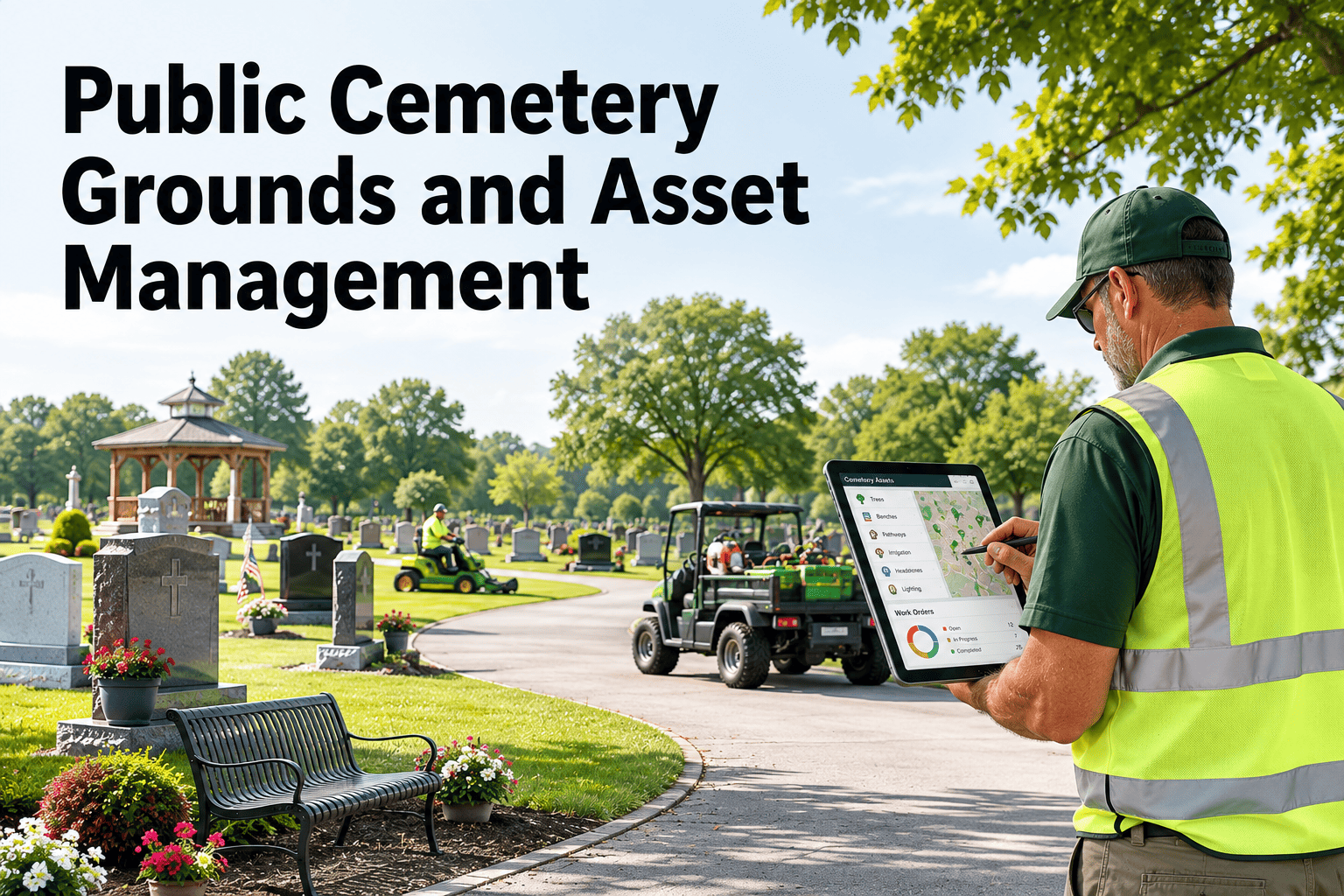
Public cemetery management demands a rare blend of meticulous grounds maintenance, perpetual-care recordkeeping, and family-facing service — all sustained over decades, not fiscal quarters. Municipal cemetery operations typically oversee thousands of plots, monuments, irrigation zones, and infrastructure assets spread across 50–500 acres, yet most still rely on paper maps, spreadsheets, and tribal knowledge to track them. The result is deferred maintenance, lost burial records, and strained public trust when families cannot locate or verify grave sites. A modern public cemetery asset management program — backed by AI-powered CMMS software like OxMaint — brings predictable scheduling, GPS-linked asset tracking, and audit-ready records to government cemetery maintenance so crews can focus on dignity and grounds quality rather than paperwork. See how OxMaint transforms cemetery operations when you Start Free Trial today.
Are your cemetery records, grounds schedules, and asset histories scattered across paper, spreadsheets, and filing cabinets?
Municipal cemetery management teams oversee hundreds of acres, thousands of plots, and decades of perpetual-care obligations — often without a single source of truth. OxMaint unifies grounds maintenance scheduling, burial records, monument service logs, and asset tracking into one AI-powered platform built for government cemetery maintenance.
Why public cemetery grounds management breaks down without a CMMS
A 200-acre municipal cemetery typically manages 8,000–15,000 plots, 20–40 acres of irrigated turf, 5–15 miles of roadways, and hundreds of monuments, fences, gates, and irrigation zones — yet over 60% of public cemetery operations still track maintenance on paper or in disconnected spreadsheets.
When a family requests a grave location, a crew needs a monument service record, or an auditor asks for maintenance compliance logs, paper-based cemetery operations management grinds to a halt. Staff retire and take institutional knowledge with them. Irrigation zones fail because preventive maintenance was never scheduled. Monuments deteriorate without documented inspection cycles. The cost of inaction compounds annually — and the public trust cost is incalculable.
The five pillars of municipal cemetery maintenance and asset management
A complete public cemetery maintenance program integrates grounds care, monument service, records management, family services, and compliance into one operational system — each with defined cycles, owners, and measurable outcomes.
Grounds Maintenance Program
Scheduled mowing cycles (7–14 days), irrigation system preventive maintenance, tree and shrub care, road and pathway upkeep, and seasonal preparations. A 200-acre site typically requires 40–60 recurring work orders per month — impossible to manage on paper without missed cycles and turf degradation.
Monument and Marker Service
Inspection cycles for leaning, sinking, or damaged headstones; reset and leveling services; foundation repairs; and documentation of each intervention. Most municipalities inspect monuments annually, but without a tracking system, 30–40% of service needs go undocumented until families complain.
Records and Plot Management
Burial records, deed and ownership transfers, plot availability maps, GPS coordinates, interment orders, and perpetual-care trust tracking. These records must be retrievable in minutes — not hours — and must survive staff transitions, software changes, and physical deterioration of paper archives.
Family Services Coordination
Scheduling interments, coordinating with funeral homes, managing grief-support logistics, handling genealogy requests, and responding to family inquiries. Response time and accuracy directly shape public perception of municipal cemetery management quality.
Compliance and Audit Readiness
Perpetual-care trust reporting, state and municipal cemetery commission filings, grounds safety inspections, environmental compliance for chemical applications, and OSHA-aligned crew safety documentation. Audit-ready records protect the municipality from liability and funding clawbacks.
Infrastructure Asset Tracking
Irrigation pumps and valves, roadways, fencing, gates, maintenance equipment, storage buildings, and utility connections — each with preventive maintenance schedules, lifecycle cost tracking, and replacement forecasting aligned to ISO 55000 asset management principles.
Cemetery grounds maintenance checklist by season and cycle
A defensible cemetery grounds management program runs on recurring preventive cycles — daily, weekly, monthly, and seasonal — each with assigned crews, documented completion, and photo verification. Below is the operational rhythm most high-performing municipal cemeteries follow.
Daily / Weekly Cycles
- Turf mowing on 7–14 day rotation across all sections
- Trash and debris removal from pathways and roadways
- Irrigation zone inspection and valve cycle testing
- Restroom and public facility cleaning and restocking
- Gate, fence, and signage condition check
- Vase and floral arrangement compliance sweep
Monthly Cycles
- Monument lean and stability inspection (rotating zones)
- Irrigation pump performance and pressure testing
- Tree hazard assessment and pruning work orders
- Road and pathway surface condition survey
- Equipment preventive maintenance per OEM schedule
- Plot map accuracy audit and GPS verification
Seasonal Cycles
- Spring: irrigation system startup, aeration, overseeding
- Summer: heat-stress turf monitoring, pest scouting
- Fall: leaf removal, tree pruning, irrigation winterization
- Winter: snow and ice removal, equipment storage prep
- Annual: full monument inventory and reset work orders
- Annual: perpetual-care trust and compliance reporting
| Asset Category | Inspection Frequency | PM Work Orders / Year | Avg. Lifecycle Cost | Tracking Method with OxMaint |
|---|---|---|---|---|
| Irrigation Systems | Monthly + Seasonal | 18–24 | $3,200–$7,500 | GPS-tagged zones, automated PM triggers |
| Monuments & Markers | Annual per zone | 40–80 | $200–$1,800 per reset | Photo log, condition score, service history |
| Roads & Pathways | Quarterly | 8–12 | $2,500–$15,000 | Condition survey, repair work order tracking |
| Trees & Landscaping | Bi-annual | 12–20 | $500–$4,500 per tree | Asset registry, hazard flag, pruning cycle |
| Maintenance Equipment | Per OEM schedule | 30–50 | $1,200–$8,000 | Equipment PM calendar, meter-based triggers |
| Fencing, Gates & Signage | Quarterly | 8–16 | $400–$3,200 | Asset tag, inspection form, repair queue |
How OxMaint powers public cemetery asset management
OxMaint replaces paper logs, spreadsheets, and disconnected scheduling with an AI-powered CMMS and EAM platform purpose-built for asset-intensive operations. For a municipal cemetery managing 10,000+ plots and 200+ infrastructure assets, OxMaint delivers measurable outcomes within the first 90 days.
Automated Preventive Maintenance Scheduling
Convert every mowing cycle, irrigation inspection, and monument check into a recurring work order with automated triggers based on date, meter reading, or condition. Eliminates 90% of missed PM cycles and cuts reactive maintenance 30–50%.
GPS-Linked Asset and Plot Tracking
Tag every plot, monument, irrigation zone, and infrastructure asset with GPS coordinates and photos. Field crews locate any grave site in seconds, and condition histories follow the asset — not the staff member — across decades of perpetual care.
Digital Burial Records and Audit Trails
Every interment, deed transfer, monument service, and family request is logged with timestamps, photos, and crew attribution. Audit-ready reports for state cemetery commissions and perpetual-care trust filings compile in minutes instead of weeks.
Predictive Analytics and Cost Tracking
AI-driven failure prediction flags irrigation zones, equipment, and monuments likely to need service before they fail. Lifecycle cost tracking per asset informs budget requests and capital replacement planning with defensible data.
Worked example: A 180-acre municipal cemetery with 11,500 plots
A mid-sized city cemetery operations team was spending $52,000 annually on reactive irrigation repairs, emergency monument resets, and overtime from missed PM cycles — all tracked on paper logs and three shared spreadsheets. After implementing OxMaint, they digitized 1,840 assets and 11,500 plot records in the first 45 days, automated 62 recurring PM work orders, and cut reactive maintenance spend by 41% ($21K saved) in year one. Family inquiry response time dropped from 2–3 hours to under 4 minutes using GPS-linked plot lookup. The system paid for itself within the first fiscal quarter, and the cemetery passed its state commission audit with zero findings for the first time in a decade.
What municipal cemetery operations lose every year on paper systems
When cemetery maintenance stays reactive and paper-based, costs compound across labor, assets, compliance, and public trust. Below is the annual financial impact for a typical 150–250 acre municipal cemetery managing 8,000–15,000 plots.
Emergency irrigation pump replacements, monument resets driven by complaints rather than inspections, and equipment failures from missed PM cycles cost 2.5–4x more than scheduled maintenance.
Crews spend 4–6 hours per week searching for records, verifying plot locations, and duplicating work that a CMMS would automate — equating to 0.5–1.0 FTE annually.
Missing inspection records, undocumented monument hazards, and incomplete perpetual-care trust reporting create audit failures, insurance claims, and in rare cases litigation from injured visitors.
Untracked spare parts, over-ordered irrigation supplies, and chemical applications without usage logs quietly drain budgets that could fund grounds improvements.
The total annual cost of staying on paper systems: $43,000–$73,000 per cemetery — before accounting for the intangible cost of public trust erosion when families experience slow service, unlocatable plots, or visibly deteriorating grounds. OxMaint customers typically recover the full platform cost within 90–120 days of implementation and reinvest the savings into grounds enhancement rather than emergency repairs.
How to transition from spreadsheets to a cemetery CMMS in 30 days
Most municipal cemetery management teams can move from paper and spreadsheets to a fully operational CMMS within 4–6 weeks. The key is sequencing: asset registry first, then PM schedules, then records migration, then field crew adoption.
Asset Registry and GPS Tagging
Import existing plot maps, monument inventories, and infrastructure asset lists into OxMaint. Tag high-priority assets (irrigation zones, entrance gates, major monuments) with GPS coordinates and baseline condition photos. Most cemeteries complete 80% of the registry in 10–12 days using mobile data collection.
PM Schedule Build-Out
Convert existing mowing cycles, irrigation inspections, monument checks, and equipment maintenance into recurring work orders with automated triggers. Assign crew members, set priority levels, and configure mobile notifications for field staff.
Records Migration and Digitization
Migrate burial records, deed transfers, interment orders, and perpetual-care trust documentation into OxMaint's record system. Link each record to its GPS-tagged plot so staff can pull complete histories in seconds from any device.
Field Crew Training and Go-Live
Train grounds crews, office staff, and family services coordinators on mobile work order completion, photo logging, and record lookup. Most teams reach full adoption within 2 weeks of go-live as crews experience the time savings firsthand.
What cemetery operations teams say about switching to OxMaint
"We managed 12,000 plots and 200 acres on paper for 30 years. Within six weeks of implementing OxMaint, our crew had every asset and burial record on their phones. We cut reactive irrigation repairs by 38% in the first year, and for the first time our state audit had zero findings. The platform paid for itself before the first budget cycle closed."
See OxMaint manage your cemetery assets — book a 30-minute demo
Walk through a live cemetery operations setup: GPS-linked plot tracking, automated PM work orders, digital burial records, and audit-ready reporting. See how your team can cut reactive maintenance 30–50% within the first 90 days.
Public cemetery management software: frequently asked questions
What is public cemetery management software and how does it differ from general CMMS?
Public cemetery management software is a specialized CMMS and EAM platform that combines standard asset and maintenance management with cemetery-specific capabilities: burial record tracking, plot and deed management, GPS-linked grave location, perpetual-care trust documentation, and family services coordination. General CMMS platforms handle work orders and PM scheduling but lack the records, compliance, and public-facing service features that municipal cemetery operations require. OxMaint bridges both by delivering full CMMS functionality plus cemetery-specific asset and records modules.
How much does cemetery maintenance software cost for a municipal cemetery?
Most municipal cemetery CMMS platforms range from $300 to $1,200 per month depending on plot count, acreage, number of users, and feature depth. OxMaint typically delivers positive ROI within 90–120 days by eliminating $18K–$28K in annual reactive repair overspend and 4–6 hours of weekly labor lost to paper record searches. You can Start Free Trial to evaluate the platform on your assets at no cost for 14 days.
Can OxMaint track both grounds maintenance and burial records in one system?
Yes. OxMaint unifies grounds maintenance scheduling (mowing cycles, irrigation PM, monument inspections, equipment maintenance) with digital burial records, plot maps, deed transfers, and perpetual-care documentation in a single platform. Each plot and asset carries its own GPS tag, condition history, photo log, and service record — so field crews and office staff access the same source of truth from any device.
How long does it take to migrate paper cemetery records into a CMMS?
A typical municipal cemetery with 8,000–15,000 plots can complete full digitization in 4–6 weeks. The process involves importing existing plot maps and asset lists (Week 1–2), building PM schedules (Week 2–3), migrating burial records and deed documentation (Week 3–4), and training field crews (Week 4–6). OxMaint provides onboarding support and mobile data collection tools that accelerate the registry build — most teams tag 80% of priority assets within the first 10–12 days.
Does cemetery management software help with state cemetery commission audits?
Absolutely. OxMaint generates audit-ready reports for state cemetery commission filings, perpetual-care trust documentation, grounds safety inspections, and monument condition surveys — each with timestamps, photos, and crew attribution. Instead of assembling paper records over weeks, cemetery directors compile complete compliance packages in minutes. Many OxMaint customers report passing audits with zero findings for the first time after switching from paper systems.
Bring dignity, accuracy, and efficiency to your cemetery operations
Join municipal cemetery teams using OxMaint to manage 10,000+ plots, automate preventive maintenance, and deliver audit-ready records — all from one AI-powered platform. Book a 30-minute demo and see your cemetery's data come to life.
Free 14-day trial · No credit card