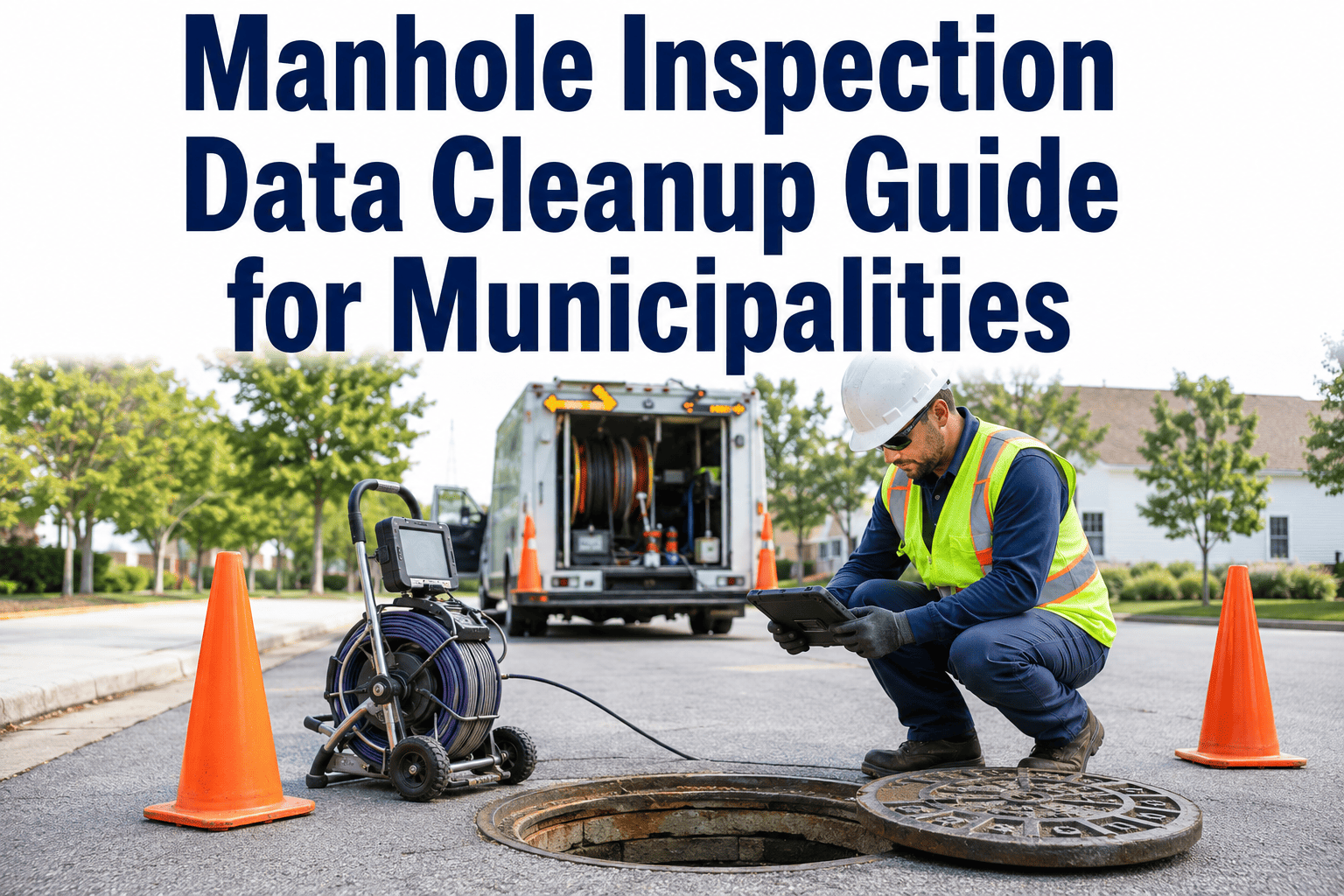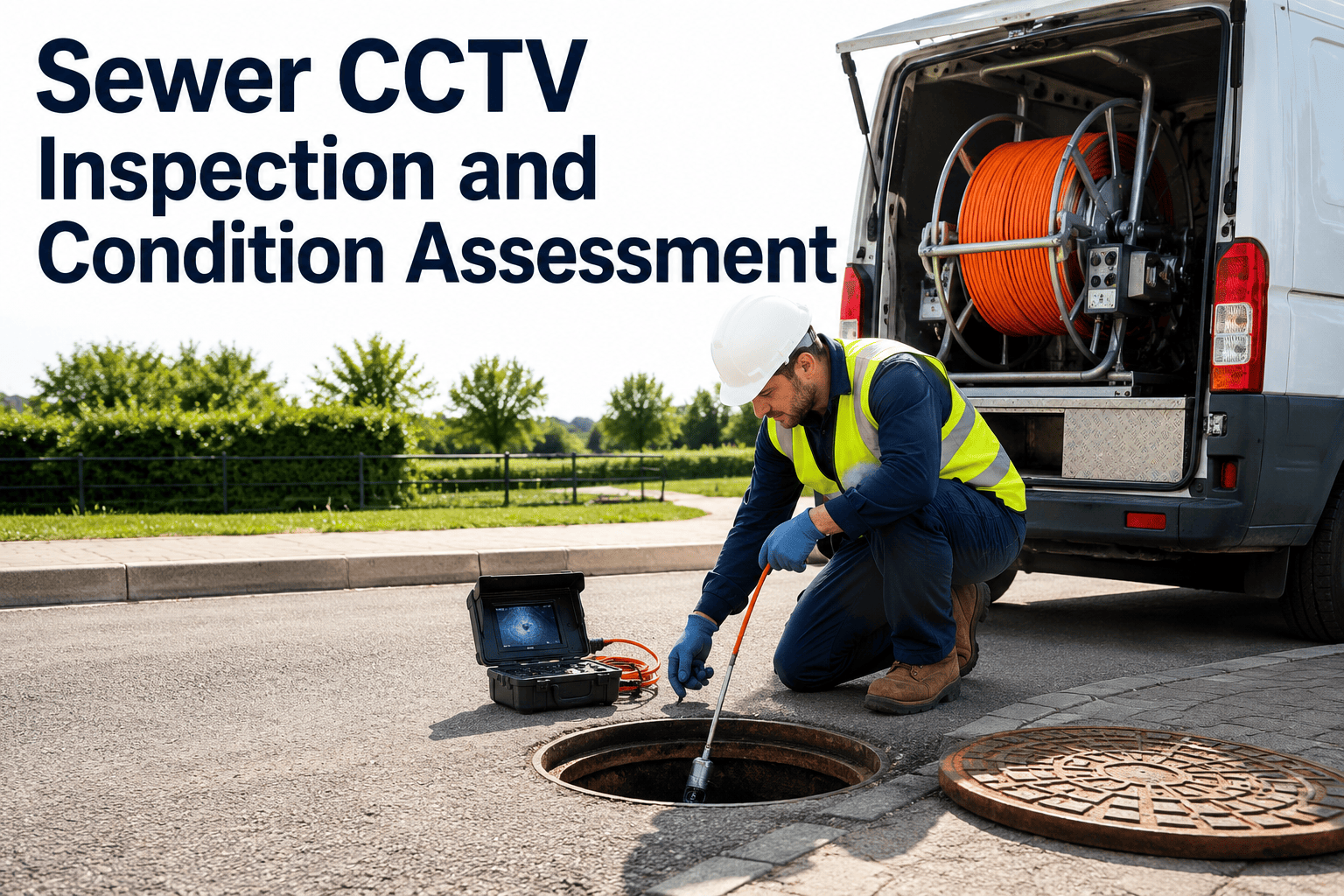
Most collection system failures aren't surprises — they're unrecorded defects that progressed unchecked because nobody drove a camera down the line. Sewer CCTV inspection is the single most cost-effective way to convert buried, out-of-sight pipe into measurable, codable, prioritizable asset data. This guide walks through inspection cadence by pipe class, NASSCO PACP defect coding, condition-grade prioritization, and the CMMS-integrated CCTV workflow that turns footage into capital plan decisions. Ready to operationalize it? Start Free Trial and build your assessment program on a real asset registry today.
You can't fix a pipe you can't see inside.
Every catastrophic sewer collapse started as a defect the system never recorded. A disciplined CCTV inspection program finds the cracks, root balls, offsets and voids before they become six-figure emergency repairs — and feeds PACP-coded condition data straight into your capital plan.
The hidden cost of uninspected pipe
A 10-inch trunk main collapse under a two-lane arterial typically runs $80K–$320K in emergency repair, traffic control and surface restoration. The same defect — a longitudinal crack, a dropped joint, a hydrogen sulfide crown attack — would have shown on a CCTV pass costing roughly $1.50–$4.00 per linear foot.
Not every line earns the same camera time
Mature asset programs tier inspection frequency by criticality, material and consequence of failure — not by a flat "every ten years" rule that leaves force mains and trunk sewers flying blind.
| Pipe Class | Typical Diameter | Inspection Cadence | Criticality Driver |
|---|---|---|---|
| Force mains & siphons | 6"–24" | Every 3 years | High-pressure failure, no redundancy, hard to bypass |
| Trunk / interceptor sewers | 24"–60"+ | Every 5 years | High flow volume, large consequence of failure |
| Collector mains (VCP/ACP) | 8"–15" | Every 7 years | Older materials, root intrusion, joint offset |
| PVC collector mains (post-1990) | 8"–12" | Every 10 years | Lower defect incidence, but still subject to I&I |
| Laterals (agency-owned) | 4"–6" | Every 12 years or on complaint | Root intrusion, grease, SSO source |
A Midwestern utility operating 480 miles of gravity sewer adopted this tiering in 2019. Previously inspecting on a flat 10-year cycle, they were spending $240K/yr on CCTV but missing 60% of developing defects on force mains. After tiering, CCTV spend rose to $285K/yr — but emergency point repairs dropped 38% within two years, saving $1.1M annually.
Footage is useless without PACP structure
NASSCO's Pipeline Assessment Certification Program (PACP) is the de facto standard for sewer defect coding in North America. Without it, you have video. With it, you have comparable, queryable, trending asset condition data.
Continuous defect logging
Every observation is timestamped to footage, geolocated to upstream manhole distance, and assigned a PACP feature code (e.g. CRC, ILJ, RMU). This makes re-inspection trend analysis possible — is that crack widening at 0.2mm/yr or 2mm/yr?
Grade 1–5 severity scale
Each defect carries a structural and O&M grade. Grade 1 is minor. Grade 5 is imminent failure. Aggregated pipe scores drive whether the segment gets a next-cycle re-watch, a point repair, or a full structural lining.
MACP & LACP extensions
Manhole Assessment (MACP) and Lateral Assessment (LACP) extend the same coding discipline to the assets most often skipped — the structures and service lines where 40% of I&I actually originates.
Queryable condition database
PACP-coded records let you ask "show me every Grade 4+ structural defect in 8-inch VCP under 25 years old, ranked by traffic-volume consequence." That query — not the video — drives the CIP.
From PACP score to repair decision
A condition assessment program only earns its budget when inspection data drives a clear action matrix. Below is the decision framework most CMMS-integrated programs adopt to convert PACP scores into prioritized work.
| PACP Grade | Condition | Response Window | Typical Action |
|---|---|---|---|
| 1 | Minor — pre-defect | Next inspection cycle | Log, monitor, no intervention |
| 2 | Light deterioration | 5–7 years | Schedule re-inspection, note trend |
| 3 | Moderate defects | 2–3 years | Plan point repair or partial lining |
| 4 | Significant / near-failure | 6–12 months | Emergency CIPP or structural lining |
| 5 | Imminent collapse | Immediate (days) | Bypass, excavate, replace; traffic control |
The prioritization math behind your CIP
Quantitative scoring removes politics from capital planning. The standard composite Risk Index used by municipal asset teams multiplies defect severity by consequence of failure and failure probability.
Turn footage into asset condition data
Inspection video sitting on a contractor's hard drive is a sunk cost, not an asset. The CMMS-integrated CCTV program pushes PACP records, footage links, and severity scores directly into the asset registry — so every work order, CIP candidate and renewal forecast is traceable to a defensible inspection record.
Auto-create asset records
Each inspected segment is registered with material, diameter, install year, upstream/downstream manholes, and linear footage — no manual spreadsheet reconciliation.
Ingest PACP-coded defects
Defect XML or CSV imports attach directly to the asset record with footage, timestamp, and a hyperlink to the video clip at the moment of observation.
Auto-generate work orders
Grade 4–5 defects trigger preventive or corrective work orders automatically, routed to the right crew with the clip, location, and recommended action attached.
Feed capital renewal forecasting
Multi-year defect trend data feeds deterioration curves, projecting when each segment crosses from Grade 3 to Grade 4 — and what that will cost if left alone.
Stop inspecting pipes into a spreadsheet black hole.
Oxmaint turns CCTV footage and PACP codes into a live asset registry that drives work orders, CIP candidates, and renewal forecasts — all from one dashboard.
Sewer CCTV inspection, answered
How often should a municipal sewer be CCTV inspected?
Cadence should be tiered by pipe class. Force mains every 3 years, trunk sewers every 5, older VCP collectors every 7, PVC collectors every 10, and laterals every 12 or on complaint. A flat 10-year cycle across all pipe leaves high-criticality assets under-inspected and wastes budget on low-risk PVC.
What is NASSCO PACP and why does it matter?
PACP is the Pipeline Assessment Certification Program — the North American standard for coding sewer defects on a 1–5 severity scale. It matters because raw video is not asset data. PACP-coded records are queryable, comparable across inspections, and trendable over time, which is what turns CCTV from a sunk cost into a capital-planning input. You can Book a Demo to see how PACP records flow into Oxmaint's registry.
How much does sewer CCTV inspection cost per foot?
For gravity sewer, expect $1.50–$4.00 per linear foot depending on diameter, access difficulty, cleaning required, and reporting format. Force mains and siphons run $4–$8/ft due to dewatering and bypass needs. Pre-cleaning adds $0.50–$1.50/ft. The cost is small relative to a single emergency point repair at $80K–$320K.
Can CCTV inspection data integrate with our CMMS?
Yes — and it should. PACP XML/CSV exports, footage hyperlinks, and severity scores can be ingested directly into a modern CMMS asset registry. This auto-creates work orders for Grade 4–5 defects, attaches the video clip to the work order, and feeds deterioration curves for renewal forecasting. Start a Start Free Trial to see the integration live.
What defects can CCTV actually detect in a sewer?
CCTV identifies cracks (longitudinal, circumferential, spiral), joint offsets, root intrusion, grease buildup, deposits, crown corrosion, sagging, debris, collapsed sections, infiltrating connections, and voids behind the pipe wall. It cannot see behind the pipe wall or assess soil conditions — for that, pair CCTV with sonar, laser profiling, or ground-penetrating radar.
Build a sewer inspection program that actually prevents failures.
Turn CCTV footage and PACP codes into prioritized work orders, CIP candidates, and defensible renewal forecasts — all in one platform.
Free 14-day trial · No credit card