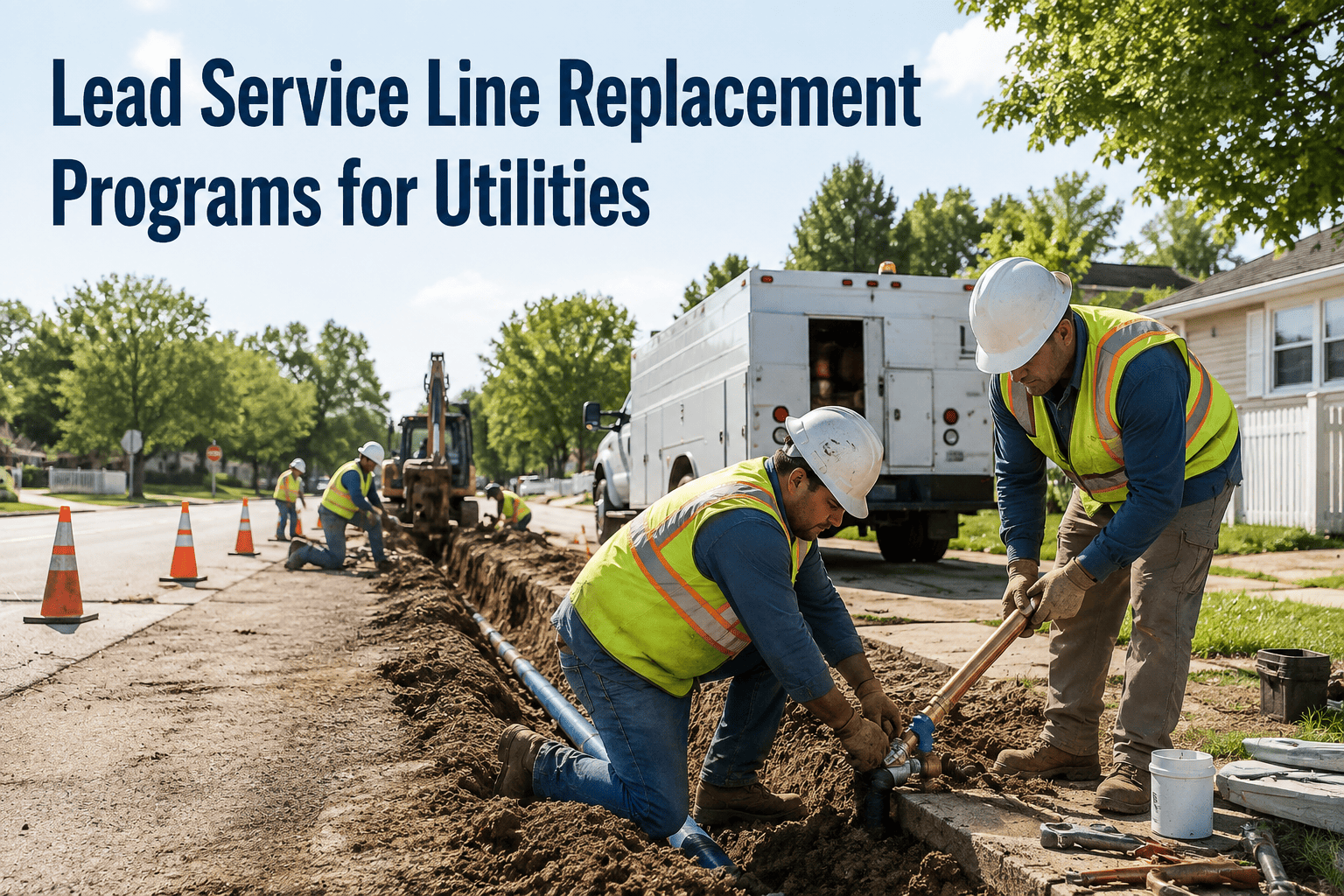
Federal Lead and Copper Rule Revisions now require every U.S. water utility to complete a lead service line inventory and replace lead pipes on a strict deadline. A well-structured lead service line replacement program protects public health, secures billions in federal funding, and keeps utilities compliant with EPA enforcement timelines. OxMaint helps maintenance and reliability teams orchestrate the complex work orders, asset tracking, and documentation that LSL replacement demands — you can Start Free Trial to see how quickly a digital program comes together.
Can your utility inventory, replace, and document every lead service line before the federal deadline?
The EPA's Lead and Copper Rule Improvements mandate replacing 100% of lead service lines at the utility's expense — with hard compliance milestones and public reporting requirements. Utilities that wait risk enforcement penalties, lost funding, and public-health liability.
How to build a lead service line inventory that passes EPA review
The first enforcement milestone under the Lead and Copper Rule Revisions was the initial LSL inventory submission — and utilities that submitted incomplete or "unknown material" entries now face escalating pressure to classify every line. An accurate lead service line inventory is the backbone of any compliant lead service line replacement program.
Mine plumbing records, tap cards, meter installation logs, tax-parcel data, and historical construction standards predating the 1986 lead solder ban. Digitize and geo-link every record to parcel IDs for traceability.
For lines classified as "unknown," deploy crews for physical verification, excavation, or predictive methods like water quality profiling. Document GPS coordinates, depth, and material on both public and private sides.
Connect inventory records to your GIS so every service line is spatially referenced. This enables prioritization, crew routing, and the public-facing inventory notifications the LCRI requires.
Send written notices to all customers served by a known or possible lead, GRR, or unknown service line. Track delivery, response, and follow-up inside your work-order system for audit evidence.
Lead service line replacement timeline and prioritization strategy
Utilities must replace a minimum of 10% of confirmed lead lines annually, prioritizing communities most impacted by lead exposure, child-care facilities, and low-income areas. A phased program — rather than reactive spot replacement — drives cost down and audit-readiness up.
Year 1
Close out "unknown" lines, confirm replacement counts, finalize GIS base layer, and submit updated inventory to the state primacy agency. Secure SRF funding agreements and finalize procurement contracts for replacement crews.
Years 2–4
Target schools, day-care facilities, and environmental-justice neighborhoods first. Execute block-by-block replacements to capture economies of scale (typically $3,000–$5,000 per line vs. $8,000+ for scattered sites). Flush, sample, and restore.
Years 5–7
Expand to full system coverage, including private-side replacements where authorized. Coordinate with road-paving and sewer projects to cut excavation costs by 30–40%. Track every work order digitally for LCRI reporting.
Years 8–10
Complete remaining replacements, validate 100% non-lead status, submit final compliance documentation, and transition the program into a long-term asset-management and monitoring workflow.
Funding your lead pipe replacement municipal program
The Bipartisan Infrastructure Law dedicated $15B over five years to LSL replacement through the Drinking Water State Revolving Fund (DWSRF), with 49% as principal-forgiveness loans for disadvantaged communities. But funding requires rigorous documentation — utilities without a digital asset and work-order system struggle to draw down funds and prove eligibility.
| Funding Source | Eligible Use | Max Award / Terms | Documentation Required |
|---|---|---|---|
| DWSRF Lead Service Line Replacement | LSL identification, design, replacement, associated appurtenances | Principal forgiveness up to 100% for disadvantaged communities | Approved inventory, prioritization plan, cost estimates |
| Bipartisan Infrastructure Law (BIL) LSLF | Replacement of lead and galvanized requiring replacement lines | $15B allocated nationally through FY 2026 | State Intended Use Plan compliance, quarterly reporting |
| USDA Rural Development | Small-system LSL replacement & water system upgrades | Grants + low-interest loans up to $5M+ | Engineering report, environmental review, financial capability |
| State Supplemental Grants | Gap funding, private-side replacement, emergency response | Varies by state ($500K–$10M) | Match requirements, local approvals, progress tracking |
See how OxMaint digitizes your entire lead service line replacement program
From GIS-linked asset records to crew work orders, compliance documentation, and real-time replacement dashboards — book a 30-minute demo and we'll map it to your system.
CMMS capabilities that keep your LSL replacement program on schedule and audit-ready
A lead service line water utility program generates thousands of field work orders, material-verification records, restoration tasks, and compliance reports. OxMaint's AI-powered CMMS and EAM platform eliminates the spreadsheets, paper tickets, and disconnected GIS data that stall compliance.
GIS-Linked Asset Tracking
Every service line becomes a tracked asset with material status, GPS coordinates, replacement history, and photos. Filter by "lead," "GRR," or "unknown" in seconds — no more digging through paper tap cards.
Mobile Work Orders for Field Crews
Dispatch replacement crews with digital work orders on any device — including excavation checklists, material-verification photos, flush-and-sample protocols, and restoration sign-off — all synced in real time.
Compliance & Reporting Dashboards
Live dashboards track replacement counts, annual replacement-rate compliance (10% minimum), funding draw-down status, and public-notification delivery — exportable for state primacy and EPA submissions.
Predictive Scheduling & Cost Control
AI-driven scheduling groups replacements by neighborhood, coordinates with paving projects, and flags cost overruns in real time — keeping per-line replacement costs in the $3,000–$5,000 target range.
A 12,000-service-line utility moving from spreadsheets to OxMaint
A mid-sized municipal utility managing 12,000 service lines identified 2,800 confirmed or probable lead lines during their initial inventory. Their program was running on shared spreadsheets, paper work orders, and a legacy GIS that didn't talk to their maintenance system — resulting in 15% of completed replacements lacking the photo and material documentation needed for compliance. After deploying OxMaint, they digitized every service line as a tracked asset, issued mobile work orders to replacement crews with built-in verification checklists, and generated compliance reports in one click. Within 18 months they completed 560 replacements — hitting their 10% annual rate — with 100% documentation and a 30% reduction in per-line cost through batch scheduling.
Lead service line replacement program FAQs
What is the deadline for lead service line replacement under federal rules?
Under the EPA's Lead and Copper Rule Improvements, water systems must replace 100% of lead and galvanized-requiring-replacement service lines within 10 years, with a minimum annual replacement rate of 10%. The initial lead service line inventory was due October 16, 2024, and systems must update it annually. Utilities falling behind face enforcement actions and loss of funding eligibility.
How much does lead pipe replacement cost a water utility?
The average cost to replace a single lead service line ranges from $3,000 to $5,000 for public-side replacement, and $5,000 to $8,000+ when including the private side. Costs vary by soil conditions, depth, paving restoration, and whether replacements are batched (lower cost) or scattered (higher cost). Federal DWSRF funding can offset 50–100% of program costs for qualifying communities.
How does a utility build a lead service line inventory?
Utilities compile historical records — tap cards, meter logs, plumbing codes, construction standards — then verify unknown lines through field investigation, excavation, or predictive methods. Every record must be geo-located and linked to parcel data. Many utilities use a CMMS like OxMaint to digitize records, track verification work orders, and generate the inventory submissions required by state primacy agencies.
Can federal funding cover private-side lead service line replacement?
Yes. DWSRF funds provided through the Bipartisan Infrastructure Law explicitly allow utilities to use federal funding for private-side LSL replacement, a change from prior rules. Utilities must document ownership, obtain access agreements, and track every replacement with material verification and photo evidence — requirements that digital work-order systems like OxMaint handle out of the box.
What software do utilities use to manage an LSL replacement program?
Most compliant programs use a CMMS or EAM platform that integrates with GIS, manages field work orders, tracks asset materials and replacement status, and generates compliance reports. OxMaint combines all four capabilities with AI-driven scheduling and mobile field documentation — you can book a demo to see it mapped to your system.
Get your LSL replacement program audit-ready in weeks, not years
Join utilities using OxMaint to inventory lead lines, dispatch replacement crews, document every job, and report compliance with one platform.
Free 14-day trial · No credit card