Every public highway bridge in the United States must be inspected under the National Bridge Inspection Standards — a federal mandate that has been in place since 1971. With over 623,000 bridges in the national inventory, more than 42,000 rated in poor condition, and FHWA now enforcing 23 compliance metrics with real funding penalties, the margin for missed inspections or incomplete records has never been thinner. Public works engineers who run bridge inspection programs need more than spreadsheets and calendar reminders — they need a system that tracks every inspection cycle, documents every finding, and keeps every bridge asset audit-ready. OxMaint helps public works teams run FHWA-compliant bridge inspection programs on schedule.
Blog · Roads, Bridges & Pavement · FHWA Compliance · 2026
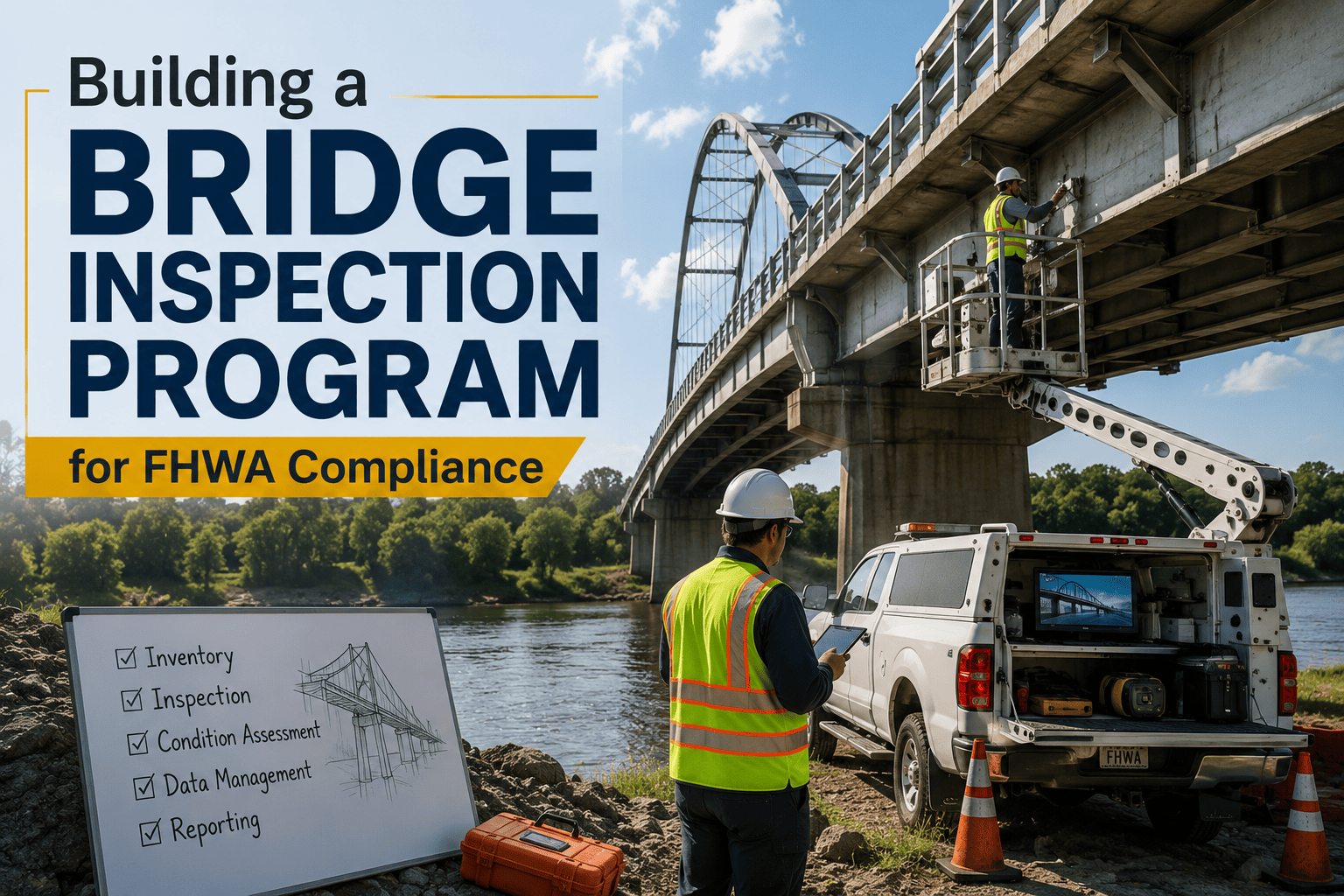
Building a Bridge Inspection Program for FHWA Compliance
Bridge inspection deferrals risk lives and federal funding. Here is how to run a bridge inspection program that meets NBI and FHWA requirements — on schedule, every cycle, with full documentation.
Public Works Engineer
6 min read
NBI Compliance
The Federal Mandate
Why bridge inspection compliance is non-negotiable
The FHWA evaluates every state's bridge inspection program annually against 23 performance metrics. Non-compliance triggers Plans of Corrective Action, increased federal audits, and — if unresolved — the withholding of federal-aid highway funds. The 2022 NBIS update raised the bar further with new personnel qualification requirements, risk-based inspection intervals, and mandatory SNBI data reporting starting March 2026.
623,218
bridges in the U.S. National Bridge Inventory requiring federally mandated inspections
42,067
bridges rated in poor condition — 168 million vehicle crossings per day on these structures
23
FHWA compliance metrics assessed annually — covering organization, personnel, frequency, and data quality
$27.5B
federal bridge formula funding under the Bipartisan Infrastructure Law — tied to compliance standing
FHWA 23-Metric Framework
What FHWA actually evaluates in your bridge inspection program
Each metric maps directly to 23 CFR Part 650 Subpart C. During annual compliance reviews, every metric is rated as Compliant, Substantially Compliant, Conditionally Compliant, or Non-Compliant. Here are the six categories your program must satisfy.
01
Inspection Organization
Defined roles, designated Program Manager, documented delegation of responsibilities across all bridge owners in the state.
02
Personnel Qualifications
Team leaders must hold PE license or NHI comprehensive training. New 2022 rules add qualifications for damage, special, and service inspections.
03
Inspection Frequency
Routine inspections at intervals not exceeding 24 months. Extended intervals (up to 72 months) require Risk Assessment Panel approval from FHWA.
04
Inspection Procedures
Documented QC/QA processes, in-depth inspection procedures, and protocols for underwater, scour-critical, and fracture-critical members.
05
Critical Findings
Conditions posing imminent public safety threats demand immediate action. Monthly reporting to FHWA Division Office required until resolution.
06
Inventory Data Quality
Accurate NBI data submissions on condition ratings, load ratings, scour assessments, and element-level data for NHS bridges.
Bridge Inspection Compliance
Track every inspection cycle, every metric, every bridge — in one platform.
OxMaint gives public works engineers a centralized system to schedule inspections, assign qualified personnel, document findings, and generate audit-ready compliance records across your entire bridge inventory.
Building the Program
What a compliant bridge inspection program actually requires
Step 1
Inventory Every Structure
Catalog all bridges over 20 feet, assign NBI structure numbers, record location, design type, materials, year built, and current load ratings. Every bridge on a public road must be in the inventory — including locally owned structures.
Step 2
Establish Inspection Intervals
Set routine inspection cycles at 24 months maximum. Identify fracture-critical, scour-critical, and underwater bridges that need shorter intervals. Document risk-based interval justifications for any extensions beyond 24 months.
Step 3
Qualify and Assign Personnel
Verify that every team leader holds a PE license or has completed NHI comprehensive bridge inspection training with documented field experience. Maintain credential records and refresher training schedules for all inspectors.
Step 4
Inspect, Document, Report
Rate deck, superstructure, and substructure on the 0-to-9 NBI scale. Record element-level data for NHS bridges per SNBI specifications. Report critical findings to the FHWA Division Office immediately and monthly until resolved.
Step 5
Submit NBI Data Annually
Compile condition ratings, load ratings, scour data, and inventory updates. Submit to FHWA in SNBI format — the first SNBI-based submittal was due March 2026. Full SNBI compliance is required by March 2028.
Penalty vs Compliance
What happens when bridge inspections fall behind — and what compliance protects
| Area |
Non-Compliant Program |
FHWA-Compliant Program (OxMaint) |
| Inspection Scheduling |
Overdue inspections, missed 24-month cycles |
Automated scheduling with deadline alerts and tolerance tracking |
| Personnel Records |
Expired certifications, undocumented qualifications |
Credential tracking with renewal reminders per inspector |
| Critical Findings |
Delayed reporting, no follow-up trail |
Immediate work order creation, monthly status tracking to resolution |
| NBI Data Quality |
Incomplete records, inconsistent coding |
Structured data entry aligned with SNBI specifications |
| Federal Funding |
Funding withheld, project approvals suspended |
Clean compliance standing, uninterrupted federal-aid access |
| Audit Readiness |
Scramble to locate records across systems |
One-click export of inspection history, ratings, and work orders |
SNBI Transition Timeline
Key dates every bridge program manager needs to know
June 2022
Updated NBIS final rule took effect — new requirements for inspection intervals, personnel qualifications, and critical finding reporting
Jan 2025
States began SNBI data collection — replacing the legacy 1995 NBI Recording and Coding Guide with granular component-level tracking
Mar 2026
First SNBI-based bridge inventory submittal to FHWA — new data items including dedicated fields for bearings, joints, and rail conditions
Mar 2028
Full SNBI compliance required — all states must report complete element-level data in SNBI format for every NBI bridge
Frequently Asked Questions
What public works engineers ask about bridge inspection compliance
What is the maximum interval allowed between routine bridge inspections under NBIS?
The standard maximum interval is 24 months. States can apply for extended intervals up to 48 or 72 months for qualifying low-risk bridges, but this requires a formal Risk Assessment Panel of at least four members (including two PEs) and written FHWA approval. OxMaint tracks interval compliance and flags bridges approaching deadline tolerance automatically.
See how interval tracking works in a demo.
What happens if our bridge inspection program is found non-compliant by FHWA?
FHWA issues a notification by December 31. You have 45 days to correct the issue or submit a Plan of Corrective Action. If non-compliance persists past August 1, FHWA can require the state to dedicate federal funds exclusively to correcting the issue — and in severe cases, suspend federal-aid project approvals entirely.
Start building your compliance records today.
How does OxMaint help with the new SNBI data collection requirements?
OxMaint structures inspection data entry around component-level fields that align with SNBI specifications — including dedicated condition tracking for bearings, joints, and bridge railings that were previously bundled into broader ratings. This ensures your data is organized for SNBI-format export when annual submissions are due.
Book a demo to see SNBI-ready data workflows.
Can OxMaint manage bridge inspections for both state-owned and locally owned bridges?
Yes — each bridge is set up as an individual asset regardless of ownership. States responsible for ensuring NBIS compliance across all public bridges can use OxMaint to assign inspections to local agencies, track completion status, and consolidate NBI data submissions from one platform.
Try multi-owner bridge management in a free trial.
What qualifications do bridge inspection team leaders need under the updated NBIS?
Team leaders must hold a PE license or have completed FHWA-approved NHI comprehensive bridge inspection training with documented field experience under a qualified leader. The 2022 update also added qualification requirements for damage, special, and service inspections. OxMaint tracks certifications, expiration dates, and refresher training for every inspector in your program.
See credential management in action.
Free Trial · FHWA-Ready · No Credit Card
Your bridges are federally mandated to be inspected. Make sure the program behind those inspections is built to pass every audit.
Schedule inspections, track personnel qualifications, document findings, manage critical follow-ups, and generate NBI-ready data — all from one platform built for public works teams managing bridge infrastructure at scale.