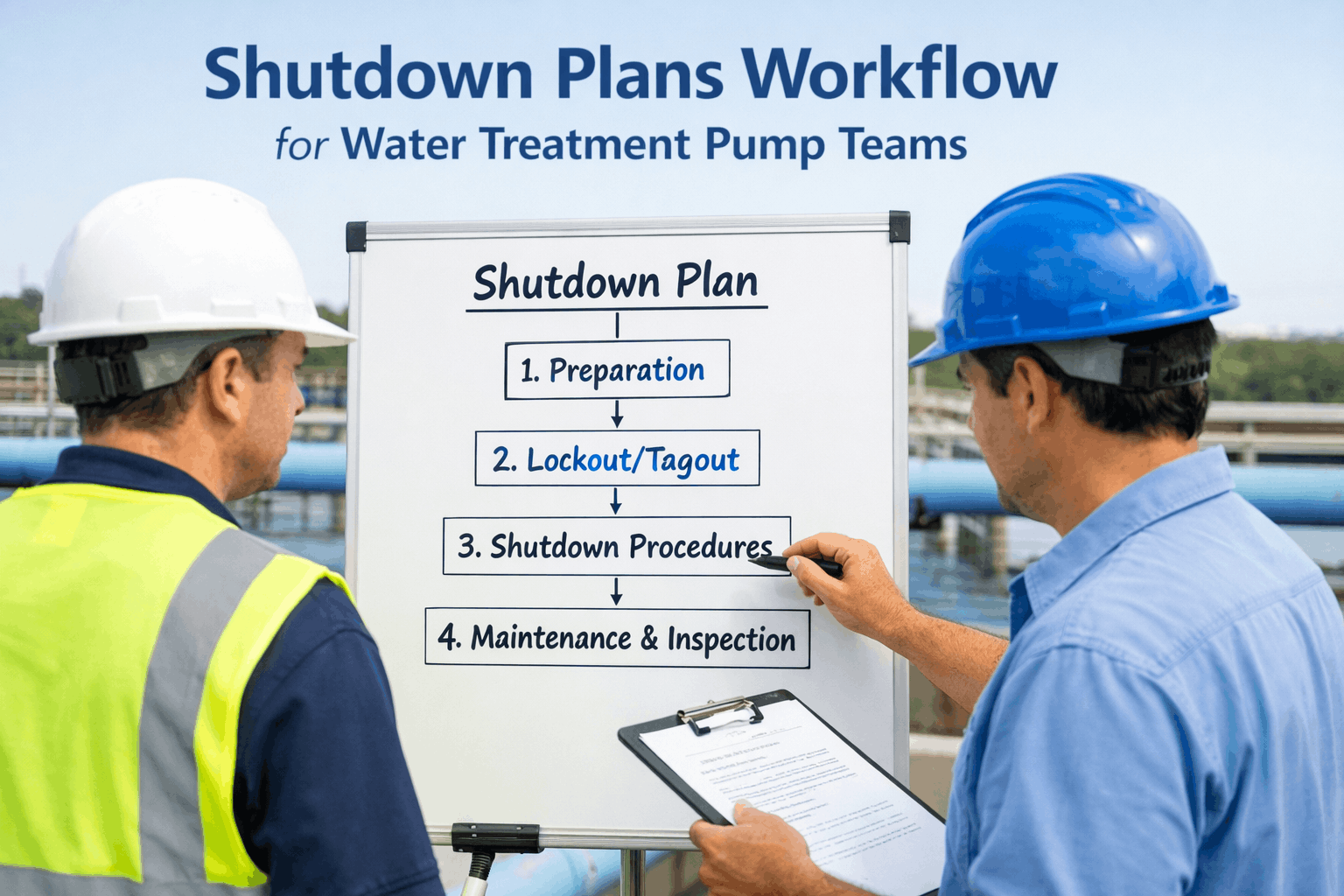
Shutdown Plans Workflow for Water Treatment Pump Teams

By Taylor on January 31, 2026

shutdown-plans-water-treatment-pump-workflow

When a water treatment plant takes a critical pump offline without proper planning, the consequences cascade through the entire system. Communities lose water pressure during peak demand hours. Treatment capacity drops below minimum flow requirements. Operators scramble to bring backup equipment online while managing chemical dosing adjustments. Unplanned pump outages cost U.S. water utilities an estimated $2.8 billion annually in emergency repairs, regulatory penalties, and customer service disruptions. For treatment facilities serving populations from 10,000 to 500,000, shutdown planning isn't a maintenance convenience; it's the foundation of reliable public water service.

EPA regulations, AWWA standards, and state primacy agency requirements mandate documented maintenance procedures that many facilities struggle to maintain with paper-based systems. Pump shutdown sequences, valve isolation procedures, and restart verification checklists generate documentation that must survive audit scrutiny years later. Facilities that implement integrated shutdown workflow systems discover that systematic planning documentation not only satisfies regulators but also reduces outage duration by 40-60% while preventing the equipment damage that turns routine maintenance into emergency repairs.

The Pump Shutdown Reality
Why water treatment teams can't afford planning gaps
$2.8B
Annual unplanned outage costs
40-60%
Outage reduction with planning
73%
Failures from poor procedures
4-8 hrs
Average planned vs. emergency

Elevate water utility reliability using digital shutdown workflows

The gap between regulatory requirements and operational reality often comes down to documentation. State drinking water programs require documented standard operating procedures for all critical equipment. AWWA standards recommend shutdown checklists that verify isolation, lockout/tagout compliance, and safe work conditions before maintenance begins. Every pump shutdown generates paperwork that must demonstrate proper sequencing, valve positions, and verification steps. Missing even one critical isolation step can result in equipment damage, worker injury, or water quality violations.

Pump Shutdown Planning Requirements
Critical workflow stages for safe, compliant maintenance
Pre-Planning
Capacity Assessment
Verify backup pump availability, check system demand forecasts, confirm maintenance window timing
Isolation
Valve Sequencing & LOTO
Execute valve closure sequence, apply lockout/tagout devices, verify zero energy state
Execution
Maintenance Activities
Complete planned repairs, document findings, capture as-found/as-left conditions
Restart
Return to Service
Remove LOTO, execute valve opening sequence, verify pump operation parameters
Verification
System Confirmation
Confirm flow rates, check for leaks, verify SCADA readings match field conditions
! Skipping isolation verification is the #1 cause of pump damage during maintenance

Digital shutdown workflow platforms transform these requirements from administrative burdens into streamlined processes. Operators follow guided checklists with required fields, capture timestamped photos of valve positions and gauge readings, and submit documentation that syncs instantly to cloud storage. Supervisors receive real-time visibility into shutdown status across all equipment, while automated alerts ensure critical steps aren't skipped. Facilities exploring these capabilities should schedule a demo for pump shutdown workflows to see how digital documentation eliminates compliance gaps and reduces outage duration.

Shutdown Planning Toolkit
Your 30-day implementation roadmap
Week 1
Asset Mapping
Inventory all pumps: raw water, high service, transfer, backwash
Document valve locations, types, and isolation sequences
Assign asset tags and QR codes to equipment
Map electrical isolation points and VFD locations
Week 2
Procedure Development
Build shutdown checklists for each pump type
Configure mandatory photo capture points
Set verification requirements before proceeding
Create restart sequences with safety checks
Week 3
Integration Setup
Connect SCADA for real-time pump status
Configure notification chains for stakeholders
Set up approval workflows for critical pumps
Establish documentation retention policies
Week 4
Training & Launch
Train operators on mobile workflow app
Conduct supervised shutdown drill
Verify report generation and audit trail
Go live with digital shutdown planning

From reactive to predictive—a water utility roadmap with analytics

Traditional maintenance approaches wait for problems to manifest—a seized bearing during routine operation, a failed seal that floods the pump room, or worst case, a complete pump failure during peak summer demand. Predictive maintenance inverts this model by analyzing operational data to identify degradation before failure occurs. Vibration trends, motor amperage patterns, discharge pressure variations, and seal water flow rates all provide early warning signals that trained algorithms can detect weeks or months before catastrophic failure.

Shutdown Planning Evolution
Reactive
Fix when broken
Emergency shutdowns, system disruption
Planned
Scheduled maintenance
Controlled outages, some over-maintenance
Optimized
Data-driven timing
Minimal disruption, maximum reliability
Vibration Analysis
Bearing wear detection 2-4 months before failure
Motor Current Signature
Electrical degradation indicators in real-time
Discharge Pressure Trends
Impeller wear and cavitation early warning
Seal Water Flow
Mechanical seal condition monitoring

The transition from reactive to optimized shutdown planning requires systematic data collection—exactly what digital CMMS platforms enable. Every shutdown captures operational parameters that build historical baselines. Analytics compare current readings against these baselines and against fleet-wide patterns from similar equipment. When anomalies emerge, the system generates predictive work orders that schedule shutdown during optimal windows rather than emergency response. Facilities building these capabilities can get started with predictive analytics integration to accelerate their optimized maintenance journey.

Digitize Your Pump Shutdown Planning
Oxmaint CMMS delivers automated shutdown workflows, mobile procedure checklists, and predictive analytics—purpose-built for water treatment facilities managing critical pump infrastructure.

Risk Scoring: Prioritizing Pump Shutdowns

Not all pump shutdowns carry equal risk. Taking a raw water intake pump offline during peak summer demand requires different planning than servicing a backwash pump during low-demand winter months. Risk scoring frameworks help operations teams allocate limited maintenance windows where they matter most, ensuring that shutdown timing, backup equipment verification, and stakeholder communication align with actual system reliability impact.

Pump Criticality Risk Scoring
Critical
Risk Score: 9-10
Raw water intake pumps (no redundancy) High service distribution pumps Single-source well pumps
Shutdown: Off-peak only | Backup: Required
High
Risk Score: 7-8
Transfer pumps between basins Chemical feed system pumps Filter backwash pumps
Shutdown: Low demand | Backup: Preferred
Moderate
Risk Score: 4-6
Sludge handling pumps Dewatering equipment Secondary lift stations
Shutdown: Scheduled | Backup: Optional
Low
Risk Score: 1-3
Plant utility pumps HVAC system pumps Wash water recovery pumps
Shutdown: Any time | Backup: Not required

Digital CMMS platforms automate risk-based prioritization by scoring each pump based on system redundancy, failure consequence, and current condition indicators. Shutdown requests automatically inherit priority levels that guide approval workflows. Dashboard views highlight equipment requiring attention before risk scores escalate. This systematic approach ensures that facilities facing limited maintenance windows make data-driven decisions about shutdown timing. For guidance on implementing risk-based frameworks, book a demo for criticality scoring configuration.

Expert Review: Building Audit-Ready Documentation

Compliance Perspective
What Regulators Look For in Shutdown Documentation

The most common shutdown-related audit findings aren't equipment failures—they're documentation gaps. Facilities with well-maintained pumps still receive citations when they can't produce isolation verification records, when LOTO procedures weren't documented, or when restart confirmations are missing. Digital systems that enforce required fields and timestamp every entry create audit trails that withstand the most rigorous regulatory scrutiny.

Shutdown Documentation Requirements
Pre-shutdown capacity verification documented
Valve isolation sequence with positions recorded
LOTO application with authorized signatures
Zero energy state verification before work
Maintenance activities with findings documented
LOTO removal with clearance signatures
Restart sequence with valve positions confirmed
Return-to-service verification with SCADA confirmation
Implementation Priority
Start with critical pump shutdown procedures—they generate the most regulatory attention. Once digital workflows ensure complete documentation for high-risk equipment, expand to lower-criticality pumps. Get started with phased shutdown workflow implementation to build capabilities systematically.
Ready to Eliminate Shutdown Planning Gaps?
Join water treatment facilities using Oxmaint to automate pump shutdown workflows, maintain audit-ready documentation, and protect communities from preventable service disruptions.

Conclusion: From Maintenance Burden to Operational Excellence

Pump shutdown planning will never be optional for water treatment facilities—regulatory requirements, safety standards, and system reliability demands exist because unplanned pump failures in water treatment settings can leave communities without safe drinking water. But the approach to meeting these requirements is entirely within your control. Paper checklists vulnerable to incomplete entries, verbal coordination prone to miscommunication, and reactive maintenance that discovers problems during emergencies represent approaches that maximize both compliance risk and system reliability risk.

Digital CMMS platforms transform the same operational requirements into systematic workflows that actually reduce administrative burden while strengthening service reliability. Automated scheduling ensures shutdowns happen during optimal windows. Mobile workflows capture complete documentation with timestamps and photos. Predictive analytics identify degradation before failures occur. Risk scoring prioritizes resources where they matter most. For water treatment facilities serving communities that depend on reliable pump infrastructure for safe drinking water, the investment in digital shutdown planning systems isn't just about passing audits—it's about ensuring that when maintenance is needed, your pumps return to service faster, safer, and more reliably.

Frequently Asked Questions

What documentation is required for water treatment pump shutdowns?
Regulatory agencies and industry standards require comprehensive shutdown documentation including: pre-shutdown capacity verification confirming backup availability, valve isolation sequences with documented positions, lockout/tagout application and removal records with authorized signatures, zero energy state verification before maintenance begins, maintenance activities performed with as-found and as-left conditions, restart sequences with valve positions confirmed, and return-to-service verification with SCADA confirmation. Digital CMMS platforms automate this documentation by requiring completion of each step before proceeding to the next.
How can shutdown planning reduce pump maintenance outage duration?
Facilities implementing digital shutdown workflows report 40-60% reductions in total outage duration. The improvement comes from eliminating pre-shutdown delays (parts staged in advance, procedures reviewed, stakeholders notified), reducing execution time (clear step-by-step checklists prevent missed steps and rework), and accelerating restart (verification requirements prevent false starts and repeated attempts). Planning also prevents the cascade failures that occur when rushed shutdowns damage equipment, turning 4-hour jobs into multi-day emergencies.
What is risk-based criticality scoring for pump shutdowns?
Risk-based criticality scoring assigns numerical values to each pump based on three factors: failure probability (equipment age, condition, maintenance history), failure consequence (system redundancy, population served, regulatory impact), and current condition indicators (vibration trends, performance degradation, previous issues). Scores typically range from 1-10, with critical pumps (9-10) requiring off-peak shutdowns with backup verification, while low-criticality equipment (1-3) can be serviced during any available window. Digital CMMS platforms automate scoring and route shutdown requests through appropriate approval workflows.
How long should pump shutdown records be retained?
State drinking water programs typically require maintenance documentation retention for 3-10 years depending on jurisdiction, with many utilities maintaining records for the equipment's entire service life. Beyond regulatory minimums, historical shutdown records provide valuable data for predictive maintenance analytics, warranty claims, capital planning decisions, and incident investigations. Digital systems provide significant advantages—cloud storage ensures records survive physical disasters, while search functionality enables instant retrieval during audits or emergency troubleshooting.
What predictive indicators help optimize pump shutdown timing?
Four key predictive indicators help determine optimal shutdown windows: vibration analysis detects bearing wear 2-4 months before failure through frequency spectrum changes; motor current signature analysis identifies electrical degradation in real-time; discharge pressure trending reveals impeller wear and cavitation conditions; and seal water flow monitoring indicates mechanical seal condition. When digital CMMS platforms integrate with monitoring systems, analytics compare current readings against historical baselines to recommend optimal shutdown timing—before emergency failure but not before necessary.

Share This Story, Choose Your Platform!