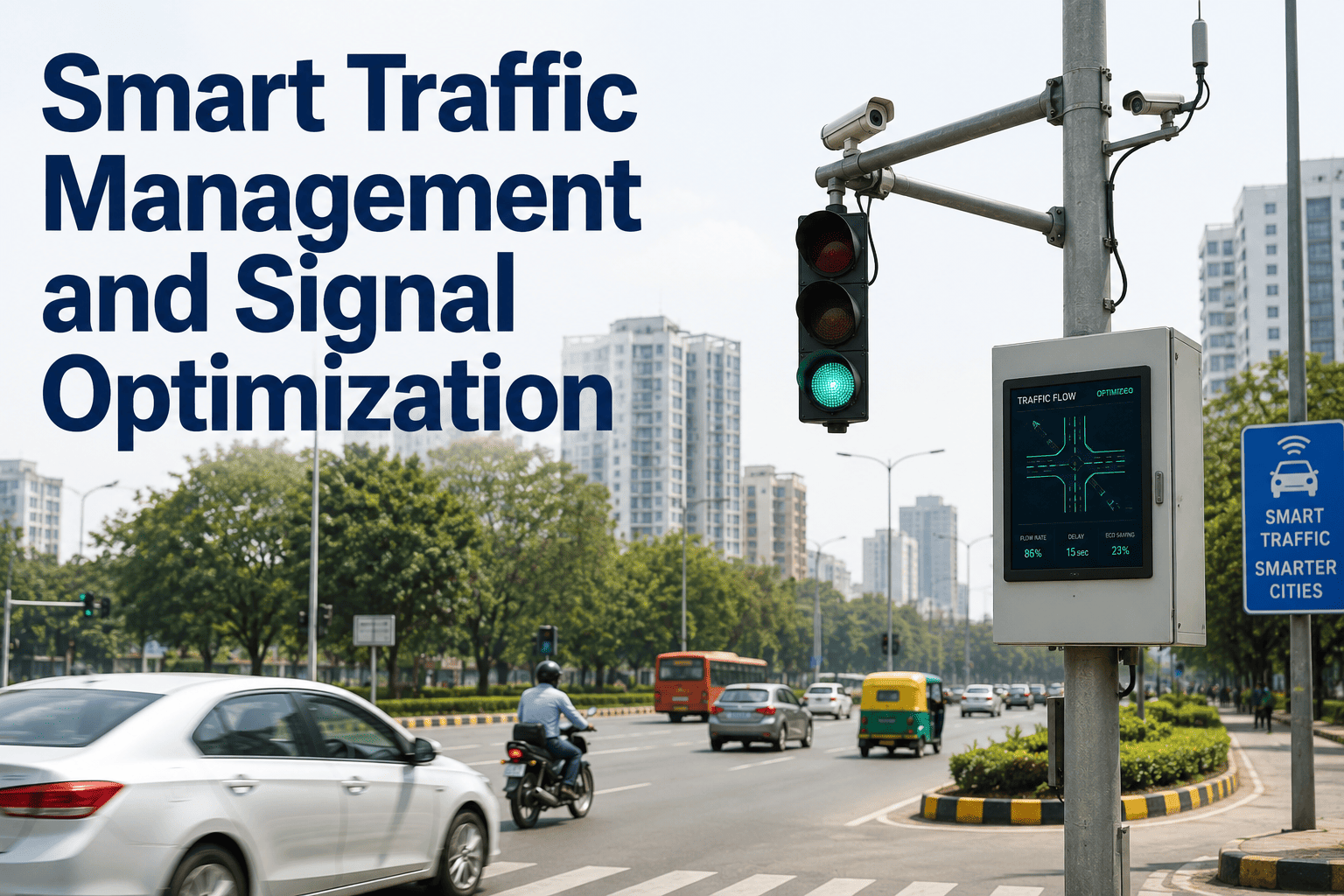
Smart traffic management and signal optimization use adaptive algorithms, connected-sensor data, and centralized corridor control to cut urban congestion, reduce vehicle emissions, and improve travel-time reliability across municipal road networks. For public works and transportation departments, deploying intelligent transportation systems is only half the equation—the other half is keeping that infrastructure online through proactive, CMMS-driven maintenance. Modern adaptive traffic signals pay back rapidly in citizen time saved, but only if signal cabinets, detection cameras, and communication networks remain highly available. Municipalities can Start Free Trial of OxMaint to eliminate reactive maintenance cycles and ensure their smart traffic system never goes dark.
Is your city's smart traffic system failing because of reactive maintenance?
Adaptive traffic signals and intelligent transportation systems deliver massive ROI in reduced congestion and emissions—but only when they stay online. A single dark signal cabinet can cost a municipality $15,000+ per day in delayed citizen time, wasted fuel, and safety liabilities. OxMaint keeps your traffic optimization government infrastructure reliable with AI-driven preventive maintenance.
Why smart traffic management and signal optimization drive municipal ROI
Traffic congestion costs the U.S. economy over $50B annually in lost productivity and wasted fuel. Smart traffic management directly attacks this cost by dynamically adjusting signal timing based on real-time vehicle demand rather than fixed historical schedules. When a corridor of 20 intersections transitions from fixed-time to adaptive control, municipalities typically see a 10–25% drop in average delay and a 12% reduction in stops—translating to measurable emission reductions and immediate citizen satisfaction.
Worked example: A mid-sized municipality operating 340 signalized intersections across 12 arterial corridors was spending $42K annually on emergency electrical callouts and citizen complaint remediation. After implementing an intelligent transportation system with adaptive traffic signals, they required a robust maintenance backbone to protect that investment. By shifting from spreadsheet-based reactive repairs to a CMMS-driven preventive maintenance program, the transportation department cut unplanned signal downtime by 47% within the first year and recovered the software cost in under four months.
How to implement traffic flow optimization municipal networks
Effective traffic flow optimization municipal networks require more than deploying smart traffic signals at a single intersection. True intelligent traffic management coordinates adjacent signals to create "green waves" along arterial corridors, integrating pedestrian phases, transit signal priority (TSP), and emergency vehicle preemption. The implementation timeline below outlines the phases a municipal traffic management government team should follow to move from legacy fixed-timing to a fully adaptive traffic system.
Asset inventory & condition assessment
Catalog every signal cabinet, detection camera, radar sensor, and communication node. Log GPS coordinates, firmware versions, and manufacturer specs into a centralized EAM to establish a baseline for your smart traffic system.
Adaptive algorithm deployment & integration
Install adaptive traffic signal controllers and integrate them with centralized traffic management software. Connect vehicle detection inputs and configure split, offset, and cycle parameters for corridor-level coordination.
Preventive maintenance scheduling
Build PM checklists for detector cleaning, cabinet ventilation, battery backup testing, and communication module firmware updates. Automate these work orders to ensure signal optimization traffic performance never degrades due to dirty lenses or dead backups.
Predictive analytics & continuous tuning
Use maintenance analytics to predict controller failures before they cause dark intersections. Continuously refine signal timing based on live traffic data, construction detours, and seasonal volume shifts.
The cost of ignoring signal maintenance in smart traffic government programs
A smart traffic government initiative is only as reliable as the maintenance program supporting it. When municipalities deploy intelligent transportation systems without a dedicated CMMS, signal cabinets degrade silently. Detection cameras get covered in grime, backup batteries fail without warning, and communication modules drop offline—turning a $200K adaptive corridor investment back into a fixed-time system within 18 months. The formula below illustrates how unmaintained infrastructure erodes the ROI of smart signal management.
For a 100-intersection network with just 5% cabinet downtime and a 10% detection drift rate, this translates to over $280,000 in leaked value annually. Reactive maintenance costs 3–5x more than scheduled preventive work, making the case for a CMMS undeniable.
| Maintenance Approach | Avg. Signal Uptime | Annual Emergency Callouts | Citizen Complaint Volume | ROI Protection |
|---|---|---|---|---|
| Reactive / Spreadsheet | 89% | 140+ | High | Low |
| Basic CMMS (Preventive) | 96% | 45 | Moderate | Medium |
| OxMaint AI CMMS (Predictive) | 99.2% | Under 12 | Low | High |
See how OxMaint protects your smart traffic investment
Book a 30-minute demo and discover how AI-driven maintenance keeps adaptive signals online, cuts emergency callouts by 70%, and secures your traffic optimization ROI.
How OxMaint powers intelligent transportation systems maintenance
OxMaint is an AI-powered CMMS and Enterprise Asset Management platform built to keep high-criticality infrastructure online. For municipal traffic management government teams, OxMaint replaces chaotic paper work orders and siloed spreadsheets with a unified system for preventive scheduling, predictive failure alerts, and real-time asset tracking—ensuring smart traffic signals operate at peak performance 365 days a year.
Predictive signal failure alerts
AI analyzes communication dropouts, voltage anomalies, and detector drift to predict controller and cabinet failures before they cause a dark intersection—cutting unplanned downtime 30–50%.
Automated preventive scheduling
Auto-generate PM work orders for lens cleaning, battery replacement, and firmware updates based on meter readings or calendar intervals. Eliminate missed maintenance cycles and paper work orders.
Centralized asset & spare parts tracking
Track every signal head, controller card, and detection camera by GPS location. Link spare-parts inventory to specific cabinet models so field crews have the right parts on the first truck roll.
Maintenance analytics & compliance
Generate audit-ready reports on MTBF, asset availability, and work order completion rates. Prove compliance with municipal DOT standards and justify future infrastructure budgets with hard data.
"After deploying our adaptive signal network, maintenance became our biggest bottleneck. OxMaint's predictive alerts helped us cut emergency electrical callouts by 70% and kept our corridors running at 99% uptime. The ROI was undeniable within the first quarter."
Smart traffic signal optimization FAQs
What is smart traffic management and signal optimization?
Smart traffic management uses sensors, communication networks, and adaptive algorithms to dynamically adjust traffic signal timing based on real-time vehicle and pedestrian demand. Signal optimization specifically focuses on coordinating adjacent intersections to minimize stops, reduce delay, and improve overall traffic flow along a corridor. Together, they form the backbone of intelligent transportation systems.
How much do adaptive traffic signals cost to maintain?
Maintaining an adaptive traffic signal intersection typically costs $800–$1,500 annually for preventive upkeep, including detector cleaning, firmware updates, and battery backups. Without a CMMS, emergency reactive repairs can push that cost to $4,000+ per intersection. You can Start Free Trial of OxMaint to shift from costly reactive repairs to scheduled, predictable maintenance.
How does a CMMS improve traffic optimization government programs?
A CMMS like OxMaint improves municipal traffic optimization by ensuring the physical infrastructure—signal cabinets, controllers, detection cameras—remains online at 98%+ uptime. By automating preventive maintenance work orders and using AI to predict failures, transportation departments prevent the detection drift and communication dropouts that silently degrade adaptive signal performance.
Can smart traffic signals integrate with connected vehicles?
Yes, modern intelligent transportation systems use Dedicated Short-Range Communications (DSRC) and cellular V2X protocols to share signal phase and timing (SPaT) data with connected vehicles. This integration improves traffic flow, supports transit signal priority, and enables emergency vehicle preemption, but requires rigorous maintenance of roadside communication units to ensure data reliability.
How long does it take to deploy a smart traffic system?
Deploying smart traffic signals across a municipal corridor of 15–20 intersections typically takes 4 to 6 months, covering asset inventory, controller installation, algorithm configuration, and preventive maintenance setup. To see how OxMaint accelerates the maintenance-readiness phase, Book a Demo with our infrastructure team.
Stop losing ROI to dark signal cabinets
Join the municipalities using OxMaint to predict failures, automate preventive work orders, and keep their smart traffic systems running at peak performance.
Free 14-day trial · No credit card required



-workflow-for-traffic-signal-teams.png)