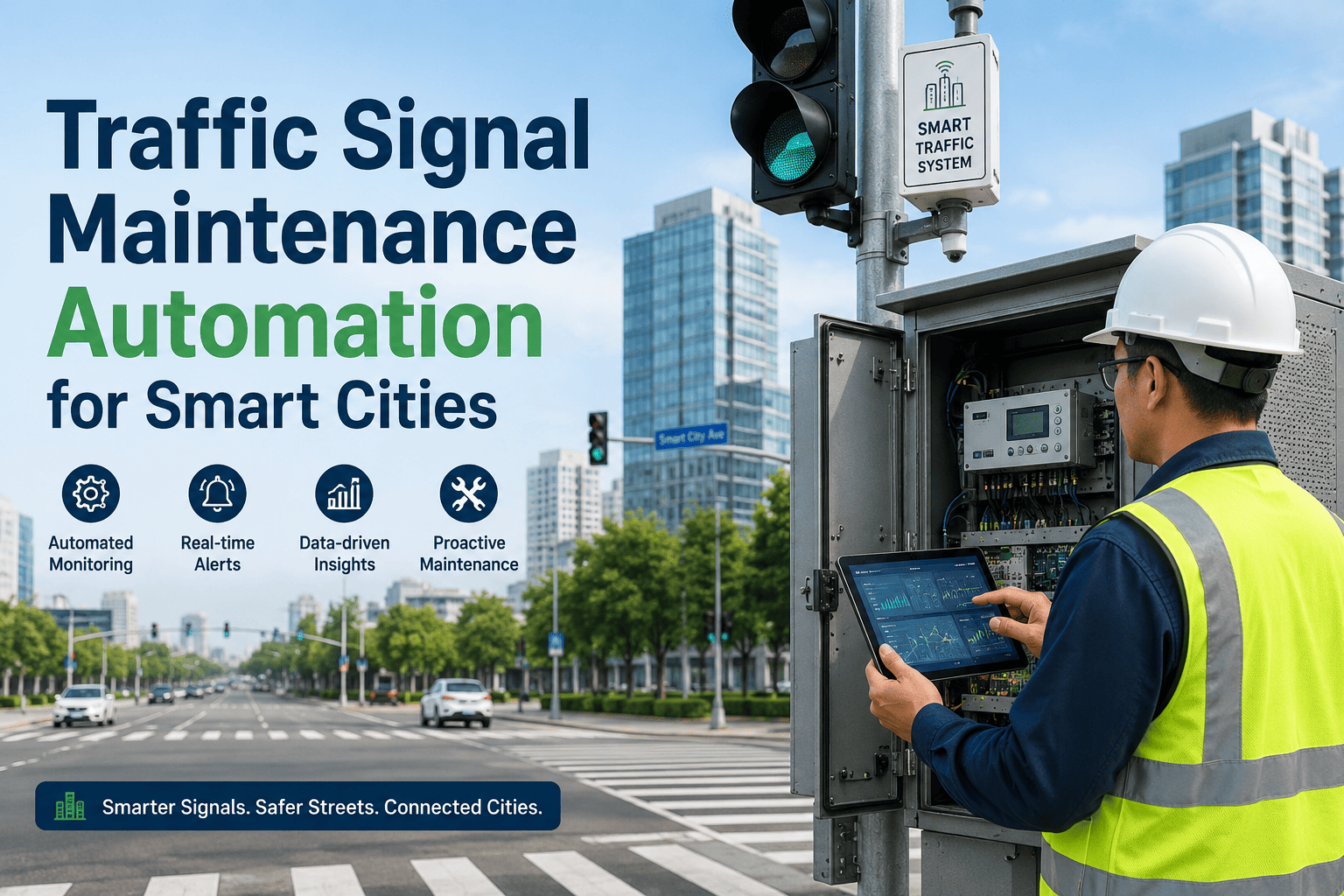
A traffic signal that fails during morning peak hour does not just cause frustration — it creates intersection gridlock, diverts emergency response routes, and exposes the municipality to liability for any accident that occurs while the signal is dark. Most signal failures are not sudden events. They are the result of skipped inspection cycles, aging controllers that were never flagged for replacement, and maintenance programmes that react to failure calls rather than preventing them. Oxmaint gives municipal traffic operations teams the tools to schedule, track, and document every signal maintenance task — before the failure, not after the call. Start automating your signal maintenance programme or book a free demo to see how municipalities cut signal failure rates by up to 60%.
60%
reduction in signal failure incidents for municipalities running structured preventive maintenance programmes
$18K
average cost per major signal controller replacement when deferred maintenance accelerates failure
7 yrs
additional service life from LED signal heads vs incandescent — with documented maintenance records
Real-time
fault detection and work order dispatch achievable with Oxmaint-connected signal monitoring
The Four Failure Modes That Close Intersections
Understanding where signals fail is the prerequisite for building a maintenance programme that prevents those failures. Each of the four modes below has a different inspection frequency, technical requirement, and documentation obligation — and all four are manageable with a structured CMMS schedule.
01
Controller and Cabinet Failure
Signal controllers are the brain of every intersection. Heat, moisture ingress, and power surge damage are the primary failure drivers. Cabinet inspections, ventilation checks, and surge protector testing prevent the single most expensive failure mode in any signal programme.
02
Lamp and LED Head Failure
Burned incandescent lamps and failed LED modules create dark signal heads — the most visible and highest-liability failure. LED programmes require module condition checks rather than lamp replacement cycles, but systematic inspection remains mandatory.
03
Detection and Sensor Fault
Loop detectors, video detection, and pedestrian push-button failures create timing malfunctions that are invisible until a complaint is filed. Detection system testing on a scheduled cycle catches degraded performance before it becomes a full failure event.
04
Structural and Pole Integrity
Mast arm fatigue, anchor bolt corrosion, and pole base deterioration are slow-developing structural failures. Once cracking or spalling is visible, emergency repair is imminent. Annual structural assessments are required by most state and national road codes.
Schedule Every Signal Inspection Automatically
Controllers, LED heads, detection systems, and pole structures — all inspection tasks auto-generated in Oxmaint before due dates are missed
Traffic Signal Preventive Maintenance Schedule
The schedule below represents the minimum inspection and maintenance programme required for a compliant, well-managed municipal signal operation. Oxmaint auto-generates all of these as recurring work orders — assigned, tracked, and documented without manual scheduling.
Oxmaint Signal Maintenance Workflow and Roadmap
From initial asset registration to predictive failure forecasting, Oxmaint deploys a structured four-phase signal maintenance programme that scales from a single municipality to a regional network of hundreds of intersections.
Phase 1
Asset Registration and Condition Baseline
Weeks 1–2
Register every signal asset — controllers, heads, poles, detectors — with location, age, and condition rating
Upload existing maintenance history per intersection to establish PM backlog baseline
Tag assets with priority classification — high-volume arterials, school zones, emergency vehicle routes flagged first
Phase 2
Automated PM Schedule Activation
Week 3
Activate recurring work orders for all inspection types — quarterly, semi-annual, and annual — auto-assigned to field crews by zone
Configure mobile inspection checklists per asset type — technicians complete tasks on device in the field with photo capture
Set escalation rules — overdue tasks and fault reports auto-escalate to signal operations supervisor
Phase 3
Fault Response and Diagnostics Integration
Month 2
Connect fault reporting to Oxmaint — public reports, monitoring system alerts, and field observations all generate prioritised work orders
Activate response time tracking — all fault work orders are timestamped from report to resolution for SLA compliance
Begin asset failure analytics — identify which intersections and equipment types are generating the most reactive work orders
Phase 4
CapEx Planning and Predictive Optimisation
Month 3 onwards
Use Oxmaint asset lifecycle data to build evidence-based controller replacement and LED upgrade plans — prioritised by condition score and failure history
Generate compliance audit reports automatically — every inspection record, corrective action, and maintenance log available for state and federal review
Expand predictive capability — use failure frequency data to shift PM intervals from calendar-based to condition-based scheduling
From Reactive to Predictive — in 90 Days
Oxmaint's 4-phase rollout gives municipal signal teams a fully automated maintenance programme, live compliance audit trail, and CapEx forecast — within one quarter
LED Signal Upgrade Planning with Oxmaint
LED conversion is the highest-ROI capital programme in most municipal signal budgets — but the planning is only as good as the underlying asset data. Oxmaint tracks the age, condition, energy consumption, and failure frequency of every signal head, giving traffic operations teams the evidence to prioritise and justify LED upgrade sequences to council and funding bodies.
E
Energy Cost Reduction
LED signal heads consume 80–90% less energy than incandescent equivalents. Oxmaint tracks energy data per signal and models the payback period for each upgrade — providing the financial case for capital approval.
L
Extended Service Life
LED modules rated at 50,000+ hours eliminate the monthly lamp replacement cycle of incandescent programmes. Oxmaint tracks LED module age and flags units approaching end-of-rated-life before visible failure occurs.
P
Prioritised Upgrade Sequencing
Oxmaint ranks remaining incandescent heads by failure frequency, energy cost, and remaining asset life — giving signal managers a data-driven upgrade priority list rather than a geographic or budget-only approach.
C
Compliance Documentation
LED upgrades must meet MUTCD photometric standards and state approval requirements. Oxmaint stores installation records, manufacturer certifications, and inspection sign-offs against each upgraded head — ready for federal and state audit.
Regional Compliance Standards Oxmaint Supports
Municipal traffic signal programmes operate under different regulatory frameworks in each jurisdiction. Oxmaint provides the inspection scheduling, documentation, and reporting infrastructure to meet all major national standards without manual record management.
USA
United States
MUTCD / FHWA / State DOT Standards / NEMA TS-2
The Manual on Uniform Traffic Control Devices governs all signal installation and maintenance. State DOTs require documented inspection records, timing plans, and structural assessments. Oxmaint generates MUTCD-compliant maintenance logs and stores all records for federal-aid programme audits.
CA
Canada
TAC Manual / Provincial MTO Standards / CSA Standards
Transport Canada's TAC Manual and provincial Ministry of Transportation standards govern signal maintenance obligations. Oxmaint tracks all inspection cycles against provincial schedules and exports compliance documentation formatted for Ministry review.
AU
Australia
AUSTROADS / State Roads Authority Standards / AS 2144
AUSTROADS guidelines and state roads authority standards define inspection frequencies and fault response obligations for traffic signals. Oxmaint stores all Australian-standard inspection records with timestamped completion logs exportable for state audit requests.
DE
Germany
StVO / RiLSA / DIN EN 12368 / GDPR
German traffic signal maintenance is governed by RiLSA guidelines and DIN EN 12368 technical standards. All operational data must comply with GDPR. Oxmaint stores maintenance records with EU-compliant encryption and provides GDPR-ready audit trails for German municipal operators.
UK
United Kingdom
TR2500 / TSRGD 2016 / DMRB / UK GDPR
UK traffic signal maintenance must comply with TR2500 maintenance standards and TSRGD 2016 equipment requirements. Oxmaint generates TR2500-aligned maintenance records, tracks response times against SLA obligations, and stores all data under UK GDPR-compliant protocols.
SA
Saudi Arabia
MOT Standards / MOMRA Guidelines / SASO
Saudi Arabia's Ministry of Transport and MOMRA define traffic signal maintenance obligations for municipal and highway networks. Oxmaint supports Arabic-language work orders and generates SASO-compatible documentation for signal maintenance programmes across Vision 2030 infrastructure projects.
Oxmaint vs. Competitor CMMS Platforms for Traffic Signal Programmes
Before vs. After: Signal Maintenance with Oxmaint
Reactive Signal Operations
Inspections scheduled manually — missed when crews are diverted to fault calls
Controller failures discovered when intersection goes dark — no early warning
Compliance records on paper or spreadsheets — weeks to compile for audit
LED upgrade priority set by budget availability, not asset condition data
Fault response time untracked — no SLA performance visibility
CapEx surprises — controller replacements forced by crisis, not planned
Oxmaint Proactive Operations
Recurring PM work orders auto-generated — crews receive tasks on mobile before due date
Controller condition tracked per inspection cycle — deterioration flagged before failure
Full compliance audit trail exportable in minutes — every inspection timestamped
LED upgrade list ranked by Oxmaint failure data — highest-risk heads prioritised first
Response time tracked per work order — SLA compliance visible in real time
CapEx submissions built from live asset lifecycle data — no surprises
Results from Municipal Signal Programmes Using Oxmaint
60%
Fewer unplanned signal failures after switching to structured PM programme on Oxmaint
86%
PM task completion rate across all signals — vs industry average of under 50% for reactive programmes
3 min
Time to export full compliance audit trail for any date range and any intersection in the network
40%
Reduction in reactive work orders within 6 months of Oxmaint PM programme activation
We were running 400 intersections on spreadsheets. Inspection records were filed in folders. When our state DOT requested a 3-year maintenance history for a federal-aid audit, it took two staff members a week to compile it. Oxmaint produced the same report in four minutes. That alone paid for the platform many times over.
Director of Traffic Operations, Mid-Western US Municipality — 400 Signal Intersections
Your Next Federal Audit Could Be 4 Minutes Away — Not 4 Days
Oxmaint stores every signal inspection record with a timestamp and exports your full compliance history in minutes — formatted for state DOT, FHWA, and international regulatory review
How Oxmaint Manages the Full Signal Programme
A
Signal Asset Register with GIS Location
Every intersection is registered in Oxmaint with GPS coordinates, asset inventory, controller type, age, and condition rating. Signal managers see their full network on a location-aware dashboard — no spreadsheet cross-referencing required.
P
Automated PM Scheduling by Asset Type
Controllers, LED heads, detection systems, poles, and emergency power units each have their own inspection frequency configured in Oxmaint. Work orders generate automatically — assigned to field crews by zone — before any task falls overdue.
M
Mobile Field Inspection with Fault Capture
Field technicians complete inspection checklists on mobile with photo evidence attached. Faults detected during inspection automatically generate corrective work orders — no paper, no radio handoff, no delay between detection and dispatch.
F
Fault Response and SLA Tracking
All fault reports — from monitoring systems, public reports, or field observations — are logged in Oxmaint with priority classification. Response time is tracked from report to resolution, and SLA performance is visible in real time for every jurisdiction and crew.
C
Compliance Audit Export — Any Format, Any Date
Every inspection, corrective action, and maintenance event is stored with a timestamp in Oxmaint. Full compliance reports are exportable in minutes — formatted for MUTCD, TR2500, AUSTROADS, or any other national standard — without manual compilation.
R
CapEx and Replacement Forecasting
Oxmaint uses controller age, failure frequency, and condition scores to build evidence-based replacement and LED upgrade priority lists. Signal operations managers present data-driven CapEx submissions to council — not engineering estimates on ageing spreadsheets.
Traffic Signal PM — Oxmaint
Every Signal Inspected. Every Record Stored. Every Audit Ready.
60%
fewer signal failures
400+
intersections on one dashboard
Frequently Asked Questions