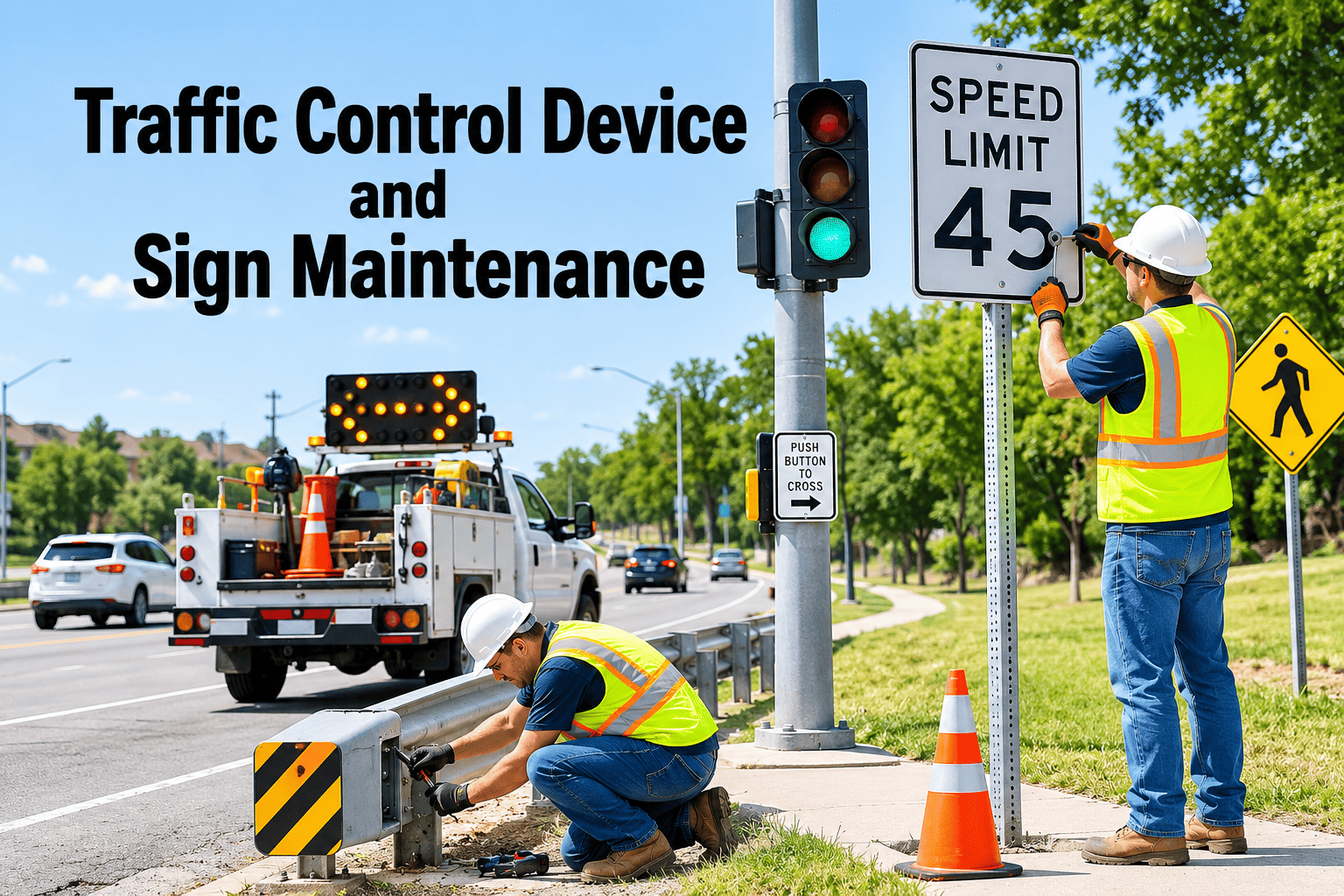
Traffic control device and sign maintenance is one of the highest-liability responsibilities a municipal public works department manages — a single faded stop sign or downed warning device can trigger fatal crashes and costly litigation. The FHWA's Manual on Uniform Traffic Control Devices (MUTCD) mandates that all public agencies maintain minimum sign retroreflectivity levels, putting the burden of compliance squarely on local governments. A modern traffic sign maintenance program moves teams away from reactive windshield surveys and paper logs toward data-driven asset management, ensuring road sign maintenance is proactive, documented, and audit-ready. See how OxMaint's AI-powered CMMS streamlines municipal traffic sign management and Start Free Trial to digitize your entire traffic control maintenance municipal workflow today.
Are your municipal traffic signs visible at night — or a liability waiting to happen?
Over 50% of agencies struggle to maintain MUTCD minimum retroreflectivity standards. Faded signs, untracked assets, and paper-based road sign maintenance programs directly increase crash risk and expose your municipality to devastating negligence claims.
Why municipal sign maintenance fails without a CMMS
Most public works departments manage thousands of traffic signs across hundreds of miles of roadways. Without traffic control device management software, agencies rely on inefficient windshield surveys and fragmented paper records that guarantee missed inspections and expired warranties.
A 180-mile roadway network in a county public works department held approximately 12,000 traffic signs. Using spreadsheets and paper maps, the team replaced roughly 800 signs yearly but had no centralized data for sign retroreflectivity maintenance. After an nighttime audit, they discovered 1,400 non-compliant signs — a massive liability. By implementing a CMMS for traffic signage maintenance, the agency mapped every asset with GPS, automated condition assessments, and eliminated compliance blind spots within six months.
Essential traffic sign maintenance program checklist
A defensible traffic control sign maintenance program requires systematic, documented inspections. Use this municipal sign maintenance checklist to ensure your road signs meet federal and state retroreflectivity mandates.
- Nightly visual inspections from a standard vehicle
- Calibrated retroreflectometer measurements for Type IX & XI sheeting
- Documented pass/fail thresholds per MUTCD Table 2A-3
- Check for physical damage, leaning posts, and vandalism
- Verify vegetation overgrowth clearance (min. 12 ft visibility)
- Inspect mounting hardware and anti-theft bolts
- Confirm GPS coordinates match the GIS database
- Update MUTCD code (e.g., R1-1, W2-1) and installation date
- Log manufacturer and sheeting type warranty data
- Auto-generate work orders for signs failing threshold tests
- Dispatch crews with correct replacement signs & hardware
- Verify installation and close the digital work order on-site
| Sign Sheeting Type | Typical Lifespan | Min. Retroreflectivity (RA) | Required Action |
|---|---|---|---|
| Type I (Engineer Grade) | 7–10 years | Below 70 cd/lx/m² | Immediate Replacement |
| Type III (High Intensity) | 10–12 years | Below 100 cd/lx/m² | Schedule Replacement |
| Type IX (Diamond Grade) | 12–15 years | Below 250 cd/lx/m² | Schedule Testing |
| Type XI (Prismatic) | 15–20 years | Below 300 cd/lx/m² | Routine Inspection |
How OxMaint modernizes traffic control device management
OxMaint's AI-powered CMMS transforms municipal sign maintenance from a reactive, paper-heavy burden into a predictive, data-driven operation. Map assets, automate inspections, and generate audit-ready compliance reports in minutes.
GIS Asset Tracking
Pin every sign on an interactive map with exact GPS coordinates, MUTCD codes, and installation dates. Eliminate lost assets and reduce windshield survey time by up to 70%.
Automated Night Inspections
Digitize nighttime retroreflectivity assessments. Mobile field apps flag failing signs instantly and auto-generate priority replacement work orders before liability strikes.
Predictive Replacement
AI analyzes sheeting type, age, and environmental exposure to predict sign degradation. Cut unplanned sign replacements by 30–50% and optimize your annual budget.
Audit-Ready Compliance
Generate MUTCD compliance reports with one click. Every inspection, replacement, and cost is logged immutably, giving you instant proof of compliance during federal audits.
How to launch your traffic sign maintenance program
Transitioning from spreadsheets to a modern traffic control device management system takes days, not months. Here is the standard 90-day rollout for public works teams using OxMaint.
Asset Inventory & Import
Upload existing sign data via CSV or GIS integration. Field crews use the OxMaint mobile app to capture GPS points, photos, and condition data for unmapped traffic signage.
Define Maintenance Triggers
Configure retroreflectivity thresholds, age-based replacement triggers, and post-storm inspection routes. OxMaint's AI begins analyzing data to predict near-term failures.
Automated Work Order Dispatch
The system auto-generates and routes priority work orders to field crews. The municipality runs its first fully digital, paperless night inspection cycle with instant reporting.
Stop risking municipal liability on paper logs and fading signs
See how OxMaint digitizes your traffic control device maintenance, automates MUTCD compliance, and cuts field inspection time in half.
Traffic sign maintenance and MUTCD compliance FAQ
What are the MUTCD retroreflectivity maintenance requirements?
The MUTCD requires all public agencies to establish and implement a sign maintenance program that addresses minimum retroreflectivity levels. Agencies must use an assessment or management method to ensure traffic signs meet or exceed the minimum levels outlined in Table 2A-3, maintaining documentation of these methods for federal compliance audits.
How often should municipal traffic signs be inspected?
Municipalities should perform visual nighttime inspections of traffic signs at least annually, though high-risk areas like school zones and major intersections benefit from quarterly checks. Using a traffic sign management CMMS like OxMaint allows agencies to optimize inspection routes based on sign age and material degradation rather than arbitrary timelines.
What is the average lifespan of a road sign?
Lifespan depends heavily on the retroreflective sheeting type. Standard engineer-grade signs (Type I) typically last 7–10 years, while prismatic sheeting (Type XI) can last 15–20 years. Environmental factors like sun exposure, road salt, and vandalism significantly impact these timeframes, making predictive tracking essential.
How does a CMMS improve traffic control device management?
A CMMS centralizes asset data, GPS locations, and condition history into a single platform. It replaces paper work orders with mobile-enabled digital forms, automates preventive maintenance scheduling, and provides instant compliance reporting, drastically reducing the administrative burden on public works teams. Book a demo with OxMaint to see it in action.
Who is legally responsible for damaged or missing traffic signs?
The municipality or public agency holding jurisdiction over the roadway bears the legal responsibility for maintaining traffic control devices. If an agency fails to repair or replace a known non-compliant or missing sign within a reasonable timeframe and a crash occurs, the agency can be held liable for negligence and face multi-million dollar settlements.
Ready to modernize your traffic sign maintenance program?
Join the public works teams using OxMaint to eliminate paper logs, automate MUTCD compliance, and keep their roadways safe. See it live on your assets today.
Free 14-day trial · No credit card