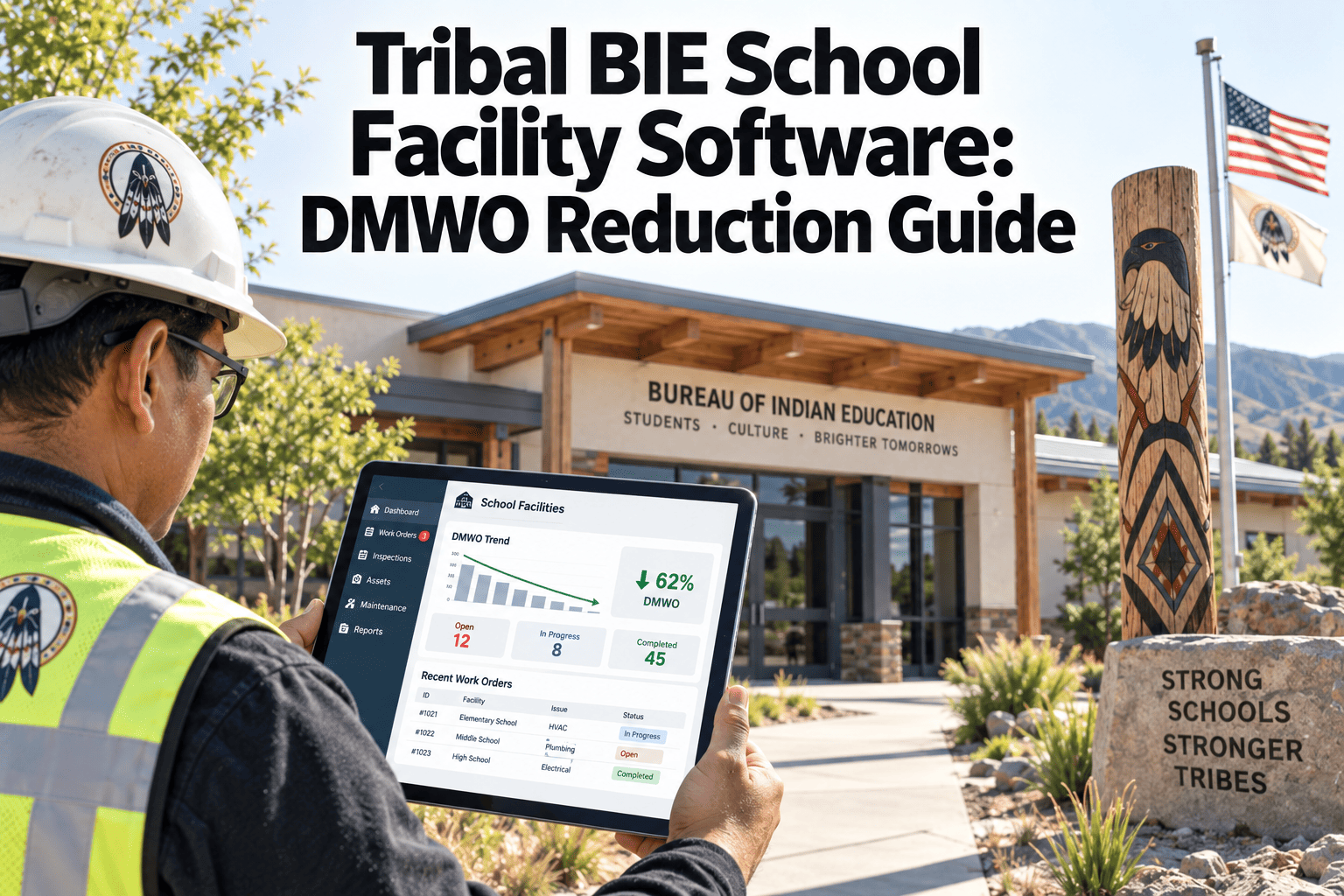
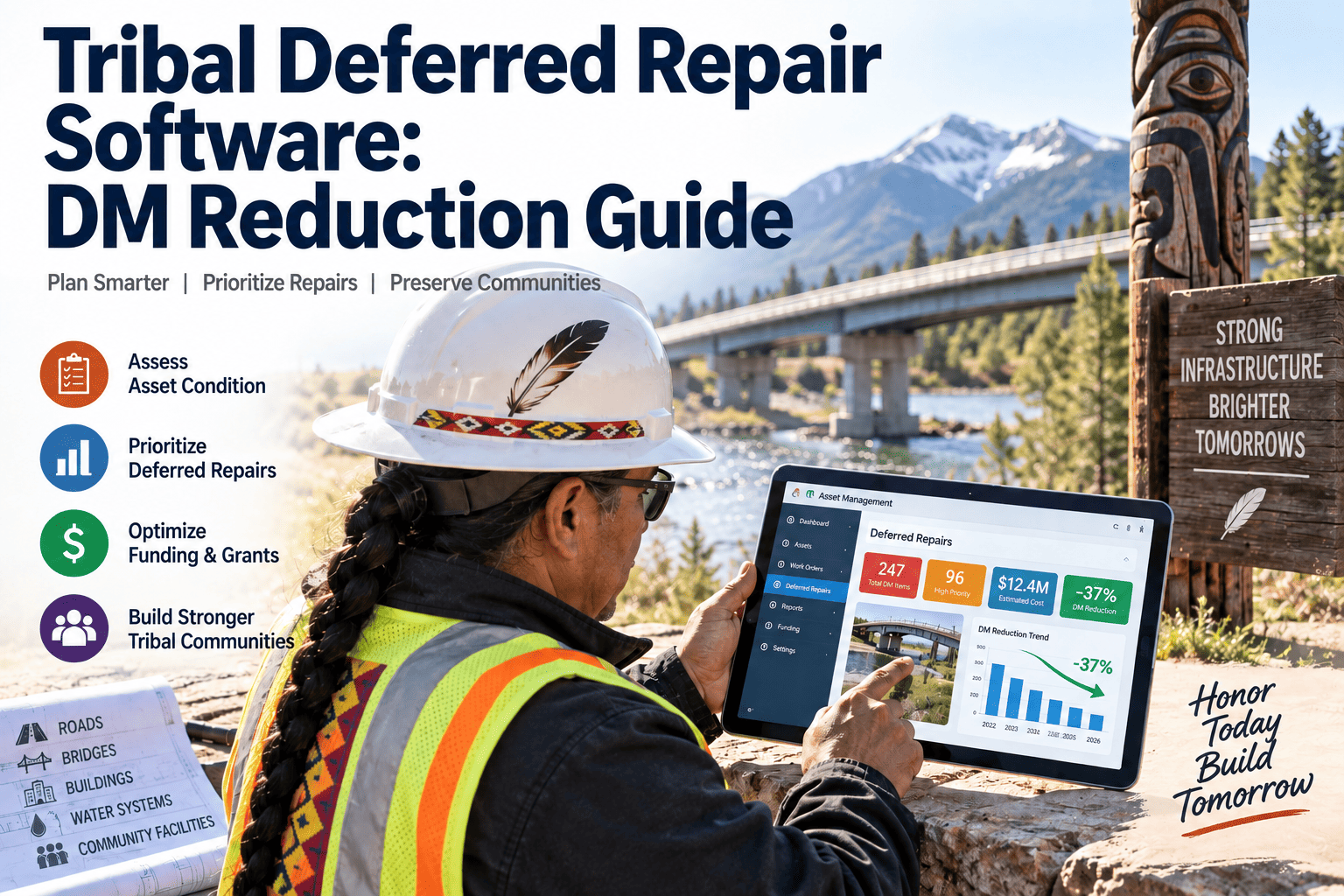
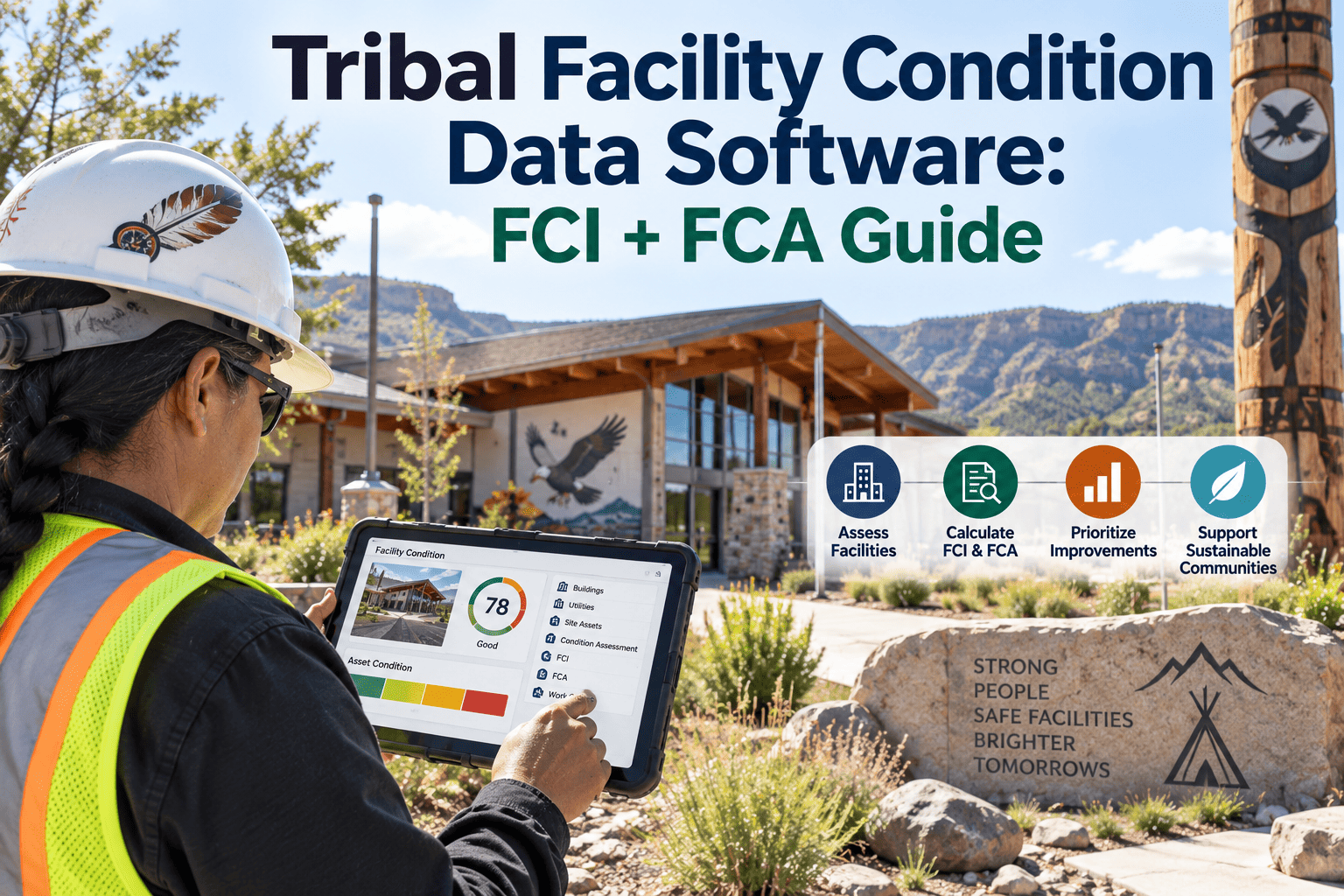
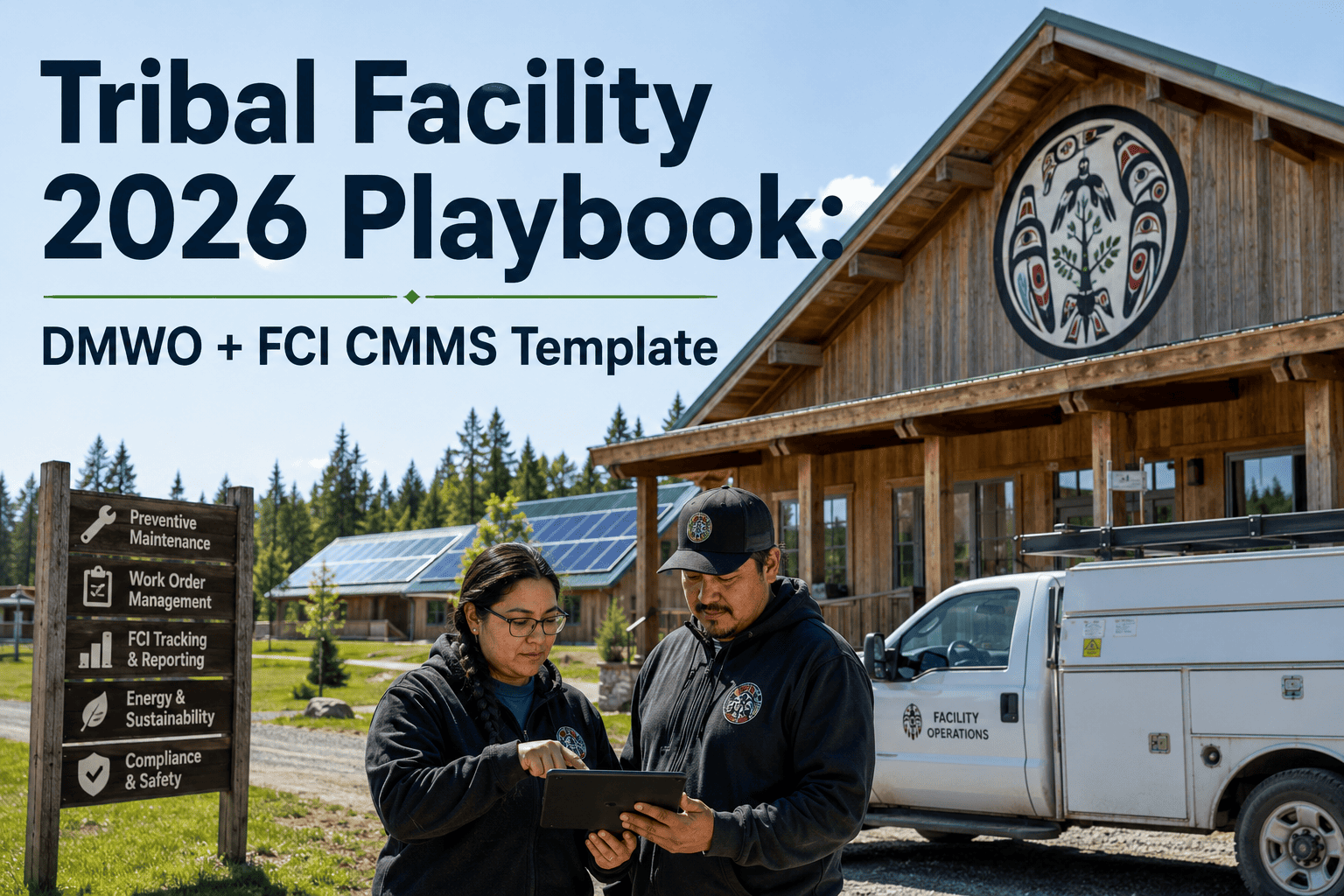
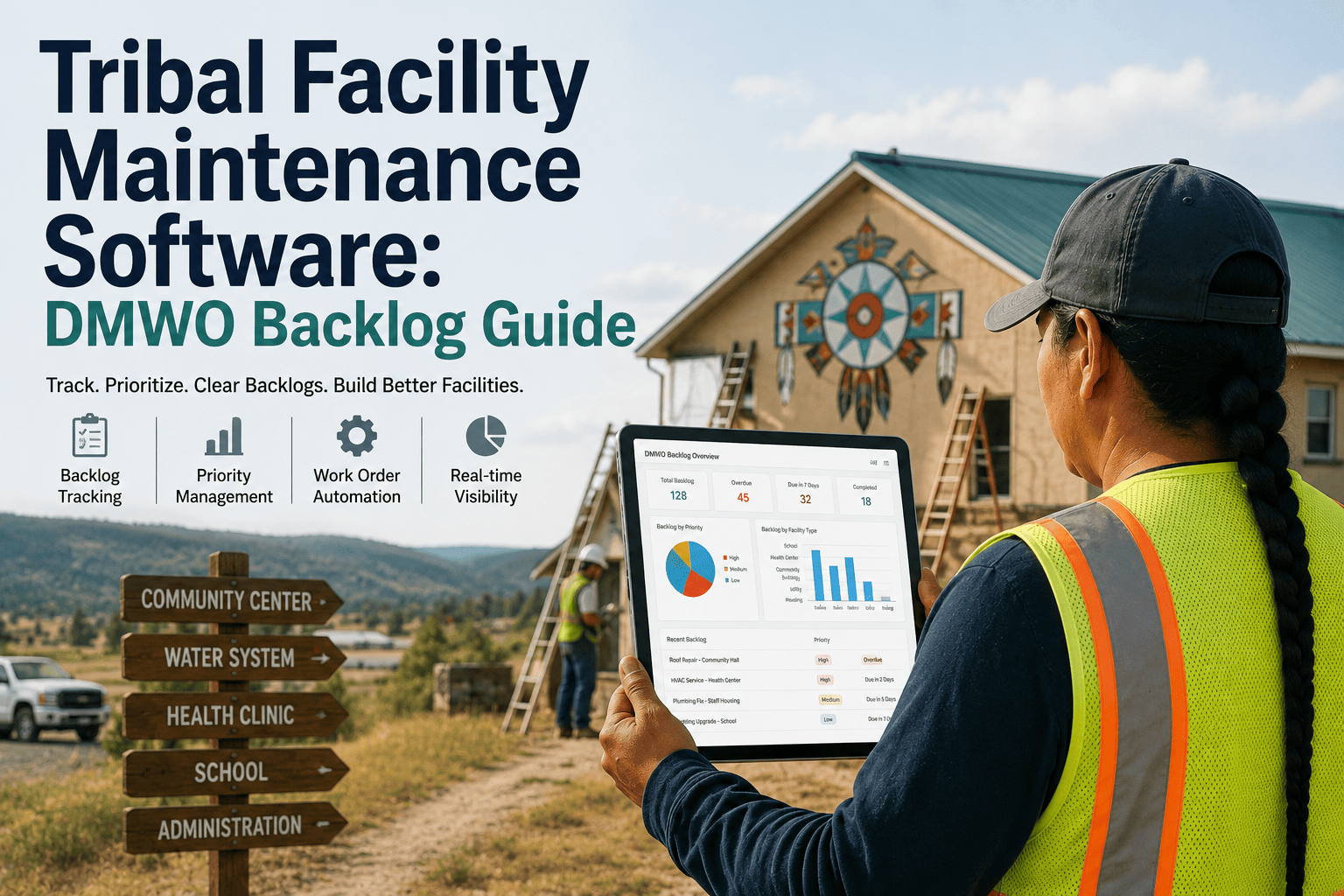
Across Indian Country, more than 180 schools funded by the Bureau of Indian Education serve thousands of Native students inside buildings that are, on average, decades older than the public school down the road. When a boiler fails, a roof starts leaking, or a fire panel stops responding, the fix becomes a Deferred Maintenance Work Order — a DMWO — that can sit unresolved for months or years while funding and crews are found. Facilities staff at tribal BIE schools juggle safety inspections, GAO oversight, and BIE reporting requirements using paper logs, spreadsheets, and phone calls, while the nationwide DMWO backlog has climbed past a billion dollars. A CMMS built around how tribal BIE school facility teams actually work turns that backlog into a tracked, prioritized, audit-ready queue instead of a drawer full of sticky notes, and you can see how at oxmaint.ai.
Tribal BIE School Facilities — 2026 Guide
Cutting the DMWO Backlog at Tribal BIE Schools Before It Cuts Into Learning Time
Deferred Maintenance Work Orders are the single biggest threat to safe, functioning tribal BIE school campuses. This guide breaks down why DMWO backlogs form, what a CMMS-tracked reduction program looks like in practice, and how facility teams turn a wall of overdue repairs into a manageable, defensible plan.
183
BIE-funded schools operating across tribal communities nationwide
$1B+
Accumulated deferred maintenance reported across the BIE school system
50%
Estimated reduction in building lifespan tied to chronic deferred maintenance
27%Facilities staff vacancy rate reported across BIE-funded schools
67%Historical funding level against calculated facilities operations need
$6,900Approximate per-student spend reported for the 2023-24 school year
AnnualBuilding inspections required at every BIE-funded facility
Why DMWO Backlogs Keep Growing at Tribal BIE Schools
Every tribal BIE school facility manager inherits the same structural problem: buildings that are older than the funding model was ever designed for, spread across some of the most remote geography in the country. A single facilities team might be responsible for a K-12 campus, a dormitory, staff quarters, and a bus fleet, all while reporting up through BIE, the Bureau of Indian Affairs Division of Facilities Management and Construction, and sometimes tribal government channels at the same time. Deferred Maintenance Work Orders pile up not because staff do not care, but because there is no single, current, prioritized view of what is actually broken, how urgent it is, and what it will cost to fix. The result is a facilities condition index that keeps sliding while the list of open DMWOs keeps growing.
This is not a hypothetical problem. Congressional testimony has described BIE-funded schools with boilers so deteriorated they failed inspection on gas leaks and carbon monoxide readings, forcing a full building evacuation while emergency repairs were made. Multiplied across 183 campuses, incidents like that are the visible tip of a much larger pattern: routine deficiencies that were never resolved on schedule because nobody had a system built to track them all the way to closure. A roof membrane that should have been patched two years ago becomes a structural repair. A worn electrical panel that should have been swapped during a summer break becomes a code violation an inspector has to write up. Every deferred item compounds, and the schools carrying the heaviest backlogs are often the ones with the least staff capacity to dig out of them.
Paper-Based Work Order Logs
Repair requests are written on carbon-copy forms or emailed as attachments, so nobody outside the building knows a DMWO exists until an inspector asks for the file.
No Shared Priority System
Without a consistent scoring method, a failing exhaust fan and a leaking gym roof compete for the same limited crew hours with no clear rule for which goes first.
Disconnected Funding Cycles
Facilities Operations and Maintenance dollars, Great American Outdoors Act capital funds, and tribal contributions move on different calendars, so approved DMWOs stall waiting on the right funding line.
Remote Site Logistics
Parts and specialized contractors often have to travel hundreds of miles to reach a campus, so a DMWO that looks small on paper can take weeks to close in the field.
Thin, Overstretched Staff
With facilities vacancy rates running high across the BIE system, the people who remain are stretched across safety inspections, minor repairs, and major DMWO documentation at once.
Inspection-to-Action Gaps
Annual safety inspections generate long deficiency lists, but without a system to convert findings into tracked work orders automatically, items get re-discovered every year instead of resolved.
Turn Your DMWO List Into a Working Plan
Oxmaint gives tribal BIE school facility teams one shared system to log, prioritize, and close Deferred Maintenance Work Orders — with the documentation trail that inspectors and funders expect.
The Four-Stage DMWO Reduction Workflow
Cutting a DMWO backlog is not a one-time project — it is a repeatable cycle that has to run every school year, layered on top of the inspections and emergency repairs that never stop. Facility teams that make real progress tend to follow the same four-stage pattern, whether their campus has forty buildings or four. The stages below are not a theoretical model; they mirror the order in which a facilities director actually has to work through a backlog when a new school year starts with a hundred or more open items and a finite number of maintenance hours to spend.
1
Capture Every DMWO in One Register
Every deficiency from annual inspections, teacher reports, and walkthroughs gets logged as a discrete DMWO with a building, system, and asset tag attached, replacing scattered paper trails with one searchable record.
2
Score Urgency and Safety Impact
Each DMWO is scored against a consistent set of criteria — life-safety risk, code exposure, and instructional disruption — so a gas leak and a cracked sidewalk are never competing for the same crew hour by accident.
3
Match Work to the Right Funding Line
Minor repairs route to routine O&M budgets, while major system failures get flagged for capital or Legacy Restoration Fund review, so nothing stalls simply because it was filed under the wrong category.
4
Track Closure and Rebuild the Condition Score
As DMWOs close, the facility condition index recalculates automatically, giving school leadership and tribal partners a current, defensible number instead of a backlog that only ever seems to grow.
Paper-Based Tracking vs. CMMS-Tracked DMWO Management
The difference between a school that is slowly losing ground on its backlog and one that is closing it out shows up clearly once the two approaches are compared side by side. A connected CMMS does not remove the underlying funding pressure tribal BIE schools face, but it does remove the guesswork about what is broken, what matters most, and what is actually getting fixed. The table below reflects the same six tasks every facilities team handles weekly, just carried out two very different ways — one dependent on institutional memory, the other backed by a record every stakeholder can see.
| Facility Task | Paper & Spreadsheet Tracking | CMMS-Tracked DMWO System |
| Logging a new deficiency |
Handwritten form or email, filed locally |
Logged once, instantly visible to every stakeholder |
| Setting repair priority |
Judgment call by whoever is on site that day |
Consistent scoring rule applied to every DMWO |
| Finding backlog status |
Manual count across binders and folders |
Live dashboard of open, in-progress, and closed items |
| Preparing for GAO or BIE review |
Days spent reconstructing paper trails |
Audit-ready export generated in minutes |
| Connecting repairs to funding |
Tracked separately, often disconnected |
Each DMWO tagged to its funding source and status |
| Preventing repeat deficiencies |
Rediscovered at the next annual inspection |
Flagged with history, parts used, and recurrence pattern |
Before we had a shared system, our DMWO list lived in three different binders and one facilities director's memory. When she was out, nobody could tell an inspector what was actually open. Moving to a tracked, scored backlog did not make our funding problem disappear, but it meant every dollar we did get went to the highest-risk repair first, and we could finally show our school board a real number instead of a guess.
— Facilities Director, tribal BIE-funded K-12 campus
Signs Your Tribal BIE School Backlog Needs a System, Not Just More Staff
Facilities directors rarely wake up one day and decide to overhaul how DMWOs are tracked. It usually happens gradually, after enough small warning signs stack up that the old way of doing things stops being sustainable. Recognizing those signs early is often the difference between a manageable backlog and one that takes years to unwind, and between a facilities team that feels constantly behind and one that can finally show measurable progress from one school year to the next.
Nobody Can State the Real Number
When a tribal council or school board asks how many DMWOs are open, the honest answer is an estimate, not a count, because the true total is scattered across binders, inboxes, and someone's memory.
Inspection Findings Repeat Every Year
The same deficiencies show up on consecutive annual safety inspections because there was no mechanism converting last year's finding into a tracked, assigned work order this year.
Funding Requests Get Rejected for Missing Data
Capital and Legacy Restoration Fund applications stall because the facility cannot produce the dated history, cost estimate, and condition evidence that funders and BIE regional offices require.
What a CMMS-Tracked DMWO Program Actually Delivers
A reduction program is only as strong as the outcomes it produces on the ground — for students, for staff safety, and for the tribal leadership and BIE partners who depend on accurate reporting. These are the pillars that hold a DMWO reduction program together over multiple school years, not just one budget cycle. None of them require replacing existing maintenance staff or bringing in outside contractors; they require giving the people already doing the work a system that remembers what they already know and makes it visible to everyone who needs it.
Life-Safety First
Boiler, electrical, and fire-system DMWOs are automatically surfaced above cosmetic repairs, so a leaking gas line never waits behind a paint job again.
Audit-Ready Documentation
Every inspection finding, work order, and closure is time-stamped and exportable, cutting the scramble before a GAO or Office of Inspector General review.
Visible Progress for Leadership
Tribal councils, school boards, and BIE regional offices get a plain-language view of backlog trends instead of a raw number with no context behind it.
Stronger Funding Applications
Every DMWO carries its own dated history, cost estimate, and photo record, so a Legacy Restoration Fund or capital request arrives with the evidence reviewers ask for the first time.
Continuity Across Staff Turnover
Because facilities vacancy rates run high across the BIE system, a new hire can see the full history of a building's open and closed DMWOs from day one instead of starting from zero.
Put together, these pillars change what a DMWO backlog actually represents to a school. Instead of a source of dread before every inspection, it becomes a working plan that leadership can point to, staff can act on, and funders can trust. That shift in how the backlog is perceived — from an unmanageable liability to a tracked project — is often what unlocks the political and financial support needed to shrink it for good.
Frequently Asked Questions
What exactly is a DMWO at a BIE-funded school?
A DMWO, or Deferred Maintenance Work Order, is a documented repair that could not be completed when identified and instead waits in a backlog for funding, parts, or crew availability. Learn how tribal facility teams manage this backlog with a connected
CMMS platform.
Why do tribal BIE schools carry larger backlogs than typical public schools?
Many campuses are older, more remote, and historically funded below the calculated need for facilities operations and maintenance, which compounds small deferred repairs into large structural and safety issues over time.
How does a CMMS help reduce an existing DMWO backlog?
A CMMS centralizes every open deficiency, applies a consistent urgency score, and tracks each item through to closure, replacing scattered paper logs with one dashboard your team and reviewers can trust.
Book a demo to see the workflow in action.
Does DMWO tracking help during GAO or BIE facility inspections?
Yes. When every deficiency, work order, and closure date is logged in one system, facility teams can generate an audit-ready history in minutes instead of reconstructing records from memory and paper files scattered across an office.
Can one system manage DMWOs across multiple tribal school campuses?
A shared platform lets a facilities director compare backlog status, urgency, and funding source across every campus in a network from one screen, rather than checking each site separately, which matters most for tribes operating several BIE-funded sites under one facilities team. Explore this at
oxmaint.ai.
Stop Letting DMWOs Outrun Your Team
Get every deferred maintenance item at your tribal BIE school into one prioritized, trackable system built for how facility teams actually work.