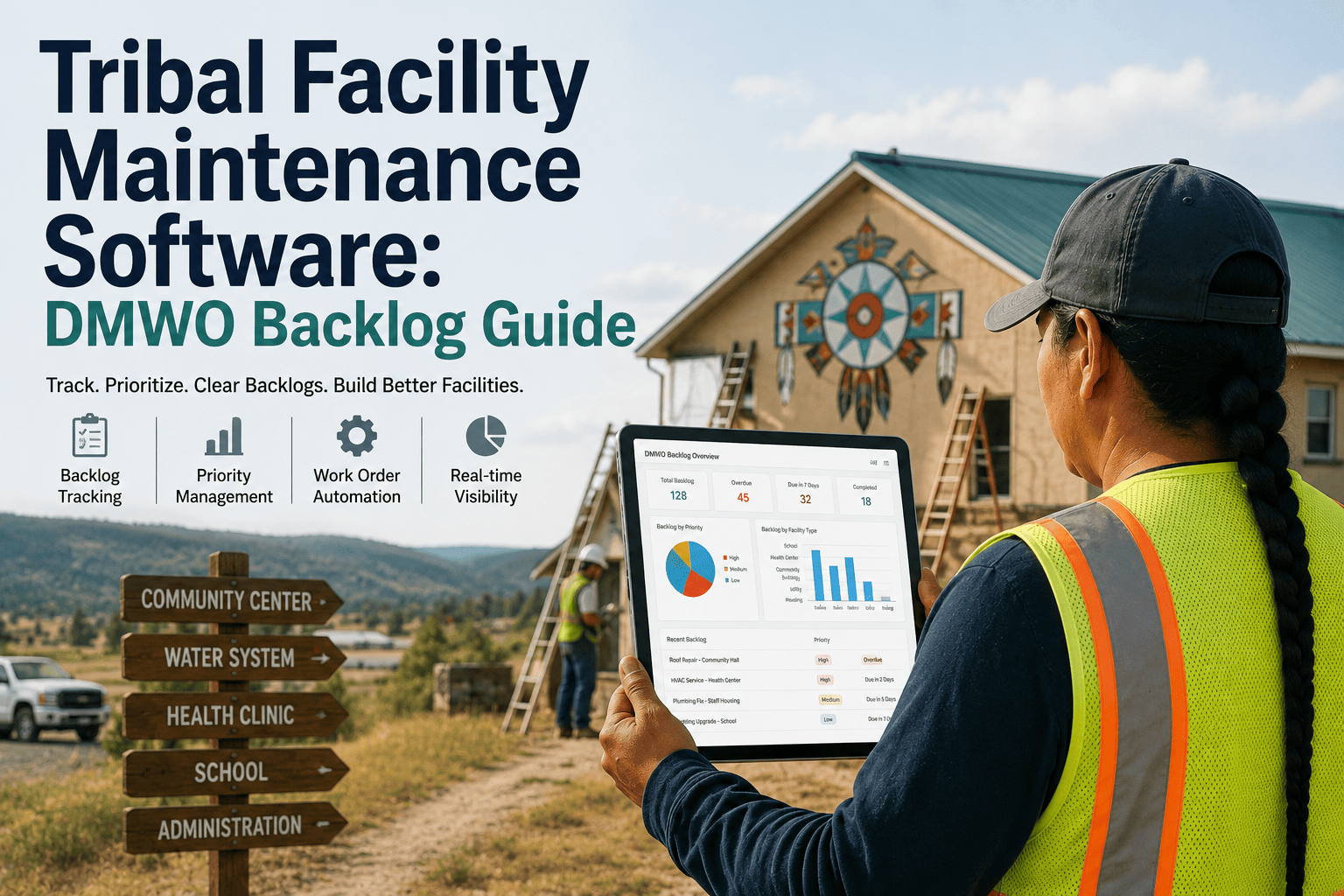
Running a health clinic, school, or administration building forty minutes past the nearest paved highway changes what facility maintenance actually costs. A blown compressor that would draw three competing bids in a metro area might mean one available vendor, a four-hour round trip, and a two-week wait on a freight-shipped part when it happens on a reservation. Fuel, mileage, standby time, and shipping surcharges quietly turn a routine repair into a budget event, and most maintenance software was never designed to see any of that, so the numbers only surface as an unexplained overrun months later. Tribal facility teams manage this reality every day, stretching housing, health, and administrative budgets across distances that generic CMMS benchmarks simply do not account for. Sign in to OxMaint to see how a maintenance system built around real travel time and vendor scarcity changes the math.
The Real Cost of Distance in Tribal Facility Maintenance
Every mile between a tribal facility and the nearest qualified vendor adds cost that national maintenance benchmarks were never built to track. Here is where the geographic premium actually comes from, how it compounds across a fiscal year, and how a CMMS designed around real travel time, vendor scarcity, and freight delay closes the gap between what a repair should cost and what it actually costs on the ground.
Why Tribal Facilities Pay a Location Tax
A national maintenance budget benchmark assumes a competitive local vendor market, same-day parts, and short response windows. Tribal and reservation-based facilities frequently operate under the opposite conditions, and each of those gaps shows up as real, recurring cost rather than a one-time inconvenience. Understanding each driver separately makes it possible to plan for it instead of treating every overrun as an unpredictable one-off.
Travel Time Becomes Billable Time
When the nearest licensed electrician or refrigeration tech is ninety minutes away, that drive is billed as labor before any diagnostic work even starts. Round-trip travel, mileage, and sometimes lodging turn a two-hour repair into a full-day invoice, and that pattern repeats on every service call rather than showing up as a one-off exception in the budget.
Vendor Scarcity Removes Competitive Pricing
Urban facility managers can shop three bids for the same job. In many rural and tribal service areas there is a single contractor willing to make the drive, which removes the price pressure that competition normally provides and leaves little room to negotiate on rate, callout fee, or timeline once a repair becomes urgent.
Freight and Parts Lead Time
A compressor, control board, or specialty gasket that ships overnight to a metro address can take one to two weeks to reach a reservation address, especially where carriers route through a regional hub first. That delay often costs more in downtime, spoiled inventory, or displaced staff than the part itself.
Funding Cycles Do Not Match Emergency Repairs
Many tribal facility budgets are tied to annual grant cycles, BIA allocations, or Section 105(l) lease reimbursement schedules. An emergency failure that falls between funding windows still needs a fix today, which forces facility teams to document costs carefully to recover them later through the correct reimbursement channel.
Seasonal Access Can Shut the Window Entirely
Unpaved access roads, seasonal weather closures, and limited winter daylight can remove a repair window altogether for weeks at a time. A facility team that cannot get a vendor onto the property until conditions change needs a maintenance plan that anticipates the closure, not one that reacts to it after the fact.
Signs Your Facility Is Already Paying a Hidden Distance Premium
Most facility teams do not see the geographic premium as a single line item — it hides inside labor invoices, delayed work orders, and budget overruns that look unrelated until they are compared side by side. A few patterns are worth watching for.
Repeat Callout Fees on the Same Asset
If the same rooftop unit or boiler generates a fresh travel and callout charge every few months, the underlying issue is likely being patched rather than fixed, and each visit is paying the same distance tax again.
Work Orders Sitting Open for Weeks
A long gap between a reported issue and a completed repair is often a scheduling and vendor-availability problem in disguise, not a low-priority issue. Tracking how long remote work orders actually sit open reveals where the bottleneck really is.
Emergency Spend Outpacing Preventive Spend
When reactive, emergency repairs consistently cost more than planned preventive maintenance across a fiscal year, distance is usually amplifying the size of every failure that preventive work could have caught earlier and cheaper.
Grant Reports Missing Cost Detail
If lease reimbursement or grant reporting requires reconstructing labor, travel, and parts cost after the fact from paper invoices, that missing documentation is quietly costing the facility reimbursement dollars it was entitled to claim.
See Your Real Maintenance Cost, Not the National Average
OxMaint lets tribal facility teams tag every work order with actual travel distance, vendor rate, and freight time, so budget planning reflects the facility's real geography instead of a national benchmark that was never built for it. The result is a maintenance budget that holds up under audit and grant review, because every dollar tied to distance is documented at the moment it is spent.
How Cost and Response Time Escalate With Distance
The relationship is not gradual — it tends to step up sharply once a facility passes certain distance thresholds from the nearest service hub. The bands below illustrate the general pattern facility teams report as sites move further from town, and they help explain why two facilities with identical equipment can carry very different maintenance budgets purely based on where the property sits on a map.
What Tribal Facility Teams Should Budget For
Comparing a near-metro baseline against remote reservation conditions makes the true cost gap visible, and shows where a CMMS built for distance actually earns its keep. Facility teams that map these categories against their own asset list typically find the gap is largest in exactly the areas that are hardest to plan for without a system tracking them.
| Cost Factor | Near-Metro Baseline | Remote & Reservation Reality | How OxMaint Helps |
|---|---|---|---|
| Vendor response time | Same day to next day, multiple bidders | Multi-day wait, often one available vendor | Tracks vendor lead time by asset so delays are planned for, not a surprise |
| Parts and freight | Overnight shipping widely available | One to two weeks through regional freight hubs | Flags long-lead parts and links them to preventive schedules |
| Standby and travel billing | Minimal, folded into local rate | Often exceeds the repair labor itself | Logs travel and standby against each work order for accurate cost history |
| Grant and lease reimbursement | Simple capital expense records | Requires documented lifecycle cost for 105(l) and BIA reporting | Generates exportable maintenance history tied to each funded asset |
| Preventive scheduling | Reactive repairs are affordable | A single reactive failure can consume a quarter's budget | Automates PM schedules to reduce reliance on emergency, high-premium callouts |
Building a Preventive Maintenance Plan That Fits Remote Realities
A preventive maintenance program built around a distant vendor relationship looks different from one built around a nearby contractor on call. The goal shifts from fast response to fewer surprises, since fast response is often not available at any price, no matter how urgent the failure or how large the budget behind it.
Bundle Trips Around Trades, Not Buildings
When a specialty vendor is already making the drive for one job, scheduling every other asset that trade can touch on the same visit spreads the travel cost across several work orders instead of paying it fresh each time.
Stock Critical Spares On-Site
Identifying the handful of parts that cause the longest downtime when they fail, and keeping one of each on a shelf on-site, can turn a two-week freight wait into a same-day fix for the failures that matter most.
Track Every Vendor by Reliability, Not Just Rate
Where only one or two vendors serve an area, the vendor's track record on showing up and finishing the job matters more than a marginally lower quote. A maintenance history that scores this over time protects against relying on the wrong one.
Plan Around Seasonal Access Windows
Scheduling major preventive work before a road closure season or weather window closes, rather than after a failure forces the issue, keeps the facility from being stranded without a fix during the months a vendor cannot reach the site at all.
Facility teams supporting tribal health centers, schools, and administration buildings tell us the same thing in different words: the maintenance software they were sold assumed a service market that does not exist where they operate. A generic CMMS tracks what broke and when it was fixed. It does not tell a facility director why a single HVAC failure cost four times the manufacturer's estimate, or help build the documentation a lease reimbursement claim requires. That gap is exactly what a distance-aware CMMS is meant to close — not by changing the geography, but by making its cost visible, plannable, and fundable instead of a recurring budget surprise. Over a full fiscal year, that visibility is often the difference between a maintenance budget that quietly runs out in the third quarter and one that holds because every travel hour, vendor rate, and freight delay was logged the moment it happened rather than reconstructed later from memory and paper receipts, long after the details anyone could still recall clearly have faded.
Frequently Asked Questions
Stop Budgeting for Distance With Guesswork
OxMaint gives tribal facility teams a maintenance system that accounts for travel, vendor scarcity, and freight delay from the first work order, turning a recurring budget surprise into a documented, plannable cost. Start with the assets that cost you the most today, and build a maintenance history that makes next year's budget easier to defend than this year's was.