When the spillway gate at Meadow Creek Dam seized during a flash flood in October 2024, the failure report revealed a maintenance history that defied operational logic. The gate had received its annual lubrication and inspection seven months earlier — right on schedule — despite having cycled only 34 times since the previous service. Meanwhile, the identical gate at Ridgeline Dam — same manufacturer, same age, same maintenance interval — had cycled 3,800 times during an unusually active flood season and received zero additional attention because the calendar said it wasn't due yet. The Ridgeline gate's harmonic drive failed catastrophically at 3,847 cycles, triggering an emergency drawdown thatcost $3.1 million, evacuated 6,200 downstream residents, and exposed a systemic truth: calendar-based maintenance treats every dam asset as if it experiences identical operational stress, when in reality, usage varies by 10x or more between facilities.
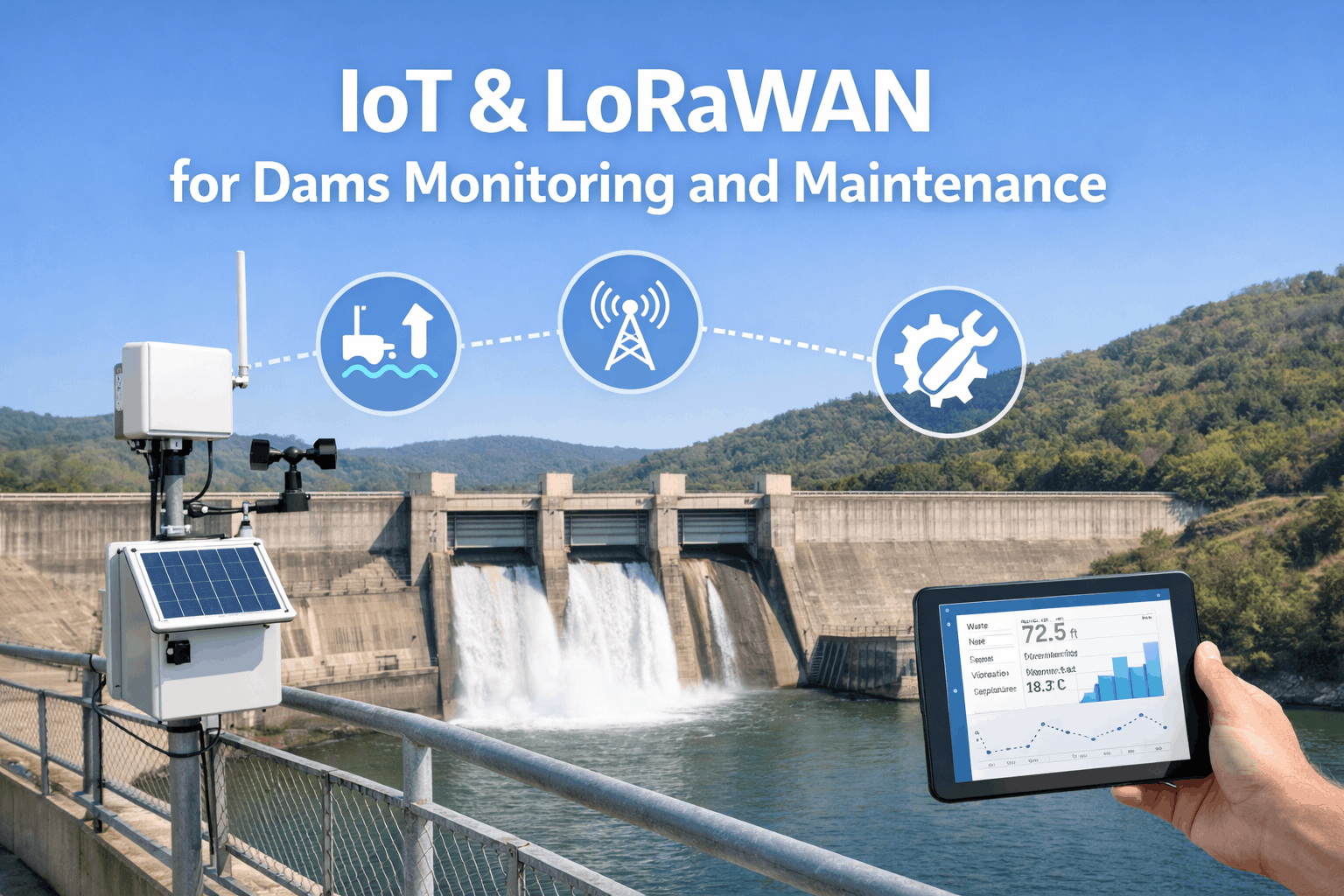
IoT sensor networks have made this calendar fiction unnecessary. Piezometers stream real-time pore pressure data, accelerometers count every gate cycle and measure vibration severity, inclinometers track embankment displacement continuously, and flow sensors quantify seepage at toe drains around the clock. When this usage data feeds a CMMS platform, maintenance shifts from arbitrary calendars to actual asset consumption — scheduling inspections, calibrations, and repairs based on what the dam is doing, not when a schedule says. Oxmaint AI integrates drones, robots, sensors, and analytics to automate dam inspections, reduce downtime, and keep citizens safe. Start free trial today.
Dam Asset Intelligence 2026
Usage-Based Maintenance for Dams Assets Using IoT Data
Replace calendar-based dam maintenance with IoT-driven usage intelligence. Piezometers, accelerometers, inclinometers, and flow sensors stream real-time operational data into Oxmaint CMMS — triggering inspections, calibrations, and repairs based on actual asset stress, cycle counts, and environmental loading rather than arbitrary time intervals that ignore how hard each asset actually works.
91,457Dams in U.S. National Inventory
72%Still on Calendar-Only Maintenance
45%Budget Wasted on Low-Use Assets
3–8xROI From Usage-Based Scheduling
The Usage-Based Maintenance Maturity Spectrum
Most dam-owning agencies remain locked in calendar-based maintenance — inspecting every asset on the same schedule regardless of how hard it works. Usage-based maintenance shifts this paradigm by linking maintenance triggers to actual operational data: gate cycle counts, pore pressure accumulations, seepage flow rates, and vibration severity indices. Oxmaint helps agencies advance from "Calendar-Bound" through "Usage-Aware" to "Predictive" maintenance where every work order is justified by sensor evidence rather than arbitrary time intervals.
Calendar-Bound (No IoT)
72%
Usage-Aware (IoT Triggers)
20%
IoT Sensor Categories for Dam Usage Tracking
Usage-based dam maintenance requires IoT sensors that quantify actual operational stress on each asset class. A comprehensive CMMS acts as the central authority for these data streams — correlating pore pressure trends, gate cycle counts, seepage volumes, and displacement readings into actionable maintenance triggers that replace arbitrary calendar intervals with evidence-based scheduling.
IoT Sensor Framework for Dam Usage IntelligenceSensor Matrix
Piezometers
Pore Pressure Monitoring
Vibrating-wire and standpipe piezometers measure pore water pressure within embankment fill and foundations. Cumulative pressure-hours above threshold trigger grouting inspections and seepage pathway investigations.
Seepage Critical
Accelerometers
Gate Vibration & Cycle Counting
MEMS accelerometers on spillway gates, outlet valves, and mechanical operators track vibration severity and cumulative cycle counts. Maintenance triggered at cycle thresholds rather than calendar intervals.
Mechanical Wear
Inclinometers
Embankment Displacement
In-place inclinometers and SAA arrays measure lateral displacement within embankment and foundation soils. Cumulative displacement above threshold triggers geotechnical review and stabilisation assessment.
Stability Risk
Flow Sensors
Seepage & Drain Monitoring
Weir-based and electromagnetic flow sensors at toe drains, relief wells, and collection galleries measure seepage volumes continuously. Rising flow trends trigger inspection and remediation work orders.
Erosion Indicator
Pool Level
Reservoir Loading Accumulation
Pressure transducers and radar level sensors track reservoir pool elevation continuously. Cumulative hours above normal pool trigger embankment stress assessments and spillway readiness inspections.
Loading Stress
Weather
Environmental Load Tracking
On-site weather stations track precipitation, temperature, and freeze-thaw cycles. Cumulative environmental loading triggers concrete crack inspections, joint seal assessments, and riprap condition reviews.
Degradation Driver
Usage Threshold Severity Scale
Not all usage accumulations carry equal maintenance urgency. A spillway gate approaching its manufacturer's cycle limit demands immediate action; a piezometer showing gradual seasonal variation requires monitoring but not emergency response. This severity scale helps dam safety engineers prioritise CMMS work orders based on how close each asset is to its usage-based intervention threshold.
5
Emergency Threshold
Asset exceeded manufacturer limits or safety thresholds. Immediate shutdown, inspection, and repair required. CMMS escalation to dam safety officer.
4
Critical Threshold
90%+ of usage limit reached. Schedule repair within 72 hours. CMMS auto-generates priority work order with full sensor evidence package.
3
Warning Threshold
70-89% of usage limit. Plan intervention in next maintenance window. CMMS schedules inspection with parts pre-staging and crew allocation.
2
Advisory Threshold
50-69% of usage limit. Monitor trend acceleration. CMMS flags for next scheduled inspection cycle with updated sensor baseline.
1
Normal Operation
Below 50% of usage limit. Continue monitoring. No action required. CMMS logs data for trend analysis and lifecycle planning.
Replace Calendar Guesswork With IoT-Driven Dam Maintenance
Oxmaint ingests real-time IoT data from piezometers, accelerometers, inclinometers, and flow sensors — automatically triggering CMMS work orders when dam assets reach usage-based maintenance thresholds. Stop maintaining by the calendar. Start maintaining by the data.
Usage-Based Maintenance by Dam Asset Class
Different dam asset classes accumulate usage stress in fundamentally different ways. Mechanical assets like gates and valves wear through cycle counts; geotechnical assets like embankments degrade through cumulative pore pressure loading; concrete structures deteriorate through freeze-thaw cycles and thermal stress. The usage metric, sensor type, and CMMS trigger logic must be tailored to each asset class for effective maintenance scheduling.
Mechanical
Spillway Gates & Operators
Cycle-Count Trigger
Accelerometers and position sensors track every gate cycle. CMMS triggers bearing inspection at 500 cycles, seal replacement at 2,000 cycles, and full overhaul at 5,000 cycles — regardless of calendar time elapsed.
Cycle CounterVibration RMSMotor CurrentSeal Wear
Critical
Outlet Works & Valves
Flow-Hours Trigger
Flow sensors and valve position monitors track cumulative flow-hours through outlet conduits. Cavitation risk escalates with flow velocity duration. CMMS triggers conduit inspection at 10,000 flow-hours and valve overhaul at 25,000.
Flow RateValve PositionCavitation IndexConduit Pressure
Geotechnical
Embankment & Foundation
Pressure-Hours Trigger
Piezometers track cumulative pore pressure hours above baseline. Inclinometers measure total displacement. CMMS triggers geotechnical review when pressure-hours exceed seasonal norms by 2 standard deviations.
Pore PressureDisplacementSettlementSeepage Flow
Structural
Concrete Structures
Thermal-Cycle Trigger
Temperature sensors and crack monitors track freeze-thaw cycle accumulation and thermal gradient stress. CMMS triggers joint seal inspection at 150 freeze-thaw cycles and concrete condition survey at 500 cycles.
F-T CyclesCrack WidthJoint MovementThermal Gradient
Monitoring
Instrumentation Systems
Reading-Count Trigger
IoT sensor health monitoring tracks reading counts, battery voltage, signal quality, and calibration drift. CMMS triggers calibration at 50,000 readings or when drift exceeds ±2% of full-scale range.
Reading CountBattery LifeSignal QualityCal Drift
Environmental
Riprap & Erosion Protection
Wave-Energy Trigger
Wave height sensors and wind speed monitors track cumulative wave energy impacting upstream slope protection. CMMS triggers riprap condition survey when seasonal wave energy exceeds design thresholds.
Wave EnergyWind SpeedIce LoadingRunoff Volume
Usage Profiles by Dam Classification
Different dam classifications experience fundamentally different usage profiles. A high-hazard flood control dam with frequent gate operations and seasonal pool fluctuations accumulates mechanical and hydraulic stress at 5-10x the rate of a low-hazard recreation impoundment. The usage-based maintenance strategy must adapt sensor density, threshold settings, and CMMS trigger logic to each classification's operational reality.
High-Hazard / Flood Control
2,000-5,000 gate cycles per year
Seasonal pool fluctuations of 30-60 ft
Continuous seepage monitoring required
50+ piezometer readings per dam per day
FERC / state inspection compliance
Significant-Hazard / Water Supply
200-1,000 gate cycles per year
Moderate pool variation of 10-25 ft
Quarterly seepage measurement baseline
10-20 piezometer readings per day
State dam safety programme oversight
Low-Hazard / Recreation
Under 200 gate cycles per year
Minimal pool variation under 5 ft
Annual seepage check sufficient
Basic monitoring — minimal IoT density
Owner self-certification in many states
The Cost of Calendar vs. Usage-Based Maintenance
Calendar-based maintenance creates two simultaneous failures: over-maintaining low-stress assets (wasting budget) and under-maintaining high-stress assets (creating safety risk). The cost escalation model below shows how these failures compound across a typical 30-dam public agency portfolio — and how usage-based IoT intelligence redirects every maintenance dollar to where it actually prevents failure.
$180K/yr
Usage-Based (IoT-Driven)
Every work order justified by sensor data. Gate inspections triggered by cycle counts. Embankment reviews triggered by pore pressure trends. Zero wasted inspections on low-stress assets.
Efficiency: High
$420K/yr
Calendar-Based (Time-Only)
45% of budget spent on unnecessary inspections of low-stress assets. High-stress assets still under-maintained between fixed intervals. No data to justify scheduling decisions.
Efficiency: Low
$3.1M+
Reactive (After Failure)
Emergency gate repair after undetected cycle fatigue. Embankment remediation after seepage breakthrough. Evacuations, regulatory penalties, litigation, and public trust damage.
Efficiency: Zero
Stop Maintaining by the Calendar — Start Maintaining by the Data
Oxmaint connects to your dam IoT sensor network and converts real-time piezometer, accelerometer, inclinometer, and flow data into usage-based CMMS work orders — ensuring every inspection is justified by actual asset stress, not arbitrary time intervals that ignore operational reality.
CMMS Features for Usage-Based Dam Maintenance
A specialised CMMS is the command centre behind usage-based dam maintenance. It links IoT sensor streams with asset usage thresholds, converts threshold breaches into prioritised work orders, and ensures every maintenance action is justified by data evidence — giving dam safety engineers full auditability for FEMA, FERC, and state regulatory compliance.
A
IoT Usage Dashboard
Real-time visualisation of every dam asset's usage accumulation — cycle counts, pressure-hours, flow volumes, displacement totals, and freeze-thaw cycles displayed against configurable maintenance thresholds with colour-coded urgency indicators.
B
Threshold-Triggered Work Orders
When any asset's usage metric crosses its configured threshold, CMMS auto-generates a prioritised work order with sensor evidence, GPS location, recommended action, and parts requirements — no manual review needed for routine triggers.
C
Trend Analysis & Prediction
AI analyses usage accumulation rates to predict when each asset will reach its next maintenance threshold — enabling proactive crew scheduling, parts procurement, and budget allocation weeks or months in advance of trigger dates.
D
Regulatory Compliance Reports
Auto-generated reports map every maintenance action to its IoT usage trigger — providing FEMA, FERC, and state dam safety programmes with evidence-based documentation that every inspection was data-justified and completed on time.
E
Sensor Health Monitoring
Track IoT sensor battery levels, signal quality, calibration drift, and communication heartbeats. Auto-generate sensor maintenance work orders before data gaps compromise usage tracking accuracy across critical dam instrumentation.
F
Portfolio-Wide Usage Ranking
Rank every dam and asset across your portfolio by usage intensity — identifying which assets are approaching thresholds fastest and enabling risk-based prioritisation of limited maintenance budgets and crew resources across dozens of facilities.
Frequently Asked Questions
Q. What is usage-based maintenance for dam assets?
Usage-based maintenance (UBM) replaces fixed calendar schedules with maintenance triggers driven by actual asset operational data. Instead of inspecting a spillway gate every 12 months regardless of how many times it cycled, UBM triggers inspection at 500 cycles — whether that takes 6 months on a high-use flood control dam or 4 years on a low-use recreation impoundment. IoT sensors track the relevant usage metric for each asset class (cycle counts for gates, pressure-hours for piezometers, flow volumes for seepage, freeze-thaw cycles for concrete), and the CMMS auto-generates work orders when thresholds are crossed.
Sign up for Oxmaint to see usage-based dam maintenance in practice.
Q. What IoT sensors are needed for usage-based dam maintenance?
The core sensor suite includes: vibrating-wire piezometers for pore pressure monitoring, MEMS accelerometers for gate and valve cycle counting and vibration analysis, in-place inclinometers for embankment displacement tracking, electromagnetic flow sensors for seepage measurement, pressure transducers for pool level monitoring, and on-site weather stations for freeze-thaw and precipitation tracking. Most sensors communicate via LoRaWAN, cellular, or satellite to a central data logger that streams via MQTT to the CMMS. Sensor density varies by dam hazard classification — high-hazard dams typically require 50-200 sensors while low-hazard structures may need only 10-20.
Q. How does usage-based maintenance integrate with FEMA and state dam safety regulations?
FEMA and state dam safety programmes increasingly recognise data-driven maintenance as best practice. Usage-based CMMS platforms like Oxmaint generate audit-ready reports that document every maintenance action alongside its IoT usage trigger — showing regulators that each inspection, calibration, and repair was justified by sensor evidence rather than arbitrary calendar intervals. This evidence-based approach strengthens regulatory compliance documentation and demonstrates due diligence in dam safety management.
Schedule a demo to see compliance reporting for usage-based dam maintenance.
Q. What is the ROI of transitioning from calendar to usage-based dam maintenance?
Agencies typically achieve 3-8x ROI within 18-24 months. The savings come from three sources: eliminating 40-50% of unnecessary inspections on low-stress assets (direct budget savings), preventing 50-70% of unplanned failures through early detection on high-stress assets (avoided emergency costs of $2-8M per incident), and extending asset lifecycles by 15-25% through optimised maintenance timing rather than over- or under-maintaining. For a 30-dam portfolio, the typical transition investment is $120K-$250K for IoT sensors and CMMS integration, with annual savings of $200K-$600K from optimised scheduling alone.
Q. Can usage-based maintenance work alongside existing calendar inspection requirements?
Absolutely — usage-based maintenance complements rather than replaces regulatory inspection calendars. State and federal dam safety programmes mandate minimum inspection frequencies that remain in force regardless of usage data. Usage-based maintenance adds an intelligence layer on top of these minimums — triggering additional inspections when sensor data indicates high-stress assets need attention between scheduled intervals, and identifying low-stress assets where budget can be redirected to higher-priority work. The CMMS tracks both calendar-required and usage-triggered work orders in a unified system, ensuring regulatory compliance while optimising resource allocation.