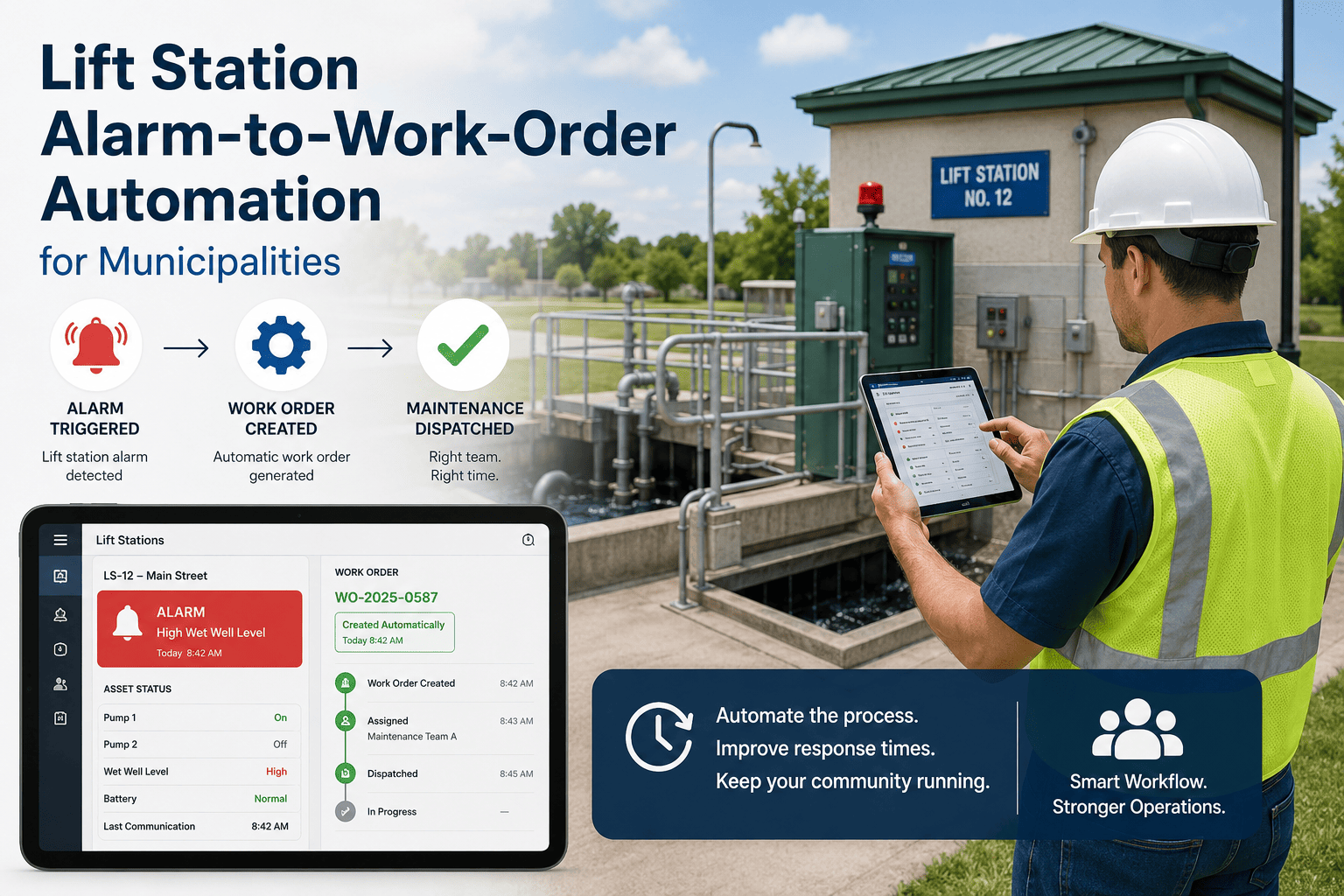
Wastewater lift stations are among the most failure-prone assets in municipal utility infrastructure — operating 24 hours a day, submerged in corrosive environments, and subject to highly variable loading conditions. A single wet-well overflow from a pump failure can generate EPA fines of $25,000 per day and trigger sanitary sewer overflow (SSO) reporting obligations that damage a utility's regulatory standing for years. OxMaint's predictive maintenance AI monitors lift station pump health in real time, detecting failures weeks before wet-well overflow becomes a risk. Book a 30-minute demo with our wastewater operations specialists.
Wastewater Lift Station Intelligence
Most Pump Failures Are Broadcast for Weeks Before They Happen
Vibration signatures, current draw anomalies, temperature drift, and wet-well level patterns all carry predictive signals that appear well before a pump fails and a SSO event occurs. The utilities catching these signals are eliminating reactive pump replacement entirely.
$25K
Per-day EPA fine for sanitary sewer overflow events
75%
Of lift station pump failures show detectable warning signs 2–6 weeks prior
4–5x
Higher cost of emergency pump replacement vs. planned maintenance
Why Lift Stations Fail — The Real Failure Distribution
Lift station failures trace to a predictable set of root causes. Every one of these failure modes produces measurable sensor signatures before catastrophic failure — vibration, current draw, temperature, and flow data all shift in detectable ways weeks before the pump stops responding.
38% — Pump bearing wear and seal failure
22% — Motor overload and insulation breakdown
18% — Rag/debris clogging and impeller damage
12% — Check valve failure and backflow
10% — Control panel and float switch failures
What This Means for Your Maintenance Program
The top three failure categories — bearing wear, motor degradation, and clogging events — are detectable through continuous vibration, current draw, and flow monitoring before the pump enters a failure condition. Only check valve and control panel failures require dedicated sensor investments beyond standard pump monitoring. Utilities with continuous monitoring in place catch 70 to 80 percent of lift station failures before wet-well level is affected.
The Predictive Monitoring Signal Chain
OxMaint connects to IoT sensors on your lift station pumps and wet-well instrumentation, building a continuous health model for each pump unit. The AI establishes normal operating signatures for your specific pumps under your specific loading conditions — then alerts your team when any parameter drifts outside learned baselines.
Pump Failure Detection Timeline — Predictive vs. Reactive
6 Weeks Before
Micro-vibration change in bearing. Current draw 3–5% above baseline. AI flags anomaly — low-priority alert generated. Work order for inspection scheduled.
3 Weeks Before
Vibration amplitude increasing. Pump efficiency dropping. Temperature rising on motor housing. Medium-priority alert — parts ordered, repair scheduled for next maintenance window.
1 Week Before
Multiple sensors crossing alert thresholds. Wet-well cycle time lengthening. High-priority work order — planned repair prevents failure. Cost: $800–$2,400. SSO risk: zero.
Day 0 — Failure
Reactive scenario: pump stops. SSO risk immediate. Emergency replacement cost $8,000–$22,000. EPA reporting triggered. Fine exposure begins at $25,000/day.
Predictive monitoring stops the timeline at Week 3. Reactive maintenance reaches Day 0.
Catch pump failures before the wet well overflows
OxMaint connects to your lift station sensors and starts detecting failure signatures from day one of monitoring.
Predictive vs. Reactive — Lift Station Cost Comparison
| Cost Category |
Reactive Response |
Predictive Prevention |
| Pump repair / replacement |
$8,000–$22,000 emergency rate |
$800–$2,400 planned maintenance |
| Emergency labor premium |
1.5–2.5× overtime rates |
Standard shift rates |
| SSO regulatory fines |
$25,000/day — often 3–7 days |
$0 — no overflow event |
| SSO reporting burden |
40–80 staff-hours per event |
No reporting required |
| Public notification costs |
Required for SSO events |
Not applicable |
| Total per-failure cost |
$85,000–$200,000+ per event |
$800–$2,400 per intervention |
Proven Results at Wastewater Utilities
89%
SSO Reduction
Achieved by a Southeast regional utility authority after deploying continuous pump monitoring across 34 lift stations — measured over a 24-month post-deployment period.
$1.4M
Annual Savings
In combined emergency repair costs and EPA fines avoided by a municipal utility district after implementing predictive lift station monitoring covering 28 pump stations.
63%
Fewer Emergency Callouts
Reduction in after-hours emergency crew dispatches to lift station failures — directly reducing overtime costs and improving crew work-life balance and retention.
Expert Perspective
The regulatory exposure from a single SSO event — fines, public notification, consent order risk, and the reputational damage with your regulatory agency — far exceeds the entire annual cost of a predictive monitoring program for most utility collections systems. The math is not complicated. What has been missing until recently is a monitoring platform that works at the asset level of lift stations, not just at the SCADA system level where alarms only fire when the pump has already failed.
Sandra Mitchell, P.E.
Collections System Operations Director — Water Environment Federation
Pump bearing failures in submersible wastewater pumps give you a predictable signal window — typically four to eight weeks from first detectable vibration anomaly to failure. Utilities that are monitoring continuous vibration spectra from their lift station pumps are catching almost every bearing failure in that window. Those that are relying on SCADA high-level alarms are catching them at the moment of failure. The difference is whether your maintenance team is solving a $1,500 bearing replacement or a $50,000 emergency response with an active overflow.
Dr. Kevin Zhao
Asset Management Research Lead — Water Research Foundation
Frequently Asked Questions
What sensors does OxMaint use to monitor lift station pumps?
OxMaint integrates with vibration sensors (accelerometers), current transducers for motor draw monitoring, temperature sensors on motor housings, wet-well level sensors, and flow meters on discharge headers. Most lift stations already have SCADA-connected level sensors and motor controls — OxMaint reads these through existing SCADA connections while adding vibration and current monitoring at the pump unit level for the predictive failure detection capability that SCADA alone cannot provide.
Book a demo to map the sensor requirements for your specific pump types.
How does OxMaint differentiate between a real pump anomaly and a normal variation in loading?
The OxMaint AI builds a baseline model specific to each pump unit under your actual operating conditions — accounting for influent flow variation, wet-well level cycles, seasonal temperature changes, and day-of-week loading patterns. Alerts are generated only when sensor readings deviate from this learned baseline in patterns consistent with known failure precursors. This approach significantly reduces the false-positive alarm rate that makes many SCADA alarm systems ineffective — utilities typically see a 70 to 80 percent reduction in nuisance alarms compared to threshold-based monitoring after the AI baseline matures over 6 to 8 weeks.
Does OxMaint help with SSO reporting documentation when an overflow does occur?
Yes. OxMaint maintains a continuous record of wet-well levels, pump operational status, flow data, and all maintenance and alert activity for every lift station. When an SSO event occurs, the platform can generate the complete operational timeline — pre-event conditions, alert status, maintenance history, and post-event response — in the format required for EPA 40 CFR Part 122 reporting and state environmental agency notifications. This reduces the typical 40 to 80 staff-hour SSO documentation burden to a matter of hours. Sign up at
app.oxmaint.ai to explore the compliance reporting module.
How quickly can OxMaint be deployed across a utility's lift station network?
Most utilities are monitoring their first lift stations within 1 to 2 weeks of deployment — connecting existing SCADA data streams requires only network configuration, not physical installation. For stations without existing vibration sensors, wireless sensor installation at a single lift station typically takes 2 to 4 hours of technician time. A standard deployment covering 20 to 30 lift stations is typically complete within 4 to 8 weeks. The AI predictive baseline matures over the following 6 to 8 weeks as normal operating patterns are established.
Book a demo for a deployment timeline specific to your station count and configuration.
Before the next overflow — not after
Your Lift Stations Are Sending Failure Signals Right Now. Is Anyone Listening?
OxMaint connects to your lift station pump sensors, learns your normal operating signatures, and alerts your team to failure precursors weeks before a wet-well overflow becomes a possibility. One avoided SSO event covers the entire cost of a predictive monitoring program for most utilities.