Lift station odor control failures generate more citizen complaints per asset than almost any other wastewater infrastructure problem — and they generate regulatory violation exposure simultaneously. Hydrogen sulfide from septic wastewater corrodes concrete structures, damages electrical equipment, and creates a genuine H2S poisoning risk for maintenance personnel entering wet wells without proper atmospheric monitoring. A functioning odor control system is not just a community relations matter: it is a corrosion management programme, a worker safety requirement, and in many jurisdictions, a permit compliance obligation. OxMaint's Preventive Maintenance and Work Order Management modules give wastewater operations managers a structured PM schedule for odor control systems, with mobile inspection forms, automatic service reminders, and a maintenance history that demonstrates regulatory compliance. Book a demo to see how wastewater utilities manage lift station PM in OxMaint.
Maintenance Checklist · Wastewater Utilities · Preventive Maintenance · OSHA Compliance
Wastewater Lift Station Odor Control Maintenance Checklist
Chemical dosing systems, biofilter maintenance, wet well monitoring, and H2S corrosion tracking — the complete PM framework for lift station odor control operations.
H2S
50 ppm OSHA PEL — routinely exceeded in unventilated lift station wet wells during high-flow periods
10 ppm
Threshold for immediate evacuation — detectable odor begins at 0.5 ppb; personnel cannot rely on smell as safety indicator
$180K
Average cost of H2S-related concrete corrosion damage to a lift station wet well (USEPA data)
3 types
Odor control technologies: chemical dosing (iron salts, nitrates), biofiltration, and activated carbon — each requires different PM schedule
Odor Control Technology — PM Schedule Overview
Chemical Dosing
Iron salt or nitrate dosing systems that treat wastewater to reduce sulfide generation
DailyDose rate verification, chemical level check
WeeklyPump condition, pipe and fitting inspection
MonthlyDosing pump calibration, sample analysis
Biofiltration
Biological media beds that oxidise H2S through microbial action before discharge
WeeklyInlet/outlet H2S measurement, moisture check
MonthlyMedia condition assessment, airflow measurement
AnnualMedia replacement assessment, fan service
Activated Carbon
Carbon adsorption units that capture H2S and other VOCs from extracted air streams
MonthlyOutlet H2S breakthrough testing
QuarterlyCarbon bed weight / saturation assessment
As neededCarbon media changeout on breakthrough
PM Zone 01
Chemical Dosing System Maintenance
Chemical dosing is the most common first-line odor control approach for force main lift stations. Iron salts (ferrous or ferric chloride) and magnesium hydroxide are dosed into the wet well or force main to precipitate dissolved sulfides before they can be released as H2S gas. Dosing pump calibration and chemical supply management are the critical PM activities — underdosing is invisible until odor complaints arrive, and overdosing wastes chemical and can affect downstream treatment processes.
Chemical Dosing PM ChecklistDaily + Weekly
Chemical storage tank levels checked and recorded — current level documented as percentage of capacity; reorder trigger point confirmed (typically 25% capacity); chemical delivery lead time and reorder quantity confirmed current; any tank level below minimum trigger generates automatic purchase request work order in OxMaintRecord: Daily level log · Role: Assigned Operator
Dosing pump operation confirmed — pump activates at correct intervals per setpoint; stroke rate and output volume verified against calibration sheet; any drift from calibrated output triggers recalibration procedure; pump motor temperature, noise, and vibration within normal range confirmed by physical checkRecord: Pump operation log with output measurement · Role: Assigned Operator
Dosing line integrity checked — injection point accessible and clear; dosing line shows no blockage (confirmed by flow test or inline pressure reading); check valve at injection point confirmed functional; any chemical staining or crystallisation at fittings indicates leak and triggers immediate inspectionRecord: Line integrity log with photo if defect found · Role: Assigned Operator
Monthly dosing rate optimisation review — wastewater sulfide loading estimated from grab sample or continuous monitor; dosing rate adjusted to match current loading; chemical consumption per unit of sulfide removed tracked as efficiency KPI; OxMaint work order created for any dose rate change with before/after settings documentedRecord: Monthly optimisation work order in OxMaint · Role: Operations Manager
PM Zone 02
Wet Well Entry Safety & Atmospheric Monitoring
Wet well entry is a permit-required confined space event under OSHA 1910.146. H2S concentrations in lift station wet wells frequently exceed immediately dangerous to life and health (IDLH) levels of 100 ppm during active pumping cycles. The most common scenario for wastewater worker fatalities is entry without atmospheric pre-testing, often combined with a secondary entry by a would-be rescuer who also enters without protection. Pre-entry atmospheric testing and standby attendant are non-negotiable.
Wet Well Entry Safety ChecklistOSHA 1910.146 — Before Every Entry
Atmospheric pre-testing completed at wet well access point and at working depth — multi-gas meter readings: O2 (19.5–23.5% required), H2S below 10 ppm, LEL below 10%, CO below 25 ppm; if any parameter outside acceptable range, ventilation required and re-test before entry; meter serial number and calibration date documented on confined space permitRecord: Gas readings on confined space permit · Role: Entry Supervisor
Attendant stationed at entry point throughout work period — attendant does not enter confined space; attendant maintains visual or voice contact with entrant; retrieval equipment (tripod, winch, harness) set up and confirmed operational before entry; attendant has emergency contact numbers and rescue service pre-notified per confined space programmeRecord: Attendant assignment on entry permit · Role: Entry Supervisor
Continuous atmospheric monitoring during wet well work — portable multi-gas alarm worn by entrant with audible alarm set to action levels; H2S alarm at 10 ppm triggers immediate evacuation; any change in wastewater inflow rate monitored from surface as indicator of rising sulfide load; entrant communicates status every 10 minutesRecord: Continuous monitoring log during entry period · Role: Entrant + Attendant
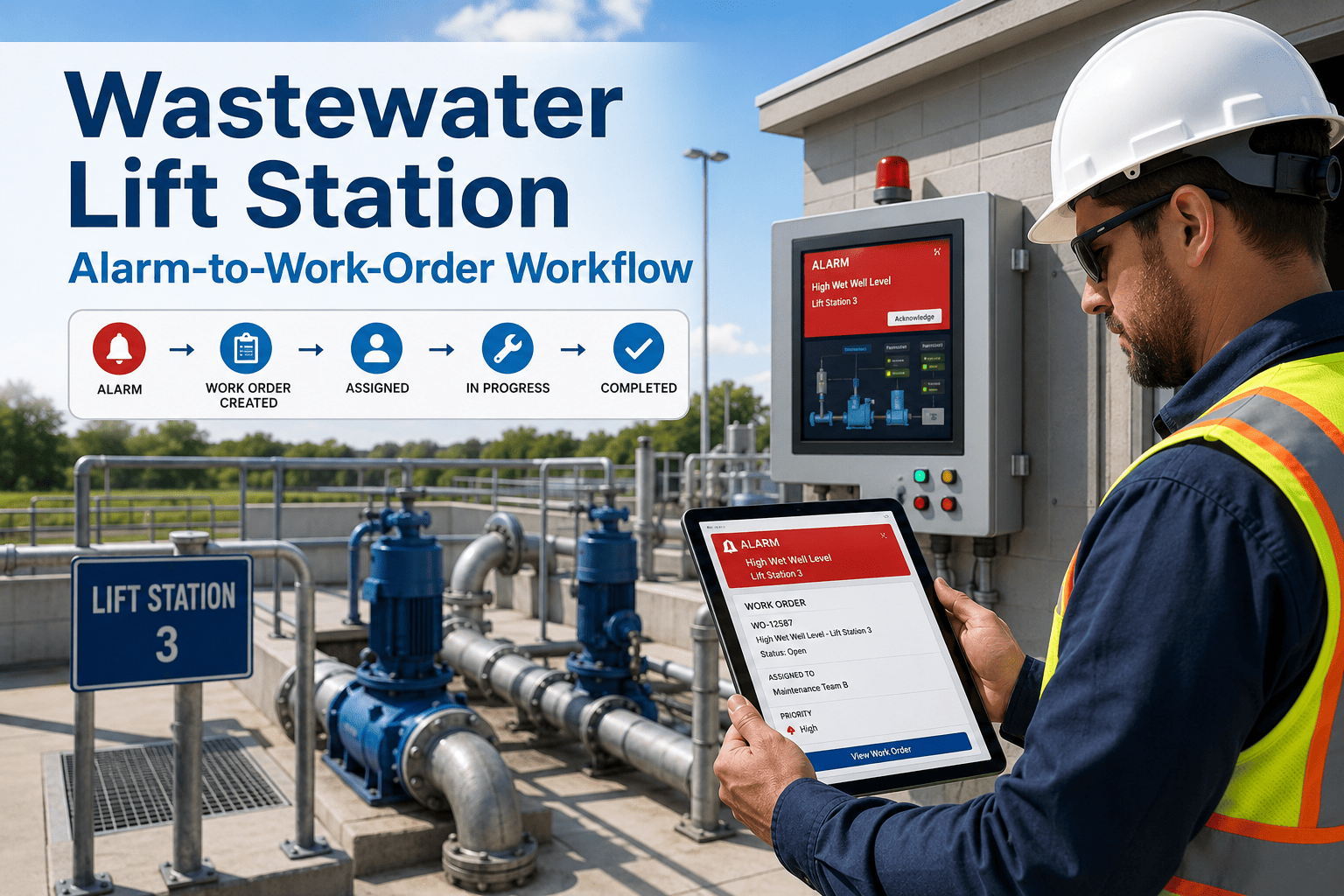
OxMaint's PM scheduler ensures no lift station odor control service window is missed — dosing pump calibrations, carbon breakthrough tests, and wet well entry permits are all scheduled automatically and assigned to operators. Supervisors see overdue items in real time across all stations in the network.
Expert Review
TC
Thomas Carver
Wastewater Operations Manager · 21 years · Class A Wastewater Treatment Operator · OSHA CSHO (Confined Space)
Odor control maintenance is one of those programmes that looks fine on paper until it fails visibly — and the failure mode is usually not gradual. A chemical dosing pump that has been running at 70% calibrated output for three months, a biofiltration bed that has lost 40% of its active media, an activated carbon unit that hit breakthrough six weeks ago — all of these produce no visible warning until residents start calling. The only way to catch them is through disciplined, documented PM. OxMaint's PM scheduling module assigns these inspections automatically, records the findings against each lift station's asset record, and shows you which stations have upcoming or overdue PM tasks across your entire service territory. That visibility is what turns a complaint-driven odor programme into a proactive one.
Frequently Asked Questions
How does OxMaint manage preventive maintenance schedules for multiple lift stations across a service territory?
OxMaint's PM scheduler allows wastewater operations managers to set recurring maintenance triggers for each lift station asset — daily, weekly, monthly, or condition-based — and assign them to specific operators or crews. When a PM window arrives, the assigned operator receives a task notification on the mobile app and completes the inspection form in the field. Supervisors monitor completion status across all stations on a live dashboard.
Book a demo to see multi-station PM scheduling.
Can OxMaint track the maintenance history of specific odor control assets like dosing pumps or biofilters?
Yes. Each odor control component — dosing pump, carbon unit, biofilter bed, wet well — is set up as an individual asset record in OxMaint with its own PM schedule and maintenance history. Every calibration, service, chemical changeout, and inspection result is stored against the asset record, enabling operators and managers to see the full maintenance history of any component and identify recurring failure patterns.
Start a free trial to explore asset-level PM history.
Does OxMaint support confined space permit documentation for wet well entry events?
OxMaint's work order and inspection forms can be configured to include all required confined space permit fields — atmospheric test readings, entrant and attendant names, entry supervisor sign-off, and emergency procedure acknowledgement. Every wet well entry event is documented in OxMaint with a time-stamped record that satisfies OSHA 1910.146 documentation requirements and provides defensible evidence in the event of an incident investigation.
See confined space documentation in a live demo.
OXMAINT · WASTEWATER UTILITIES · PREVENTIVE MAINTENANCE
Proactive Odor Control. Zero Missed PM. Every Station Documented.
OxMaint gives wastewater operations managers scheduled PM workflows for every lift station odor control system, mobile field checklists with automatic work order creation, and an asset maintenance history that demonstrates compliance to regulators and citizens alike.