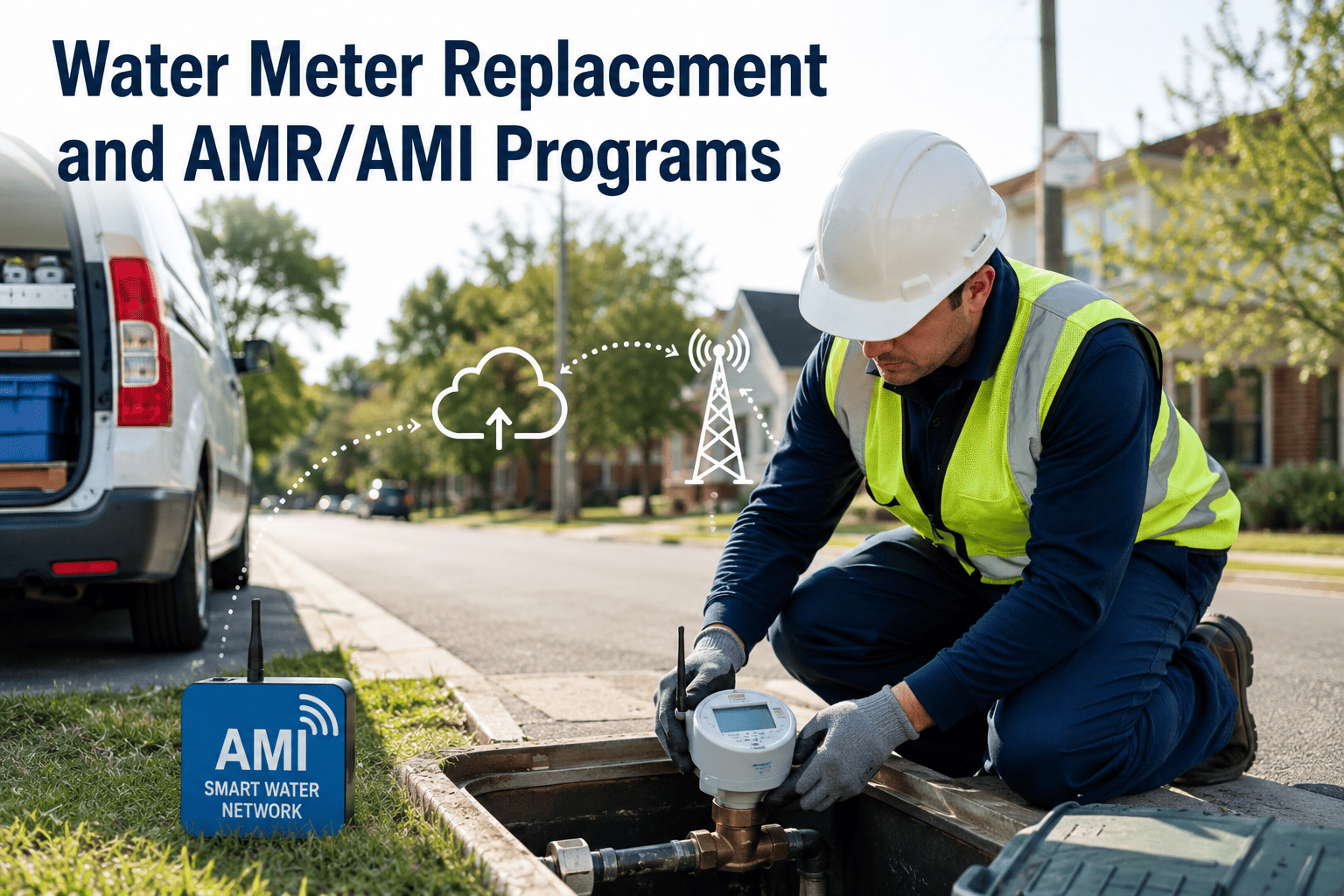
Every water meter in your distribution system starts losing accuracy the moment it begins spinning, and most utilities do not find out how much revenue that costs until a budget shortfall forces the question. Mechanical meters that measured within 98-99% accuracy when new can drift to 85% or lower after 15 to 20 years underground, and every gallon that goes unmeasured is a gallon your utility pumped, treated, and delivered for free. Aging AMR transmitters fail in clusters too, forcing manual re-reads, estimated bills, and customer complaints that a modern metering program is built to eliminate. Utilities that plan a structured meter replacement and AMR/AMI program recover lost revenue within months, not years, while gaining the interval usage data needed for leak detection and conservation reporting. See how OxMaint supports a meter replacement program.
Meter Replacement · AMR/AMI Programs · Water & Wastewater Utilities
Aging Meters Are Under-Reading Your Revenue. A Structured AMR/AMI Program Is How You Get It Back.
OxMaint helps water and wastewater utilities plan, prioritize, and track a meter replacement and AMR/AMI upgrade program — scoring every meter by age and accuracy risk, routing field work orders, and turning replacement data into recovered revenue and faster leak detection.
15-20 yrs
average service life before a mechanical water meter's accuracy drifts below acceptable billing standards
12-15%
water sales revenue increase documented by utilities within 18 months of a phased large-meter AMI replacement
41%
share of U.S. water meter sales revenue coming from AMR/AMI technology, up from roughly 22% a decade earlier
$30K
One utility recovered an additional $30,000 in monthly revenue simply by replacing a single aging six-inch commercial meter. Multiply that gap across every large meter still running on a decades-old mechanical register, and a structured replacement program stops being optional. OxMaint tracks meter age, accuracy risk, and replacement priority in one place, so your highest-value meters get replaced first.
Three Metering Technologies — What Each One Actually Delivers
Legacy Technology
Conventional Mechanical Meters
Conventional meters require a technician to physically visit every property to record a dial reading before each billing cycle. Internal gears and registers wear down with every gallon that passes through them, so accuracy declines steadily long before the meter fails outright, and a missed visit turns into an estimated bill.
What Conventional Metering Costs a Utility
Estimated bills whenever a technician cannot access the meter on schedule
Mechanical accuracy loss from continuous internal wear over years of flow
Staff hours spent driving and walking routes for a single monthly read
No leak visibility — customers learn about a running fixture only when the bill arrives
Transitional Technology
AMR — Automatic Meter Reading
AMR equips a meter with a radio transmitter that sends its reading electronically to a handheld device or vehicle passing on the street. Reads become faster and more consistent, but communication is one-way, data is typically limited to one reading per cycle, and the battery inside every transmitter eventually reaches end of life.
What AMR Capability Adds
Drive-by or walk-by collection that removes most site-access visits
Fewer estimated bills and faster monthly meter-to-cash cycles
One-way radio transmission with limited diagnostic data
Battery and transmitter replacement required roughly every 15-20 years
Current Standard
AMI — Advanced Metering Infrastructure
AMI adds always-on, two-way communication between the meter and the utility, delivering hourly or interval consumption data instead of a single monthly snapshot. That data resolution is what makes near-real-time leak alerts, remote diagnostics, and customer self-service usage portals possible.
Book a demo to see how OxMaint plans a phased AMI rollout for your utility.
What AMI Capability Adds
Hourly or 15-minute interval reads instead of one read per month
Two-way communication for remote diagnostics and tamper detection
Automated continuous-flow and leak alerts sent before the bill arrives
Customer usage portal that reduces high-bill calls to the utility
OxMaint Meter Program Management · Utility Field Operations
Every Old Meter Still In the Ground Is Either Costing You Revenue — or Waiting to Be Replaced
OxMaint gives utility operations teams one place to score meter accuracy risk, prioritize replacements, and route field crews — instead of tracking a multi-year program across spreadsheets, work orders, and separate vendor portals.
How OxMaint Supports a Meter Replacement and AMR/AMI Program
Planning · Prioritization
Meter Age & Accuracy Risk Scoring
Every meter in your system gets a risk score based on install date, meter class, and consumption history, so large commercial meters and end-of-life residential meters are replaced in the right order instead of by street or by guesswork.
Priority flag: meter age exceeds 15 years and revenue class is large
Execution · Field Service
Replacement Work Order Routing
Field crews receive scheduled replacement work orders with property access notes, old and new serial numbers, and install verification checklists, closing the gap between an approved program and completed installs on the ground.
Install verification required before a work order is marked complete
Outcome · Revenue Recovery
Revenue Recovery & Leak Analytics
Consumption before and after each replacement is compared automatically, quantifying recovered revenue meter by meter, while interval data from new AMI endpoints flags continuous-flow leak signatures for proactive customer outreach.
Alert: continuous flow detected for 24+ hours on a residential account
Meter Age vs Accuracy Risk — What a Replacement Program Should Prioritize
Low Risk
New Meters (0-5 Years)
Registration accuracy is typically within manufacturer tolerance. Routine inspection and calibration checks are sufficient at this stage.
Moderate Risk
Mid-Life Meters (5-15 Years)
Gradual mechanical wear begins to reduce low-flow registration. Monitoring consumption trends helps catch drift before it affects billing.
Elevated Risk
Aging Meters (15-20 Years)
Under-registration becomes measurable, especially at low flow rates from leaking fixtures. This is the window where replacement delivers the fastest payback.
Critical Risk
End-of-Life Meters (20+ Years)
Accuracy loss and mechanical failure risk are both high. These meters generate the largest, most immediate revenue gap once replaced.
Critical Risk
Large Commercial & Industrial Meters
These accounts represent a small share of total connections but a disproportionate share of revenue, so even small accuracy losses create large dollar gaps.
Moderate Risk
AMR Transmitters Near Battery End-of-Life
Batteries failing in clusters cause missed reads and estimated bills, even when the underlying mechanical meter is still measuring correctly.
Metering Technology Comparison — Conventional vs AMR vs AMI
Documented Outcomes from Meter Replacement and AMI Programs
20.9M gal
of water saved in just seven months at one utility after AMI leak alerts prompted proactive customer outreach
70%
of a full AMI network deployed in about 18 months by a mid-size utility replacing roughly 34,000 connections
2-way
communication that lets an AMI endpoint report a stopped register or tamper event without a truck roll
90 days
typical time for billing accuracy to visibly improve after large-meter replacements begin
15 min
interval data most modern AMI ultrasonic endpoints are capable of reporting to the utility
8-15%
industry-cited range of billed water utilities lose to under-registration before a meter upgrade program
SRF / ARPA
grant and low-interest loan programs utilities have used to accelerate meter replacement timelines
Frequently Asked Questions — Meter Replacement & AMR/AMI Programs
How should a utility decide which meters to replace first?
Prioritize by revenue impact, not just age — large commercial and industrial meters usually deliver the fastest payback, followed by residential meters past 15-20 years.
Activate OxMaint to score every meter in your system automatically.
What is the real difference between AMR and AMI for a mid-size utility?
AMR is one-way and typically gives one read per cycle, while AMI adds two-way communication and hourly or interval data. That extra resolution is what enables automated leak alerts and a customer usage portal.
Can OxMaint work alongside our existing metering vendor and hardware?
Yes. OxMaint is built to sit on top of meter and endpoint data from major vendors, managing the replacement program, work orders, and revenue analytics without requiring a hardware change.
Book a demo to see it with your current meter data.
How long does a phased AMI rollout typically take?
Mid-size utilities have completed large portions of a network in 12-18 months when large meters are prioritized first and residential deployment follows in mass-installation phases.
Can a meter replacement program help us qualify for grant or SRF funding?
Many state revolving fund and federal infrastructure programs treat metering upgrades as qualifying water-efficiency projects, and documented replacement and leak-savings data strengthens funding applications.
The Meters Aging Out This Year Are Either Recovering Revenue for Your Utility — or Quietly Costing You More Every Month. OxMaint Helps You Decide Which.
Meter risk scoring, field work orders, and revenue recovery analytics — start planning your program today.