Water Treatment Plant Robotics: Maintenance, Monitoring & Compliance 2026
By Taylor on February 13, 2026
Beneath every city, water treatment plants run around the clock to deliver safe drinking water to millions. Yet many of these facilities still rely on manual inspections of dark, confined tanks, hand-calibrated chemical dosing systems, and paper-based compliance logs that are one misplaced binder away from an EPA citation. When a sediment buildup goes undetected in a clearwell or a chlorine dosing pump drifts out of calibration, the consequences aren't just operational—they're a public health emergency. Talk to our specialists about building a robotics-integrated maintenance strategy for your water treatment facility.
Water Infrastructure Intelligence 2026
Water Treatment Plant Robotics: Maintenance, Monitoring & Compliance
Deploy underwater inspection robots, chemical dosing automation, and tank-cleaning robots to maintain Safe Drinking Water Act compliance while reducing confined-space risk and manual labor.
Water treatment plants are uniquely hazardous environments. Operators face confined-space entry risks in tanks and basins, exposure to chlorine gas and chemical residuals, and the constant pressure of regulatory compliance under the EPA Safe Drinking Water Act (SDWA). Traditional manual inspections require draining tanks—a process that takes days, wastes millions of gallons, and takes critical infrastructure offline. Robotic alternatives perform the same inspections underwater, in real time, without draining a drop. Book a Demo.
Common Water Treatment Maintenance Challenges
01
Confined-Space Risk
Tank inspections require permit-required confined-space entry—one of the leading causes of fatalities in water utilities. Each entry demands rescue teams on standby.
02
Chemical Dosing Drift
Manual calibration of chlorine, fluoride, and coagulant dosing pumps leads to over- or under-treatment—risking both public health and regulatory violations.
03
Sediment Accumulation
Sedimentation basins and clearwells accumulate sludge that reduces capacity and breeds bacteria. Manual cleaning requires costly shutdowns and dewatering.
04
Compliance Documentation
EPA SDWA requires meticulous records of chemical levels, filter changes, and inspection results. Paper-based logs are prone to errors, gaps, and audit failures.
05
Filter Lifecycle Tracking
Granular activated carbon (GAC), membrane, and sand filters degrade at variable rates. Without condition monitoring, replacement is either premature (costly) or late (unsafe).
The Robotic Water Treatment Stack
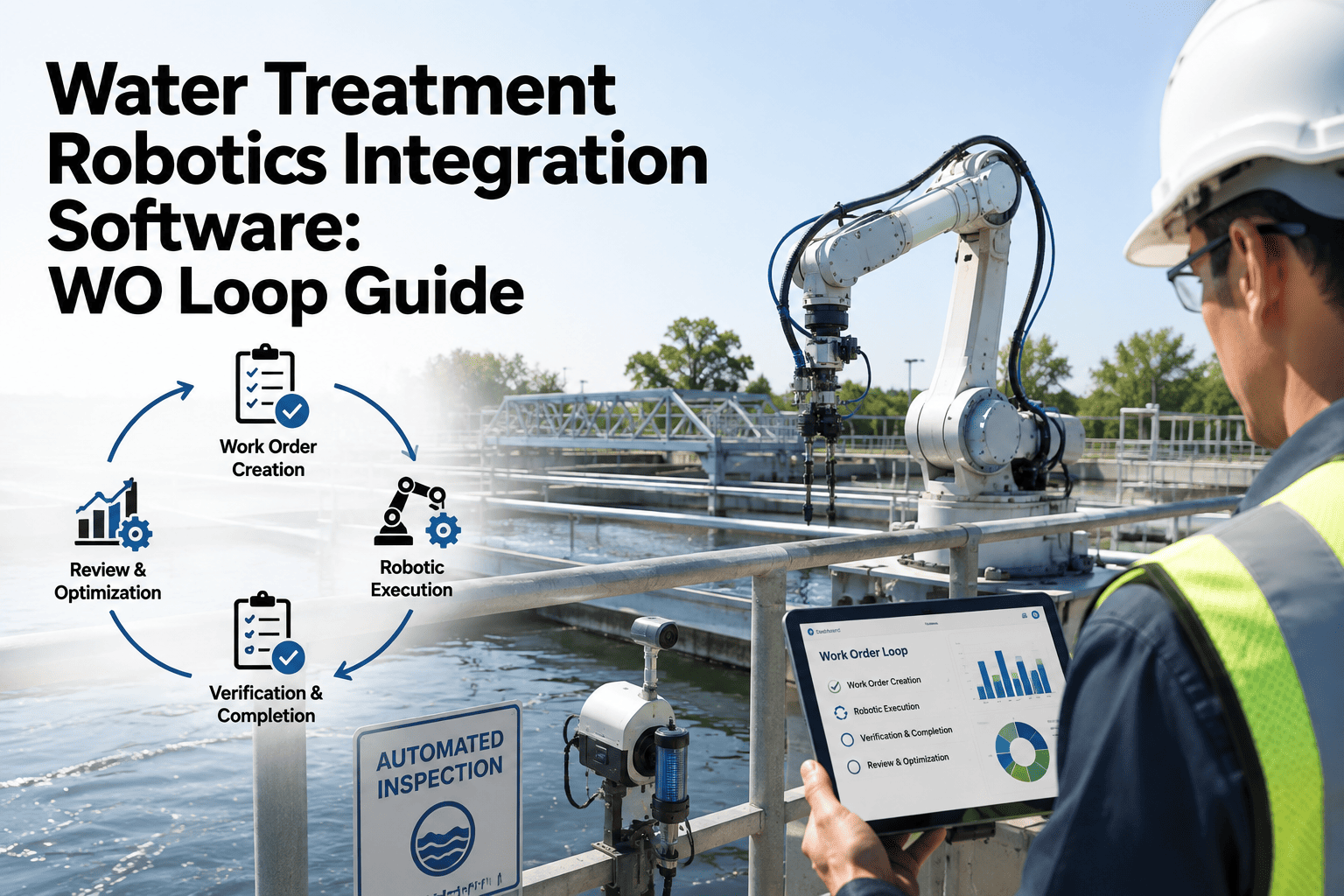
A modern water treatment robotics architecture layers capabilities across the treatment process: underwater inspection robots survey tank conditions without drainage; chemical dosing automation maintains precise residual levels; tank-cleaning robots remove sediment while the plant stays online; and a CMMS like Oxmaint ties it all together with scheduled maintenance, compliance documentation, and performance analytics. Book a Demo.
Robotics Integration Layers
From tank floor to compliance dashboard: a unified maintenance pipeline
1
Underwater Inspection Robots
ROV and AUV robots equipped with HD cameras, sonar, and thickness-gauging sensors inspect tank walls, baffles, and floors without draining. Detect cracks, corrosion, and sediment depth in real time.
No-Drain Inspection
2
Chemical Dosing Automation
AI-controlled dosing systems continuously adjust chlorine, fluoride, coagulant, and pH chemical feed rates based on real-time water quality sensor data. Maintains ±0.1 ppm accuracy.
Real-Time Control
3
Tank-Cleaning Robots
Submersible cleaning robots vacuum sediment from clearwells, sedimentation basins, and reservoirs while the tank remains in service. Eliminates multi-day shutdown cycles.
Online Cleaning
4
Filter Condition Monitoring
Differential pressure sensors and turbidity monitors track filter media health in real time. AI predicts optimal replacement timing for GAC, membrane, and sand filters.
Predictive Replacement
5
CMMS & Compliance Layer (Oxmaint)
Oxmaint tracks robot maintenance schedules alongside EPA SDWA compliance documentation, filter replacement cycles, chemical inventory, and work order history—all in one platform.
Audit-Ready
Unify Robot & Plant Maintenance
Oxmaint integrates seamlessly with water treatment robotics, triggering maintenance work orders from inspection findings, dosing drift alerts, and filter condition data. Build a compliant, proactive plant—not just a monitored one.
The difference between robotic and manual water treatment maintenance isn't just efficiency—it's compliance reliability. Robotic systems generate timestamped, GPS-tagged digital records automatically. Manual processes rely on operator memory, handwritten logs, and hope that the binder is where someone left it. During an EPA audit, one approach delivers confidence; the other delivers anxiety.
Robotic vs. Manual Maintenance Comparison
Robotic + CMMS (Proactive)
Inspections: No-drain, real-time video
Chemical dosing: AI auto-adjustment
Tank cleaning: Online, no shutdown
Compliance: Auto-generated digital logs
vs
Manual Operations (Reactive)
Inspections: Drain, dewater, enter tank
Chemical dosing: Periodic manual checks
Tank cleaning: Multi-day shutdowns
Compliance: Paper binders, error-prone
Expert Perspective: Safety & Compliance
Every time we send a person into a clearwell for inspection, we're accepting a life-safety risk that technology has already solved. Underwater inspection robots give us better data—millimeter-accurate wall thickness measurements, sediment depth mapping, and HD video records—without anyone entering a confined space. When we pair that with a CMMS that automatically links the inspection report to our EPA compliance file, we've eliminated two of our biggest operational risks simultaneously: worker safety and audit readiness. This isn't future technology; it's available now, and every utility that delays adoption is choosing risk over reliability.
— Water Treatment Plant Operations Manager, Municipal Utility
Zero
Confined-space entries for inspections
100%
Digital compliance records
24/7
Automated dosing monitoring
Water treatment plants that integrate robotics with CMMS platforms like Oxmaint aren't just modernizing—they're building the foundation for safe, compliant, and efficient operations for decades to come. By automating the most dangerous and error-prone tasks, they protect workers, protect public health, and protect their standing with regulators. Start Free Trial and start driving compliant, robotic-integrated water treatment operations.
Achieve Regulatory Readiness with Robotics
Oxmaint provides water treatment facilities with integrated robot and plant equipment maintenance management. Track inspection robots, dosing systems, filter replacements, and EPA SDWA documentation—all from a single, audit-ready platform.
What types of robots are used in water treatment plants?
Three primary robotic categories are deployed in water treatment: (1) Underwater inspection robots (ROVs/AUVs) that survey tank walls, floors, and baffles using HD cameras, sonar, and ultrasonic thickness gauges without draining; (2) Chemical dosing automation systems that use AI and real-time water quality sensors to continuously adjust chlorine, fluoride, coagulant, and pH levels with ±0.1 ppm precision; and (3) Tank-cleaning robots that vacuum sediment from clearwells, sedimentation basins, and reservoirs while the tank remains in service, eliminating multi-day shutdown cycles.
How does a CMMS help with EPA Safe Drinking Water Act compliance?
A CMMS like Oxmaint serves as the digital backbone for SDWA compliance by maintaining timestamped records of every inspection, chemical dosing adjustment, filter replacement, and maintenance activity. It automates scheduling for required inspections, generates compliance reports with audit-ready documentation, tracks chemical inventory and usage rates, and links robotic inspection data directly to equipment maintenance histories. During an EPA audit, operators can pull complete compliance records in seconds rather than searching through paper binders.
Can underwater robots really replace tank draining for inspections?
Yes. Modern underwater inspection robots equipped with HD cameras, multi-beam sonar, and ultrasonic thickness gauging sensors can perform comprehensive tank assessments while the tank remains full and in service. They detect cracks, corrosion, sediment depth, baffle condition, and coating integrity—often providing more detailed data than human divers. This eliminates the need to drain millions of gallons, avoids multi-day shutdowns, and removes the confined-space entry risk entirely. Many utilities have adopted no-drain inspection as their standard practice.
What maintenance do water treatment robots themselves require?
Underwater inspection robots require thruster motor servicing, camera lens cleaning, sonar calibration, tether inspection, and battery/power system checks. Chemical dosing automation systems need sensor calibration (pH, chlorine analyzers), pump diaphragm replacement, tubing inspection, and software updates. Tank-cleaning robots require vacuum head maintenance, debris filter cleaning, drive motor servicing, and navigation sensor calibration. Oxmaint CMMS tracks all of these robot-specific maintenance schedules alongside traditional plant equipment PMs in one unified system.
How does Oxmaint track filter replacement cycles?
Oxmaint tracks filter media lifecycle using a combination of calendar-based schedules, meter-based triggers (gallons processed), and condition-based inputs (differential pressure readings, turbidity data). When any threshold is approached, the system automatically generates a work order for filter media replacement, assigns the task to qualified technicians, and logs the replacement in the compliance record. This ensures filters are replaced at the optimal time—not too early (wasting money) and not too late (risking water quality violations).