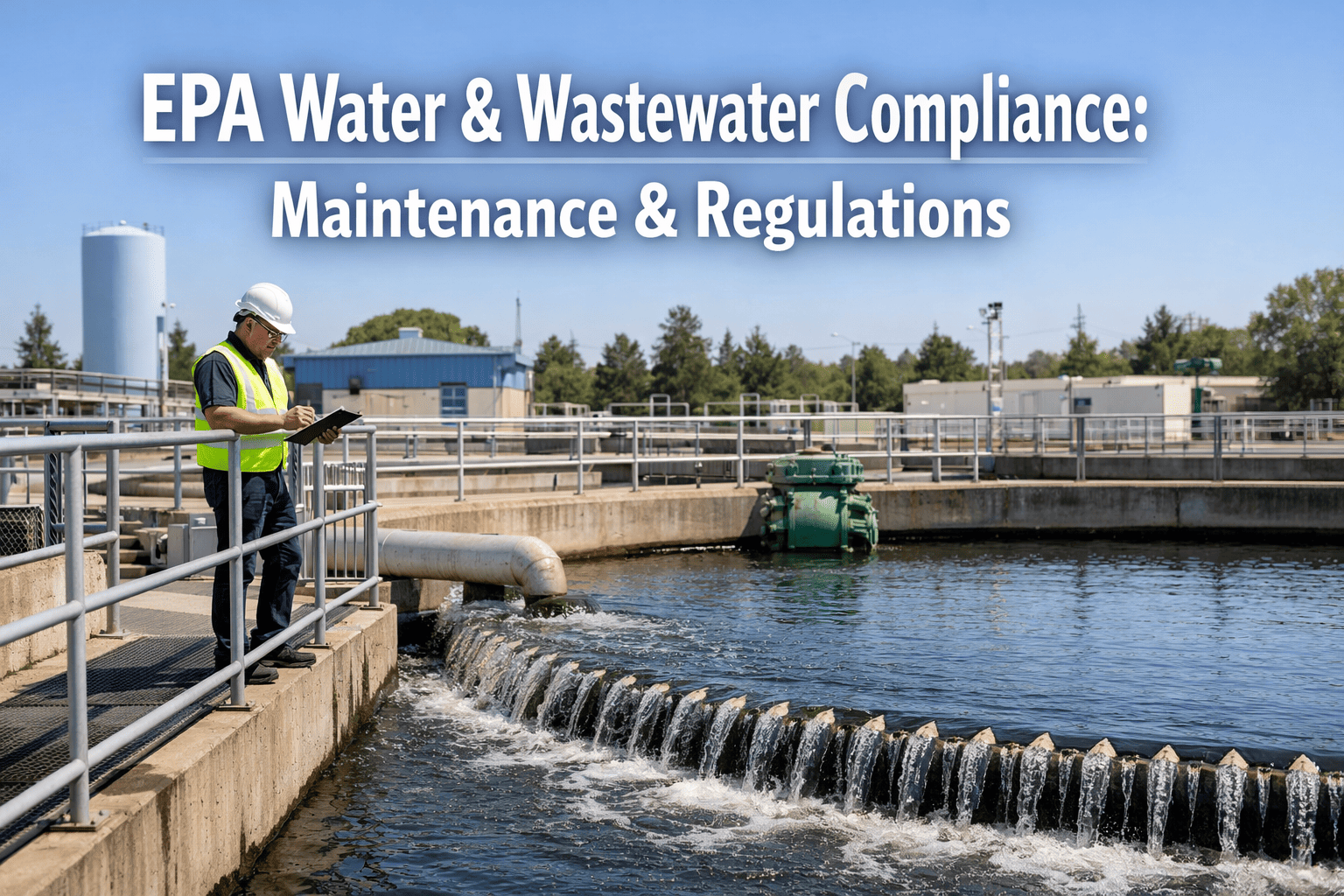
EPA and State Compliance Maintenance for Water and Wastewater Treatment Facilities
By Jason on March 25, 2026
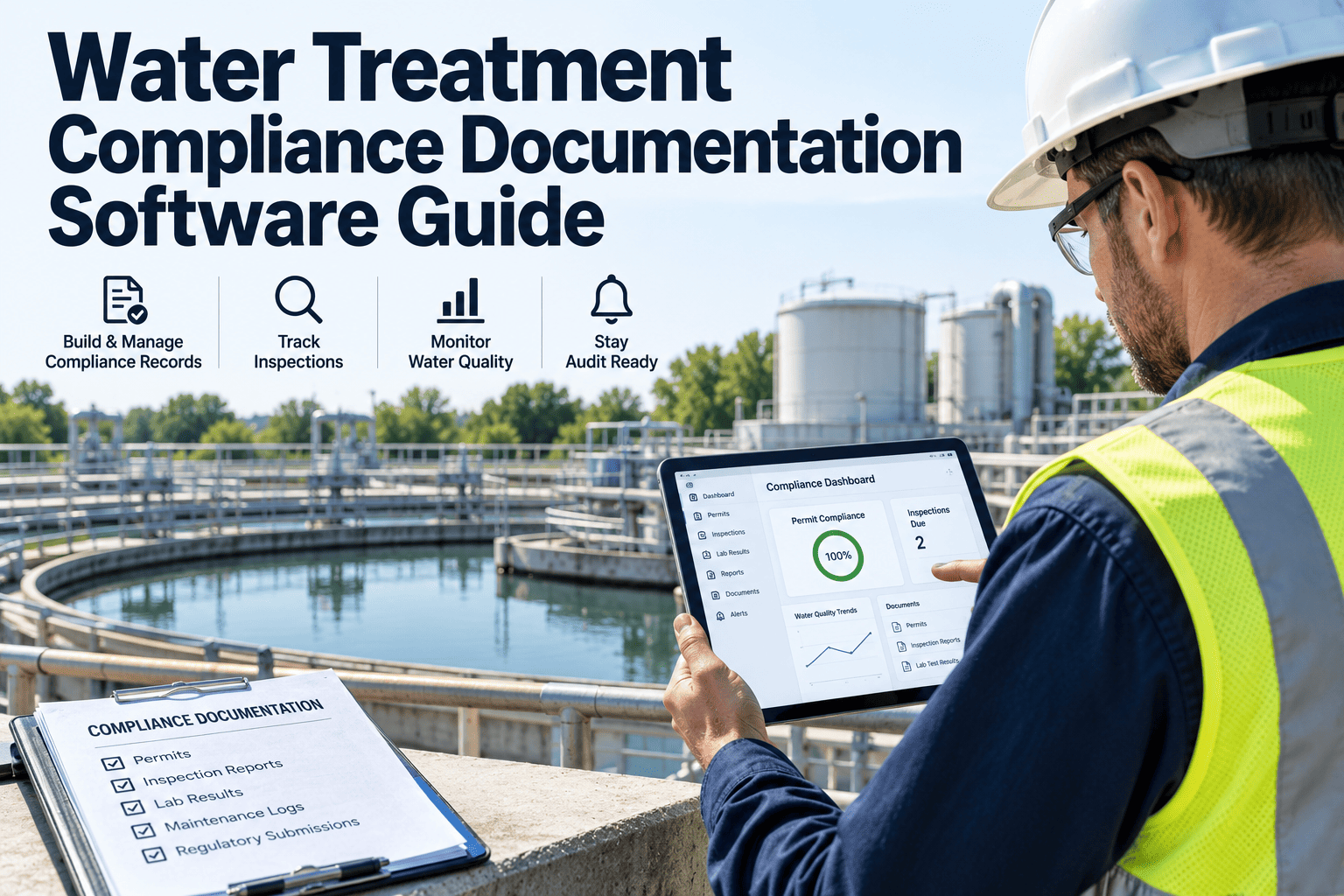
Water and wastewater utilities operate inside one of the most complex regulatory environments in public infrastructure — EPA Safe Drinking Water Act, Clean Water Act NPDES permits, Surface Water Treatment Rule, Lead and Copper Rule, and state primacy agency requirements all impose documented maintenance obligations with penalties ranging from $25,000 per day for significant violations to criminal liability for willful noncompliance. Yet the majority of municipal utilities still prepare compliance documentation from paper maintenance logs, disconnected spreadsheets, and operator memory — a gap that creates audit exposure every single day. Book a demo to see how Oxmaint automates EPA compliance documentation across your entire water and wastewater operation.
Compliance GuideEPA and State Compliance Maintenance for Water and Wastewater Treatment Facilities12 min read
$25K
Maximum EPA penalty per day for significant violations of the Safe Drinking Water Act at community water systems
72 hrs
Maximum reporting window for Tier 1 public notification under SDWA — requiring timestamped maintenance records on demand
61%
Of EPA Notice of Violations at water utilities stem from missing or incomplete maintenance documentation, not actual treatment failures
4 hrs
Time to produce a full EPA audit documentation package with Oxmaint versus 3 to 6 weeks of manual log compilation
In Short
EPA and state compliance maintenance for water and wastewater utilities means maintaining documented, timestamped records of every chemical feed calibration, filter inspection, equipment PM, and treatment process deviation — structured to satisfy EPA SDWA, NPDES, SWTR, Lead and Copper Rule, and state primacy agency requirements. A CMMS configured for regulatory compliance automates permit calendar tracking, generates discharge monitoring records, routes SCADA alarms to documented corrective actions, and exports audit-ready packages in the format accepted by EPA Region offices and state primacy agencies — without the 3 to 6 weeks of manual log compilation that currently precedes most utility compliance audits.
The Regulatory Framework: What Water and Wastewater Utilities Must Document
Federal and state compliance obligations for water and wastewater utilities are not aspirational standards — they are legally enforceable permit conditions with documented penalties for each day of noncompliance. Understanding which framework governs which asset class and maintenance activity is the foundation of any defensible compliance program. See how Oxmaint is configured for water treatment plant maintenance operations.
Drinking Water
EPA Safe Drinking Water Act
Governs all community water systems serving 25 or more people. Requires documented treatment technique compliance, chemical feed calibration records, monthly operating reports, and public notification for violations. Penalties up to $25,000 per day per violation.
Wastewater
Clean Water Act NPDES Permits
National Pollutant Discharge Elimination System permits set enforceable effluent limits for BOD, TSS, nitrogen, phosphorus, and pathogen indicators. Discharge Monitoring Reports must be filed monthly with state agencies. Permit exceedances trigger penalties and public disclosure requirements.
Filtration
Surface Water Treatment Rule
Requires documented log removal credits for Cryptosporidium, Giardia, and viruses. Filter turbidity records, CT disinfection calculations, and membrane integrity test logs must be maintained and available for state primacy review within specified time windows.
Distribution
Lead and Copper Rule
Requires documented corrosion inhibitor dosing, distribution system pH and alkalinity records, and chemical feed calibration logs. The 2021 LCR Revisions impose tighter action levels and mandatory inventory of lead service lines with documented replacement programs.
Safety
OSHA PSM — 29 CFR 1910.119
Process Safety Management applies to utilities handling chlorine gas, anhydrous ammonia, or other highly hazardous chemicals above threshold quantities. Mechanical integrity PM records, pre-startup safety reviews, and management of change documentation are mandatory under PSM.
State Level
State Primacy Agency Requirements
All 50 states hold EPA-delegated primacy for the Safe Drinking Water Act with state-specific permit conditions, inspection frequencies, and reporting formats. State agencies conduct sanitary surveys every 3 years for most community water systems — requiring complete maintenance history for all treatment processes.
Your Maintenance Records Are Your Compliance Defense
Water Utility Compliance: SDWA and State Primacy Requirements
The Safe Drinking Water Act creates a layered compliance obligation — federal minimum requirements enforced through state primacy agencies that may impose stricter standards. Utilities must document maintenance activities across treatment, distribution, and chemical feed systems in formats that satisfy both federal and state-specific audit expectations.
What Must Be Documented
Chemical Feed System Calibration
Chlorination, coagulant, pH adjustment, fluoridation, and corrosion inhibitor feed systems require documented calibration at intervals specified in operating permits. Each calibration event must record technician identity, date, feed rate setting, and verification method — with records available for state review for a minimum of 3 years.
Filter Performance and Backwash Records
Surface Water Treatment Rule requires continuous turbidity monitoring with records maintained for each filter run. Backwash cycle events, differential pressure readings, and filter-to-waste records must be logged with timestamps. Membrane systems require integrity test documentation at frequencies established by the Long Term 2 Enhanced Surface Water Treatment Rule.
CT Disinfection Calculations
Log removal credit for Cryptosporidium, Giardia lamblia, and viruses requires documented CT value calculations — the product of disinfectant concentration and contact time — at defined monitoring points. Records must demonstrate required log inactivation credits on a continuous basis with operator attestation.
Monthly Operating Reports
State primacy agencies require monthly operating reports documenting average and maximum contaminant levels, treatment violations, system deficiencies, and corrective actions. Records must be submitted within 10 days of month end. Missing or late MORs constitute reporting violations independent of any treatment exceedance.
Oxmaint Documentation Coverage
Chemical calibration work orders with auto-generated timestamps, technician attribution, and feed rate fields — no manual log entry required
Filter backwash cycle records linked to asset history with differential pressure trending and turbidity event logs per filter cell
CT calculation fields built into disinfection inspection checklists — disinfectant concentration and contact time recorded per monitoring point
Monthly operating report data populated directly from completed work order records — exportable to state-agency format with one-click compliance dashboard export
Permit calendar module tracks all recurring submission deadlines with automated alerts at 30, 14, and 3 days before each deadline
Sanitary survey preparation package exported from compliance dashboard — complete maintenance history, PM completion rates, and corrective action records in under 4 hours
Wastewater Compliance: NPDES Permits and Clean Water Act Requirements
Wastewater treatment facilities operate under NPDES permits that set facility-specific effluent limits enforceable as federal law. Unlike SDWA requirements, NPDES permit conditions vary significantly between facilities — making documented, asset-specific maintenance records critical evidence that permit compliance is actively managed rather than passively monitored. See the complete wastewater treatment plant maintenance best practices guide.
01
Discharge Monitoring Reports
Monthly DMRs document effluent quality against permit limits for BOD, TSS, ammonia, total nitrogen, phosphorus, fecal coliform, and other facility-specific parameters. Maintenance records for aeration systems, clarifiers, and disinfection equipment are the upstream evidence supporting DMR data integrity.
02
Aeration System Maintenance Records
Biological treatment performance depends on documented blower and diffuser maintenance. Dissolved oxygen compliance relies on functioning aeration — deferred blower PM is the most common upstream cause of BOD and ammonia permit exceedances. Records must show inspection dates, repair history, and DO monitoring calibration.
03
Biosolids Handling Documentation
EPA Part 503 Biosolids Rule requires documented pathogen reduction processes, vector attraction reduction records, and land application site records. Belt filter press, centrifuge, and digester maintenance records are part of the regulatory audit trail for Class A and Class B biosolids production.
04
Pretreatment Program Oversight
POTWs with approved pretreatment programs must document industrial user inspections, sampling events, and enforcement actions. Headworks analysis and industrial user permits must be current and accessible for EPA and state inspection. Records retention requirements extend 3 to 5 years depending on permit conditions.
Compliance Documentation: Federal and State Requirements by Region
Region
Primary Frameworks
Documentation Requirements
Oxmaint Coverage
USA and Canada
EPA SDWA, Clean Water Act NPDES, SWTR, Lead and Copper Rule, OSHA PSM, state primacy agencies
Chemical feed logs, filter records, DMRs, MORs, sanitary survey packages, PSM mechanical integrity records
Full compliance module — permit calendar, DMR data export, SCADA alarm-to-work-order, audit trail reporting
Australia
State drinking water quality frameworks, ADWG, Australian Water Quality Guidelines, Safe Work Australia, ISO 55000
Oxmaint delivers the permit calendar, discharge monitoring records, SCADA alarm documentation, and audit trail exports that water and wastewater utilities need to satisfy EPA, state primacy, and NPDES permit requirements — from a single compliance dashboard accessible to utility leadership, operators, and regulators.
Oxmaint's EPA compliance module is not a document repository — it generates compliance records as a byproduct of daily maintenance operations, so utilities are always audit-ready without a separate compliance data entry burden.
01
Permit Calendar and Deadline Tracking
Every permit condition — chemical calibration frequency, filter inspection interval, MOR submission deadline, sanitary survey preparation window — loaded into the permit calendar module with automated alerts at 30, 14, and 3 days. No deadline is missed because no one remembered to add it to a spreadsheet. Book a demo to see the permit calendar configured for your specific operating permit.
02
SCADA Alarm to Documented Corrective Action
SCADA alarms above configurable thresholds automatically generate Oxmaint work orders with equipment ID, alarm type, sensor value, and timestamp pre-populated. Operators close alarms in the mobile app — creating a permanent, technician-attributed corrective action record linked to the originating SCADA event. Zero untracked alarm acknowledgments. Every corrective action is EPA-documentable.
03
Discharge Monitoring Record Generation
DMR-relevant data — effluent sampling events, equipment operating status during monitoring periods, corrective actions taken in response to limit approaches — captured in work orders and automatically formatted for monthly DMR export. State agency submission formats pre-configured. DMR data integrity supported by the maintenance audit trail showing equipment condition during the monitoring period.
04
One-Click Audit Package Export
EPA Region auditors, state primacy inspectors, and NPDES permit reviewers receive a complete documentation package — equipment PM history, calibration records, SCADA event logs, corrective action trails, and operator certifications — exported from the compliance dashboard in under 4 hours. No manual compilation, no missing records, no paper log reconstruction. Book a demo to see the audit export module for your regulatory framework.
Compliance KPIs: Benchmarks and Targets
PM Compliance Rate
91%
Chemical Calibration Currency
97%
SCADA Alarm Documentation Rate
100%
Emergency Work Order Ratio
14%
Audit Package Prep Time
4 hrs
Permit Deadline Compliance
100%
Compliance Outcomes: Performance Metrics
PM Compliance Rate After Deployment91%
Emergency Work Order Reduction68%
Audit Preparation Time Reduction78%
NOV Exposure Reduction61%
Permit Deadline Compliance Rate88%
Capital Request Approval Rate With FCI Data74%
Frequently Asked Questions
QWhat specific EPA documentation does Oxmaint generate for a community water system?
Oxmaint generates timestamped chemical feed calibration records, filter backwash and turbidity event logs, disinfection CT calculation records, corrective action trails from SCADA alarms, and monthly operating report data fields — all exportable in formats accepted by EPA Region offices and state primacy agencies. Sanitary survey preparation packages are produced from the compliance dashboard in under 4 hours. Book a demo to see the compliance documentation module for your specific operating permit.
QHow does Oxmaint handle NPDES Discharge Monitoring Report requirements for wastewater utilities?
Oxmaint captures DMR-relevant operational data — effluent sampling coordination, aeration system status, clarifier and disinfection equipment PM records — as part of normal work order workflow. DMR data fields are pre-formatted for state eDMR submission systems. The maintenance audit trail provides supporting evidence that equipment was functioning correctly during monitoring periods, which is critical during permit exceedance investigations. Book a demo to see the wastewater compliance module configured for NPDES requirements.
Yes. For utilities handling chlorine gas, anhydrous ammonia, or other covered hazardous chemicals above threshold quantities, Oxmaint generates the mechanical integrity PM records, pre-startup safety review documentation, and management of change work order trails required under OSHA 29 CFR 1910.119. Each record includes technician certification, inspection date, findings, and corrective actions. Book a demo to review Oxmaint's PSM mechanical integrity documentation module.
QWhat is the business case for a utility director presenting EPA compliance software to a city council?
The ROI case rests on three figures: penalty avoidance (EPA SDWA violations carry penalties up to $25,000 per day; a single consent order can cost $500,000 to $2M in compliance costs), audit preparation cost reduction (eliminating 3 to 6 weeks of staff time before each inspection cycle), and emergency repair cost avoidance (documented PM programs reduce emergency repair spend by 60 to 70%). Oxmaint deployment costs are recovered within 6 to 8 months at most mid-size utilities. Book a demo to model the compliance ROI case for your utility's regulatory profile.
QHow long does it take to configure Oxmaint for EPA compliance documentation at a water treatment plant?
Most water utilities complete asset registry setup, permit calendar configuration, and compliance template activation within 10 to 14 days. SCADA integration adds 3 to 5 days depending on protocol. The first EPA-documentable work orders generate within 21 days of contract execution. No IT implementation project, no consultant fees beyond standard onboarding. Book a demo to review the deployment timeline for your facility.
QCan Oxmaint support compliance documentation across multiple treatment plants and pump stations?
Yes. Oxmaint supports multi-site utility portfolios under one compliance dashboard — water treatment plants, wastewater treatment facilities, booster stations, and pump stations each maintain their own operational work queues while utility leadership views portfolio-level PM compliance rates, permit calendar status, and audit readiness scores across all sites simultaneously. See the municipal water infrastructure asset management framework.
Continue Reading: Water and Wastewater Utility Resources
Stop Rebuilding Compliance Records Before Every Audit
Water and wastewater utilities on Oxmaint produce EPA-ready audit packages in under 4 hours, reach 91% PM compliance, and eliminate documentation-based Notice of Violations — deployed in 14 days with no hardware replacement and no consultant fees.