Why Fragmented Gov Asset Data Sinks Every Public Budget Cycle

By Corin Hale on August 17, 2026

why-fragmented-gov-asset-data-sinks-every-public-budget-cycle

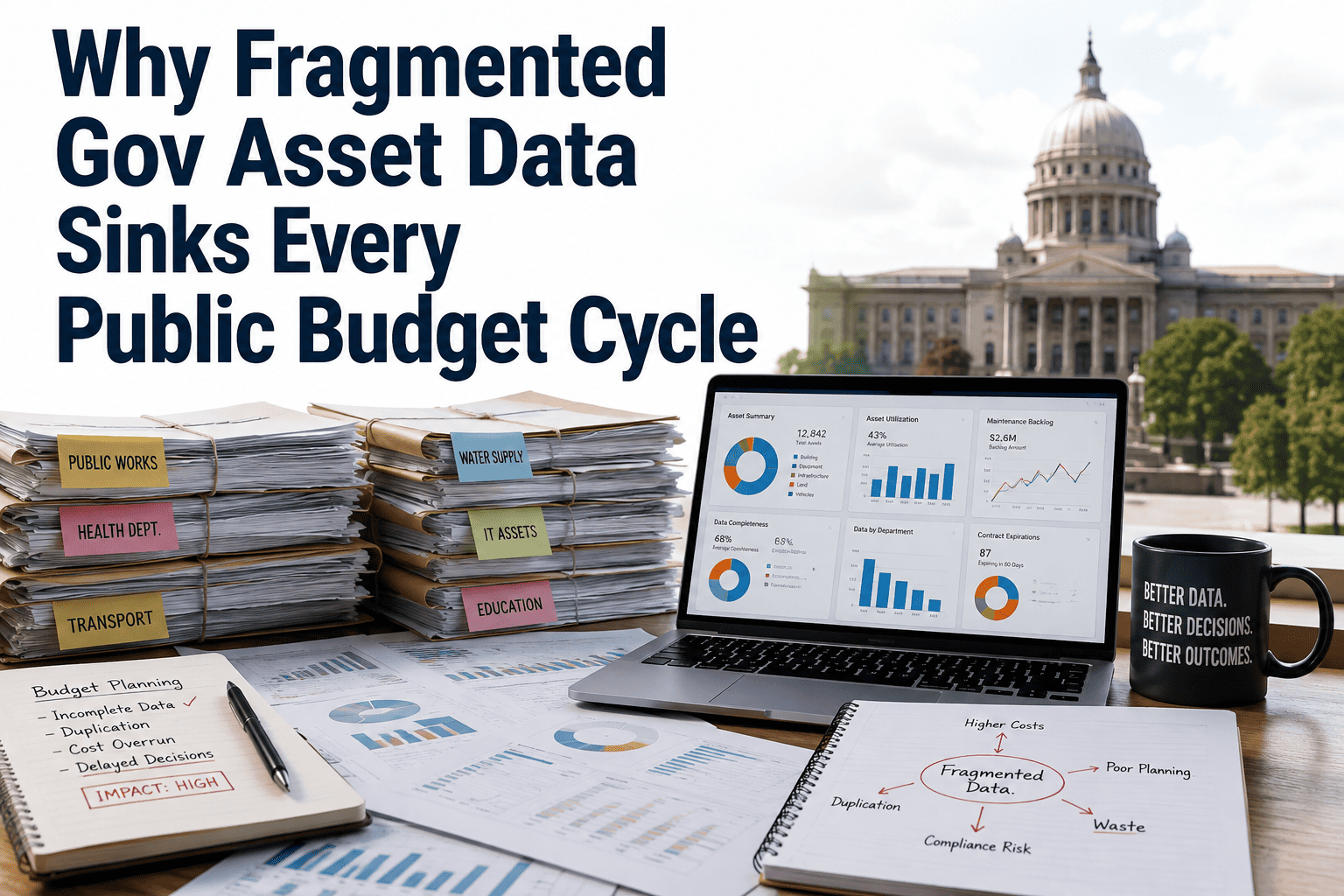
Every public budget cycle starts the same way: someone asks how many assets the department actually owns, what condition they are in, and how much keeping them running cost last year. In agencies still running on spreadsheets, paper logs, and three disconnected systems, nobody has a confident answer. The request gets padded with guesswork, the council pushes back, and the cycle repeats twelve months later with the same fragmented data quietly sinking the same budget request. A county technical services director once summed it up as hundreds of spreadsheets and no reliable answer to which assets the department even has. You can see what a single connected asset record looks like at app.oxmaint.ai.

Government Asset Management · Budget Planning

Why Fragmented Asset Data Sinks Every Public Budget Cycle

A budget request is only as strong as the data behind it. When asset counts, condition scores, and spend history live in different systems that never talk to each other, every budget cycle starts from a guess instead of a record — and councils, auditors, and taxpayers all notice.

Where Fragmentation Breaks the Budget Cycle
1
Data Collection
Break: asset counts differ across spreadsheets, so nobody trusts the starting number
2
Justification
Break: spend history and condition data live in separate systems with no link between them
3
Approval
Break: council receives estimates instead of records, and funds the loudest request
4
Execution & Audit
Break: nobody can reconstruct what was actually spent, on what, or why
40%
more unplanned downtime reported by agencies relying on manual, fragmented asset tracking
25%
higher emergency repair spend for departments without a connected condition-and-cost record
120 hrs
typical staff time spent reconstructing paper maintenance records for a single audit request
93%
of compliance and asset teams still rely on spreadsheets as their primary tracking system

Why "We'll Fix It Next Cycle" Never Actually Happens

Almost every agency running on fragmented data has already decided, informally, that it needs to change. The problem is that fragmentation never announces itself as a crisis. It shows up as a slightly frustrating afternoon reconciling two spreadsheets before a budget hearing, or a slightly longer wait for an auditor's request, and each of those moments feels too small to justify a project. Multiply that across a dozen departments and several budget cycles, and the agency has quietly built a permanent tax on every capital decision it makes — paid in staff hours, in weaker justifications, and in funding that goes to whichever department happened to document its case best rather than whichever asset actually needed it most.

Who Feels Fragmented Asset Data First

Fragmentation does not hit every role in an agency the same way. These are the four positions that usually notice the problem before anyone puts a name to it.

Budget & Finance Officers
Spend hours reconciling department estimates against finance records that were never designed to talk to each other before every hearing.
Public Works & Facilities Directors
Submit capital requests backed by age and anecdote instead of a documented condition trend, and watch better-documented departments win the funding.
Compliance & Audit Teams
Field records requests that turn into multi-day paper searches, with no guarantee the reconstructed record will actually satisfy the reviewer.
Elected Officials & Council Members
Vote on capital requests without a consistent way to compare them, since every department's numbers come from a different, unverified source.

The Data Silo Map — What Fragmentation Actually Looks Like

Fragmentation rarely looks dramatic day to day. It looks like five separate systems, each holding a piece of the truth, none of them synchronized, and nobody quite sure which version is current when a budget question actually comes up. A vehicle's mileage lives in one spreadsheet, its last repair lives in a paper work order, its purchase cost lives in the finance system, and its physical location lives in a GIS layer that was last updated by someone who left the department two years ago. None of that is a data problem in isolation. It becomes a budget problem the moment someone has to answer a question that spans all four sources at once.

Disconnected Today
Department spreadsheet A
Department spreadsheet B
Paper work order logs
Legacy finance system
GIS asset layer
No shared record · no shared truth
→
Connected With a CMMS
Single asset register
Linked work order history
Condition score per asset
Spend tied to asset ID
Exportable to finance & GIS
One record every department trusts

Five Ways Fragmentation Sinks a Budget Cycle

These are not hypothetical risks. They are the specific, recurring failure points budget officers and facilities directors describe when asset data lives in disconnected systems across departments.

Inconsistent Asset Counts
Two departments report different totals for the same equipment class, and nobody can say which spreadsheet is current when the budget office asks.
Untraceable Spend History
Maintenance cost sits in a finance system with no link back to the specific asset, so nobody can prove which equipment is actually driving the repair budget.
No Condition-to-Cost Link
Without a connected condition score, a capital request reads as a guess about age instead of evidence about deterioration, and councils treat it accordingly.
Audit Reconstruction Delays
When auditors request maintenance history, staff spend days pulling paper records instead of minutes exporting a report — and sometimes still cannot prove compliance.
Inequitable Department Comparisons
Departments that track data well look worse on paper than departments that do not track it at all, skewing which requests actually get funded.

One Asset Record Beats Five Spreadsheets Every Budget Cycle

OxMaint replaces disconnected spreadsheets, paper logs, and siloed systems with one asset register that links condition, work orders, and spend — so your next budget request is backed by a record instead of an estimate.

Spreadsheet-Era Budgeting vs. Connected-Record Budgeting

The difference between the two approaches is not cosmetic. It changes what a budget officer can actually say in a council meeting when a request is challenged.

Budget Question Spreadsheet-Era Answer Connected-Record Answer
How many assets do we have? Depends which spreadsheet you open One live count, same number for every department
What did maintenance cost last year? Estimated from finance line items Exact spend, traced to each asset ID
Why does this asset need replacing now? Because it is old Because its condition score and repair cost trend say so
Can you prove compliance for the audit? Give us a few days to pull paper records Exported report, ready in minutes

The Metrics That Prove Your Asset Data Is Actually Unified

Consolidating systems is the easy part of the project. These four metrics tell you whether the unified record is actually being used when budget decisions get made — or whether departments have quietly gone back to their old spreadsheets.

Target: > 95%
Single-Source Asset Coverage
Share of registered assets with one authoritative record instead of parallel entries across multiple spreadsheets or systems.
Target: > 90%
Spend-to-Asset Linkage Rate
Percentage of maintenance and repair spend tied directly to a specific asset ID rather than a general department line item.
Target: < 1 hour
Audit Report Turnaround
Time from an audit or records request to producing a complete, exportable maintenance and cost history for the assets in scope.
Target: ↓ trend
Shadow Spreadsheet Count
Number of department-level spreadsheets still tracking assets outside the unified system, tracked and driven toward zero.

Moving From Fragmented to Unified in Four Phases

Agencies rarely need to rebuild their asset data from scratch. Most of it already exists across the spreadsheets, paper logs, and legacy systems currently in use — it just needs to be consolidated on a defined path.

Phase 1
Inventory the Silos
Identify every spreadsheet, paper log, and standalone system currently holding asset or maintenance data across departments.
Phase 2
Reconcile the Records
Merge conflicting entries into one asset register, resolving duplicate counts and missing condition data as they surface.
Phase 3
Connect Spend to Assets
Link finance data and work-order history back to each asset ID so cost and condition finally live in the same record.
Phase 4
Retire the Spreadsheets
Set the unified system as the system of record for the next budget cycle, and track shadow-spreadsheet use down to zero.

Expert Perspective — Governance, Not Just Software

The gap I see most often is not a technology gap, it is a governance gap. Departments build their own spreadsheets because nobody assigned ownership of the shared truth, and once that habit sets in, it takes years to unwind. The agencies that fix it treat asset data the same way they treat financial data — one system of record, one owner, one number everyone in the budget meeting agrees to start from. Once that happens, budget requests stop being arguments about whose estimate is more believable and start being conversations about which asset actually needs the money first.

Devon Marchetti-Okafor, MPA
Director of Enterprise Asset Governance, County Public Services Department — 12 Years in Government Asset Management and Capital Budgeting

The Economics of Fixing Fragmentation Before the Next Budget Cycle

The cost of fragmented asset data rarely shows up as a single line item. It shows up as emergency repairs that a connected condition score would have flagged early, audit findings that a traceable record would have prevented, and capital requests that lose to a better-documented department instead of a more urgent one.

Emergency repair spend reduction with a connected condition-and-cost record
Up to 25%
Staff hours saved per audit once records are exportable instead of paper-based
100+ hrs
Typical time to consolidate a mid-size department's asset data into one record
6–10 weeks
Budget cycles where requests are backed by exportable records instead of estimates, once unified
Every cycle

Reasons Agencies Delay Fixing It — and Why They Don't Hold Up

Every agency that has stayed on fragmented spreadsheets for years has a reason. Most of those reasons made sense five budget cycles ago and stopped making sense somewhere around cycle three.

Excuse 1
"Our Spreadsheets Work Fine"
They work until two departments report different totals for the same asset class in front of the council, and then the spreadsheet becomes the story instead of the budget request.
Excuse 2
"We Don't Have IT Resources"
A cloud CMMS is configured by operations staff directly, without a dedicated implementation team, which removes the resourcing barrier that used to be the real blocker.
Excuse 3
"Migration Will Take Too Long"
Most agencies consolidate one department at a time, starting with the one facing the next deadline, so the first usable result appears in weeks rather than a multi-year rebuild.
Excuse 4
"Nobody Has Complained Yet"
Fragmentation rarely produces a formal complaint. It produces a slightly weaker budget request every cycle, until an audit or a failed asset makes the cost impossible to ignore.

Frequently Asked Questions

Do we have to migrate every department at once?
No. Most agencies consolidate one department or asset class at a time, starting with the one facing the next budget or audit deadline. Book a demo to map a phased rollout for your agency.
What happens to our existing spreadsheets during migration?
Existing spreadsheets are imported as the starting data set, then reconciled against other sources during Phase 2. Nothing is discarded until the unified record is verified as accurate.
Can a unified asset record integrate with our finance and GIS systems?
Yes. A connected CMMS is built to sync with existing finance, ERP, and GIS platforms rather than replace them, so spend and location data flow into the same asset record automatically.
How long before a unified record actually changes budget outcomes?
Most agencies see a difference by the first budget cycle after consolidation, once requests can cite exportable condition and cost data instead of department estimates. Start a free trial to see the reporting departments use in budget meetings.
Does fixing fragmentation require new IT staff or infrastructure?
No. A cloud-based CMMS is configured by operations and facilities staff directly, without a dedicated IT project team or new server infrastructure to maintain.

Your Next Budget Cycle Deserves a Record, Not a Guess

OxMaint unifies asset counts, condition scores, work orders, and spend into one record your department can defend in any budget meeting or audit — built for how government agencies actually operate.
Share This Story, Choose Your Platform!