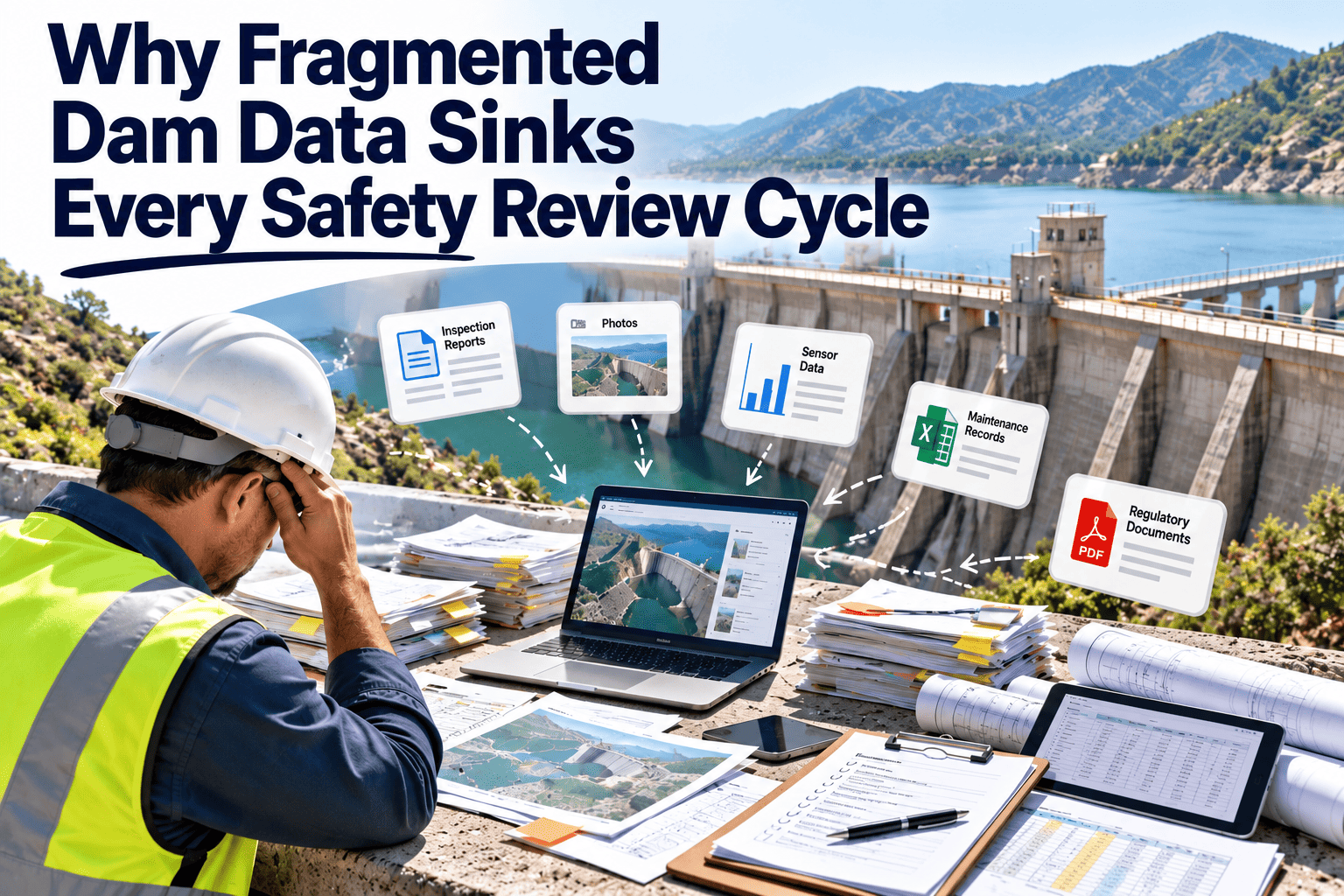
Every dam safety review starts the same way. Someone is asked to gather instrumentation readings, past inspection findings, as-built drawings, and the status of open repairs, and the pieces live in five different places. Reviewers then spend their time reconciling versions instead of judging the condition of the dam. A single maintenance record that ties sensor data, field inspections, and engineering decisions to each structure removes most of that rework, and Oxmaint maintenance management software is designed to hold exactly that record.
Why Fragmented Dam Data Sinks Every Safety Review Cycle
Dam safety reviews fail on data assembly long before they fail on engineering. When instrumentation, inspection findings, and design records sit in separate files, each cycle restarts from zero. See where the fragments come from, what they cost, and how a unified digital twin style CMMS record fixes the cycle.
Where dam data actually lives before a review
Fragmentation is rarely negligence. It is what happens when each group stores data the way its own job requires, and nobody owns the join between them.
| Data type | Typical home | What goes wrong at review time |
|---|---|---|
| Instrumentation readings | Field books, logger exports, spreadsheet ledgers | Gaps, unit mismatches, and no link to the finding that explains a spike |
| Visual inspection reports | PDF files on a shared drive or a consultant server | Findings cannot be filtered, trended, or tied to a repair |
| Engineering analyses | Consultant deliverables, binders, email attachments | Assumptions are hard to trace to current conditions |
| As-builts and drawings | Scanned archives, regional offices | Version uncertainty and unclear location references |
| Surveillance and emergency plans | Document folders owned by one coordinator | Contact lists and thresholds drift out of date |
| Repair and maintenance history | Work logs, purchase files, personal notes | No proof that a prior recommendation was closed out |
| Gate and mechanical equipment | Separate equipment lists and vendor manuals | Test records are not connected to the dam they protect |
Five ways fragmentation shows up
These are the symptoms dam owners and engineers describe most often in the weeks before a periodic inspection or external review.
The same question gets answered twice
A reviewer asks for seepage history and two staff members send two different spreadsheets, each with a slightly different date range.
Findings repeat without a history
A wet area is reported again because nobody can see that it was noted, measured, and monitored in earlier cycles.
Recommendations lose their owner
A prior engineer recommended a repair, but no work order exists and the intent lives only in a report appendix.
Instrument trends lack context
A rising piezometer line looks alarming or harmless depending on reservoir level, rainfall, and recent construction, none of which sit beside the reading.
Knowledge walks out the door
The person who knew which gauge was unreliable retires, and the explanation leaves with them.
Anatomy of a review cycle: where the time goes
Compare how the same review request unfolds with scattered records and with one linked record per structure.
Fragmented cycle
- Request arrives and staff hunt for the latest files
- Readings are copied between spreadsheets by hand
- Inspection findings are retyped into a summary
- Open repairs are rebuilt from memory and email
- Engineers receive a package they must first verify
- Judgement gets what time remains
Unified cycle
- Request arrives and the asset record is already current
- Readings display against thresholds on the same asset
- Findings are structured, dated, and filterable
- Open items show linked work orders and status
- Engineers start from verified, traceable data
- Judgement gets most of the time
Root causes behind the silo problem
Treating symptoms with another spreadsheet makes the problem worse. These structural causes are what actually need to change.
Split ownership
Operations, engineering, and outside consultants each own part of the record, so no one is accountable for the whole.
Different cadences
Readings are daily or monthly, inspections are annual or five-yearly, and analyses are episodic. Nothing forces them into one timeline.
No common asset identifier
One file says "left abutment," another says "station 12+00," and a third uses an instrument number.
Contractor-held deliverables
Reports are delivered as PDF and filed, never converted into structured, searchable findings.
Tool mismatch
Spreadsheets handle numbers well but cannot assign work, track closure, or preserve an audit trail.
Staff turnover
Informal knowledge about instrument quirks and site history is rarely written into the system.
Bring dam records into one working system
See how asset records, inspections, and work orders can sit together for every structure you manage.
Why sensor data alone does not fix it
Many owners respond to fragmentation by buying a monitoring dashboard. Dashboards help, but a reading without context is only a number.
A review is really a conversation across all five layers. If any layer is missing, the reviewer has to reconstruct it from memory or request more files.
A unified record framework in six steps
This sequence works whether you manage one embankment dam or a portfolio of small structures.
Build one asset hierarchy
Organize each dam into embankment, spillway, outlet works, gates, and instruments, with a unique identifier for every item.
Define record types
Decide what a reading, a finding, a recommendation, and a repair look like so each is captured the same way every time.
Attach readings to assets
Tie each instrument to the structure it monitors and record thresholds that trigger review.
Structure inspection findings
Use mobile inspection checklists so observations arrive dated, located, and photographed instead of buried in a PDF.
Link findings to work orders
Every deficiency or recommendation either becomes a corrective work order or a documented decision to monitor.
Report from the record
Generate review packages from live data so the document is an output, not a project.
What a digital twin means here, and what it does not
The phrase digital twin is often attached to expensive 3D models. For review readiness, the useful version is simpler.
| Common assumption | Practical meaning for dam safety |
|---|---|
| A twin is a 3D visual model | A twin is a structured, queryable record of the structure's condition, history, and actions. A model can be added later. |
| A twin replaces engineers | It gives engineers organized evidence so their judgement is applied to analysis, not file hunting. |
| A twin needs live sensors everywhere | It works with manual readings too. Automation improves frequency but is not a prerequisite. |
| A twin is a one-time project | It is a working system updated by every inspection, reading, and work order. |
How Oxmaint supports the record
- Asset management for hierarchical dam, component, and instrument records
- Mobile inspections with photos and checklists captured in the field
- Corrective and preventive work orders linked to the originating finding
- Scheduling for recurring readings, gate exercises, and inspections
- Dashboards and reports that show open items, ageing, and completion
- Inventory tracking for critical spares such as gate components and seals
Compliance context: what reviewers expect to see
Requirements vary by state, hazard classification, and ownership, so confirm the specifics with your dam safety regulator. The common thread is documented evidence.
- Periodic inspection reports with traceable findings and follow-up
- Instrumentation and surveillance records consistent with the monitoring plan
- Emergency action plan information that is current and tested
- Operation and maintenance records showing gates and outlets are exercised
- Evidence that prior recommendations were completed or consciously deferred
- Federal licensed projects often follow additional guidance from their regulator, such as FERC requirements
The FEMA Federal Guidelines for Dam Safety and state programs emphasize risk-informed management, which depends on connecting monitoring to the failure modes being watched.
Operational impact beyond the review itself
The cost of scattered data is not limited to review season. It shows up in daily decisions about risk, budget, and staffing.
Trends shaping dam data management
Three developments are pushing owners away from file-based records and toward linked, queryable ones.
- Risk-informed dam safety practice asks owners to connect monitoring and inspection to specific failure modes rather than to generic checklists.
- Remote sensing, automated loggers, and drone imagery increase data volume, which makes manual filing unworkable.
- Aging infrastructure and tighter budgets mean owners must prioritize repairs with evidence, not intuition.
None of these trends require a large capital project. They require that each new data point land on the correct asset, with a date, a source, and a follow-up path.
A realistic 90-day rollout
Small, proven steps work better than a portfolio-wide migration. Here is a sequence many teams find manageable.
Who contributes what to the unified record
A shared record only stays accurate when each role knows what it adds and what it can rely on others to add.
| Role | Adds to the record | Draws from the record |
|---|---|---|
| Operators and field technicians | Instrument readings, gate exercise logs, routine observations with photos | Round schedules, thresholds, and the last known condition of each item |
| Dam safety engineers | Interpretations, recommendations, and decisions to monitor or repair | Linked trends, finding history, and design basis documents |
| Maintenance planners | Work orders, schedules, parts, and completion notes | Prioritized findings and criticality of each component |
| Managers and owners | Budget decisions and approvals | Dashboards of open items, ageing, and review readiness |
KPIs that show fragmentation is shrinking
Track these measures quarterly. Trends matter more than any single value.
Pre-review readiness checklist
Use this list ninety days before a scheduled review to find gaps while there is still time to close them.
- Every instrument has a unique ID, location, and threshold on file
- Last twelve months of readings are loaded and unit-consistent
- Prior inspection recommendations each show a status
- Open deficiencies have owners and target dates
- Gate and outlet exercise records are current
- Emergency action plan contacts have been verified
- Drawings and as-builts are linked to the right structure
- Photos from the last inspection are attached to findings
- Consultant reports have been converted to structured findings
- One person is named owner of the review package
Common mistakes when consolidating dam data
Migrating everything at once
Start with one dam and its highest-risk components, prove the workflow, then extend.
Importing PDFs as the record
Attach them as references, but capture findings as structured items you can filter and trend.
Skipping the naming standard
Without a common asset hierarchy, you are only moving the mess into a new tool.
Ignoring field usability
If inspectors cannot enter data on site, the record falls behind within one season.
Frequently asked questions
Does a CMMS replace our monitoring system?
No. It sits beside it, holding readings or summaries on the asset record alongside inspections and work orders.
Can we start with manual instrument readings?
Yes. Scheduled mobile entries create the same linked history, and automation can be added later.
How do we handle old consultant PDF reports?
Attach them to the asset, then convert open recommendations into structured items. You can start a free workspace to test this on one dam.
Who should own the unified record?
Name one dam safety coordinator accountable for completeness, with engineers and operators contributing.
Will this satisfy my state regulator?
Requirements differ, so book a demo to map your reporting needs to the workflow.
Make your next safety review a data check, not a data hunt
Link readings, inspections, and engineering decisions to every dam, then walk into the review with evidence already organized.