.png)
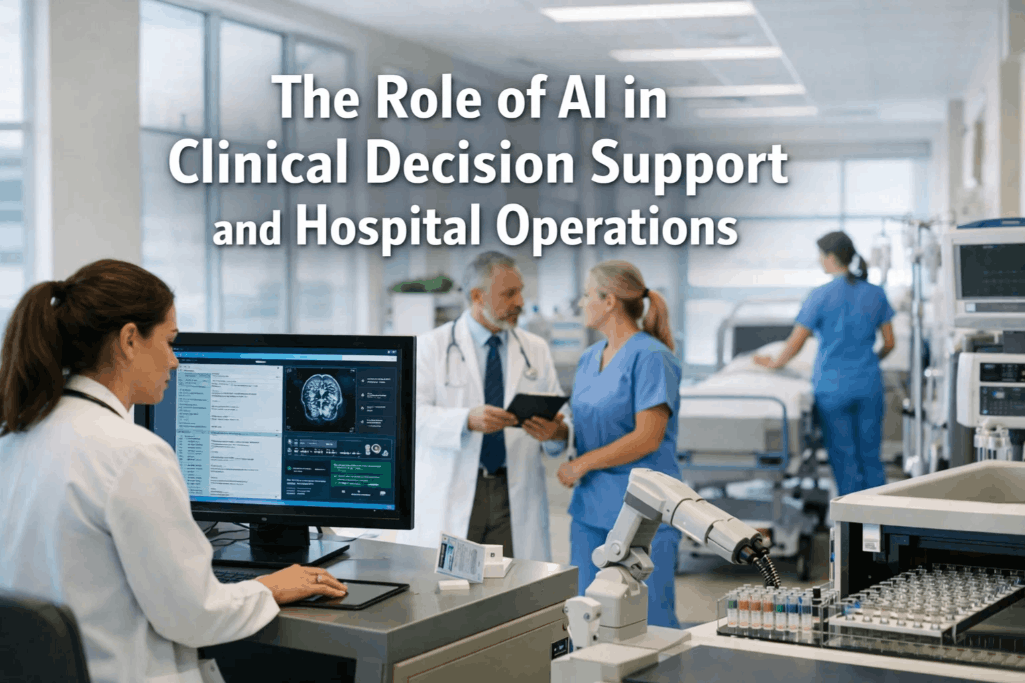
AI for Clinical Decision Support: Reducing Readmissions and Enhancing Outcomes — how modern AI models integrate vitals, lab results and patient histories to support clinicians with early alerts, risk scores and personalised treatment plans.
AI for Clinical Decision Support: Reducing Readmissions and Enhancing Outcomes
AI models now integrate vitals, lab results, and full patient histories in real time — giving clinicians early alerts, risk scores, and personalised treatment pathways that cut avoidable readmissions and measurably improve outcomes.
What Is AI-Powered Clinical Decision Support?
Clinical Decision Support (CDS) refers to systems that deliver patient-specific intelligence at the point of care. AI-powered CDS goes further — continuously ingesting vitals, laboratory results, imaging data, medication records, and historical patient notes to surface risk scores, early-warning alerts, and evidence-based treatment recommendations in near real time.
Unlike legacy rule-based CDS that fires generic alerts, modern AI models are trained on millions of clinical events. They identify subtle, multi-variable patterns that clinicians cannot catch manually — flagging deterioration before it becomes crisis. The result is a clinical environment where decisions are faster, better-informed, and consistently backed by data. If your facility is still relying on manual rounds and static order sets, start a free trial to see how AI-integrated asset and clinical workflow tools close that gap, or book a demo with our team today.
How AI Models Process Clinical Data
Effective clinical AI is built on a layered data architecture — each layer adding context and precision. Here is the core framework that underpins high-performance clinical decision support systems deployed in hospitals today.
Oxmaint brings AI-powered asset monitoring, predictive maintenance, and real-time operational visibility to healthcare facilities. Your equipment uptime directly affects patient outcomes — close the gap now.
Where Clinical Teams Are Still Failing Patients
The data is stark: most adverse events and avoidable readmissions are not caused by lack of clinical knowledge — they are caused by information delays, fragmented systems, and cognitive overload. These are infrastructure problems, not competence problems.
How Oxmaint Supports the AI Clinical Environment
AI clinical decision support works best when the physical infrastructure it depends on — medical equipment, facility systems, biomedical devices — is equally well managed. Oxmaint closes the gap between clinical AI and operational reliability. Ready to see this in action? Start a free trial and connect your asset data within hours, or book a demo to walk through a live hospital facility scenario with our team.
Reactive Clinical Operations vs. AI-Supported Care
The difference in patient outcomes — and operational costs — between reactive and AI-augmented clinical environments is not marginal. It is measurable, consistent, and growing as AI model accuracy improves.
| Factor | Reactive / Traditional | AI-Augmented Clinical CDS |
|---|---|---|
| Sepsis Detection | Manual SIRS criteria, 6—12 hr lag | AI flags rising risk 2—4 hrs earlier, alerts escalated automatically |
| Readmission Risk | Clinician intuition at discharge | LACE+ / ML risk score computed from full patient history at discharge |
| Alert Quality | Rule-based, high false-positive rate (85%+) | ML-filtered alerts, positive predictive value 3—5x higher |
| Treatment Adherence | Protocol compliance varies by shift and clinician | Evidence-based order sets surfaced contextually, adherence rises 40%+ |
| Equipment Reliability | Reactive maintenance, unplanned failures during care | Preventive + condition-based maintenance, 99.2%+ uptime on critical assets |
| Documentation | Manual, incomplete, retrospective | Automated, timestamped, audit-ready across all clinical and operational records |
| Cost per Patient Episode | Higher — driven by complications and emergency interventions | 15—22% lower total cost through early intervention and avoided readmissions |
Oxmaint gives healthcare operations teams the same predictive intelligence that clinical AI brings to patient care — applied to the equipment, assets, and infrastructure that clinical AI depends on. Start in hours, not months.
High-Impact AI CDS Applications in Active Deployment
These are not theoretical use cases. They represent AI models that are live in clinical environments across the US, UK, Australia, UAE, and Germany today — each with measurable outcome data.
The Numbers Behind AI Clinical Decision Support
Decision-makers need outcomes, not theory. These benchmarks are drawn from published clinical studies and health system deployment reports. Start a free trial to map equivalent ROI potential to your own facility's asset and maintenance operations, or book a demo and we will build a custom ROI model for your portfolio.
AI CDS Adoption Across Key Healthcare Markets
Regulatory environment, payer structure, and infrastructure maturity vary significantly by region. Here is what AI clinical decision support looks like in the markets where it is being deployed most aggressively.
Frequently Asked Questions
Does AI clinical decision support replace clinician judgment?
How long does it take to integrate AI CDS with an existing EHR?
How is patient data privacy protected in AI CDS systems?
What role does equipment maintenance play in clinical AI effectiveness?
Your Clinical AI Is Only as Good as Your Equipment Data
AI clinical decision support depends on accurate, real-time data. That data originates from equipment that must be maintained, calibrated, and monitored consistently. Oxmaint gives healthcare operations teams a modern CMMS purpose-built for clinical environments — full asset registry, preventive maintenance scheduling, IoT monitoring, and audit-ready documentation from day one.
More than 500 facilities across 6 countries trust Oxmaint to keep the operational infrastructure behind clinical care running at peak performance. No heavy implementation. No long onboarding. Visible ROI within 90 days.



.png)