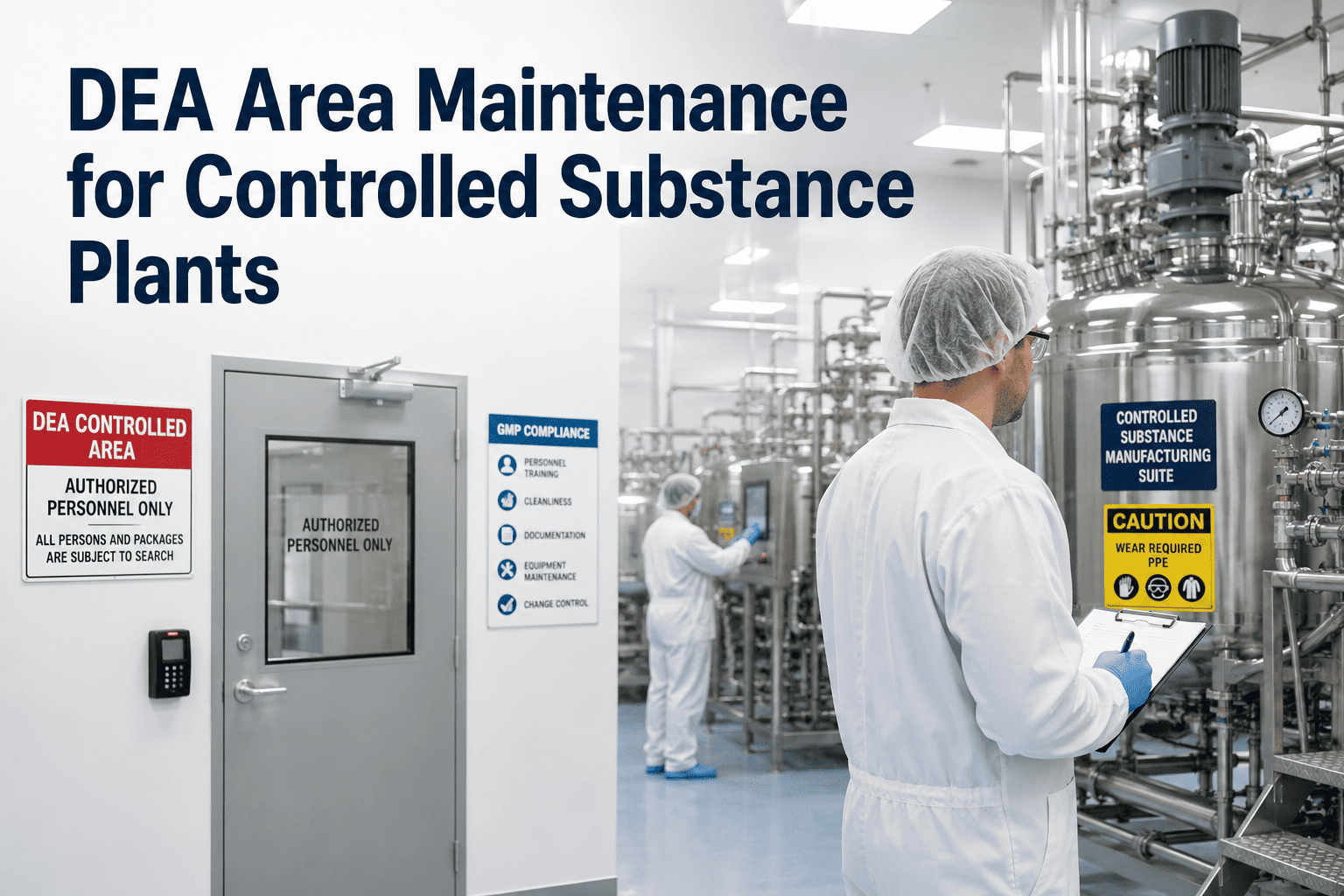
Every maintenance activity performed inside a DEA-registered controlled substance manufacturing or storage area is a regulated event — not just an operational one. Under 21 CFR 1301.71(a), all DEA registrants must provide effective controls and procedures to guard against theft and diversion, and access to controlled substances must be limited to an absolute minimum number of specifically authorised individuals. A maintenance technician entering a Schedule II production area to repair a granulator is not exempt from that requirement. Their entry must be authorised, their activity must be supervised or documented, and their access must be logged in a manner that a DEA investigator can reconstruct. The CMMS that manages the work order for that repair is also the system of record that proves the access was controlled — if it is configured to do so. Book a demo to see OxMaint's access-controlled work order management for DEA-registered facilities — or start free today.
Article · DEA Compliance · Controlled Substance Manufacturing · GMP
DEA Controlled Substance Area Maintenance
How to structure maintenance work orders, access documentation, and security records for DEA-registered controlled substance manufacturing areas — so every maintenance event in a restricted zone produces the evidence chain a DEA inspection requires.
Controlled Area Access Log — OxMaint Work Order #WO-2024-1189
Timestamp
Person
Action
Authorised By
09:14:32
J. Torres (Mech Tech)
Entry — Area CS-02
P. Ramirez, QA
09:14:40
M. Chen (QA Rep)
Entry — Escort role
Standing escort auth
10:58:11
J. Torres (Mech Tech)
Work complete — signed off
M. Chen e-sig
10:58:55
J. Torres + M. Chen
Exit — Area CS-02 cleared
System auto-logged
The 4 DEA Maintenance Documentation Requirements — and What They Mean in Practice
The DEA's regulatory framework for controlled substance manufacturing areas (21 CFR Part 1301) does not describe a maintenance management system. But it creates documentation requirements that only a controlled maintenance management system can reliably satisfy. These are the four requirements that directly affect maintenance operations.
21 CFR 1301.71(a) — Access Control
Access to controlled substance areas must be limited to an absolute minimum number of authorised individuals
Maintenance personnel are not inherently authorised for controlled substance area access. Each access event requires prior authorisation from a named responsible person — typically the area's DEA-registered Responsible Person or the QA function. The authorisation must be documented before access, not reconstructed after an incident.
CMMS requirement: Work order for CS-area maintenance must require pre-approval by an authorised person before the work order is assigned and the technician can enter the area. Approval is timestamped and tied to the specific person authorising entry.
21 CFR 1301.72(a) — Secure Storage and Work Areas
New work areas constructed or utilised for controlled substances must be approved by DEA before use
Any modification to a controlled substance manufacturing area — including the installation of new equipment, the reconfiguration of the layout, or the construction of temporary work access — that has not been previously approved by DEA may not be deemed compliant with 1301.72–1301.75, regardless of similarity to previously approved areas. Maintenance work that modifies the physical configuration of a CS area requires DEA notification or approval before execution.
CMMS requirement: Work orders involving physical modification of CS areas must carry a mandatory "DEA Approval Required" flag; work cannot be closed without confirmation that the modification was DEA-reviewed.
21 CFR 1301.74(i) — Security Controls During Manufacturing
In-process controlled substances must be returned to secure storage when manufacturing is interrupted
When maintenance work requires a production line shutdown in a CS manufacturing area, the in-process controlled substances must be returned to the vault or approved storage area — not left on the line, on a tray, or in an open vessel — before maintenance personnel enter. This is both a security requirement (preventing access to CS during maintenance) and a chain-of-custody requirement (the return to storage must be logged as part of the batch record).
CMMS requirement: Work orders for production-interrupting maintenance in CS areas include a mandatory pre-task checklist step: "CS in-process material returned to secure storage — confirmed by [name]" with a required signature field before work begins.
21 CFR 1301.71(a) + GMP — Maintenance Activity Record
All maintenance performed in CS areas must be documented in a manner reconstructable by a DEA investigator
The work order record for CS-area maintenance must show: who entered the area, when, under whose authorisation; what work was performed; whether any controlled substance contact or proximity occurred; and that the area was returned to secure status upon completion. This record serves both as a DEA security audit trail and as a GMP maintenance record under 21 CFR 211.68 and 211.182.
CMMS requirement: CS-area work orders carry mandatory fields — entry authorisation, escort identity, work performed, CS proximity (yes/no), area return to secure status confirmed, and closure signature by QA. These fields cannot be skipped.
Maintenance Work Order Configuration for DEA-Registered Areas
| Work Order Field |
Standard Facility WO |
CS Area Work Order (DEA Requirement) |
| Area access pre-approval |
Optional — assigned at manager discretion |
Mandatory — named authorised person must approve before work order is assigned to technician |
| Escort requirement |
Not applicable for most internal maintenance |
Required for non-DEA-registered maintenance staff entering CS areas; escort identity logged on work order |
| In-process CS material clearance |
Not applicable |
Mandatory pre-task checklist item for production-interrupting maintenance; signed by production supervisor |
| CS proximity during work |
Not tracked |
Mandatory field — "Was controlled substance present or in proximity during work?" Yes/No with mandatory explanation if Yes |
| Area returned to secure status |
Not tracked |
Mandatory closure step — QA or Responsible Person confirms area is secured before WO can be closed |
| DEA modification approval |
Not required |
Required for any work modifying physical configuration of CS area; WO cannot close without DEA approval reference |
| Audit trail retention |
Per CMMS default retention |
Minimum 2 years (DEA inspections may cover prior 2-year period); recommend 5 years aligning with DEA investigation windows |
DEA COMPLIANCE · OXMAINT · CONTROLLED SUBSTANCE AREAS
Every Maintenance Event in a DEA-Registered Area Is a Regulated Event. OxMaint Treats It That Way.
OxMaint configures mandatory access authorisation, escort logging, pre-task CS clearance checklists, proximity documentation, and QA closure signatures on all work orders tagged to DEA-registered areas — producing the evidence chain that reconstructs every maintenance event for a DEA investigator.
Expert Review
"The intersection of DEA security requirements and pharmaceutical GMP maintenance is an area where many manufacturers underestimate their documentation obligations. The assumption is often that DEA security is a physical security matter — locked vaults, alarm systems, perimeter controls — and that maintenance documentation is a separate GMP matter. That separation does not hold up in a DEA inspection. When a DEA investigator reviews a controlled substance manufacturing area, they look for evidence that access was controlled, that all persons who entered the area were authorised, that in-process material was not left unattended or unsecured when maintenance interrupted production, and that any modification to the area was DEA-approved before it was made. None of those requirements are satisfied by having a good physical security system. They are satisfied by having documentation. The CMMS work order is the primary documentation for maintenance access to controlled substance areas — and in facilities I have reviewed, it is frequently not configured to capture any of the DEA-specific fields that would satisfy that obligation."
Dr. Jonathan Reyes, JD, PhD, RAC
Juris Doctor · PhD Regulatory Science · Regulatory Affairs Certified (RAPS) · 14 years pharmaceutical GMP and DEA regulatory compliance · Specialist in controlled substance manufacturing facility inspections and 21 CFR Part 1301 compliance programme design
Frequently Asked Questions
Does a maintenance technician need to be DEA-registered to work in a controlled substance manufacturing area?
Maintenance technicians do not need to be individually DEA-registered, but the facility's DEA registration covers the area — and the facility's Responsible Person bears responsibility for ensuring that all persons who access the CS area are authorised and that their access is documented. In practice, this means the facility must have a written SOP that defines who may authorise maintenance access to CS areas, what documentation is required for each access event, and whether a DEA-registered escort is required for non-registered maintenance personnel. The CMMS work order is the primary vehicle for capturing and evidencing that access control process.
Book a demo to see how OxMaint configures access authorisation fields on CS-area work orders.
What happens if maintenance work in a CS area requires modifying the physical layout?
Under 21 CFR 1301.71(e) and 1301.72, any new work area constructed or utilised for controlled substances that has not been previously approved by DEA is not automatically deemed compliant, even if it is physically similar to previously approved areas. This means a facility planning to install new manufacturing equipment, build a temporary work enclosure, or reconfigure a CS storage area must submit the proposed changes to the DEA's Special Agent in Charge or the Regulatory Section for review before the modification is made. The work order for the modification should include a mandatory field requiring confirmation that DEA approval was obtained, with the approval reference number, before the work order can be closed and the modified area returned to production use.
How long must maintenance records for DEA-registered controlled substance areas be retained?
DEA regulations under 21 CFR 1304 require that records related to controlled substance handling be retained for two years from the date of the transaction. Given that DEA investigations may cover a two-year period retrospectively, facilities should retain CS-area maintenance work orders for at least two years from the date of the maintenance event. Industry best practice and legal risk management recommend a five-year retention period for all CS-area maintenance documentation, particularly for facilities that have experienced any diversion event or regulatory inquiry, where investigators may look beyond the two-year statutory minimum. OxMaint stores all work order records for configurable retention periods with the full audit trail intact for the complete retention window.
What should a CMMS work order contain to satisfy a DEA audit of CS-area maintenance?
A work order that satisfies a DEA audit of CS-area maintenance must contain:
pre-authorisation — named authorised person, timestamp of authorisation, and basis for authorisation;
entrant identity and role — every person who entered the CS area, their relationship to the work, and whether they are registered or escorted;
work performed — specific tasks, equipment touched, and whether controlled substance contact or proximity occurred;
in-process material status — confirmation that CS material was secured before maintenance entry for production-interrupting work;
area return to secure status — confirmation by QA or Responsible Person that the area was returned to approved secure status before personnel departure; and
closure signature — QA or Responsible Person e-signature.
Start free to configure OxMaint's CS-area work order template.
DEA COMPLIANCE · 21 CFR PART 1301 · OXMAINT
The DEA Investigator Does Not Ask Whether Your Security System Is Good. They Ask Whether Your Records Prove It Was Used.
OxMaint configures mandatory access authorisation, escort documentation, pre-task controlled substance clearance, proximity logging, and QA closure requirements on every work order tagged to a DEA-registered area — producing the complete, timestamped, tamper-evident evidence chain that demonstrates effective control of maintenance access to controlled substance areas.