Health Canada completed 318 domestic GMP inspections in FY 2023–2024 under its Good Manufacturing Practices programme — and as of 2025, Canada completed full harmonisation with PIC/S, meaning every Canadian GMP inspection now carries the same expectations as a European Medicines Agency audit. GUI-0001 (Good Manufacturing Practices Guide for Drug Products) requires pharmaceutical manufacturers to calibrate, inspect, and maintain equipment used in significant processing and testing operations according to a written programme, with records that demonstrate compliance. The difference between passing that inspection and receiving a Notice of Non-Compliance is not whether your maintenance programme exists — it is whether it is documented, controlled, and retrievable in the format an inspector can verify in real time. Book a demo to see OxMaint's Canadian GMP maintenance readiness capabilities — or start free and begin configuring your equipment maintenance programme today.
Landing Page · Canadian GMP · GUI-0001 · Health Canada
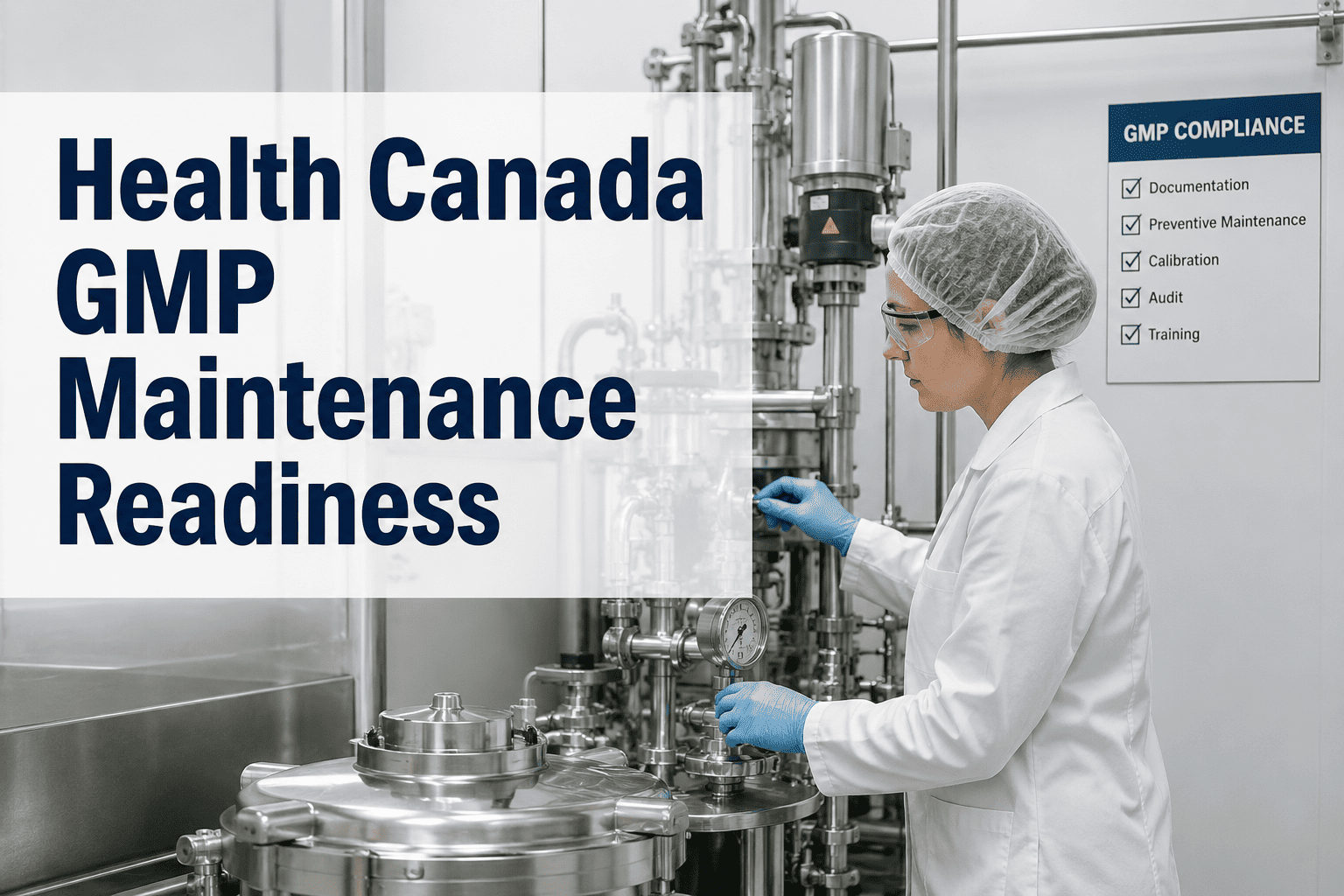
Health Canada GMP Maintenance Readiness
Support Canadian GMP inspections with controlled maintenance records, equipment status tracking, deviation links, calibration status identification, and QA-ready reports — built for GUI-0001 and PIC/S-harmonised expectations.
GUI-0001 Aligned
PIC/S Harmonised (2025)
Part C Division 2 FDR
GUI-0050 Annex 11
GUI-0001 Maintenance Requirements — Inspector's Checklist
Written PM programme exists for all significant equipment
Calibration status identifiable on all measurement equipment
Equipment logs current — last service date, next due date
Deviations linked to affected batch records
QA e-signatures on all closed maintenance records
Paper-based records — cannot demonstrate completeness under pressure
Work orders not linked to deviations or CAPA records
Calibration certificates filed by date — not searchable by asset
GUI-0001 Maintenance Requirements — What the Regulation Actually Requires
GUI-0001 and Part C, Division 2 of the Food and Drug Regulations set specific, verifiable requirements for equipment maintenance. The table below maps each regulatory requirement to the documentation that satisfies it — and what OxMaint provides to ensure every requirement is met by design, not by effort.
| GUI-0001 / FDR Requirement |
Regulatory Reference |
Documentation That Satisfies It |
OxMaint Control |
| Equipment used in significant processing must be calibrated, inspected, or checked according to a written programme |
GUI-0001 §C.02.027(a)(d) |
Calibration master plan; individual calibration records with out-of-tolerance action; written PM schedule per equipment class |
PM templates per equipment type; calibration WOs triggered by interval; all results logged against asset record |
| A system must be in place to identify the calibration status of equipment |
GUI-0001 §C.02.027(d) — may use status labelling |
Physical calibration status label on instrument; digital calibration status in equipment record — "Calibrated / Due / Overdue / Out of Service" |
Asset record displays current calibration status; QR scan shows status at point of use; overdue calibration blocks equipment "In Use" status |
| Equipment maintenance records must be kept |
FDR C.02.021 — records retained ≥ 1 year after batch expiry |
Work order records with technician attribution, timestamp, procedure followed, and QA sign-off; linked to asset maintenance history |
Every closed work order is a time-stamped, e-signed, immutable record stored against the asset ID for the retention period |
| Deviations in equipment performance must be documented and linked to affected batches |
GUI-0001 §4 (Pharmaceutical Quality System); ICH Q10 |
Deviation report linked to: work order triggering the deviation, affected batch records, CAPA record, and closure approval |
OxMaint deviation record linked to work order; batch linkage field mandatory for production equipment deviations; CAPA record linked at creation |
| Computerised maintenance systems must meet data integrity requirements |
GUI-0050 (Annex 11 equivalent) — computerised systems validation |
Validated CMMS with audit trail, access controls, e-signatures, and backup/recovery documentation |
OxMaint audit trail (always-on), role-based access, 21 CFR Part 11 / Annex 11 compatible e-signatures, SOC 2 Type II security |
| Equipment status must be clearly identified — particularly equipment out of service or under repair |
GUI-0001 §C.02.025 — premises and equipment must be clearly identified |
Equipment logbook showing current status; "Out of Service" label procedure; work order flagging equipment as unavailable during repair |
Equipment status field updated automatically when repair WO is opened — asset shows "Under Maintenance" until WO is closed and signed off by QA |
The PIC/S Harmonisation Impact — What Changed for Canadian Inspections in 2025
01
Audit trail expectations now match EU Annex 11
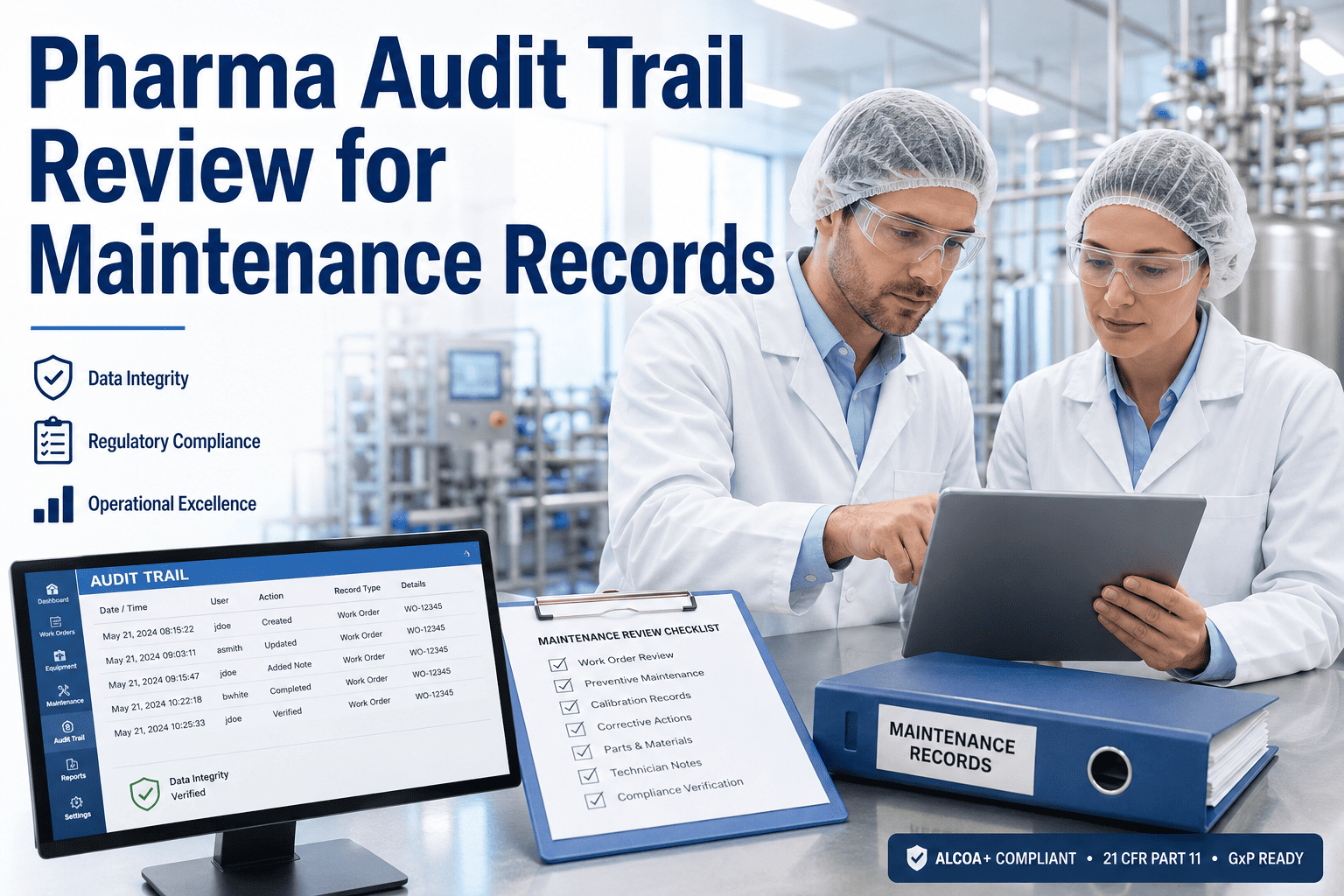
Post-harmonisation, Health Canada inspectors apply the same audit trail expectations as EMA inspectors under Annex 11 — audit trails must be "always on," cannot be disabled by any user role, and must be reviewed periodically by a named QA reviewer with a documented sign-off. Canadian firms that previously relied on less stringent audit trail practices now face the same inspection standard as EU manufacturers.
02
Data integrity expectations fully aligned with MHRA / FDA
PIC/S membership means Health Canada now references the same ALCOA+ data integrity principles that underpin US FDA and UK MHRA enforcement. Maintenance records — work orders, calibration records, equipment logs — must be Attributable, Legible, Contemporaneous, Original, and Accurate. A work order backdated or completed from memory after the fact fails ALCOA+ under any PIC/S member jurisdiction.
03
Foreign inspection equivalency — certificates of compliance now applicable
Harmonisation means Health Canada recognises GMP certificates from other PIC/S member authorities (EMA, TGA, PMDA, FDA) for foreign facility oversight. Canadian sites exporting to PIC/S member markets gain equivalent recognition. For Canadian manufacturers, the practical implication is that passing a Health Canada GMP inspection now satisfies the GMP expectations of most major international regulatory bodies simultaneously.
04
GUI-0050 (Annex 11 equivalent) now enforced with full rigour
GUI-0050 — Canada's guidance document for computerised systems in pharmaceutical manufacturing — is now applied with the same enforcement vigour as EU Annex 11. Any CMMS or electronic maintenance record system must be validated, must maintain a compliant audit trail, and must support e-signatures that meet the requirements for electronic records under both GUI-0050 and Part 11-equivalent controls.
HEALTH CANADA GMP · OXMAINT · CANADIAN PHARMA
318 Health Canada Inspections Per Year. Each One Requests Maintenance Records First.
OxMaint provides the GUI-0001 aligned equipment maintenance records, calibration status identification, deviation linkage, QA e-signatures, and GUI-0050 compliant audit trail that Health Canada inspectors expect — so your maintenance documentation satisfies the inspection before the inspector arrives.
Expert Review
"The most significant practical change from Canada's PIC/S harmonisation in 2025 for maintenance documentation is the shift in inspector expectations around audit trails and data integrity. Before harmonisation, a Health Canada inspector reviewing maintenance records was applying Canadian-specific expectations. Post-harmonisation, they are applying PIC/S GMP Guide Part I and Annex 11 expectations — which are the same standards a European inspector would apply at the same site. Canadian manufacturers who have been operating to a standard slightly below EU expectations now face those EU expectations at their domestic inspections. For maintenance CMMS systems specifically, this means the audit trail must meet the same 'always-on and locked' expectation that the 2025 EU Annex 11 draft revision has codified — and it means the periodic QA review of the audit trail must be a documented activity with a named reviewer and a sign-off, not just a technical capability that the system offers. The gap between 'our CMMS has an audit trail' and 'our QA team reviews the audit trail monthly and the review is signed and archived' is the gap that post-harmonisation Health Canada inspections are exposing."
Dr. Anita Mehta, PhD, RAC (US), RAC (Canada)
PhD Analytical Chemistry · Regulatory Affairs Certified (US and Canada — RAPS) · 18 years Canadian and North American pharmaceutical GMP compliance and data integrity · Specialist in Health Canada inspection readiness, GUI-0001 implementation, and PIC/S harmonisation impact assessment
Frequently Asked Questions
What does GUI-0001 require for pharmaceutical equipment maintenance records in Canada?
GUI-0001 (GMP Guide for Drug Products, Part C Division 2 FDR) requires that equipment used in significant processing and testing operations be:
calibrated, inspected, or checked according to a written programme; that
records of those activities be kept; and that
a system be in place to identify the calibration status of each instrument. In practice, this means a written calibration master plan, individual calibration records for each instrument, a PM schedule documented in a written programme, and a status identification system (physical label, digital status, or both). Records must be retained for at least one year after the expiry of the batch to which the equipment contributed, under FDR C.02.021.
Book a demo to see how OxMaint satisfies each GUI-0001 maintenance requirement by design.
How does Health Canada's PIC/S harmonisation in 2025 affect equipment maintenance documentation expectations?
PIC/S harmonisation means Health Canada inspectors now apply PIC/S GMP Guide Part I and Annex 11 expectations to Canadian drug manufacturing sites. For equipment maintenance documentation, the key changes are:
audit trail requirements now match EU Annex 11 — always-on, cannot be disabled by administrators, must be reviewed periodically by a named QA reviewer;
ALCOA+ data integrity principles fully apply to all electronic maintenance records; and
computerised maintenance systems must be validated under GUI-0050 (Canada's Annex 11 equivalent). Canadian firms that pass a Health Canada GMP inspection now simultaneously satisfy the GMP maintenance expectations of most other PIC/S member regulatory bodies.
Start free to configure OxMaint for Canadian GMP compliance.
What is required when pharmaceutical manufacturing equipment is found out of calibration?
An out-of-tolerance calibration finding is a deviation event under Health Canada GMP expectations. The required response is: immediate equipment quarantine (Out of Service status until investigation is complete); a written deviation record documenting the extent and nature of the out-of-tolerance condition; impact assessment on batches manufactured since the last confirmed in-tolerance calibration — this is the critical requirement, because any batch made while the instrument was potentially out of tolerance must be evaluated for product impact; a CAPA record documenting root cause and corrective action; and QA approval before the equipment is returned to service. OxMaint links the out-of-tolerance work order automatically to a deviation record, flags the affected calibration window, and blocks the equipment's "In Use" status until QA closure is documented.
Does OxMaint meet Health Canada's GUI-0050 requirements for computerised maintenance systems?
OxMaint is designed with the requirements of GUI-0050 and its EU Annex 11 equivalent in mind. The platform provides: a tamper-evident, always-on audit trail that cannot be disabled by any user role; role-based access controls with individual user authentication; e-signatures linked to records at the moment of signing with cryptographic integrity; data backup and recovery with documented procedures; and SOC 2 Type II security certification covering the controls required for GMP-regulated electronic records. Customers conducting OxMaint validation activities for GUI-0050 compliance can request the OxMaint Validation Support Package, which includes system description documentation, risk assessment template, and pre-qualified IQ/OQ protocols. Specific GUI-0050 validation questions should be directed to the OxMaint implementation team during the demo or onboarding process.
HEALTH CANADA · GUI-0001 · PIC/S HARMONISED · OXMAINT
When the Health Canada Inspector Asks for Your Maintenance Records, OxMaint Has Them Ready.
Calibration status by asset. PM completion history. Deviation records linked to affected batches. QA e-signatures on every closed work order. Audit trail reviewed and signed. All of it searchable by asset ID, date range, or batch number — in under two minutes. That is GMP maintenance readiness.