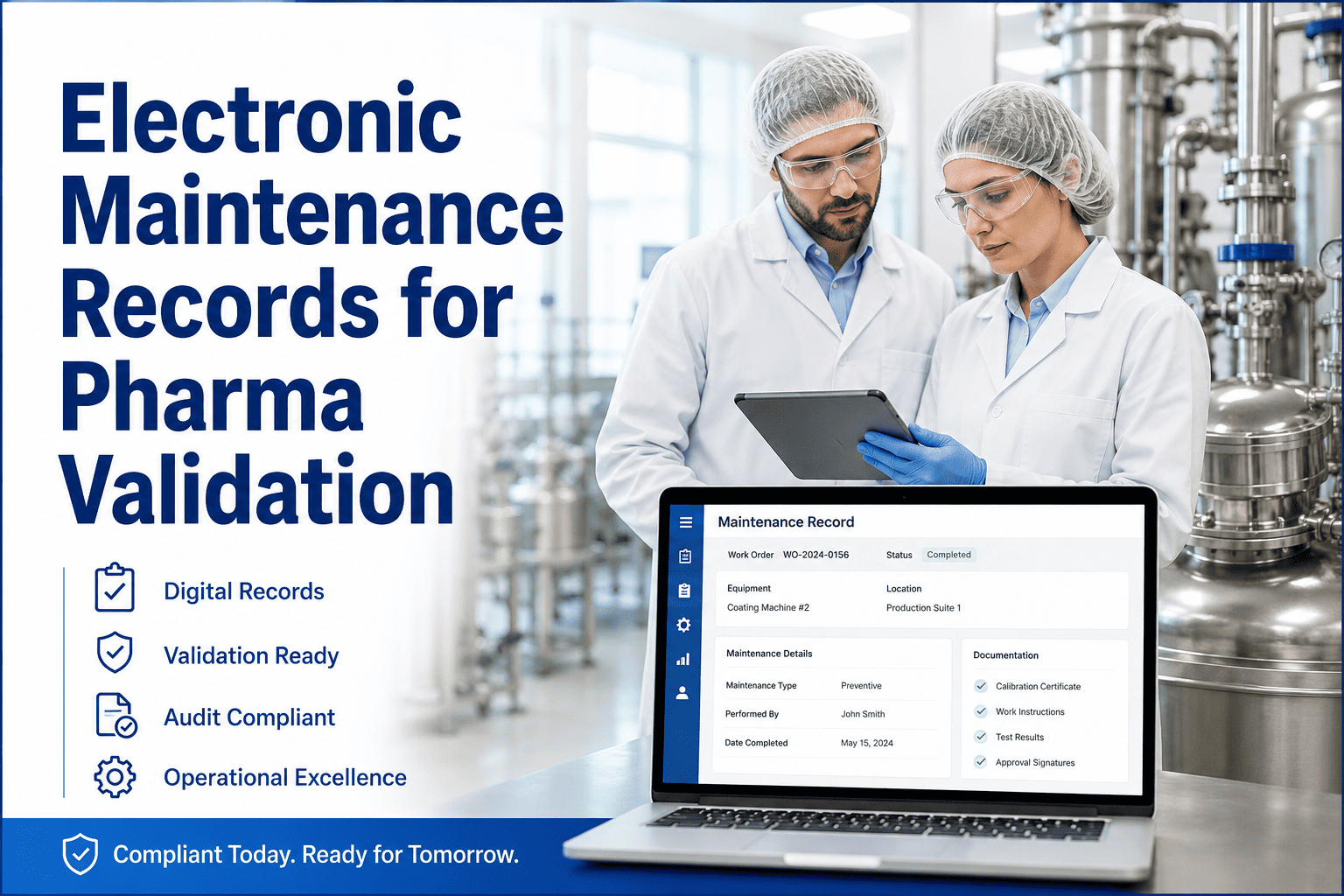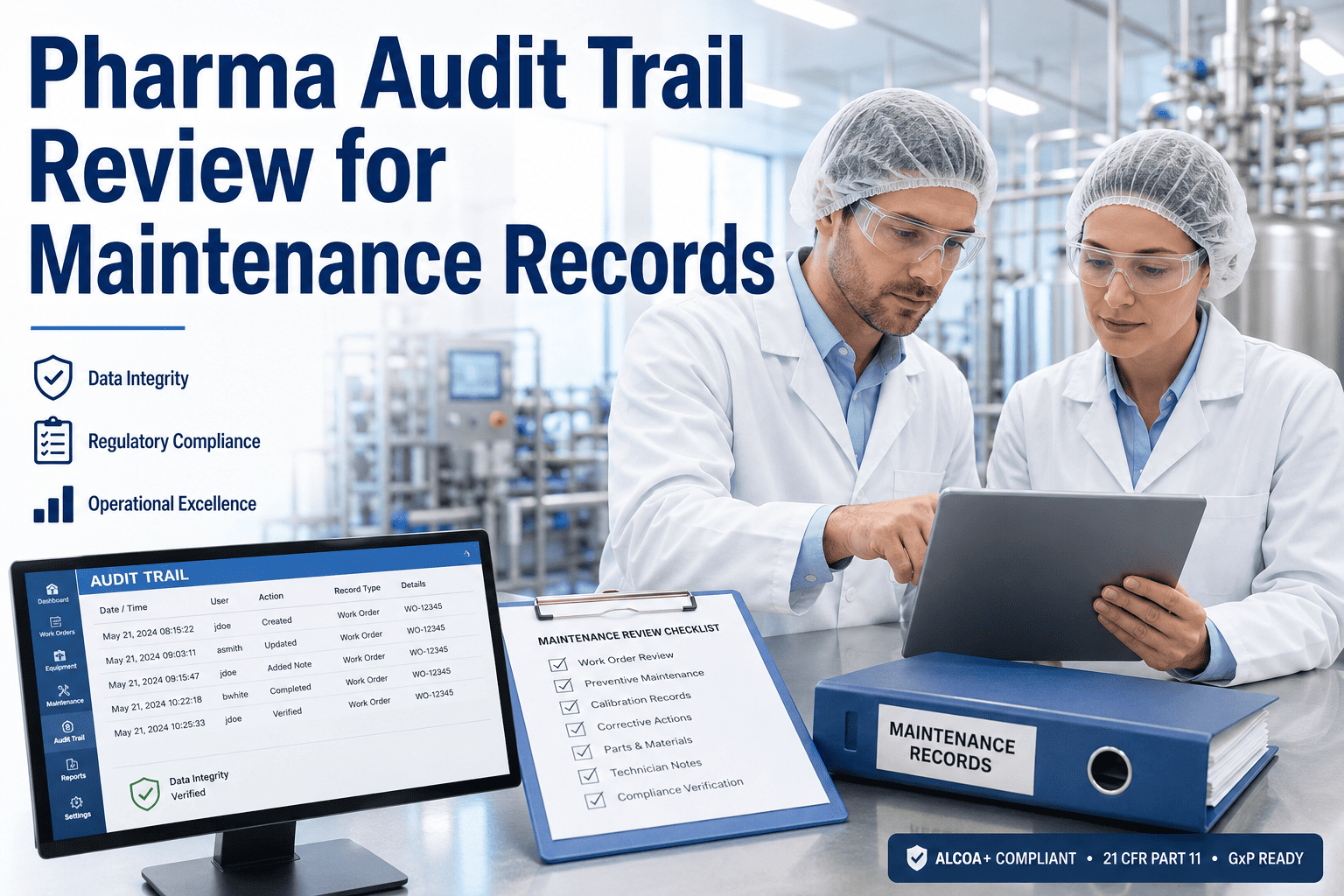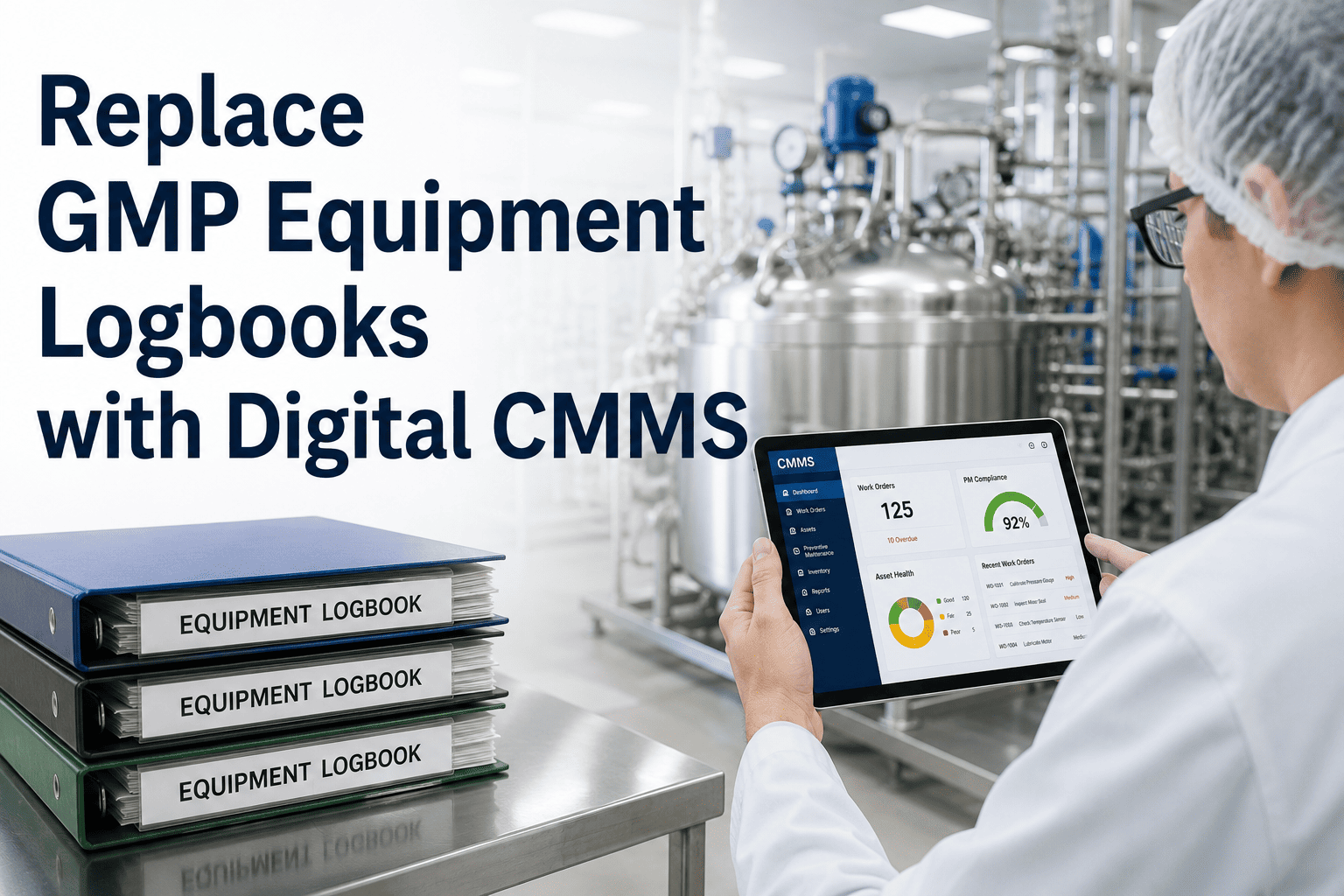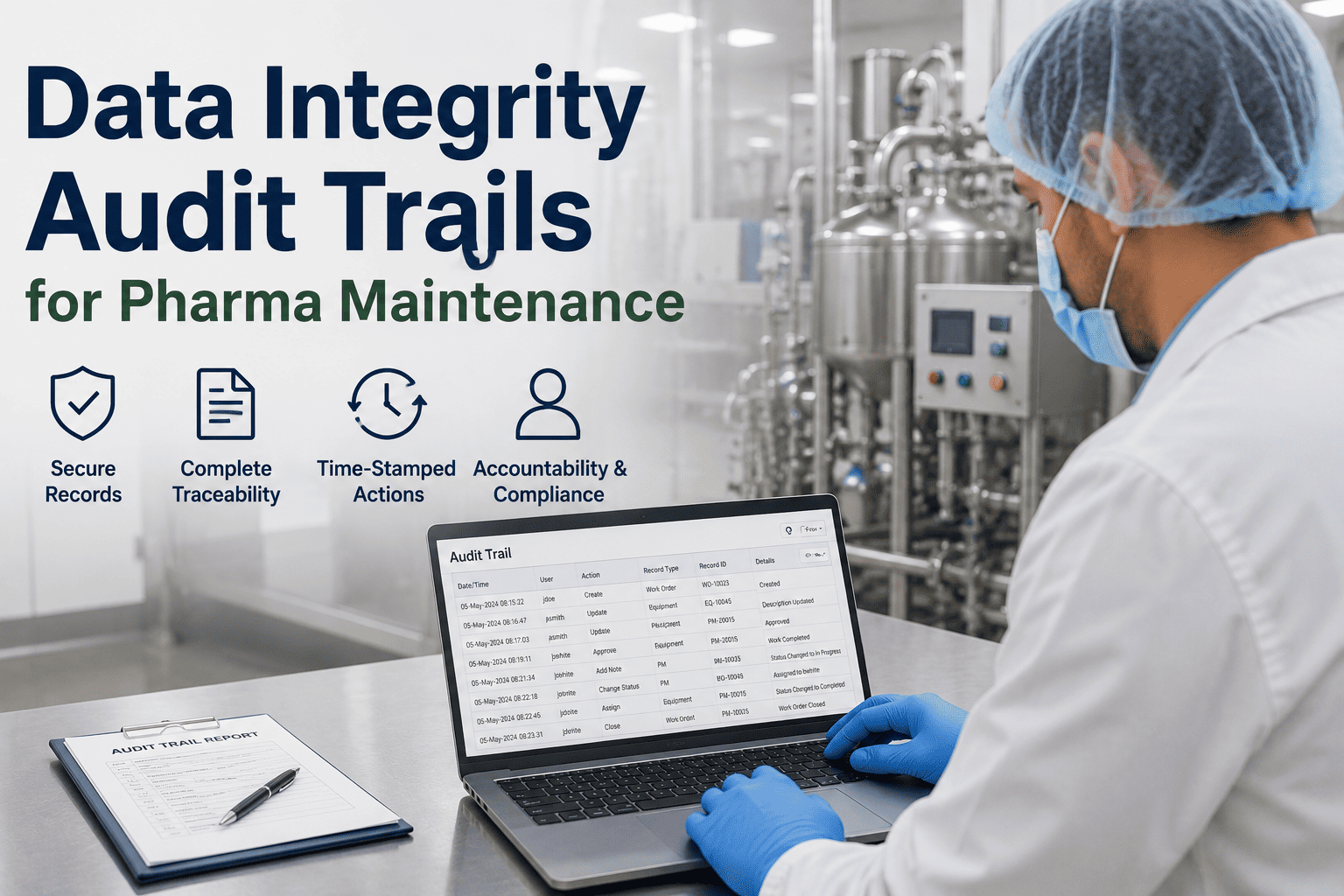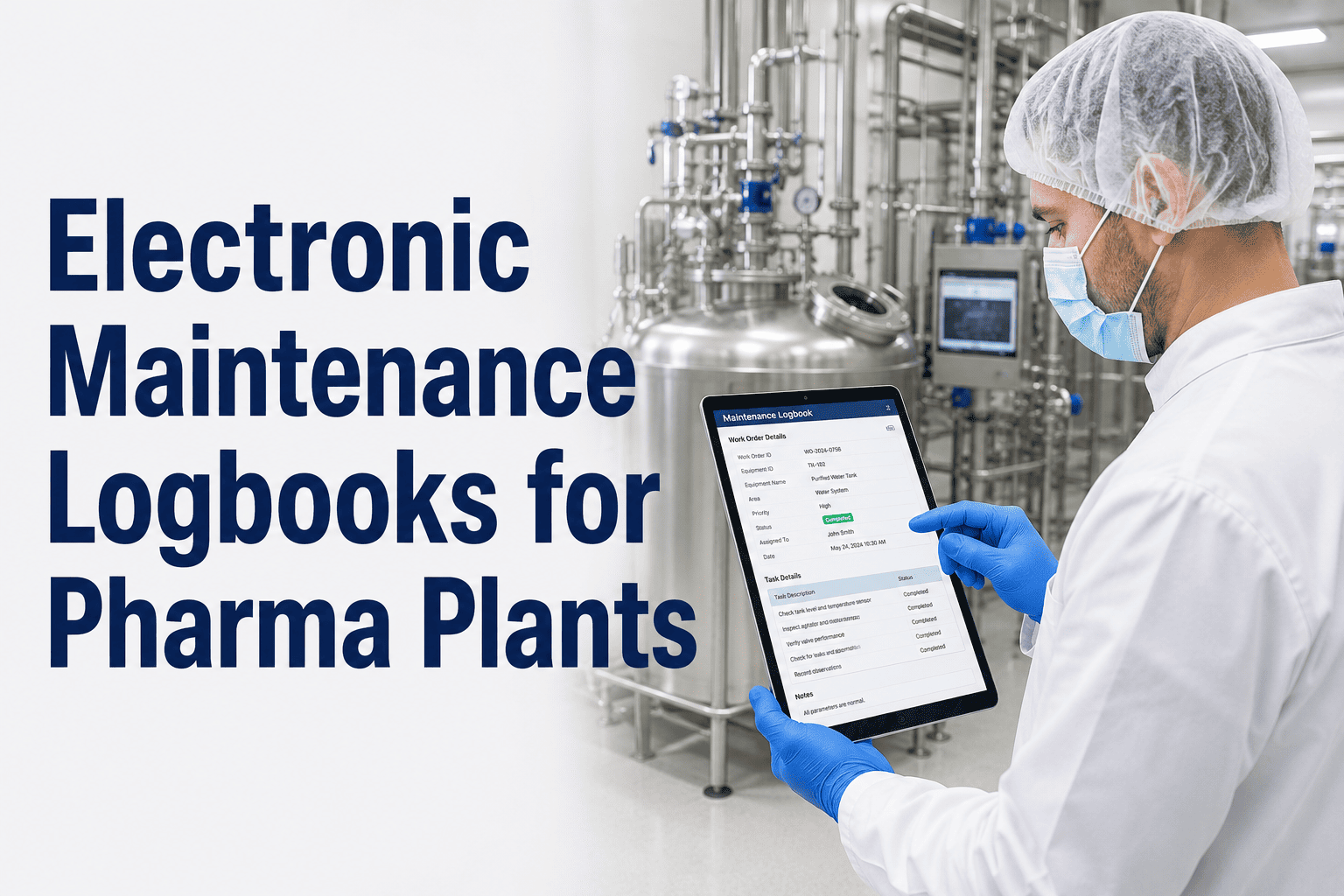
Paper maintenance logbooks in pharmaceutical manufacturing are not just inefficient — they are a documented compliance liability. Illegible entries, missing timestamps, unsigned records, and binders that take 40 minutes to locate during an FDA inspection are among the most cited data integrity failures under 21 CFR Part 11. OxMaint's electronic logbook module replaces every paper binder in your facility with searchable, time-stamped, audit-trail-compliant digital records for equipment, rooms, utilities, and production lines — live in under 60 minutes.
Replace Paper Maintenance Logbooks with Searchable, Audit-Ready Electronic Records
Every equipment entry. Every room log. Every utility check. Time-stamped, signed, and retrievable in seconds — not buried in a binder on a shelf.
What Gets Logged: Every Record Type Your Facility Needs
A complete electronic logbook programme covers four record categories. Each carries its own compliance risk if maintained on paper — and each becomes instantly retrievable and audit-trail-protected when migrated to OxMaint.
Every log type above — one platform, one audit trail, zero paper.
21 CFR Part 11 Compliance: What Your Electronic Logbook Must Deliver
| Part 11 Requirement | What Investigators Check | OxMaint Capability | Status |
|---|---|---|---|
| Audit Trail (§11.10(e)) | Every record creation, modification, and deletion logged with user ID, timestamp, and reason | Automatic — no user action required; tamper-evident | Compliant |
| Individual User Auth (§11.300) | Unique login credentials per user — shared passwords are a direct citation trigger | Individual authentication enforced; no shared accounts permitted | Compliant |
| Electronic Signatures (§11.50) | Signatures linked to record, showing printed name, date/time, and meaning of signature | E-signature with name, timestamp, role, and purpose captured per entry | Compliant |
| Record Accuracy (§11.10(b)) | Records must accurately reflect data entered and prevent record alteration without trail | Immutable record entry; edits create versioned audit trail, original preserved | Compliant |
| System Validation (§11.10(a)) | Computerised system validated to ensure accuracy, reliability, consistent performance | Full IQ/OQ documentation package provided; validation support included | Compliant |
| Record Retention (§11.10(c)) | Records retained and accessible for the duration required by applicable regulations | Configurable retention periods; records remain searchable throughout retention window | Compliant |
Paper Logbooks: The Hidden Cost Most Pharma Sites Never Calculate
The compliance risk of paper is visible. The operational cost is less often measured — but it compounds every day across every shift in every area of your facility.
Paper logbooks are a solved problem — the technology to eliminate them has existed for years. The reason facilities cling to paper is institutional inertia, not technical limitation. What finally drives change is an FDA inspection where the investigator asks for a specific equipment log, the team disappears for 45 minutes, and returns with the wrong binder. I have seen that exact scenario result in a 483 observation for inadequate record control on a record that was technically complete — the entry existed, it just couldn't be found. Electronic logbooks don't just improve data integrity; they eliminate the operational theatre of hunting for records under pressure. Under 21 CFR Part 11, the baseline expectation is that every record is retrievable in seconds. Paper cannot meet that standard at scale.
Frequently Asked Questions
Can we migrate our existing paper logbook history into OxMaint?
Yes. Historical paper records can be uploaded as scanned attachments linked to the relevant asset or room record in OxMaint, creating a unified equipment history that spans both paper and electronic eras. Going forward, all new entries are captured digitally with full 21 CFR Part 11 audit trail. The OxMaint onboarding team supports data migration for facilities with existing spreadsheets or CMMS exports — most sites complete asset setup and go live on electronic logs within 60 minutes. Start your free trial to see the asset import workflow.
How does OxMaint handle electronic signatures for GMP log entries?
Every log entry requires individual user authentication — no shared credentials. The electronic signature captures the user's full name, timestamp, role, and the meaning of the signature (reviewed, approved, verified) as required under 21 CFR Part 11 §11.50. Supervisory countersignature workflows are configurable per log type, so a room entry can require operator sign-off followed by shift supervisor countersignature before the record is locked. Book a demo to see the e-signature configuration for your specific log types.
What happens if a log entry needs to be corrected after sign-off?
Corrections follow the same ALCOA+ principle as paper records — the original entry is never deleted. A correction creates a new versioned entry with the corrected value, the correcting user's identity, timestamp, and a mandatory reason field explaining why the correction was made. The audit trail shows both the original and corrected version, which is exactly what FDA investigators expect to see. This structure makes data integrity defensible under scrutiny in a way that erasure or white-out on paper records never can be. Try OxMaint free and test the correction workflow in your own environment.
Does OxMaint cover EU Annex 11 as well as 21 CFR Part 11?
Yes. OxMaint is designed for global pharmaceutical manufacturers who must satisfy both FDA and EU GMP requirements simultaneously. The platform's validation package, audit trail architecture, access control model, and electronic signature framework address the core requirements of EU Annex 11 alongside 21 CFR Part 11. For sites operating under MHRA GxP Data Integrity Guidance or Japan PMDA requirements, the same architecture applies — all frameworks share the foundational ALCOA+ principles that OxMaint is built around. Book a demo to review the compliance framework documentation for your regulatory jurisdiction.
Every Paper Binder in Your Facility Is a Compliance Risk Waiting to Be Found
OxMaint replaces paper maintenance logbooks with searchable, time-stamped, Part 11-compliant electronic records for every equipment type, room, utility, and production line in your facility — live in under 60 minutes, no hardware required.