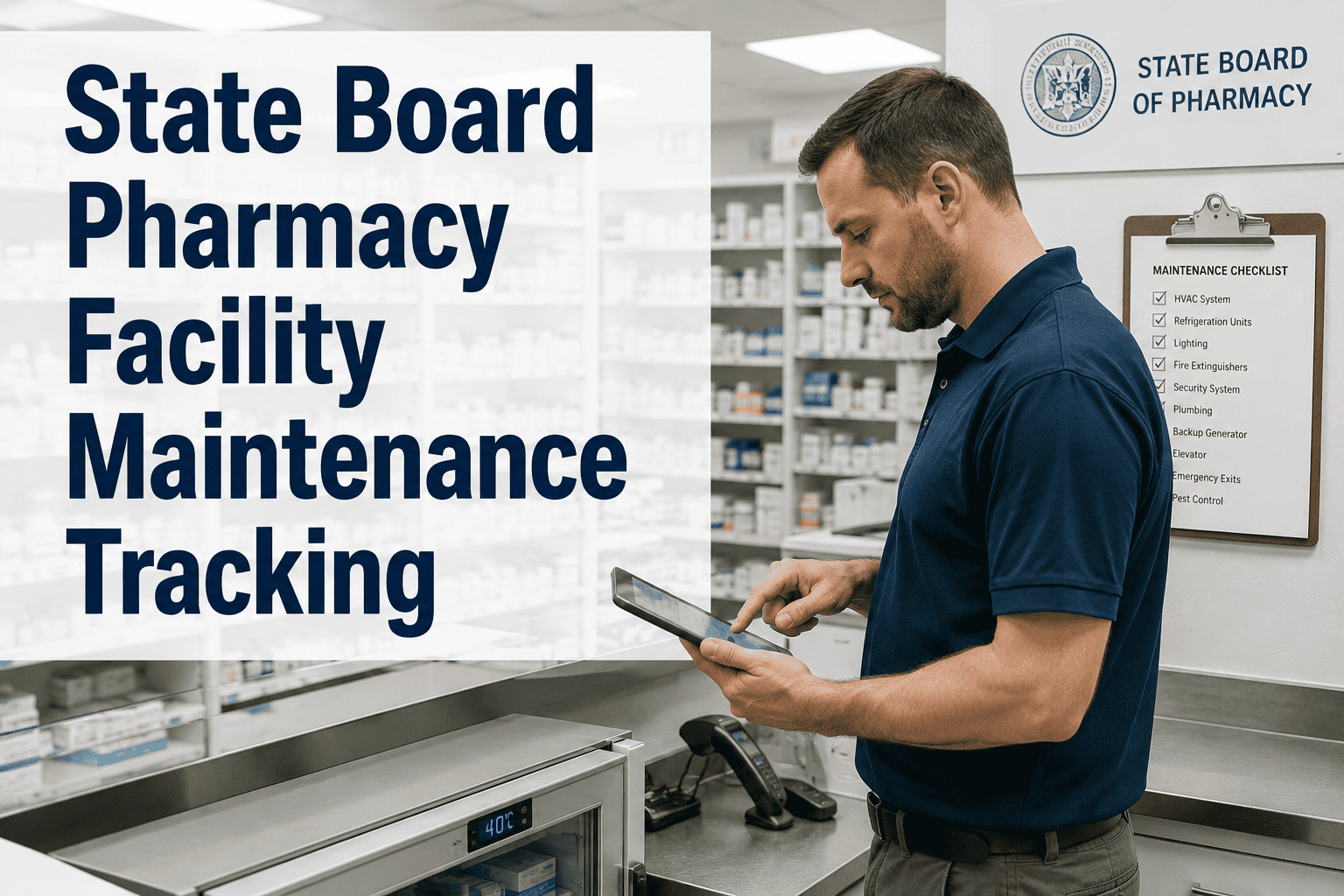
State Board of Pharmacy inspectors do not announce their visits. They arrive with a checklist, ask for documentation on the spot, and expect to see dated maintenance records, current HEPA certification reports, air pressure differential logs, and surface cleaning records within minutes — not hours. USP Chapter 797 became enforceable in November 2023 with significantly tightened environmental monitoring requirements, and USP Chapter 800 added a second layer of engineering control documentation for hazardous drug handling. Both are enforced by State Boards of Pharmacy, CMS Conditions of Participation, OSHA for USP 800 violations, and The Joint Commission during accreditation surveys. Violations can result in civil penalties up to $15,625 per violation per day and operational suspension. OxMaint's pharmacy CMMS structures every maintenance task, cleanroom check, and equipment certification as a digital record linked to the specific room or instrument asset — so when the inspector arrives, every document they need is retrievable in seconds, not assembled overnight.
From ISO classification logs to HEPA certification records to cleaning solution rotation documentation — OxMaint turns every pharmacy facility maintenance obligation into a scheduled, completed, timestamped digital record that satisfies any board inspection without last-minute scrambling.
The revised USP 797 organises maintenance and monitoring obligations by cleanroom zone and compounding category. The table below maps every maintenance task to its required frequency, the documentation format inspectors expect, and how OxMaint schedules and records each one.
| Maintenance / Monitoring Task | Zone | Required Frequency | Documentation Required | OxMaint Record Type |
|---|---|---|---|---|
| ISO particle count certification | Buffer room (ISO 7) + PEC (ISO 5) | Semi-annual (every 6 months) + after any significant maintenance | Certification report with particle counts, date, certifier credentials | Semi-annual scheduled PM work order — certification report attached to asset record |
| Airflow velocity and ACPH verification | Buffer room, ante room | Semi-annual with ISO certification | ACPH calculation, airflow velocity readings, date of test | PM work order linked to HVAC asset — ACPH readings logged per measurement point |
| HEPA filter integrity (DOP/PAO test) | All HEPA-filtered zones and PECs | Semi-annual + after filter change or maintenance event affecting filter | PAO test report, filter location, date, and result (<0.01% penetration threshold) | Linked to HEPA unit asset record — test result + report file attached |
| Differential pressure monitoring | Ante room / buffer room interface; buffer / corridor interface | Continuous electronic or minimum daily manual log | Dated log showing positive pressure differential maintained; excursions documented | Daily checklist work order or BAS integration — pressure readings timestamped per zone pair |
| Temperature and humidity monitoring | Buffer room and ante room | Continuous (electronic preferred) or daily manual | Dated records with acceptable range verification; deviation documentation | Daily environmental monitoring work order — readings logged against set-point ranges |
| Surface disinfection — sporicidal agent | ISO 5 PEC interior, ISO 7 buffer room surfaces | Monthly sporicidal + daily work surface cleaning; rotation schedule documented | Cleaning log with agent name, concentration, date, operator signature, rotation record | Monthly PM work order for sporicidal + daily checklist — agent and lot number logged |
| Viable environmental monitoring (viable air and surface) | ISO 5 PEC (Action Level ≤1 CFU/plate); ISO 7 buffer room | Per USP 797 Table 2 — frequency based on compounding category and risk level | Sample location, method, results, action and alert level comparisons, corrective actions | Recurring monitoring work order per zone — results and corrective actions linked to CAPA |
| Equipment calibration — balances and temp monitors | All compounding areas | Annual minimum; per manufacturer schedule for Class A balances | Calibration certificate, instrument ID, date, standard used, next due date | Asset-linked calibration PM work order — certificate stored, due-date alert automatic |
| Refrigerator and freezer temperature log | Drug storage areas | Daily minimum; twice daily best practice | Dated temperature readings with acceptable range; excursions documented with corrective action | Daily checklist — readings logged per unit; excursion triggers corrective work order |
| Laminar airflow workstation maintenance | ISO 5 PEC | Pre-use cleaning daily; full PM per manufacturer (typically annual with certification) | Daily cleaning log; annual PM record with technician credentials | Daily checklist + annual PM work order — linked to workstation asset record |
USP 797 and 800 set federal guidance standards. Individual State Boards of Pharmacy adopt, modify, or supplement these standards — creating variability in inspection focus areas and documentation requirements that pharmacies operating across multiple states must manage site by site.
When the inspector presents their credentials, the clock starts. Board inspectors typically expect to see current and historical records within the first few minutes of the inspection. The facilities that sail through inspections are those where every record is digitalised, searchable, and retrievable by asset, date, or task type — not filed alphabetically in three-ring binders across three different rooms.
The fastest way to accumulate inspection findings in a pharmacy cleanroom is to have complete maintenance that is incompletely documented. I have seen facilities that were doing everything right — certifying on schedule, cleaning properly, monitoring daily — but generating observations because the documentation was in three separate binders, the pressure log was a handwritten sheet with illegible dates, and the corrective action for last quarter's viable count excursion was in a different file from the original monitoring record. State board inspectors are pattern-matching for evidence of a functioning, controlled maintenance programme. The maintenance itself is necessary but not sufficient. What they need to see is an organised, contemporaneous, complete record that demonstrates the programme was operating continuously — not reconstructed the night before the visit. A CMMS that links every maintenance task to a specific asset, requires completion documentation at the time of the task, and produces a dated audit trail is not a luxury for a compounding pharmacy. It is the difference between a clean inspection and a warning letter.
Can OxMaint schedule the semi-annual cleanroom certification work orders automatically?
Yes. OxMaint creates a recurring PM work order every six months for each ISO-classified zone in the cleanroom suite, triggered from the date of the previous certification. The work order assigns to your external CETA-certified vendor, requires attachment of the certification report before closure, and stores the completed report against the specific room asset record. If the certification date approaches and the work order has not been completed, the pharmacy director receives an escalation alert. The system prevents the cleanroom from accidentally falling out of certification cycle due to scheduling oversight. Start your free trial to configure cleanroom certification scheduling for your compounding suite.
How does OxMaint handle daily pressure differential and temperature logs — does staff manually enter readings?
OxMaint supports two approaches. For facilities with a Building Automation System (BAS), OxMaint can integrate directly to pull pressure differential and temperature readings automatically — eliminating manual entry and providing continuous logged data. For facilities without BAS integration, OxMaint generates a daily mobile checklist that pharmacy staff complete on their phone or tablet — each reading is timestamped, associated with the named staff member, and stored immediately. If a reading falls outside the acceptable range, OxMaint automatically generates a corrective action work order and notifies the supervisor. Book a demo to see the environmental monitoring workflow configured for your pharmacy type.
Does OxMaint produce inspection-ready reports formatted for state board documentation requests?
Yes. OxMaint's inspection report module generates date-filtered documentation packages by record type — for example, all cleanroom certification records for the past 12 months, all surface disinfection logs for the past 90 days, or all open and closed CAPA records. Reports can be generated in PDF format for printed presentation or shared as a digital document. The report structure mirrors the sequence most state board inspectors follow — starting with certification, moving to environmental monitoring, then equipment records, then CAPA — so the documentation package is already organised in inspection order when the inspector requests it. Start your free trial to generate a sample inspection report package for your facility type.
How does OxMaint help manage corrective actions from prior inspection findings?
Each inspection finding is entered in OxMaint as a CAPA work order with the finding description, root cause, corrective action required, responsible party, and target completion date. The pharmacy director's dashboard shows open CAPA status in real time — due dates, days remaining, and completion status. Completed CAPAs require documented evidence of closure before the work order can be closed. When the next inspection arrives, OxMaint produces a CAPA closure report showing every prior finding, the corrective action taken, completion date, and responsible party — the evidence package that demonstrates the pharmacy followed through. Book a demo to see the CAPA management module for pharmacy inspection findings.
OxMaint schedules every USP 797 and 800 maintenance obligation as a recurring work order, records every completion with a timestamp and staff identity, and produces a print-ready inspection package in under 60 seconds — so every State Board inspection is a documentation review, not a document hunt.