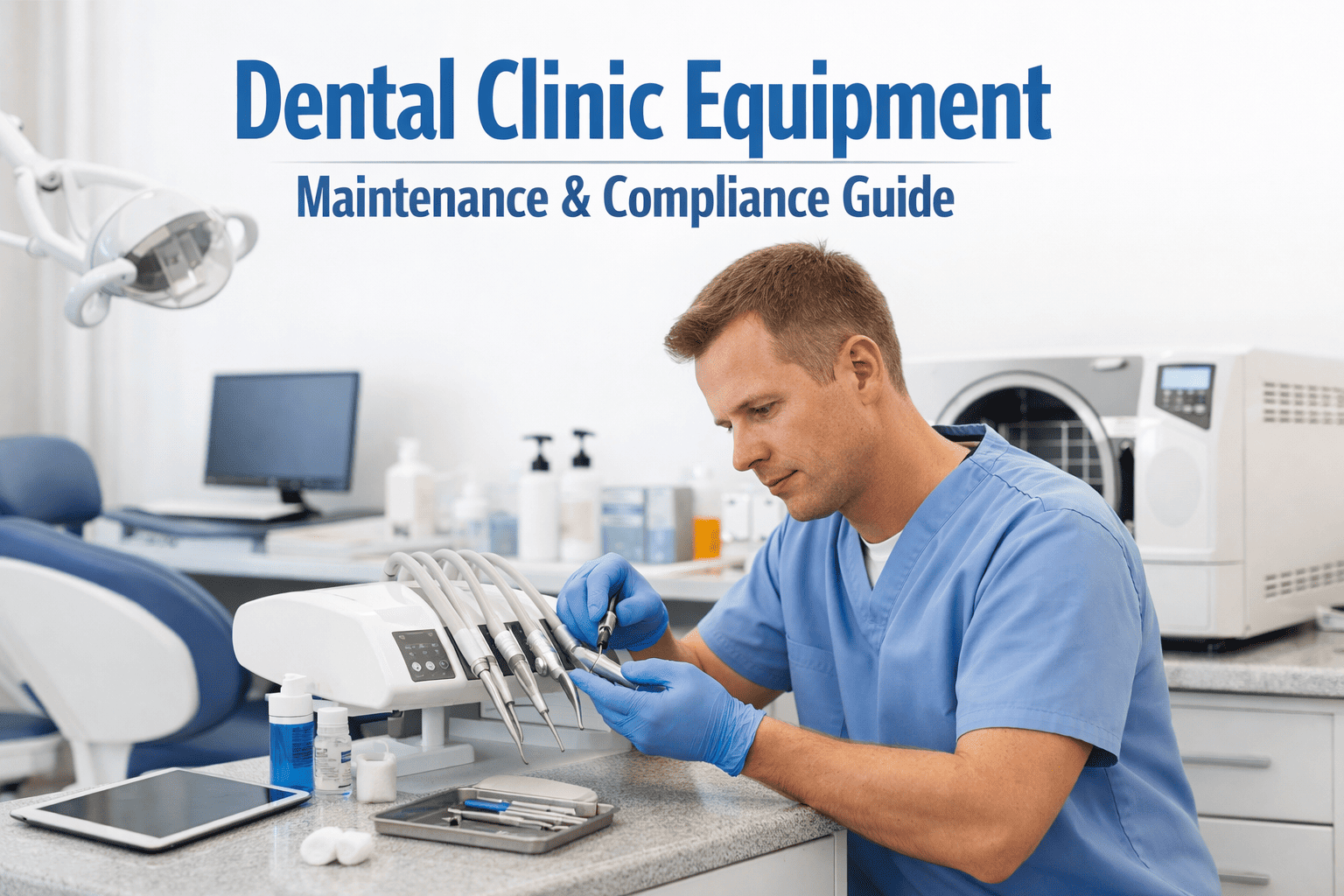
Your dental clinic's compressor fails mid-procedure. The autoclave log is a paper binder nobody can find during an infection control survey. Your X-ray units haven't had documented calibration in 14 months — and your compliance officer just walked in with a checklist. If you are running a multi-chair dental practice or a group of dental clinics and your equipment maintenance is managed through sticky notes, spreadsheets, or memory, you are one unannounced OSHA inspection away from a citation that will cost far more than the software that could have prevented it. Start your free trial and connect every dental equipment asset to a scheduled, documented, audit-ready maintenance program — or book a Strategic Equipment Audit session to see exactly where your current maintenance gaps are.
Dental clinic equipment maintenance covers five interdependent asset categories: dental air compressors and vacuum systems, autoclave sterilization units, digital and analog X-ray equipment, dental unit waterlines, and patient chairs with hydraulic and electrical systems. Each category carries distinct compliance obligations under OSHA, CDC, and state dental board regulations — and each requires documented maintenance records that are retrievable on demand during an inspection. Oxmaint replaces paper logs and spreadsheet schedules with a mobile-first digital maintenance platform that captures every service event, generates PM work orders automatically, and produces audit-ready documentation in under 10 minutes.
The Five Equipment Categories Where Dental Clinics Carry Compliance and Operational Risk
Each category has a distinct failure mode, a distinct regulatory documentation obligation, and a distinct cost when that obligation goes undocumented. Book a Strategic Equipment Audit to see your current gap across all five categories.
Oil-free dental compressors and central vacuum systems are the circulatory system of a multi-chair clinic. Compressor filter replacement, moisture trap drainage, valve inspection, and pressure relief testing all require documented intervals. A failed compressor mid-session cancels every chair in the clinic — typically 8 to 14 appointments per day. Oxmaint schedules manufacturer-specified PM intervals automatically, assigns service tasks to technicians, and captures completion with photo evidence.
Autoclave sterilization is the most compliance-dense category in dental equipment management. Weekly spore testing, daily cycle logs, annual chamber inspection, door gasket replacement schedules, and biological indicator documentation are all required and all inspected. A failed spore test without a documented corrective action protocol is a state dental board violation. Oxmaint generates spore test work orders on schedule, captures results digitally, and triggers corrective action workflows automatically when a test result requires escalation.
Intraoral X-ray units, panoramic systems, and CBCT equipment are regulated under state radiation control programs — each requiring documented calibration records, annual inspection certificates, and technician qualification records. Outdated calibration documentation triggers a state radiation safety violation and equipment suspension. Oxmaint tracks certification expiry dates for every X-ray unit, schedules calibration work orders in advance of expiry, and archives regulatory certificates against the equipment asset record.
Dental unit waterline contamination — including Legionella, Pseudomonas, and biofilm formation — is a documented patient safety risk with multiple outbreak events on record in the US. CDC recommends treating waterlines to achieve water quality of 500 CFU/mL or less. Quarterly water quality testing, shock disinfection records, and daily flushing logs are all required for defensible infection control documentation. Oxmaint manages the quarterly testing schedule, captures test results, and automates shock disinfection work order generation when results exceed thresholds.
Dental chair hydraulic systems, delivery unit motors, curing light calibration, handpiece maintenance, and suction system seals all require documented service intervals. A chair that fails mid-procedure, a curing light delivering subtherapeutic output, or a delivery unit with a blocked water valve creates both a patient experience failure and a potential clinical liability. Oxmaint registers every operatory unit with its manufacturer PM schedule and assigns service tasks to the appropriate technician — internal or third-party — with work order completion captured on mobile.
Beyond equipment maintenance, dental clinics must maintain documented infection control programs — including surface disinfection logs, PPE compliance records, sharps disposal documentation, and staff hepatitis B vaccination records. OSHA's Bloodborne Pathogens Standard requires an annual review of the Exposure Control Plan with documented staff training completion. Oxmaint manages the full infection control compliance calendar — scheduling annual reviews, capturing training completion records, and producing the documentation package an OSHA inspector requires.
Book a Free Strategic Equipment Audit — Know Your Compliance Gaps Before OSHA Does
Oxmaint's dental equipment audit session maps every asset in your clinic against its required PM schedule and compliance documentation obligation — identifying gaps before they become citations. Book your free 30-minute Strategic Equipment Audit now.
Current State vs. Future State: Dental Equipment Management
The gap between paper-based dental equipment logs and a digital maintenance management system is not a technology gap — it is a risk gap, a revenue gap, and a compliance gap running simultaneously.
| Equipment Management Area | Current State — Paper / Spreadsheet | Future State — Oxmaint Digital PM |
|---|---|---|
| Autoclave spore test schedule | Handwritten binder — missed weeks not flagged, results not linked to instrument traceability | Auto-generated weekly work order, results captured digitally, corrective action triggered on failure |
| X-ray calibration certificate tracking | Paper certificate in a folder — expiry not monitored, discovered lapsed during inspection | Certificate expiry tracked in Oxmaint with 60-day and 14-day advance alerts to schedule recertification |
| Compressor filter replacement | Replaced when remembered or when compressor faults — no interval documentation | PM work order generated per manufacturer interval with technician sign-off and parts used recorded |
| Waterline quarterly testing | Test kit results noted on a clipboard — no historical trend, no threshold alert, no shock protocol trigger | Test results entered in Oxmaint per unit; auto-alert if CFU exceeds 500; shock disinfection work order generated |
| Dental chair hydraulic service | Serviced when the chair fails or makes noise — reactive, undocumented, no asset history | Annual hydraulic inspection scheduled per chair asset; full service history in Oxmaint by asset serial number |
| OSHA infection control audit preparation | 2–4 days assembling binders from multiple physical files and staff memories | Full OSHA documentation package exported from Oxmaint in under 20 minutes |
| Curing light output verification | Not scheduled — output degrades without detection, affecting clinical outcomes and material cure quality | Monthly radiometer check scheduled per unit with output readings logged; replacement triggered when output drops below threshold |
| Multi-location equipment visibility | Each clinic maintains its own binder — group-level compliance status unknown until inspected | Group-level equipment compliance dashboard in Oxmaint — all locations, all assets, real-time status |
Clinical Impact: What Oxmaint Delivers Across Your Dental Operation
Dental practice executives and group operators see impact across four dimensions simultaneously — compliance posture, operational uptime, staff efficiency, and financial performance. Book a demo to see how each impact area applies to your clinic size and structure.
Autoclave spore logs, X-ray calibration certificates, waterline test results, and OSHA bloodborne pathogens records all maintained automatically in Oxmaint — documented, retrievable, and defensible. Inspections become routine confirmation events rather than emergency fire drills.
Compressor failures, vacuum system breakdowns, and autoclave faults are the leading causes of same-day clinic shutdowns. Systematic PM scheduling — with documented service intervals and parts replacement history — prevents the failure modes that close chairs and cancel patients.
Dental assistants and office managers currently spending 3 to 6 hours per week on manual maintenance log entry, binder filing, and certificate tracking reclaim that time for patient-facing work when Oxmaint automates scheduling, capture, and archiving. At group level, the administrative savings compound across every location.
Documented PM programs extend the serviceable life of dental compressors, autoclaves, and imaging equipment by 30 to 45 percent versus reactive-only maintenance. At $12,000 to $180,000 per imaging unit and $8,000 to $22,000 per autoclave, deferred replacement directly compounds to EBITDA improvement across a multi-location dental group.
A documented, visible infection control and equipment maintenance program is an active practice differentiator. Patients selecting between dental practices increasingly factor visible cleanliness and documented safety protocols. Oxmaint-generated compliance summaries can be shared with patients and referring providers as evidence of systematic safety commitment — a marketing asset, not just a compliance tool.
Dental groups with 3 to 50+ locations currently have no visibility into the real-time compliance status of equipment across their network. Oxmaint's group-level dashboard surfaces every overdue PM, every expiring certificate, and every open corrective action across all locations — allowing a VP of Operations to manage equipment compliance as a system, not a collection of individual clinic problems.
The Audit Is Free. The Citation Is Not.
Book a Strategic Equipment Audit session and Oxmaint will map your current equipment assets, identify your compliance gaps, and show you exactly what a complete digital PM program looks like for your clinic size and structure — at no cost. Reserve your Strategic Equipment Audit now.
Dental Clinic PM Schedule — Key Equipment and Compliance Intervals
Every interval in this table represents a documented regulatory or manufacturer obligation. Oxmaint automates the scheduling of every row — generating the work order, assigning the technician, and capturing the completion record without manual calendar management.
| Equipment Asset | PM Task | Required Interval | Compliance Authority | Oxmaint Automation |
|---|---|---|---|---|
| Autoclave / Steam Sterilizer | Biological indicator (spore) test | Weekly minimum | CDC, State Dental Board | Auto work order weekly, result capture, fail-trigger CAPA |
| Autoclave / Steam Sterilizer | Annual chamber and valve inspection | Annual | Manufacturer / State Board | Annual PM work order, service provider assignment, certificate archive |
| Dental Air Compressor | Intake filter replacement | Every 3–6 months | Manufacturer PM Schedule | Interval-based work order, parts used logged, technician sign-off |
| Dental Air Compressor | Pressure relief valve test | Annual | OSHA 29 CFR 1910.169 | Annual work order, test result captured, OSHA-ready documentation |
| Intraoral X-Ray Unit | State radiation safety inspection | Annual or biennial per state | State Radiation Control Program | Certificate expiry tracking, advance scheduling alerts, certificate archived by unit |
| Panoramic / CBCT System | Full calibration and QA imaging | Annual | FDA 21 CFR 1020 / ACR | Annual PM work order, QA test results archived, image quality records |
| Dental Unit Waterlines | Water quality culture test (CFU/mL) | Quarterly | CDC MMWR / ADA Policy | Quarterly work order per unit, CFU result logged, shock protocol auto-triggered above threshold |
| Dental Unit Waterlines | Shock disinfection treatment | Per test result or manufacturer schedule | ADA / CDC | Work order auto-triggered on failed water test, completion documented per operatory |
| Dental Chair and Delivery Unit | Hydraulic system inspection and fluid check | Annual | Manufacturer Requirement | Per-chair annual PM, service provider tracked, asset history maintained by serial number |
| Curing Light | Radiometer output measurement | Monthly | ADA Clinical Practice / Manufacturer | Monthly work order, output mW/cm2 recorded, replacement alert when below threshold |
| Central Vacuum System | Trap and separator service | Monthly to quarterly | Manufacturer PM / Infection Control | Interval-based work order, cleaning verification captured, waste disposal documented |
| OSHA Exposure Control Plan | Annual review and staff training | Annual | OSHA 1910.1030 | Annual compliance task, training completion captured per staff member, documentation archived |
Oxmaint Deployment — From Asset Inventory to Live Compliance in 3 Weeks
Most dental clinics complete Oxmaint deployment — full asset registration, PM schedule activation, and mobile field access for all staff — within 14 to 21 days. No IT project. No consultant. No disruption to clinic operations.
Every dental equipment asset registered in Oxmaint with asset type, manufacturer, model, serial number, installation date, and applicable PM schedule. Compliance category assigned per asset — autoclave, radiation, infection control, OSHA. Existing service records and certificates uploaded to establish the historical baseline. This is the foundation that makes every subsequent PM work order and compliance check meaningful and auditable.
All PM schedules activated in Oxmaint — generating first work orders for each asset based on last-service date or installation date. Dental assistants and office managers receive mobile access and a 45-minute onboarding session. QR tags applied to each piece of equipment — staff scan to access the equipment record and open the relevant PM checklist without navigating menus. Book a demo to see the mobile PM workflow for dental clinic staff.
Practice manager and group VP dashboards activated — showing real-time PM compliance rate per location, overdue tasks by category, upcoming certificate renewals, open corrective actions, and waterline test result trends. For group operators, a consolidated multi-location view provides compliance status across the entire network in one screen. Automated alert routing configured — overdue PM tasks escalate to the practice manager, then to the group VP after 7 days.
Frequently Asked Questions
Your Next OSHA Inspection Will Find Either a Paper Binder or a Digital Audit Trail
Digital autoclave spore logs, X-ray certificate tracking, waterline test management, and compressor PM schedules — all live in Oxmaint within 3 weeks, with no IT project and no disruption to patient scheduling. Book a free Strategic Equipment Audit and let Oxmaint identify exactly where your current maintenance documentation gaps are — before the next inspection does.


