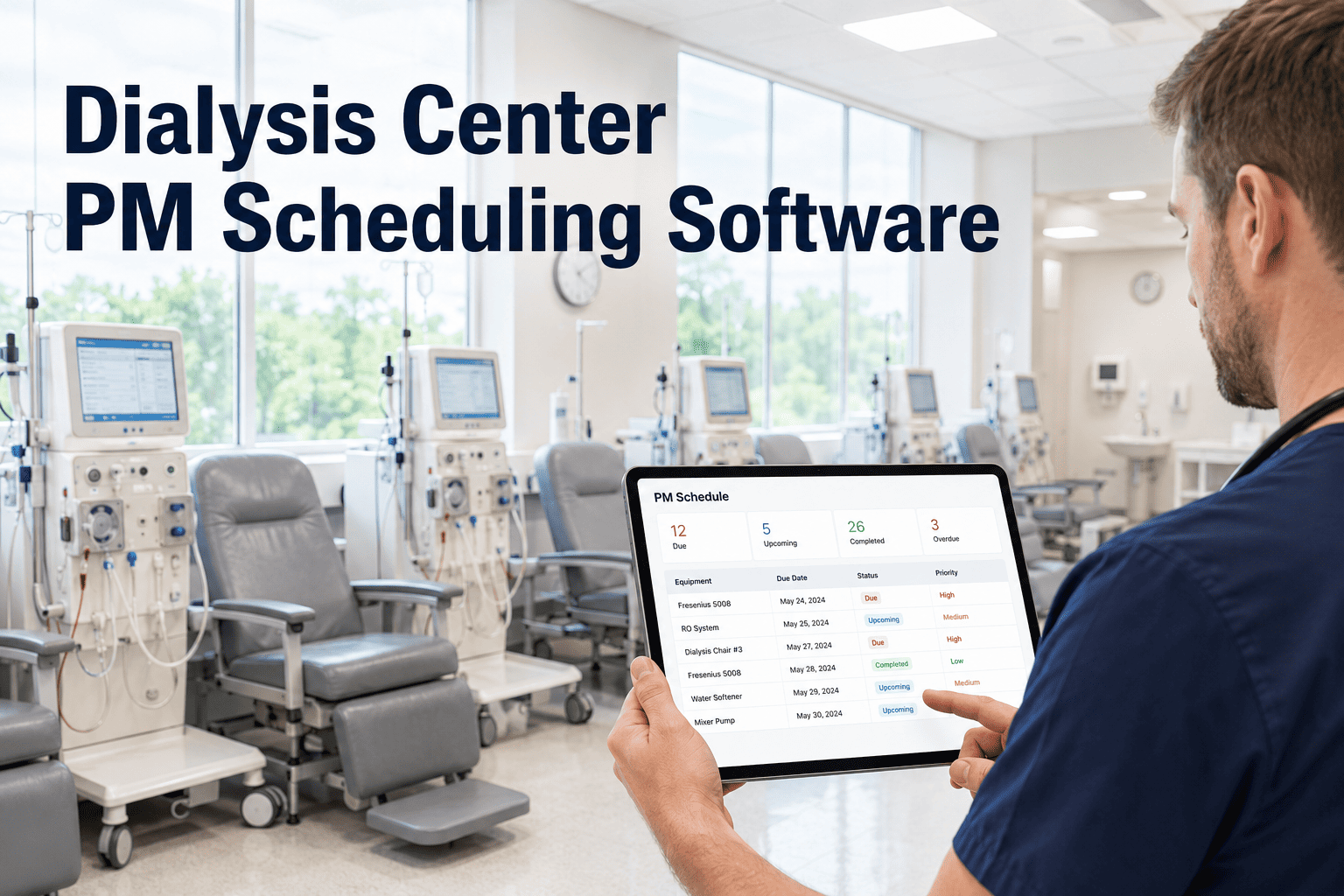
A single CMS survey deficiency citing inadequate water treatment documentation at your dialysis facility doesn't just trigger a corrective action plan — it puts your Medicare certification at risk. For the 550,000+ Americans receiving maintenance hemodialysis, the water they are exposed to during each treatment must meet standards 100 times stricter than EPA drinking water limits. When your facility's maintenance documentation can't prove compliance at the moment a surveyor arrives, you are not just facing a citation — you are facing potential immediate jeopardy status and facility closure. That documentation gap is what Oxmaint closes. Book a strategy session to see how Oxmaint structures ESRD compliance documentation across your dialysis operation.
Dialysis center compliance under CMS Conditions for Coverage (42 CFR Part 494) requires documented control across four systems: water treatment and dialysate quality (AAMI RD52/42 CFR 494.40), dialysis machine preventive maintenance, HVAC and infection control environment, and electrical/backup power continuity. A failure in any system — without documented corrective action — constitutes a survey deficiency that threatens your Medicare certification. Oxmaint digitizes the full preventive maintenance and compliance documentation workflow, connecting field execution to auditable records in real time.
The Four Systems Where Dialysis Facilities Carry the Highest Compliance Risk
Each system carries a distinct CMS documentation requirement and a specific failure mode when managed on paper. Book a session to see how Oxmaint structures all four into a unified digital compliance program for your facility.
During a standard hemodialysis session, a patient's blood is exposed to 120–180 liters of treated water. CMS requires documented microbial, endotoxin, and chemical testing at defined intervals — with written corrective action plans for every deviation that meets AAMI action levels. Oxmaint schedules every test, captures readings at the point of measurement, and auto-generates corrective action records when thresholds are breached — so your documentation trail is complete before a surveyor asks for it.
Each hemodialysis machine requires documented preventive maintenance per manufacturer specifications and CMS equipment maintenance standards. Machine failures during treatment represent an immediate patient safety event — and undocumented PM schedules expose your facility to survey deficiencies regardless of whether a machine is actually performing correctly. Oxmaint generates PM work orders per machine, assigns them to biomedical technicians, and maintains a complete service history per asset that is retrievable in under 60 seconds.
Dialysis treatment areas require documented HVAC maintenance, air quality monitoring, and infection control environment inspections aligned with CDC guidelines updated in CMS's 2008 final rule. Contaminated treatment environments in immunocompromised ESRD patients produce direct patient harm — and the documentation obligation is ongoing, not periodic. Oxmaint schedules and records every HVAC inspection, filter change, and environmental monitoring round, with results archived against the facility asset record automatically.
CMS emergency preparedness requirements mandate a documented plan covering power failures, water supply interruption, and equipment failures — evaluated and updated at least every two years. NFPA 99 requires documented testing of emergency power systems. For dialysis facilities, a power or water failure mid-treatment is a patient safety emergency — and the absence of documented backup power testing is both a life safety and a survey deficiency risk. Oxmaint maintains your generator test schedules, UPS inspection records, and emergency preparedness documentation in a single auditable system.
Your Next CMS Survey Isn't a Scheduling Event — It's a Documentation Audit
Surveyors don't evaluate whether your water tests were performed — they evaluate whether you can prove it, with dated records, corrective action documentation, and a retrievable maintenance history per machine. Book a strategy session to identify your current documentation gaps before your next survey cycle.
What CMS Surveyors Actually Review at Your Facility
Understanding the CMS survey process means understanding what documentation surveyors request first — and where paper-based facilities consistently fail to produce it.
| Survey Focus Area | Documentation CMS Requests | Common Deficiency Pattern | Oxmaint Solution |
|---|---|---|---|
| Water Treatment Quality | Microbial, endotoxin, and chemical test logs with dates, values, and corrective action records for every AAMI action level breach | Tests performed but not documented — or corrective action plans missing for out-of-range results | Automated test scheduling, point-of-measurement data capture, auto-generated CAP on threshold breach |
| Equipment Maintenance | Dialysis machine PM records, biomedical service logs, calibration certificates per machine | PM overdue or records exist only on paper in binders — not retrievable during survey | Per-machine PM schedule, technician sign-off captured on mobile, complete service history retrievable instantly |
| Infection Control | HVAC inspection records, environmental monitoring rounds, disinfection logs, CDC compliance documentation | Periodic inspections logged in disconnected spreadsheets with no audit trail | Recurring HVAC and environmental inspection work orders with photo capture and date-stamped archive |
| Emergency Preparedness | Emergency plan updated within 24 months, generator test records, staff training documentation, water supply contingency plan | Plan exists but test records are missing or undated — or plan has not been reviewed within the required 2-year cycle | Emergency preparedness task calendar, generator test scheduling, automated 2-year plan review reminder |
| QAPI Program | Quality assessment and performance improvement data, corrective action tracking, performance measure reporting | QAPI meetings held but corrective action closure not tracked — surveyors cite lack of follow-through evidence | Corrective action records linked to QAPI program, closure tracking with automated escalation at deadline |
Oxmaint Compliance KPIs — Dialysis Facility Benchmarks
Deployment Roadmap — From Paper to CMS-Ready in 4 Weeks
Every dialysis machine, water treatment component, HVAC unit, generator, and environmental monitoring station registered in Oxmaint's asset hierarchy — each with its CMS compliance category, testing frequency, and documentation requirement. Water treatment system components mapped to 42 CFR 494.40 test schedules per AAMI RD52 intervals.
Water test logs, machine PM checklists, HVAC inspection forms, and generator test records configured as mobile-first digital forms. Biomedical technicians and facility staff access tasks via QR-tagged equipment — data captured at the point of work, not reconstructed at the end of a shift. Book a session to see the water test workflow configured for your treatment station layout.
Oxmaint compliance dashboard activated — showing water test currency, overdue PM tasks, open corrective action plans, and emergency preparedness schedule status. When water test readings breach AAMI action levels, Oxmaint auto-generates the corrective action plan record required by 42 CFR 494.40(c) — the document surveyors will request first.
Complete CMS survey documentation — water test logs, machine PM histories, corrective action records, and emergency preparedness documentation — exportable in under 2 hours. QAPI program data generated automatically from Oxmaint compliance records, eliminating manual assembly before your next certification review.
Oxmaint vs. Alternative Platforms — Dialysis Facility Compliance Management
| Compliance Capability | Oxmaint | MaintainX | UpKeep | Limble | Fiix | IBM Maximo | Spreadsheets |
|---|---|---|---|---|---|---|---|
| 42 CFR 494.40 water test scheduling | Yes | Generic | No | No | No | Custom | No |
| Auto-generated corrective action plans | Yes | No | No | No | No | Custom | No |
| Per-machine biomedical PM history | Yes | Generic | Generic | Generic | Partial | Yes | No |
| CMS survey documentation export <2 hrs | Yes | Partial | Partial | Partial | Partial | Yes | No |
| QAPI performance data generation | Yes | No | No | No | Partial | Yes | No |
| Emergency preparedness plan scheduling | Yes | Generic | No | Generic | No | Custom | No |
| Deployment in weeks without IT project | Yes | Yes | Yes | Yes | Varies | No | Yes |
Oxmaint Compliance Platform — Core Capabilities for Dialysis Facilities
AAMI RD52-aligned microbial, endotoxin, and chemical test schedules per treatment station — readings captured on mobile at point of measurement, auto-flagged when AAMI action levels are breached, corrective action record generated automatically.
Per-machine preventive maintenance schedules aligned to manufacturer protocols — biomedical technician sign-off captured with timestamp and photo evidence, complete service history per machine retrievable in under 60 seconds for surveyor review.
Corrective action plans generated automatically when compliance thresholds are missed — linked to QAPI program records with closure tracking and automated escalation at deadline. Survey evidence assembled from Oxmaint records, not from manual document gathering.
Emergency plan review calendar, generator test scheduling, and power continuity inspection records — all managed in Oxmaint with automated reminders when the required 2-year plan review cycle approaches. CMS emergency preparedness compliance documented, not assumed.
Regional VP and Director-level views showing compliance status across all locations — water test currency, overdue PM tasks, open corrective actions, and survey readiness score per facility. Executive oversight without requiring manual status reporting from site managers.
Complete CMS survey documentation package — water test logs, machine PM records, corrective action histories, HVAC inspection records, and emergency preparedness documentation — exported in the format CMS surveyors require, in under 2 hours versus weeks of manual assembly.
Results Delivered — Dialysis Facility Operations
Frequently Asked Questions
Protect Your Medicare Certification — Before the Surveyor Arrives
Water treatment documentation, dialysis machine PM records, corrective action plans, and QAPI evidence — all live in Oxmaint within 4 weeks, no IT project required. Book a strategy session with your facility compliance director and see exactly where your current documentation gaps put you at survey risk.