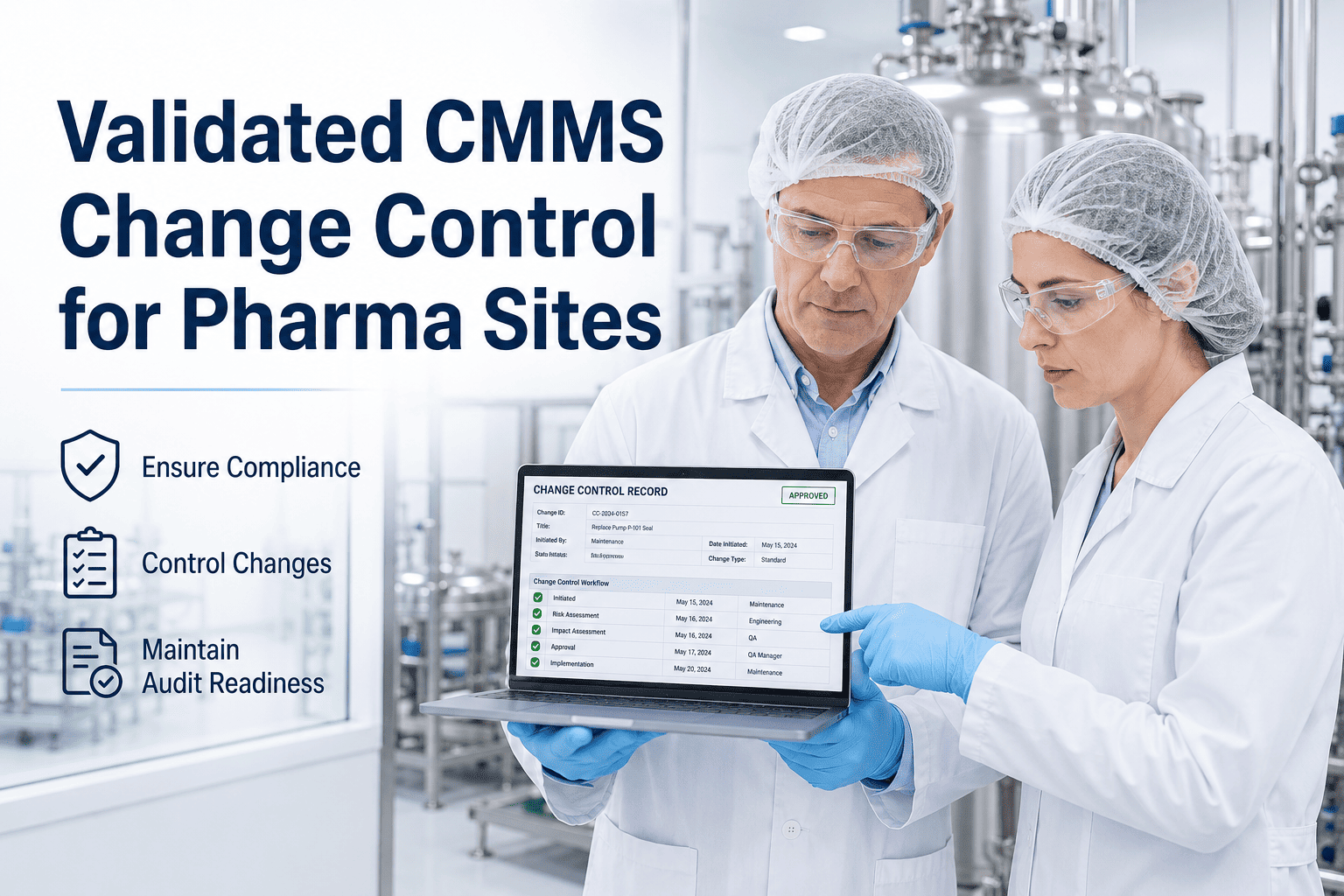
A pharmaceutical equipment modification executed without a closed change control record — no impact assessment, no validation review, no regulatory filing determination — exposes a US drug manufacturer to an FDA Form 483 observation, a warning letter, and potential consent decree. In 2024, documentation failures in change management ranked among the top five GMP deficiencies cited in FDA facility inspections, ahead of even cleaning validation and batch record errors. The permits existed. The changes were made. The failure was the missing documented evidence that the change was assessed, approved, and its impact on product quality understood. That gap is exactly what Oxmaint closes. Book a demo to see how Oxmaint digitizes pharmaceutical change control, LOTO records, and equipment qualification documentation across your full operation.
Pharmaceutical change control for maintenance requires documented management of four critical process areas: equipment modification impact assessment (GMP, validation, and regulatory filing implications), energy isolation and lockout/tagout records for maintenance activities, requalification and revalidation triggering against 21 CFR Part 211 and ICH Q7/Q8 standards, and corrective and preventive action closure linked to the originating change. Oxmaint digitizes every change request, approval chain, impact assessment, and CAPA record — connecting field execution to an auditable regulatory evidence trail automatically.
The Four Change Control Risk Areas Where Pharma Operations Carry the Highest Regulatory Exposure
Each area carries its own FDA regulatory requirement, documentation obligation, and inspection failure mode when managed on paper. Book a demo to see how Oxmaint structures all four into a unified digital change management system.
Every equipment modification — from replacing a pump seal to upgrading a control system — requires a documented impact assessment covering product quality risk, validation status, regulatory filing implications, and requalification scope. Undocumented or inadequately assessed changes are a direct 483 observation category. Oxmaint generates the change request, routes it through the required approval chain, captures impact assessment decisions with rationale, and archives the complete record against the equipment asset automatically.
Pharmaceutical manufacturing equipment — tablet presses, lyophilizers, filling lines, autoclaves, and CIP systems — requires both OSHA-compliant lockout/tagout isolation records and GMP-compliant maintenance activity documentation. A maintenance event without a closed LOTO record and an approved work order linked to the change control system is simultaneously an OSHA willful violation and a GMP documentation failure. Oxmaint generates equipment-specific LOTO checklists, captures each isolation point with technician identity and timestamp, and links the maintenance record to the parent change control request.
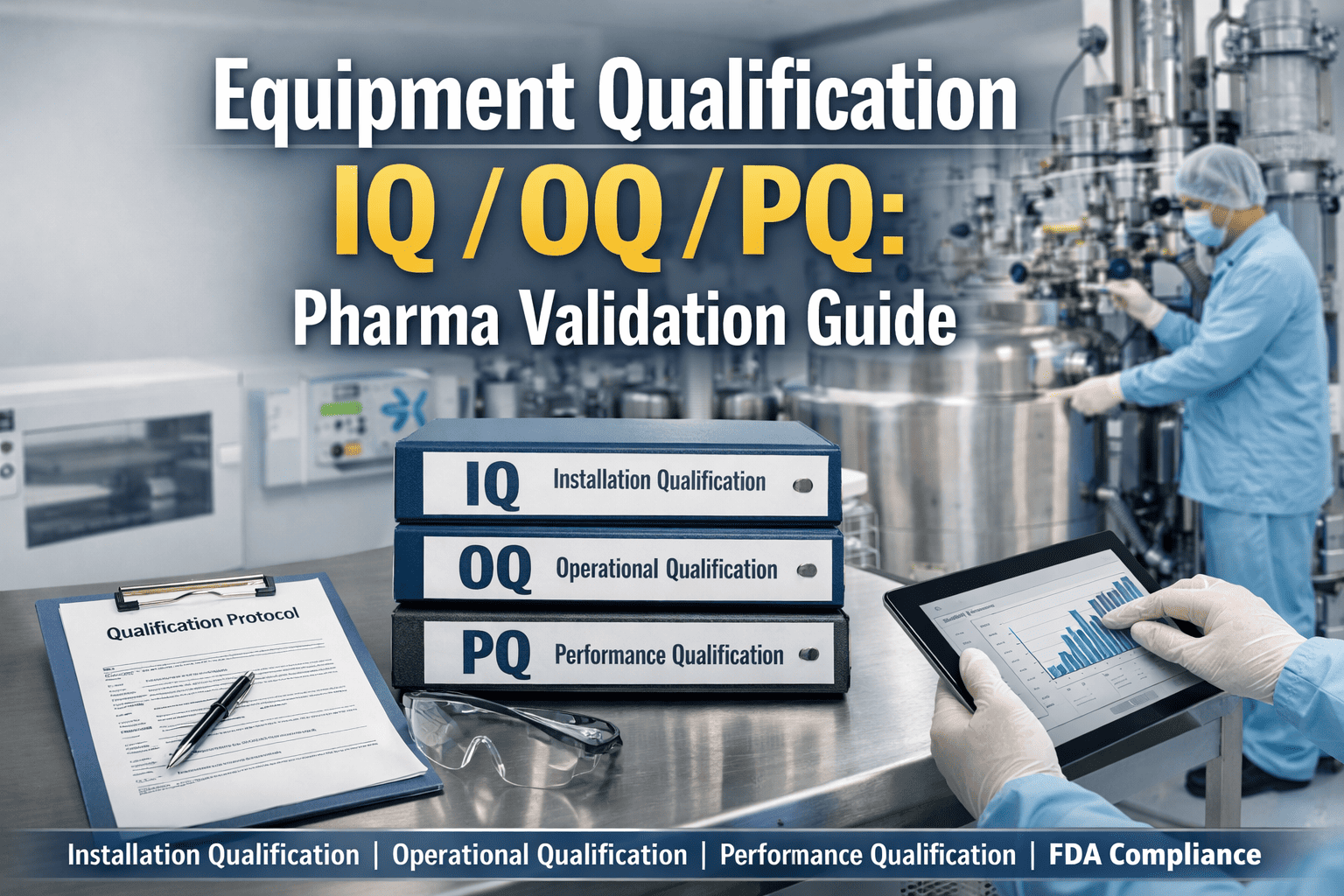
Equipment changes that affect product quality attributes — contact surface replacements, drive system modifications, control parameter adjustments, cleaning process impacts — trigger mandatory requalification activities: Installation Qualification, Operational Qualification, and Performance Qualification events with documented protocols and approved reports. Determining which changes trigger requalification, at what scope, is a regulatory judgment that must be documented regardless of the conclusion. Oxmaint's change control workflow embeds the requalification determination step, links triggered qualification events to the change request, and tracks completion before change closure is permitted.
Equipment failures, deviations, and out-of-specification events that originate change requests must be traceable through to CAPA closure — with root cause documented, corrective action implemented, effectiveness verified, and the record closed within the required timeframe. Open CAPA records past their committed closure date are a standalone FDA inspection finding. Oxmaint manages CAPA initiation from change requests, failure reports, or deviation records, routes each action to the responsible owner with an automated escalation at day 20 of an open item, and prevents change request closure until all linked CAPAs are resolved.
Every Change Request. Every Impact Assessment. Every CAPA. Documented at the Point of Decision — Not Reconstructed After the Inspection.
Oxmaint generates change control requests, routes approval workflows, captures impact assessments, and triggers requalification events on mobile — completing the regulatory evidence trail in the field, not assembled from memory before the auditor arrives. Book a demo to see the change control workflow for your manufacturing and packaging equipment.
Oxmaint Change Control — Implementation Workflow and Roadmap
A structured deployment moves your pharmaceutical facility from paper-based or disconnected change management to a fully operational digital change control system — without disrupting ongoing production or existing SOP approval processes.
Every GMP-critical equipment asset registered in Oxmaint with its qualification status, requalification trigger criteria, and applicable regulatory framework. Change categories defined — minor, moderate, and major — with the impact assessment requirements and approval chain for each category. LOTO isolation point checklists built per equipment from existing site isolation registers. Requalification scope criteria aligned to ICH Q8 and Annex 15 requirements for each asset class.
Change control request forms, impact assessment templates, LOTO maintenance checklists, and requalification trigger assessments configured as mobile-first digital workflows in Oxmaint. Maintenance technicians initiate change requests via QR-scanned equipment tags — no paper forms, no manual routing, no missing sign-offs. Impact assessment decisions captured at the time of review by the responsible Quality, Engineering, and Regulatory reviewer — not assembled retrospectively. Book a demo to see the digital change request workflow for pharmaceutical manufacturing equipment.
Oxmaint quality dashboard activated showing open change requests by status, overdue CAPA items, pending requalification events, LOTO log currency, and ICH Q10 / ISO 13485 corrective action closure rates. QA Manager, Site Director, and VP Operations views configured with role-appropriate scope. Automated escalation alerts when change request approvals are overdue, when CAPA deadlines approach, or when requalification events become outstanding against a closed change.
All change control records, LOTO logs, impact assessments, requalification reports, and CAPA closure evidence exportable in formats required for FDA inspection responses, EU GMP surveillance audits, ICH Q10 management reviews, and ISO 13485 certification audits. 21 CFR Part 11 electronic record compliance built into the Oxmaint approval and signature workflow — audit trail maintained automatically for every change event.
Regional Regulatory Compliance Coverage
Pharmaceutical manufacturers operating across multiple markets face different change control regulatory obligations per jurisdiction. Oxmaint's change control templates are pre-configured for each primary regulatory framework.
| Region | Primary Regulatory Frameworks | Key Change Control Requirements | Oxmaint Coverage |
|---|---|---|---|
| USA / Canada | FDA 21 CFR Part 211, Part 820, Part 11; ICH Q8/Q9/Q10; USP General Chapters; Health Canada Division 2 GMP; OSHA 1910.147 LOTO | Change control SOP compliance under 21 CFR 211.68 and 820.70; 21 CFR Part 11 electronic records for change approvals; OSHA LOTO documentation for maintenance activities; NDA/ANDA supplement triggering assessment | FDA-aligned change control templates with Part 11 electronic signature workflow, LOTO maintenance records integrated with change requests, regulatory filing determination step, 21 CFR audit trail maintenance |
| EU / EEA | EU GMP Annex 11, Annex 15, Chapter 4; EMA guideline on process validation; ICH Q8/Q10; EU Variation Regulation 1234/2008; EudraLex Volume 4 | Annex 15 requalification and revalidation documentation; Annex 11 computerized system validation for digital change records; variation type assessment for marketing authorization holders; ATMP change documentation | EU GMP Annex 15-aligned requalification trigger logic, Annex 11 CSV documentation support for Oxmaint system, variation type assessment workflow, EudraLex-compliant change record format |
| UK | MHRA GMP Orange Guide, UK Annex 15, MHRA Chapter 4, Human Medicines Regulations 2012, MHRA Good Manufacturing Practice post-Brexit guidance | MHRA-specific change notification and variation requirements post-Brexit; UK GMP Annex 15 requalification obligations; change documentation for MHRA inspection readiness; MHRA Defect Reporting obligations for equipment failures | MHRA-aligned change control templates, UK-specific variation assessment workflow, MHRA inspection readiness export, equipment defect report generation linked to change control records |
| India / APAC | CDSCO Schedule M (revised 2023), WHO Technical Report Series GMP, TGA Australian Code of GMP, PMDA Japan GMP, PIC/S PI 006 Change Control | Schedule M revised change control documentation requirements for Indian manufacturers; WHO GMP change management for export-licensed facilities; TGA change notification obligations for Australian TGA-licensed manufacturers; PIC/S PI 006 change classification and documentation | Schedule M-compliant change control forms, WHO GMP change record templates, TGA change notification workflow, PIC/S PI 006 change category classification, multilingual mobile forms for site crews |
| Saudi Arabia / UAE | SFDA GMP Requirements, UAE MOH Pharmaceutical Regulations, NCBE Biotechnology Guidelines, GCC Pharmaceutical Registration Requirements, ICH Q10 adopted by SFDA | SFDA change control notification requirements; UAE MOH variation and change documentation for registered products; GCC technical dossier change management; contractor qualification documentation for large manufacturing workforces | SFDA and UAE MOH-aligned change control templates, GCC variation assessment workflow, contractor qualification tracking in Oxmaint, Arabic and English bilingual mobile forms for site operations |
FDA, EU GMP, ICH Q10, and Regional Frameworks — One Digital Change Control System
Whether your pharmaceutical operation operates under 21 CFR in North America, EU GMP Annex 15 in Europe, Schedule M in India, or SFDA requirements in the Gulf — Oxmaint pre-configures the correct change control workflows, impact assessment templates, and audit exports for your regulatory jurisdiction. Book a demo to see multi-region change control configuration for your pharmaceutical group.
Oxmaint vs Competing CMMS & QMS Platforms — Pharmaceutical Change Control
Most general-purpose CMMS platforms manage work orders — they do not manage GMP change control with impact assessment workflows, requalification triggering, 21 CFR Part 11 electronic signatures, or ICH Q10 CAPA management configured for pharmaceutical operations.
| Change Control Capability | Oxmaint | MaintainX | UpKeep | Fiix | Limble | IBM Maximo | Veeva Vault | MasterControl |
|---|---|---|---|---|---|---|---|---|
| Pharma-specific change control workflow | Yes | Generic | No | No | No | Custom | Yes | Yes |
| Impact assessment with requalification trigger | Yes | No | No | No | No | Custom | Yes | Yes |
| 21 CFR Part 11 electronic signatures | Yes | No | No | No | No | Custom | Yes | Yes |
| LOTO isolation records linked to change requests | Yes | Generic | Generic | Partial | Generic | Yes | No | No |
| ICH Q10 CAPA management integrated | Yes | No | No | Partial | No | Custom | Yes | Yes |
| FDA inspection export — ready in under 2 hours | Yes | Partial | Partial | Partial | Partial | Yes | Yes | Yes |
| Equipment qualification status tracking | Yes | Generic | Generic | Generic | Generic | Yes | Partial | Yes |
| Deployment in weeks without IT project | Yes | Yes | Yes | Varies | Yes | No | No | No |
| Maintenance CMMS + QMS change control unified | Yes | No | No | No | No | Partial | No | Partial |
| Multilingual mobile forms for site crews | Yes | Yes | Partial | Partial | Partial | Yes | Yes | Yes |
Change Control KPI Benchmarks — Pharmaceutical Industry
Client Results — Pharmaceutical Facilities Using Oxmaint Change Control
These outcomes are drawn from pharmaceutical manufacturing deployments where Oxmaint's digital change control system replaced paper-based or disconnected change management, LOTO, and CAPA programs within the first year of operation.
From 58% to 96% Change Closure Rate — in 90 Days
Pharmaceutical facilities that move from paper-based change management to Oxmaint's digital change control system close the documentation gap before the next FDA inspection — not after the 483 is issued. Book a demo to see your current change control compliance gap identified in the first deployment session.
Oxmaint Change Control Platform Features for Pharmaceutical Facilities
Change requests initiated on mobile via QR-scanned equipment tags — category classification, impact assessment routing, and multi-level approval chain managed automatically. No paper forms. No missing signatures. No manual transfer.
Equipment-specific lockout isolation point checklists linked to the parent change request — each lock application captured with technician identity and timestamp. Maintenance work order cannot close until all locks are documented removed and the change record updated.
IQ/OQ/PQ requalification events triggered automatically from the impact assessment determination — linked to the originating change request and tracked to completion before product release authorization proceeds.
CAPA initiation from change requests, deviation reports, or audit findings — root cause, corrective action, and effectiveness verification tracked with automated escalation at day 20 of open items and management visibility into aging CAPA inventory.
Change control approvals, impact assessment sign-offs, and CAPA closure signatures captured with 21 CFR Part 11-compliant electronic signature workflow — complete audit trail maintained automatically for every change event.
Every GMP-critical equipment asset tracked with current qualification status, last requalification date, and outstanding requalification events — preventing production use of equipment with lapsed or unresolved qualification status following a change.
Change Control Documentation: Paper Systems vs. Oxmaint
| Change Control Area | Paper-Based Systems | Oxmaint Digital System |
|---|---|---|
| Change record retrieval for FDA inspection | 3 to 7 days searching physical binders and shared drives | Under 10 minutes from Oxmaint asset-linked search |
| Impact assessment completion verification | Manual review of paper forms — incomplete sections undiscovered until inspection | System prevents change advancement until all required assessment fields are completed |
| Requalification event linkage to change requests | Separate QMS and CMMS systems — no automated linkage or status visibility | Requalification events triggered, linked, and tracked within the originating change request |
| FDA inspection record preparation | 4 weeks of manual assembly across QA, Engineering, and Maintenance teams | 2-hour automated export from Oxmaint with complete change, LOTO, and CAPA records |
| Overdue CAPA identification | Not identified until management review or external audit | Automated alerts at day 20 of open items with escalation to QA Director |
| LOTO record linkage to GMP maintenance events | OSHA LOTO log separate from GMP maintenance record — no traceable connection | LOTO record linked to parent change work order — single audit trail for both OSHA and GMP compliance |
| Regulatory filing determination documentation | Decision made verbally — not documented at time of change initiation | Regulatory filing determination step embedded in change workflow with mandatory rationale capture |
Frequently Asked Questions
Close the Change Control Documentation Gap Before the Next FDA Inspection
Digital change control workflows, 21 CFR Part 11 electronic signatures, LOTO maintenance records, requalification triggering, and ICH Q10 CAPA management — all live in Oxmaint within 4 to 6 weeks, no IT validation project required. Book a demo with your QA Director or VP of Operations and see the full change control workflow configured for your manufacturing, packaging, and laboratory equipment.