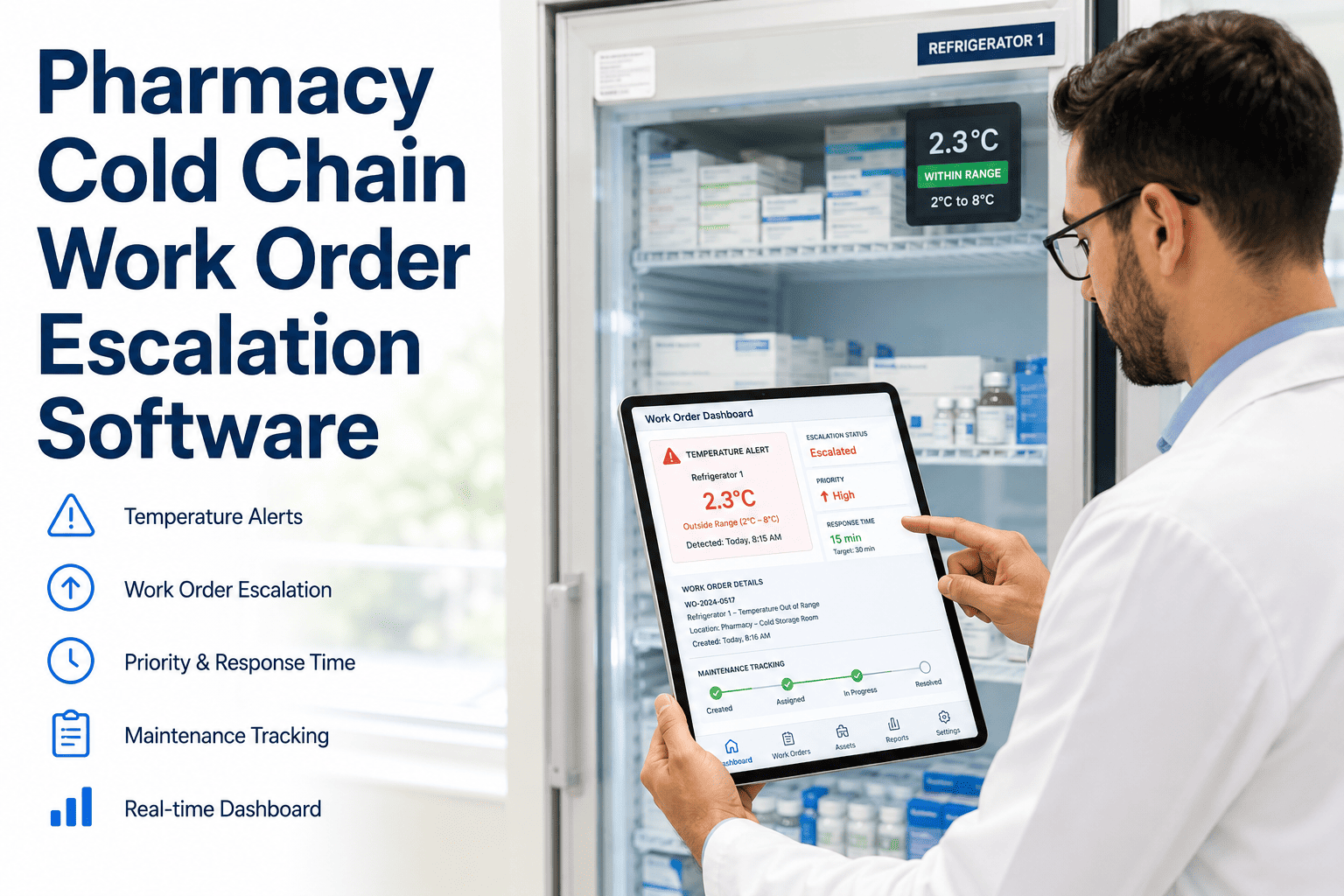
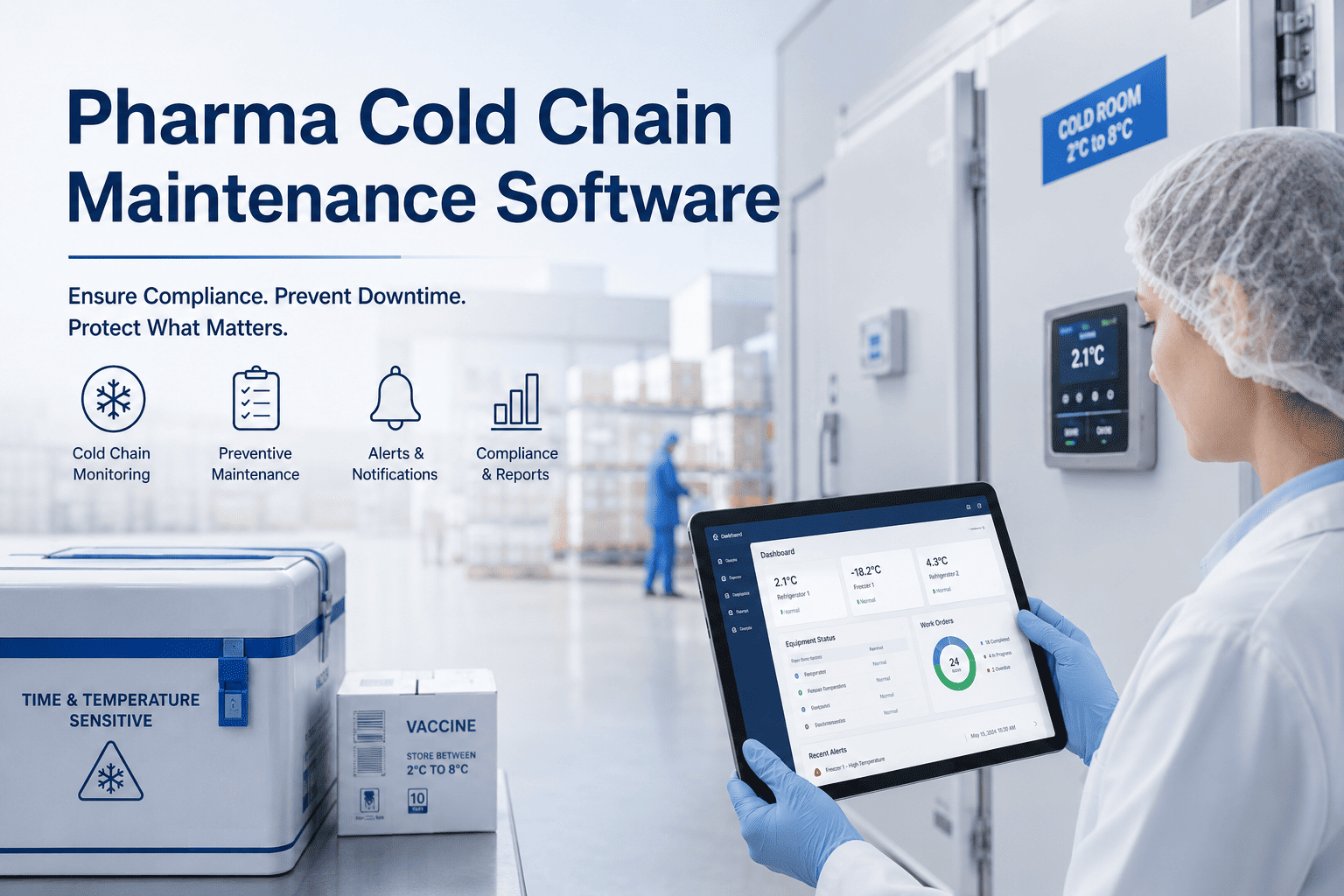
A pharmaceutical distribution centre is a different maintenance challenge from a general logistics warehouse. Cold rooms running at 2°C–8°C for refrigerated biologics, GDP-compliant temperature chain requirements, DSCSA-mandated track-and-trace infrastructure, forklift PM compliance for OSHA, and conveyor systems where a single belt failure stops serialisation and despatch simultaneously — all in a facility that operates 24 hours and cannot tolerate the 41% higher unplanned downtime rate that reactive maintenance facilities experience compared to CMMS-managed operations (MHI 2024). Book a demo to see OxMaint's pharma distribution centre maintenance platform — or start free and register your first asset zone today.
Landing Page · Pharma Distribution · Warehouse CMMS · Asset Lifecycle
Pharma Distribution Center Maintenance Software
One platform. Every asset. Conveyors, cold rooms, forklifts, labellers, dock equipment, and DSCSA serialisation infrastructure — maintained, documented, and compliant.
41%
Fewer unplanned downtime events — CMMS-managed vs reactive maintenance (MHI 2024)
23%
Higher conveyor OEE with CMMS-managed PM programmes vs reactive approach
85%
Of distribution centres depend on forklifts — OSHA requires documented PM for every unit
6 yrs
DSCSA record retention — cold room and serialisation equipment maintenance records must be retrievable
Every Asset Class in a Pharma Distribution Centre — One Platform
OxMaint manages every asset category in a pharmaceutical distribution centre with the right PM triggers, compliance documentation, and escalation logic for each asset type's specific regulatory and operational requirements.
Cold Rooms & Refrigeration
Key assetsWalk-in cold rooms (2°C–8°C), freezers (−20°C), ultra-low freezers (−80°C), refrigerated docks
ComplianceFDA 21 CFR 211.68, WHO GDP, EU GDP Guidelines — temperature excursion documentation mandatory
PM triggersDaily temperature log verification; monthly refrigeration unit PM; annual calibration with certificate
OxMaintExcursion alert links to deviation work order automatically; calibration certificates stored against each sensor asset record; 6-year retention for DSCSA compliance window
Conveyor Systems
Key assetsBelt conveyors, sortation systems, incline/decline sections, accumulation zones, merge points
ComplianceOSHA 1910.147 (LOTO before maintenance); ANSI/ASME B20.1 (conveyor safety standard)
PM triggersWeekly belt tension and roller inspection; monthly drive component service; quarterly full-line PM
OxMaintRuntime-hour triggered drive PM; belt section asset hierarchy; LOTO permit linked to every conveyor maintenance WO
Forklifts & Material Handling
Key assetsCounterbalance forklifts, reach trucks, order pickers, pallet jacks, dock spotters
ComplianceOSHA 29 CFR 1910.178(q) — daily pre-shift inspection documented; annual comprehensive PM required
PM triggersDaily operator pre-shift checklist; service every 250 operating hours or per OEM interval; annual OSHA inspection
OxMaintHour-meter triggered PM; QR scan on each forklift opens daily checklist; OSHA pre-shift record maintained per vehicle with defect escalation
Serialisation & Labelling Equipment
Key assetsThermal inkjet/TTO printers, 2D vision cameras, verification stations, label applicators, aggregation scanners
ComplianceDSCSA FD&C Act §582 — unit-level serialisation verification; 6-year equipment maintenance record retention
PM triggersChangeover checklist at each product switch; weekly read-rate KPI; monthly calibration
OxMaintRead-rate KPI alert at <99.5%; changeover mandatory checklist WO; DSCSA equipment maintenance records retained 6 years
Dock Equipment
Key assetsDock levellers, vehicle restraints, dock doors, dock seals and shelters, dock lights
ComplianceOSHA 1910.178 (dock safety); GDP temperature control — dock integrity affects cold chain
PM triggersMonthly leveller and restraint function test; quarterly seal condition inspection; annual door system PM
OxMaintCold room dock door condition linked to temperature monitoring — seal failure triggers cold chain integrity alert
Fire Safety & Building Services
Key assetsSprinkler systems, fire suppression, lighting (including emergency), HVAC, electrical distribution
ComplianceNFPA 25 (sprinkler inspection), NFPA 10 (extinguishers), NFPA 101 (emergency lighting), local fire code
PM triggersWeekly fire extinguisher visual; monthly emergency lighting test; quarterly sprinkler inspection
OxMaintNFPA inspection schedule auto-generated; compliance report by NFPA standard; failed test auto-generates corrective WO
PHARMA DISTRIBUTION · WAREHOUSE CMMS · OXMAINT
One Platform for Every Asset in Your Distribution Centre — From Cold Room to Forklift to Serialisation Line.
OxMaint manages PM schedules, compliance documentation, work orders, spare parts, and real-time asset status for every asset class in a pharmaceutical distribution centre — with the regulatory documentation that FDA, GDP, DSCSA, and OSHA inspections request.
Cold Chain Compliance — The Pharma Distribution Requirement That Cannot Fail
1
Temperature monitoring equipment calibrated and certified
Every temperature data logger and fixed probe in a pharma cold room must be annually calibrated against a NIST-traceable reference standard, with the calibration certificate stored against the individual sensor asset record. Under EU GDP Guidelines (2013/C 68/01) and WHO Technical Report Series 961, calibration is not optional — it is a GDP requirement for release of temperature-sensitive product.
2
Excursion events documented and linked to affected shipments
Every temperature excursion — any period outside the product's approved storage range — is a GDP deviation event requiring documented investigation, impact assessment on affected product, and a quality decision before the product is released. The maintenance record for the cold room that experienced the excursion is part of the investigation package — proving whether the equipment was functioning correctly when the excursion occurred.
3
Cold room qualification documentation current and retrievable
Cold room temperature mapping qualification — the validation study that proves the room maintains uniform temperature throughout its volume under real-load conditions — must be repeated after any significant maintenance event (refrigeration system replacement, room expansion, or door replacement), after any extended temperature excursion, and on a periodic schedule per the approved validation protocol. OxMaint stores the qualification document against the cold room asset record and generates a re-qualification trigger PM when qualification maintenance events occur.
Expert Review
"Distribution centres are the most maintenance-intensive facilities I manage — the combination of 24-hour operations, high-cycle mechanical systems, and direct financial exposure from every hour of downtime means that reactive maintenance is never a viable strategy. The facilities that run at the highest throughput reliability share one characteristic: they have structured PM programmes for every asset tier, not just the conveyors. Dock equipment, cold storage, and HVAC failures are just as disruptive as a conveyor outage in the right circumstances — and they are far more preventable with basic scheduled maintenance. In a pharmaceutical distribution centre specifically, the cold chain compliance dimension adds a layer of urgency that general logistics warehouses do not face. An undetected temperature excursion caused by a cold room refrigeration unit that missed its quarterly PM is not just a maintenance failure — it is a potential product quality event that triggers batch assessment, regulatory notification, and possible product destruction. The CMMS that prevents the missed PM is the system that prevents the compliance event."
Sandra Okafor, CFM, RPA
Certified Facility Manager · Real Property Administrator · 19 years multi-site facility operations · Former VP Facilities, 400+ location distribution and logistics portfolio · Specialist in pharmaceutical distribution centre maintenance framework design
Frequently Asked Questions
What OSHA requirements apply specifically to pharmaceutical distribution centre maintenance?
Four OSHA standards have direct maintenance documentation requirements in pharma distribution:
29 CFR 1910.178(q) — forklift PM and operator pre-shift inspection must be documented per vehicle;
29 CFR 1910.147 — LOTO procedures required and documented for every conveyor, dock leveller, and building service maintenance event;
29 CFR 1910.22 — housekeeping and aisle maintenance; and
NFPA 25/10 for fire suppression systems (enforced under local authority having jurisdiction). OSHA forklift inspections are among the most frequently cited violations at distribution centres — the documentation requirement applies to every vehicle, every shift. OxMaint generates daily forklift pre-shift inspection work orders per vehicle ID and stores the records for OSHA inspection requests.
Book a demo to see OxMaint's OSHA compliance tracking for distribution centres.
What is GDP (Good Distribution Practice) and how does it affect maintenance in pharma distribution?
EU GDP Guidelines (2013/C 68/01) and WHO Technical Report Series 961 define Good Distribution Practice requirements for pharmaceutical wholesale distribution. For maintenance, GDP requires:
temperature monitoring equipment to be calibrated on a defined schedule with certificates retained;
temperature excursions to be documented, investigated, and linked to the batches affected;
cold room qualification to be performed after significant maintenance events; and
maintenance records to demonstrate that equipment used to maintain product integrity was functioning correctly throughout the distribution period. In practice, GDP means every cold room, refrigeration unit, and temperature data logger is a GMP-like regulated system — not just facility infrastructure. OxMaint generates the GDP-required maintenance documentation and stores it against each asset record for the retention period.
Start free to configure OxMaint for GDP-compliant distribution maintenance.
How does OxMaint handle conveyor maintenance in a 24-hour distribution centre?
OxMaint manages conveyor maintenance in 24-hour operations through three mechanisms: runtime-hour triggered PM for drive motors, gearboxes, and belt drives — so service intervals are calculated from actual operating hours rather than calendar days, preventing both premature service and missed intervals; shift-based inspection work orders that assign the weekly belt tension and roller inspection to a specific shift crew with a defined completion window; and immediate escalation — when a conveyor stop work order is created, it routes to the on-call technician with the asset's full maintenance history, last PM date, and spare parts inventory visible on the mobile device before they leave the maintenance office. This means mean time to respond drops and first-visit resolution rises because the technician arrives prepared, not discovering what they need at the asset.
Can OxMaint manage both GDP cold chain compliance documentation and OSHA safety records in the same platform?
OxMaint manages both in a single platform — this is one of the core advantages of a single CMMS versus separate systems for regulatory compliance and operational maintenance. Cold chain GDP records (calibration certificates, excursion reports, temperature mapping qualifications) are stored against the cold room and refrigeration asset records with configurable retention periods. OSHA compliance records (forklift pre-shift inspections, LOTO permit records, fire suppression inspection reports) are stored against the relevant asset records with OSHA-specific documentation fields. Both are retrievable in under two minutes for any inspection or audit request. The maintenance manager sees all compliance status — GDP cold chain, OSHA forklift, DSCSA serialisation equipment — on a single dashboard rather than managing three separate document systems.
PHARMA DISTRIBUTION · CMMS · OXMAINT
Cold Rooms, Conveyors, Forklifts, Serialisation Lines, Dock Equipment. One Platform. Zero Gaps.
OxMaint is the single maintenance platform for pharmaceutical distribution centres — managing every asset class, every compliance requirement, and every work order from cold chain temperature calibration to daily forklift pre-shift inspection, with the documentation that FDA, GDP, DSCSA, and OSHA inspectors request available on demand.