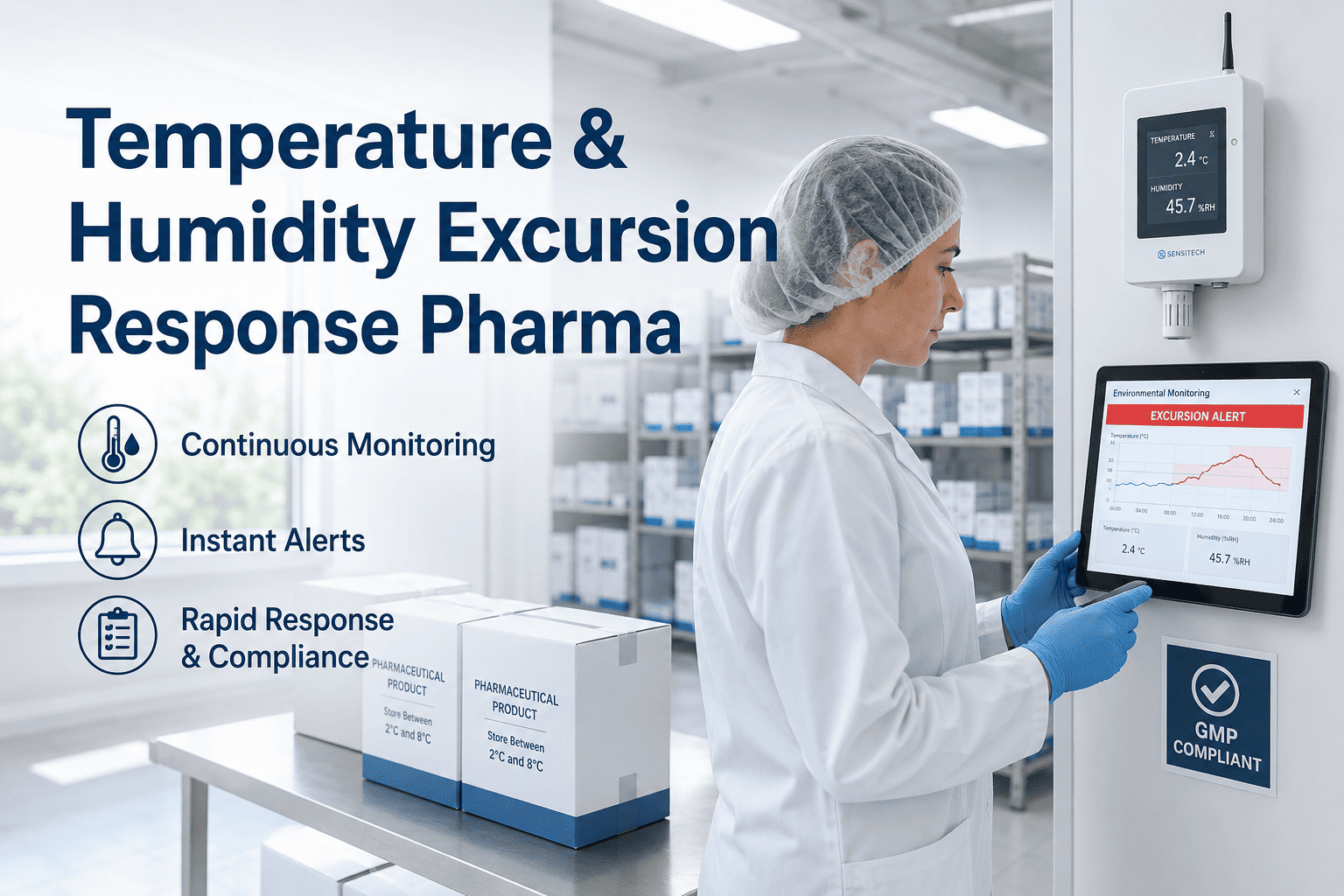
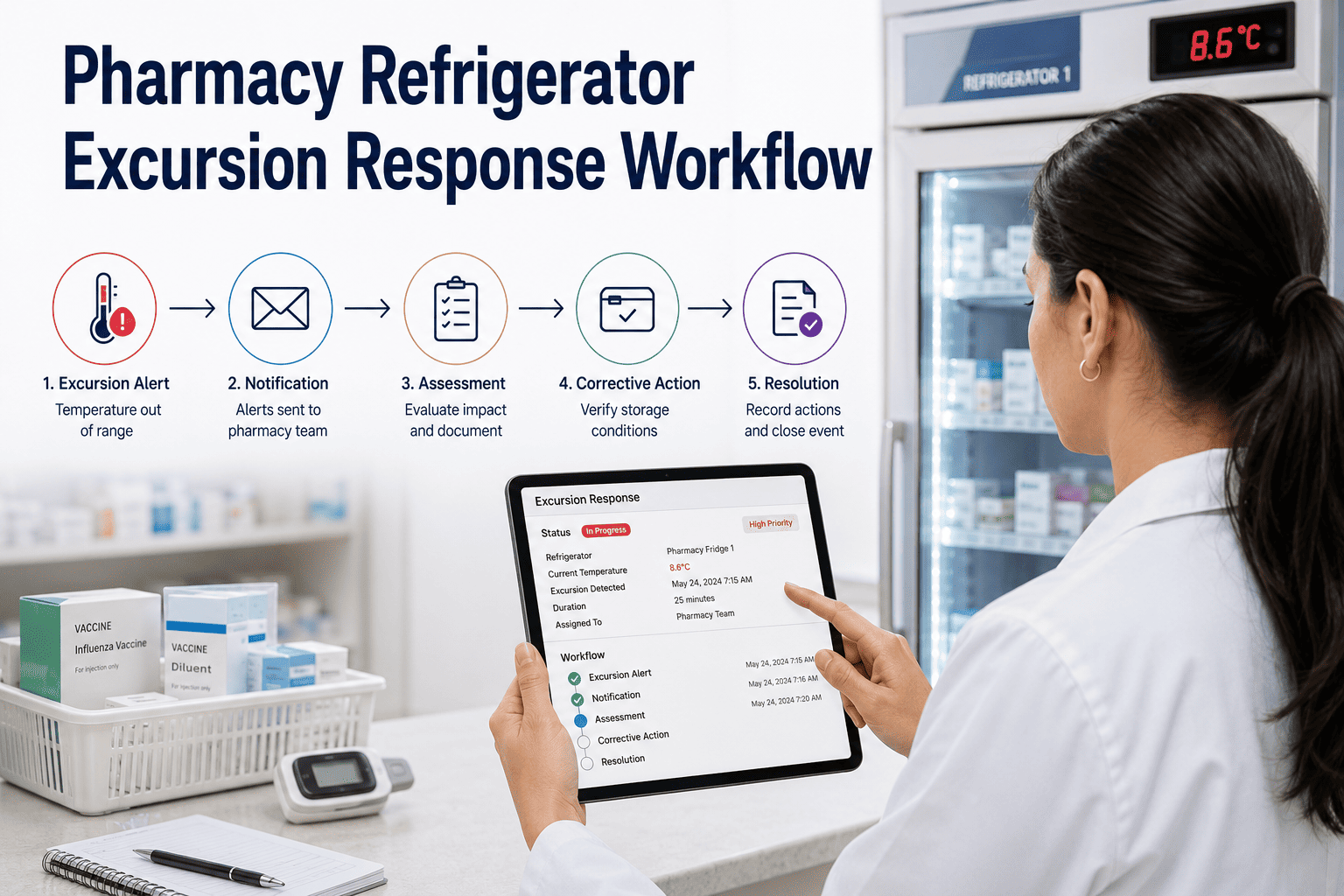
Temperature and humidity excursions do not look the same, do not propagate the same way, and do not carry the same risk profile — but most pharmaceutical facilities manage them with identical workflows. A 2°C temperature spike in a controlled room temperature storage area that lasts 45 minutes and a sustained relative humidity excursion above 65% RH in an active compounding suite for 4 hours are fundamentally different events requiring different investigation frameworks, different batch impact criteria, and different CAPA categories. Over 68% of FDA 483 observations in sterile manufacturing cite deficiencies in environmental monitoring programmes — specifically inadequate trending, missing data integrity, and failure to link monitoring results to corrective actions. OxMaint's environmental monitoring CMMS integration captures every excursion with sensor-level precision, creates zone-specific work orders with pre-loaded investigation protocols, and produces the ALCOA-compliant excursion record that closes the gap between a monitoring alarm and an inspection-ready deviation package.
Environmental Monitoring · GMP HVAC · Excursion Management · Deviation Control
Temperature & Humidity Excursion Response for Pharmaceutical Facilities
Alert-level alarm to investigation-assigned work order in under 2 minutes. Root cause documented before the shift ends. Batch impact assessed before QA release. CAPA linked to the deviation record. Every step time-stamped and audit-ready — automatically.
GMP Temperature Limits by Storage Class
Controlled Room Temp
20–25°C (MKT ≤25°C)
Spikes to 40°C ≤ 24 hrs
Refrigerated
2–8°C
No excursion without investigation
Freezer
−25°C to −10°C
Any excursion = P1 event
Cleanroom (ISO 7)
18–22°C typical ± 2°C
Site-specific validated range
RH — Cleanroom
30–65% RH typical
Alarm delay 1–4 hrs acceptable
Sources: USP <659>, USP <1079.2>, EU GMP Annex 1, ICH Q1A, ISPE guidance
68%+
of FDA 483 observations in sterile manufacturing cite environmental monitoring deficiencies — inadequate trending or failure to link results to corrective actions
$630B
US pharmaceutical market in 2024 — temperature control cited as one of the most critical quality assurance elements across the industry
MKT
Mean Kinetic Temperature — the single integrated thermal exposure metric USP <1079.2> requires for excursion evaluation, not just peak temperature
21 CFR
Parts 210 & 211 mandate suitable environmental conditions, calibrated instruments, and complete records demonstrating product integrity throughout the facility
Temperature vs. Humidity: Why Each Excursion Demands a Different Response Protocol
The most common error in pharmaceutical excursion management is applying identical investigation and batch impact criteria to temperature and humidity events. They affect product through different mechanisms, develop at different rates, and carry different consequences depending on the area type and product class.
Primary Product Risk
Degradation of active pharmaceutical ingredient — rate governed by Arrhenius equation. Higher temperature = accelerated decomposition reaction rate. Thermal stability data from stability protocols drives the investigation threshold.
Moisture absorption, hydrolysis, deliquescence, and physical form changes (polymorphic conversion). High RH promotes microbial growth on surfaces and in in-process materials. Effects are cumulative over time, not immediate.
Speed of Damage
Rapid for biologics and cold-chain products. Slower for controlled room temperature storage. Duration and peak temperature together determine impact — not peak alone. MKT calculation required per USP <1079.2>.
Generally slower — cumulative exposure over hours determines risk. ISPE guidance suggests alarm delays of 1–4 hours are acceptable for transient RH events (e.g. cleaning activities) before initiating a formal investigation.
Regulatory Metric
Mean Kinetic Temperature (MKT) — USP <1079.2> methodology. Controlled room temp: MKT ≤ 25°C. Refrigerated: 2–8°C — any excursion requires investigation regardless of duration.
Area-specific limits set by site validation and product stability data. EU GMP Annex 1 does not prescribe specific RH ranges — facilities define limits based on risk assessment. WHO recommends below 60% RH as a general benchmark.
Excursion Cause Pattern
HVAC cooling failure, compressor fault, power interruption, door left open, loading dock exposure, chiller maintenance event, sensor drift.
Dehumidifier failure, HVAC coil fouling, high outdoor humidity day (infiltration), cleaning activities generating moisture, inadequate air change rate, steam line leak.
Investigation Framework
Peak temp + duration → MKT calculation → stability protocol comparison → batch impact assessment. Biologic products: any deviation above validated range requires immediate QA escalation and potential discarding.
Duration above alert level → area and product risk classification → microbial growth risk assessment for cleanroom events → batch impact based on moisture-sensitive product profile.
CAPA Category
HVAC preventive maintenance review, chiller capacity assessment, equipment PM compliance audit, UPS and backup power verification.
Dehumidifier PM review, HVAC coil cleaning schedule, building envelope assessment, cleaning SOP review for moisture-generating activities.
The OxMaint Excursion Response Matrix: Alert vs. Action Level by Area Type
Not every temperature or humidity alarm demands the same response. OxMaint applies a configurable response matrix — work order priority, SLA, notification recipient, and batch impact trigger — based on the combination of parameter type, excursion severity, and area classification.
| Area Type |
Parameter |
Alert Level |
Action Level |
Alert Response |
Action Response in OxMaint |
| Grade A / B Cleanroom |
Temperature |
±1°C from set-point for >30 min |
±2°C from set-point or any duration >60 min |
P2 WO — HVAC technician, 60-min SLA |
P1 WO — HVAC + QA notified, batch flagged, 30-min SLA |
| Grade A / B Cleanroom |
Relative Humidity |
>65% or <30% for >1 hour |
>70% or <25% for >1 hour |
P2 WO — HVAC technician, 2-hr SLA |
P1 WO — HVAC + QA, deviation triggered, 60-min SLA |
| Controlled Room Temp Storage |
Temperature |
>25°C or <15°C |
>30°C sustained or <15°C sustained >2 hrs |
P2 WO — maintenance, MKT calculation |
P1 WO — QA notified, MKT mandatory, batch conditional hold |
| Refrigerated Storage (2–8°C) |
Temperature |
>8°C for >30 min |
>10°C for any duration |
P2 WO — immediate investigation, no batch action yet |
P1 WO — QA escalation, all products on conditional hold, engineering |
| Freezer Storage (−25° to −10°C) |
Temperature |
Any reading above −10°C |
Any reading above −5°C or door alarm |
P1 WO immediately — no alert-level protocol; all freezer events are action-level |
Same as alert — all freezer events escalate to QA and batch hold automatically |
| Manufacturing Suite |
Temperature + RH |
Either parameter outside validated range for >30 min |
Either parameter outside validated range for >60 min or process in progress |
P2 WO — production supervisor notified |
P1 WO — production suspended pending investigation, QA and supervisor |
Every cell in that matrix is configurable per area per site in OxMaint.
Your HVAC validation defines the thresholds. OxMaint enforces the response — automatically, with the right work order priority, the right SLA, and the right notification list, every time.
Root Cause Categories and the Maintenance Actions That Prevent Recurrence
Temperature
Chiller / Cooling System Failure
Refrigerant loss, compressor fault, condenser fouling, or chiller trip are the most common causes of sustained temperature excursions in cleanrooms and cold storage. Often preceded by gradual set-point deviation trend over days before full failure.
Preventive PM: Chiller quarterly inspection — refrigerant level, condenser coil cleaning, compressor amp draw measurement. Condenser coil cleaning semi-annual. Refrigerant leak check annual.
OxMaint trigger: Trending deviation >0.5°C vs. 90-day baseline → proactive HVAC inspection WO before alert threshold reached
Temperature
HVAC Supply Air Temperature Drift
AHU cooling coil fouling, VFD speed drift, or control valve actuator failure shifts supply air temperature — affecting all zones served by the air handler. Multi-zone simultaneous excursions are the signature pattern for this cause.
Preventive PM: AHU coil cleaning quarterly, VFD calibration semi-annual, control valve actuator check annually. Filter bank replacement per pressure differential trigger — not calendar date.
OxMaint trigger: Multi-zone simultaneous excursion pattern → AHU system investigation WO, not zone-by-zone response
Humidity
Dehumidifier Failure or Bypass
Desiccant wheel degradation, chilled water coil fouling, or dehumidifier bypass valve stuck open causes gradual RH rise over hours. Most commonly surfaces during high outdoor humidity periods when dehumidifier is under maximum load.
Preventive PM: Dehumidifier desiccant wheel inspection semi-annual, chilled water coil cleaning quarterly, bypass valve stroke test annually.
OxMaint trigger: RH excursion correlated with outdoor humidity data → dehumidifier inspection WO with capacity margin assessment
Humidity
Process Activity — Cleaning and Personnel
Surface cleaning with aqueous agents, steam sterilisation of equipment, and high personnel density each generate moisture loads the HVAC system must absorb. Excursions correlated with shift change times or cleaning schedules are process-related, not equipment failures — and require SOP review, not HVAC maintenance.
Response: Review cleaning agent selection and cleaning schedule timing. Increase post-cleaning HVAC recovery monitoring period. Update environmental monitoring SOP with revised alarm delay.
OxMaint trigger: Time-of-day pattern match to activity log → root cause classification as process-related, CAPA assigned to QA operations team
Both
Sensor Drift or Calibration Failure
A sensor that reads 2°C above true temperature generates 483 observations about process out-of-control conditions that were never real — and can mask actual excursions when drift goes in the opposite direction. Sensor drift is a common cause of unexplained excursion events where no physical cause is found on investigation.
Preventive PM: Annual calibration mandatory. High-risk cleanroom sensors: semi-annual calibration. Independent handheld verification at every excursion investigation — discrepancy between EMS reading and portable reference is the diagnostic test for sensor drift.
OxMaint trigger: Excursion with no physical cause found → calibration verification step mandatory before work order can close
Both
Building Envelope Failure — Infiltration
Gaps in building envelope, failed door seals, or open loading dock doors allow uncontrolled outside air to enter storage or manufacturing areas — bringing outdoor temperature and humidity conditions directly into the controlled space. Loading dock events are typically sudden and short; wall or window seal failures produce a persistent baseline shift that worsens seasonally.
Preventive PM: Annual building envelope inspection — door seals, window frames, penetrations, loading dock leveller seals. Seasonal inspection before summer high-humidity period.
OxMaint trigger: Excursion correlated with outdoor conditions and specific time window → building envelope inspection WO for affected perimeter area
"
The investigation of a temperature or humidity excursion is not completed when the HVAC technician restores the parameter to its set-point and writes "repaired" on the work order. The investigation is completed when you can answer four questions with documentation: What was the root cause? What was the duration and magnitude of the excursion? What products or batches were exposed and does the excursion exceed the product's validated stability range? What will prevent recurrence? In my experience conducting GMP audits across thirty sites over seventeen years, the most common reason an excursion generates a 483 observation is not that the excursion happened — regulators understand that HVAC systems are imperfect — but that the documented response was incomplete. The work order was closed, the product was released, and nobody could produce a batch impact assessment when the auditor asked for one six months later. A CMMS that enforces all four investigation questions before the work order closes — and links the answers to the batch record and the deviation system — is the difference between an excursion that is managed and one that becomes a regulatory finding.
Dr. Ingrid Solvang, PhD, RAC (EU)
Regulatory Affairs Certified — European Union · PhD Industrial Pharmacy · 17 years GMP environmental monitoring and pharmaceutical quality systems · Former Head of Quality Assurance, Nordic biologics manufacturer (4 manufacturing sites) · Specialist in excursion investigation methodology, environmental monitoring programme design, and CMMS-integrated GMP compliance
Frequently Asked Questions
How does OxMaint calculate Mean Kinetic Temperature for a temperature excursion automatically?
When an excursion work order is created from a temperature alarm, OxMaint retrieves the full temperature log for the excursion window from the connected EMS or sensor data feed and calculates Mean Kinetic Temperature using the USP <1079.2> Arrhenius-derived formula — applying the facility's configured activation energy value (default 83.14 kJ/mol per USP guidance). The MKT result is included automatically in the work order and the linked deviation form — the investigator sees the calculated thermal exposure alongside the product's validated stability range. No manual calculation required. Start your free trial to configure MKT calculation for your temperature zones and product stability parameters.
How does OxMaint handle alarm delay for humidity excursions to avoid false work orders from cleaning activities?
OxMaint supports configurable alarm delays per zone per parameter — consistent with ISPE guidance that 1–4 hour delays are acceptable for humidity alarms in areas where cleaning activities generate transient moisture loads. The delay is set per zone during system configuration: a sterile manufacturing suite may use a 30-minute delay, while a packaging area where aqueous cleaning is frequent may use a 2-hour delay. When the alarm persists beyond the configured delay window, OxMaint creates the work order automatically. The delay configuration is documented in the system's validation records for audit review. Book a demo to configure zone-specific humidity alarm delay parameters.
What documentation does OxMaint produce for an excursion that occurred during an active production run?
OxMaint generates a complete excursion event package containing: the sensor reading log covering 2 hours before, during, and after the excursion; the automatically created work order with assignment, priority, and SLA; the investigation record with root cause, corrective action, and technician completion; the linked deviation form with batch impact assessment completed by QA; MKT calculation (temperature events); the CAPA record with assigned owner and completion deadline; and the batch conditional hold decision. This package is stored as a linked document set in OxMaint — retrievable by event date, zone, batch number, or work order ID within seconds during an FDA or EU GMP inspection. Start your free trial to see the excursion package format for your area types.
How does OxMaint identify when excursion frequency is trending upward before a major failure occurs?
OxMaint's trend module compares excursion frequency per zone over rolling 30/60/90-day windows against the prior period baseline. When excursion frequency increases by more than 50% versus the prior window, or when a zone has experienced three or more excursions within 30 days, the system automatically generates a proactive HVAC assessment work order — before the next excursion fires and before the pattern appears in an inspection finding. This is the mechanism that converts reactive excursion response into predictive maintenance: the HVAC equipment that causes excursions leaves a trend signature weeks before it fails, and OxMaint acts on that signature. Book a demo to see the excursion trend dashboard for your monitoring programme.
Environmental Monitoring · GMP HVAC · Excursion Management · OxMaint
68% of FDA 483 Findings in Sterile Manufacturing Cite Environmental Monitoring Gaps. Close Yours.
OxMaint integrates with your EMS and BMS to convert every temperature and humidity excursion into an automatically assigned work order, batch-linked deviation, MKT-calculated investigation record, and CAPA — giving QA reviewers the complete, traceable excursion package they need before any batch goes to release.