A dialysis center is really three maintenance operations stacked on top of each other — the machines at every chair, the water-treatment train that feeds all of them, and the disinfection cycles that keep both safe — and a single weak point in any one can stop treatment for the entire floor. When a carbon tank lets chlorine break through, when an RO membrane drifts, or when a machine fails mid-session, it is not an inconvenience: during a single treatment a patient's blood is exposed to well over a hundred liters of treated water, so water and machine reliability are patient safety. Yet most centers track these three worlds in three different places — a binder, a spreadsheet, and a vendor's logbook. Putting machine PM, water-treatment monitoring, and disinfection on one schedule is what keeps the floor running and the records survey-ready. See how OxMaint Preventive Maintenance unifies all three. Book a dialysis demo to see it on your center.
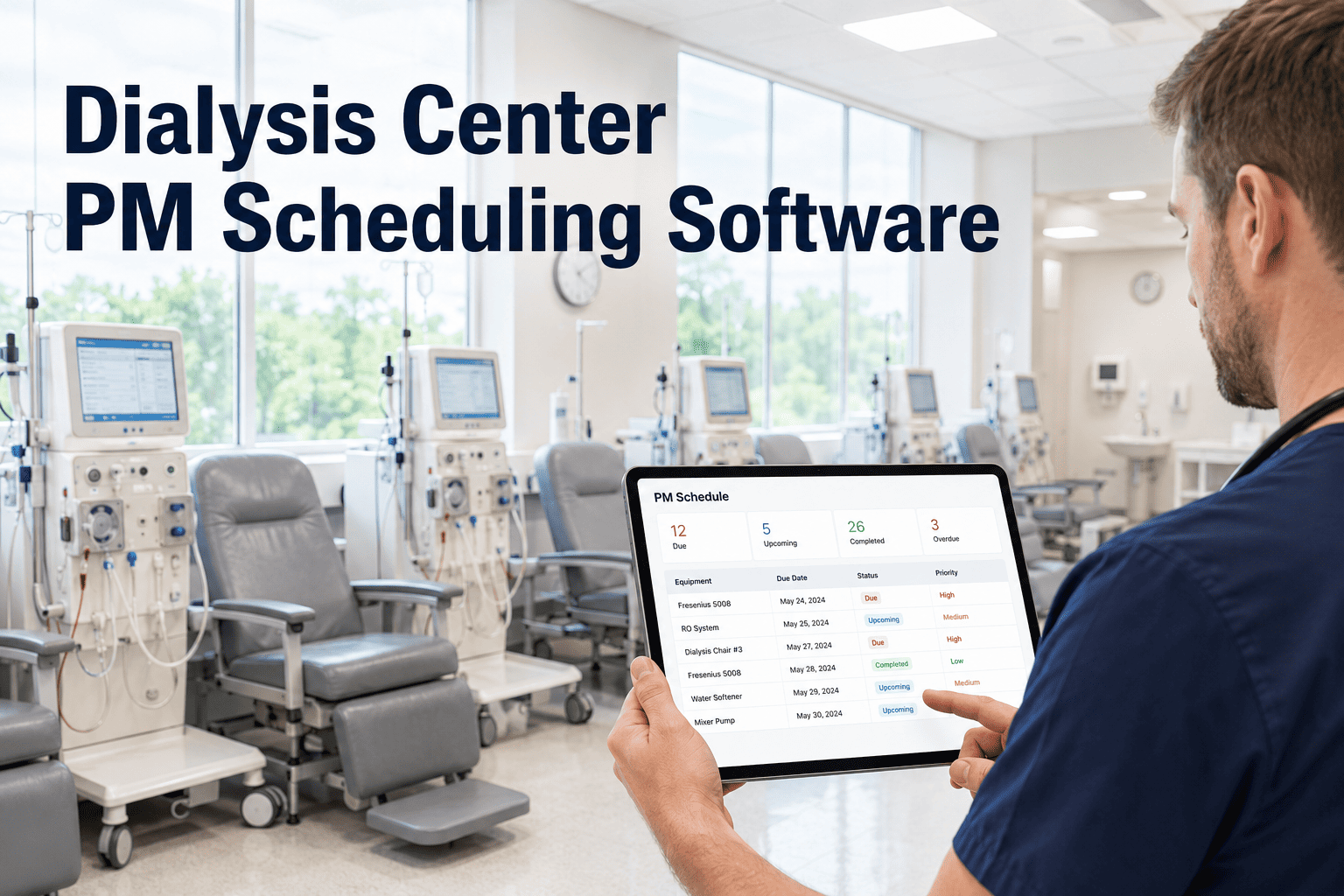
Dialysis Center PM Scheduling Software
Schedule machine PM, water-treatment monitoring, and disinfection in one CMMS — so a failure never stops the floor and every CMS and AAMI record is ready before the surveyor asks.
One Water System, Every Chair
Unlike a hospital with thousands of independent assets, a dialysis floor runs on shared infrastructure: every station draws from the same water-treatment train, so one failure upstream takes down the whole room at once. A machine fault mid-treatment is an immediate patient-safety event, and water-quality deficiencies are among the most cited Immediate Jeopardy triggers in ESRD surveys — the kind that put Medicare certification itself at risk. The three maintenance streams cannot be managed in isolation when they share that much risk.
Three Streams, One Schedule
Machines, water, and disinfection each carry their own tasks and cadences — but they belong on a single calendar, so nothing falls into the gap between a binder and a spreadsheet.
The Water-Testing Cadence
Water quality is governed by a fixed testing rhythm with hard action levels. Miss the cadence or a threshold, and the equipment comes out of service until it is corrected and re-cultured.
Built for the Conditions for Coverage Survey
CMS defines compliance against AAMI water standards, and every deviation at an action level requires a written corrective action plan tied to your QAPI program. The software produces that documentation as a by-product of the work, not a scramble before the survey.
Why One System Wins
What Dialysis Leaders Say
When the water goes, the whole floor goes — every chair depends on the same system, so I cannot afford to learn a carbon tank failed from a patient reaction. Having the daily chlorine check and the monthly cultures on one schedule, flagging me before an action level is crossed, is the difference between a quiet correction and an emptied treatment room.
Dialysis Center Director · 15 Years ESRD OperationsSurveyors do not grade the engine room; they grade the documentation, and water deficiencies are an Immediate Jeopardy waiting to happen. Once every reading was captured at the point of measurement and every breach opened its own corrective action automatically, survey prep stopped being a week-long fire drill and became an export.
Biomedical & Water Treatment Lead · 20 Years DialysisFrequently Asked Questions
What does the software actually schedule?
All three maintenance streams of a dialysis center in one place: per-machine preventive maintenance to manufacturer spec, the full water-treatment monitoring rhythm from daily chlorine checks to monthly cultures, and the disinfection cycles for the loop and the machines. Instead of a binder, a spreadsheet, and a vendor log, you get a single calendar and a single record. Book a dialysis demo to see the unified schedule.
How often is dialysis water tested?
Chlorine and chloramine are tested before each treatment day without exception, bacteria and endotoxin cultures run at least monthly, and a full chemical analysis is performed at least annually — plus extra testing after an RO membrane change, a system repair, or any sign of declining quality. The software holds each of those cadences per station so none of them drifts. Start free to set your testing intervals.
Why is chlorine and chloramine tested before every treatment day?
Because the carbon tanks that remove them can break through, especially if the municipality shock-chlorinates its supply, and chloramine reaching a patient's blood causes hemolysis. Testing at the start of every treatment day catches a breakthrough before any patient is exposed, which is why the standard allows no exceptions. A missed or failed check should stop the day, not delay a log entry. Book a dialysis demo to see the daily-check workflow.
What happens when a water test hits an action level?
The affected equipment comes out of service, is re-disinfected, and is re-cultured before it returns, and a written corrective action plan has to document the root cause. The platform auto-generates that corrective record the moment a reading crosses the threshold, links it to your QAPI program, and tracks it to closure — so the response is immediate and the paperwork is automatic. Start free to see corrective-action tracking.
Does this cover CMS Conditions for Coverage and AAMI?
Yes — the testing schedules align to the AAMI water standards that CMS uses to define Conditions for Coverage compliance, deviations generate the corrective action plans that 42 CFR 494 requires, and everything links into your QAPI records. The documentation a surveyor expects is built as the work is done rather than assembled afterward. Book a dialysis demo to review compliance mapping.
How fast can we produce records for a surveyor?
Any machine's complete service history or any station's water log can be pulled in well under a minute, because each was captured digitally at the point of work with a timestamp and signature. That replaces the all-too-common scene of a team spending hours in filing cabinets and still handing over an incomplete record — the exact gap that turns into a survey finding. Start free to see the audit exports.
Run the Whole Center on One Schedule
OxMaint unifies machine PM, water-treatment monitoring, and disinfection in a single CMMS — capturing every reading, opening corrective actions automatically, and keeping a clean CMS- and AAMI-ready trail — so your floor stays open and your survey stays calm.