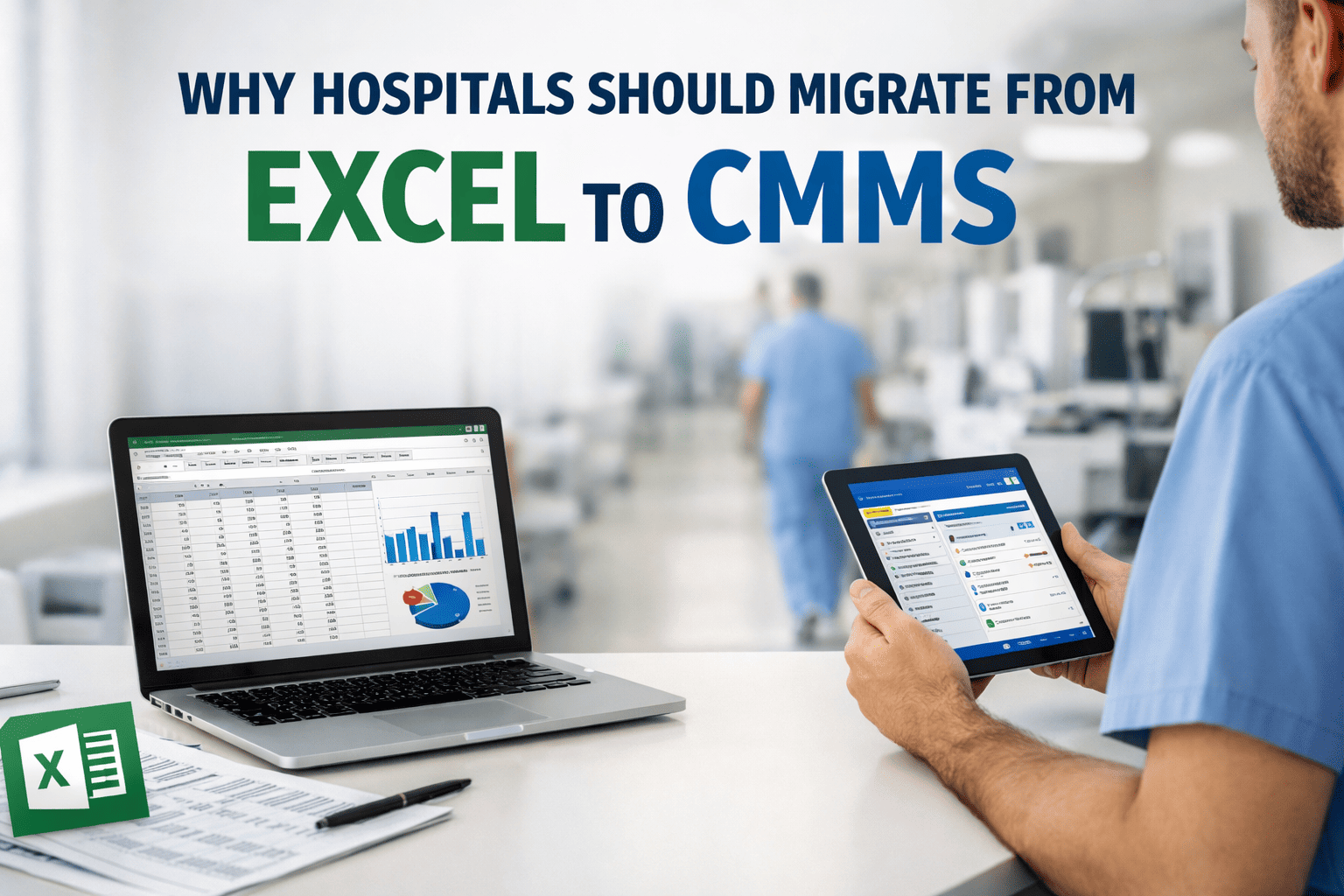
If your hospital's maintenance team is still tracking preventive maintenance schedules, work orders, and equipment inspections on spreadsheets — your next Joint Commission survey is already at risk. Excel doesn't send alerts when a PM is overdue, doesn't enforce documentation standards before a technician closes a task, and can't produce a 5-year equipment history in the 20 minutes an auditor gives you to find it. The cost of that gap is measured in findings, downtime, and patient safety events — not just compliance fines. That gap is exactly what Oxmaint closes. Book a demo to see how Oxmaint replaces spreadsheet-based maintenance with a fully auditable digital CMMS built for hospital operations.
Hospital maintenance teams managing preventive maintenance, work orders, and equipment records on Excel face three compounding risks: missed PMs due to absent automated scheduling, missing documentation at accreditation surveys, and zero visibility across facilities for health system leadership. Oxmaint replaces spreadsheets with a mobile-first CMMS that enforces PM completion, captures documentation at the point of work, and delivers real-time compliance dashboards to facility directors and VPs — within 4 to 6 weeks, without an IT project.
Four Ways Excel Creates Unacceptable Risk for Hospital Maintenance Leadership
Each failure mode carries its own regulatory consequence, operational cost, and patient safety implication. Book a demo to see how Oxmaint eliminates all four in a single deployment.
Excel does not schedule PMs, does not alert technicians when intervals are due, and cannot distinguish between completed and overdue tasks without manual review. At hospitals with 2,000 to 8,000 maintained assets, spreadsheet-dependent PM programs routinely run 20–40% of critical equipment overdue at any given time — invisible to leadership until a survey finds it.
When work orders live in a shared spreadsheet, there is no enforced documentation standard — technicians close tasks without required photos, parts records, or sign-off. During a Joint Commission survey, an inability to produce a complete corrective maintenance history for a critical asset is indistinguishable from the work not having been done. The liability consequence is the same.
A VP of Facilities overseeing five hospitals cannot see PM compliance rates, open work orders, or equipment failure trends across the system from a spreadsheet. Each facility's Excel file is a silo. Decisions about staffing, capital equipment replacement, and vendor contracts are made on anecdote — not data. This is not a workflow inconvenience; it is a governance failure with direct regulatory and patient safety consequences.
Medical equipment maintenance records — including incident history, recalls, and corrective action documentation — carry retention obligations of 10 to 30 years depending on asset class and jurisdiction. Spreadsheets stored on shared drives are lost in IT migrations, corrupted, overwritten, or simply deleted. When a malpractice claim surfaces five years after equipment service, the absence of a retrievable maintenance record is not a data management problem — it is a legal liability.
You Cannot Audit What You Cannot Find. Oxmaint Makes Every Record Retrievable in Under 10 Minutes.
When an accreditation surveyor asks for the last 12 months of PM records for your HVAC, medical gas, and emergency power systems — Oxmaint produces the complete package instantly. Excel cannot. Book a demo to see the survey-ready documentation export for your facility type.
Excel-to-CMMS Migration: Implementation Roadmap
A structured 6-week deployment moves your hospital from spreadsheet maintenance to a fully operational digital CMMS — without disrupting ongoing operations, ongoing PMs, or existing technician workflows.
Every maintained asset imported into Oxmaint from your existing spreadsheets — with equipment class, PM interval, regulatory category (life safety, medical, utility), and maintenance responsibility assigned. TJC and DNV equipment categories pre-mapped to Oxmaint asset types. Existing PM schedules converted to automated recurring work orders with technician assignment and escalation rules.
Technicians access work orders, PM checklists, and equipment records on mobile — documentation completed at the asset, not reconstructed from memory at a desk. Required fields enforced before work order closure: parts used, labor time, condition notes, and supervisor sign-off. QR-tagged equipment enables instant work order access without manual search. Book a demo to see mobile PM completion for your hospital equipment categories.
Facility Director and VP-level dashboards activated showing PM compliance rates by department, overdue work orders, open corrective actions, and equipment failure frequency — across all facilities in a single view. Automated escalation alerts when PM compliance falls below threshold or when critical equipment corrective actions exceed response SLA. Survey-ready documentation packages exportable in under 2 hours for TJC, DNV, and CMS inspection responses.
Oxmaint's equipment failure trend data and maintenance cost history integrated into capital equipment replacement planning cycles. Vendor and contractor work order management activated — every third-party PM recorded against the asset record alongside in-house work. Recall and safety alert management linked to affected equipment records for immediate identification and documentation of remediation actions.
Your Next Survey Is Not the Time to Discover Your PM Records Are Incomplete
Oxmaint gives facility directors and VPs real-time PM compliance visibility across every department and every facility — before an accreditation surveyor asks for it. Book a demo to see your current PM compliance gap identified in the first deployment session.
Oxmaint vs Competing CMMS Platforms — Hospital Maintenance Management
Most general-purpose CMMS tools manage work orders. They do not manage TJC survey documentation, life-safety equipment PM enforcement, or multi-facility compliance dashboards configured for hospital operations.
| Capability | Oxmaint | MaintainX | UpKeep | Fiix | Limble | IBM Maximo | Hippo | Infor EAM |
|---|---|---|---|---|---|---|---|---|
| TJC/DNV survey-ready PM export | Yes | Partial | No | No | No | Custom | No | Custom |
| Life-safety PM enforcement gates | Yes | Generic | Generic | Partial | Generic | Yes | Generic | Yes |
| Multi-facility VP compliance dashboard | Yes | Partial | No | Partial | No | Yes | No | Yes |
| Medical equipment recall management | Yes | No | No | No | No | Custom | No | Custom |
| 30-year equipment record retention | Yes | Partial | Partial | Partial | Partial | Yes | Partial | Yes |
| Deployment without IT project | Yes | Yes | Yes | Varies | Yes | No | Yes | No |
| Vendor/contractor PM documentation | Yes | Generic | No | No | No | Yes | No | Partial |
Healthcare Facility Maintenance KPI Benchmarks
Client Outcomes — Hospitals Using Oxmaint
From 61% to 97% PM Compliance — in 90 Days. Without an IT Project.
Hospitals that move from Excel to Oxmaint close their PM documentation gap and produce survey-ready records before the next accreditation cycle — not after a finding. Book a strategy session to identify your current compliance exposure in the first 30 minutes.
Oxmaint Platform Capabilities for Hospital Maintenance Teams
PM schedules generated per asset class with interval enforcement — automatic alerts to technicians and supervisors when PMs are due, approaching overdue, or missed. No manual tracking required.
Required documentation fields enforced before work order closure — parts, labor, condition findings, and sign-off captured at the equipment on mobile. Work cannot be marked complete without a complete record.
Complete accreditation survey documentation packages exportable in under 2 hours — PM records, corrective maintenance history, equipment certifications, and vendor service records, organized by asset class.
VP and Director dashboards showing PM compliance, open corrective actions, and equipment failure frequency across all facilities in a single view — with drill-down to department and asset level.
Safety alerts and manufacturer recalls linked to affected equipment records — immediate identification of impacted assets, documented remediation actions, and closure evidence retained against each equipment record.
Third-party service records documented in Oxmaint against the asset — every vendor PM, calibration, and inspection captured in the same retrievable history as in-house work. One record per asset, not two systems.
Frequently Asked Questions
Stop Managing Hospital Maintenance on Spreadsheets. Your Next Survey Cannot Wait.
Oxmaint replaces Excel with a fully auditable CMMS — automated PM scheduling, mobile work order enforcement, TJC/DNV survey-ready exports, and multi-facility compliance dashboards for health system leadership — live within 6 weeks, no IT project required. Book a strategy session with your facility management team and see exactly where your current PM compliance gaps are before your next accreditation cycle.



.png)


