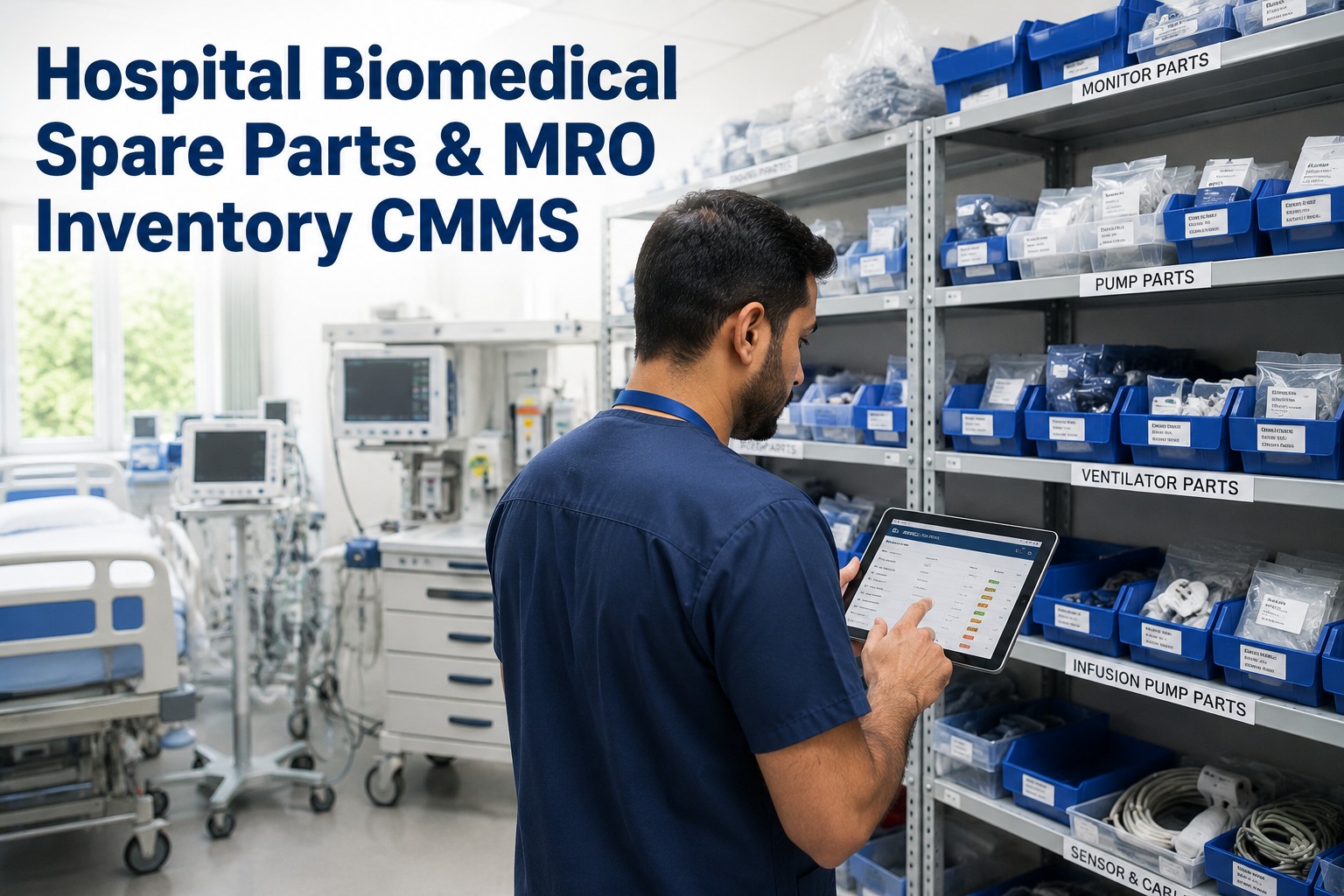
Hospital spare parts inventory management is the hidden backbone of patient care — when a single biomedical connector, filter, or circuit board is missing, a critical device sits idle and procedures get delayed. This guide covers biomedical MRO inventory strategy for healthcare facilities: criticality-based stocking, ABC classification, min/max reorder automation, vendor lead-time management, and how a CMMS for hospital MRO keeps life-critical spares available without tying up capital in dead stock. If your biomed team is still tracking parts on spreadsheets or paper requisitions, switching to an AI-powered platform like OxMaint can cut stockouts by 40–60% and reduce excess inventory carrying costs by 20–35% — Start Free Trial to see it in action.
Biomedical MRO Inventory Guide
One missing part. One stranded procedure. What is it costing your hospital?
Stockouts of a single biomedical spare — a sensor, a valve, a power module — can sideline a $250K imaging system or a ventilator for days while clinical teams scramble. A healthcare parts CMMS with criticality-based stocking, automated reorder points, and real-time vendor lead-time tracking eliminates that risk while cutting carrying costs up to 35%.
Criticality-Based Stocking
Why hospital critical parts stocking needs a criticality framework — not guesswork
In a 400-bed acute-care hospital running 8,000+ biomedical devices, biomed teams manage anywhere from 3,000 to 12,000 unique spare-part SKUs. Without a criticality framework, the result is predictable: critical parts run out while dusty "just-in-case" spares sit on shelves for years absorbing capital and obsolescence risk.
Parts for ventilators, defibrillators, anesthesia machines, infusion pumps, and imaging systems where failure delays patient treatment.
- Target availability: 99.5%+
- Reorder trigger: 30-day supply or sooner
- Safety stock: 1.5x average lead-time demand
- Review cadence: Weekly automated cycle counts
Parts for patient monitors, surgical tools, diagnostic equipment, and beds where downtime is disruptive but clinically manageable.
- Target availability: 95–98%
- Reorder trigger: 45-day supply
- Safety stock: 1x average lead-time demand
- Review cadence: Bi-weekly automated review
Filters, gaskets, batteries, fuses, cables, and consumables needed for preventive maintenance and non-urgent repairs.
- Target availability: 85–92%
- Reorder trigger: 60–90-day supply
- Safety stock: Minimal or vendor-managed
- Review cadence: Monthly or quarterly review
ABC Classification & Min/Max Design
How to design min/max reorder points for biomedical spare parts inventory
ABC classification combined with data-driven min/max levels is the core of hospital parts optimization. The formula is straightforward but must be calibrated to actual usage velocity and vendor lead-time variability — which is where a healthcare inventory management CMMS earns its keep by automating calculations that manual spreadsheets cannot sustain.
Reorder Point (ROP)
ROP = (Average Daily Usage × Vendor Lead Time in Days) + Safety Stock
Example: A defibrillator battery used 0.5 units/day, 14-day lead time, 7 units safety stock → ROP = 14 units. When on-hand hits 14, the CMMS auto-generates a PO.
Safety Stock
SS = Z-score × σ(usage during lead time)
For Class A life-critical parts, use Z = 1.65 (95th percentile). For Class B, use Z = 1.28 (90th). The CMMS recalculates σ dynamically as usage history grows.
Worked Example
A 280-bed regional hospital's biomed team managed 4,200 spare SKUs on spreadsheets. Annual carrying cost was estimated at $185,000 with frequent stockouts on Class A ventilator components averaging 6 per quarter. After implementing OxMaint CMMS with ABC classification and automated ROP recalculation: stockouts dropped to under 1 per quarter, carrying cost fell to $142,000 (23% reduction), and technician time spent on parts lookup dropped from 12 hrs/week to 3 hrs/week.
MRO CMMS Guide for Healthcare
Healthcare CMMS vs. spreadsheet MRO tracking: what changes when you go digital
Most hospital biomed shops start with Excel and a stockroom — and many never move beyond it. The gap between spreadsheet tracking and a CMMS built for hospital MRO is not just convenience; it is the difference between predictive restocking and reactive scrambling, between audit-ready compliance and documentation gaps.
| Inventory Capability | Spreadsheet / Manual | OxMaint CMMS |
|---|---|---|
| Reorder point automation | Manual review, often missed | Auto-PO generation at ROP threshold |
| Lead-time tracking | Static estimates, rarely updated | Dynamic rolling average per vendor/SKU |
| Multi-site stock visibility | Separate files per location | Unified dashboard across all facilities |
| Work-order parts linkage | Manual entry, error-prone | Parts auto-issue to work orders in real time |
| Compliance & audit trail | Paper logs, gaps on retrieval | Full timestamped history per part & device |
| Stockout alerts | Discovered when needed | Proactive alerts before threshold breach |
| Obsolescence & expiry tracking | Manual rotation, high waste | FEFO alerts & automatic expiry flags |
| Inventory carrying cost visibility | Calculated annually, roughly | Real-time carrying cost per SKU & category |
How OxMaint Helps
How OxMaint CMMS optimizes hospital biomedical spare parts inventory
OxMaint is built for the realities of healthcare maintenance — where a missing $40 sensor can delay a $15,000 procedure, and where regulatory audits demand a full chain-of-custody for every part installed in a patient-connected device. Here is what changes when biomed teams move to OxMaint.
Automated ROP & PO Generation
OxMaint monitors on-hand levels in real time and auto-generates purchase orders the moment a SKU hits its reorder point — recalculated dynamically from rolling usage data and vendor lead-time averages. Hospitals typically cut stockouts by 40–60% within the first quarter.
Predictive Parts Forecasting
AI-driven usage forecasting analyzes seasonal demand patterns, device age, and PM schedules to predict which parts you will need — and when. One 180-asset biomed shop reduced emergency air shipments by 70% after switching from reactive ordering to OxMaint's predictive model.
Full Compliance & Audit Trail
Every part issued, installed, returned, or scrapped is timestamped and linked to the work order, device serial number, and technician — creating a defensible audit trail for Joint Commission, DNV, and FDA inspections. No more scrambling to reconstruct paper logs.
Multi-Site Inventory Pooling
See every spare part across every facility in one dashboard. Transfer stock between sites with a click instead of ordering new — a hospital network of 3 campuses cut duplicate inventory by $48,000 in year one by pooling Class B and C spares they did not know were already on a sister campus.
ROI & Inventory Analytics
What does a hospital spare parts inventory CMMS cost — and what is the payback?
For a mid-sized hospital biomed department managing 5,000–8,000 device assets, the financial math of a CMMS is rarely close. The combination of reduced stockouts, lower carrying cost, fewer emergency shipments, and reclaimed technician time typically delivers payback in 3–6 months.
| Savings Category | Annual Impact (Mid-Size Hospital) | How OxMaint Delivers It |
|---|---|---|
| Reduced carrying cost (dead stock elimination) | $22,000 – $35,000 | ABC reclassification & dynamic ROP right-sizing |
| Fewer emergency/expedited parts orders | $8,000 – $15,000 | Predictive forecasting & automated reorder triggers |
| Reclaimed technician labor (parts admin) | $18,000 – $28,000 | Work-order-linked auto-issuing & mobile parts lookup |
| Reduced device downtime (clinical revenue protection) | $15,000 – $50,000+ | Pre-staged PM kits & stockout alerts |
| Audit preparation time savings | $4,000 – $8,000 | Full timestamped part-to-device traceability |
| Total estimated annual benefit | $67,000 – $136,000 | vs. OxMaint subscription cost of $6K–$15K/yr |
See OxMaint on Your Assets
Book a 30-minute demo and see your biomed stockroom go from reactive to predictive
We will map your current spare-parts workflow, identify your top stockout risks, and show you exactly how OxMaint's automated ROP engine, predictive forecasting, and audit trail would work on your real device inventory — before you commit to anything.
Frequently Asked Questions
Hospital biomedical spare parts inventory management — your questions answered
What is biomedical MRO inventory management in a hospital?
Biomedical MRO inventory management is the process of sourcing, stocking, tracking, and issuing maintenance, repair, and operations spare parts specifically for medical devices — from ventilator sensors to imaging-system power modules. A CMMS automates this by linking every part to a device, work order, and technician, with reorder points recalculated dynamically from actual usage and vendor lead-time data. Start Free Trial to see how OxMaint handles this end-to-end.
How does a CMMS improve hospital spare parts tracking?
A CMMS replaces manual spreadsheet tracking with real-time stock visibility, automated reorder triggers, and full part-to-device traceability. When a technician closes a work order, the issued parts are automatically deducted from inventory, the ROP is checked, and a purchase order is generated if needed — eliminating the lag between usage and restocking that causes 80% of hospital biomed stockouts.
How do you calculate reorder points for critical medical device spares?
The standard formula is ROP = (Average Daily Usage × Vendor Lead Time in Days) + Safety Stock. For life-critical Class A parts, set safety stock using a Z-score of 1.65 (95th percentile) to protect against demand variability and supplier delays. OxMaint recalculates both usage averages and lead-time variance automatically as new data flows in, so your ROPs stay accurate without manual spreadsheet maintenance.
What are the biggest risks of managing hospital spare parts on spreadsheets?
The top risks are stockouts on life-critical devices (causing procedure delays and patient safety exposure), excess dead stock tying up capital (typically 15–25% of inventory value), no real-time visibility across multiple sites, no automated expiry tracking for date-sensitive components, and no defensible audit trail for Joint Commission or FDA inspections. These risks compound as device count grows beyond 2,000 units.
How long does it take to implement a CMMS for hospital biomed inventory?
Most mid-sized hospital biomed teams go live on OxMaint in 4–8 weeks, including data migration from spreadsheets, ABC classification setup, ROP calibration, and technician training. The process is phased: import your asset and parts data first, configure reorder points and vendor lead times, then enable work-order integration. You can Book a Demo to get a tailored implementation timeline based on your facility size and current systems.
Ready to Eliminate Biomed Stockouts?
Stop managing spare parts on spreadsheets. Start preventing stockouts before they happen.
Join the hospital biomed teams using OxMaint to cut inventory carrying costs by 20–35%, reduce emergency parts orders by 70%, and keep every life-critical device ready when patients need it. See it on your assets in a 30-minute demo — or start a free trial today.
Free 14-day trial · No credit card


.png)
.jpeg)

