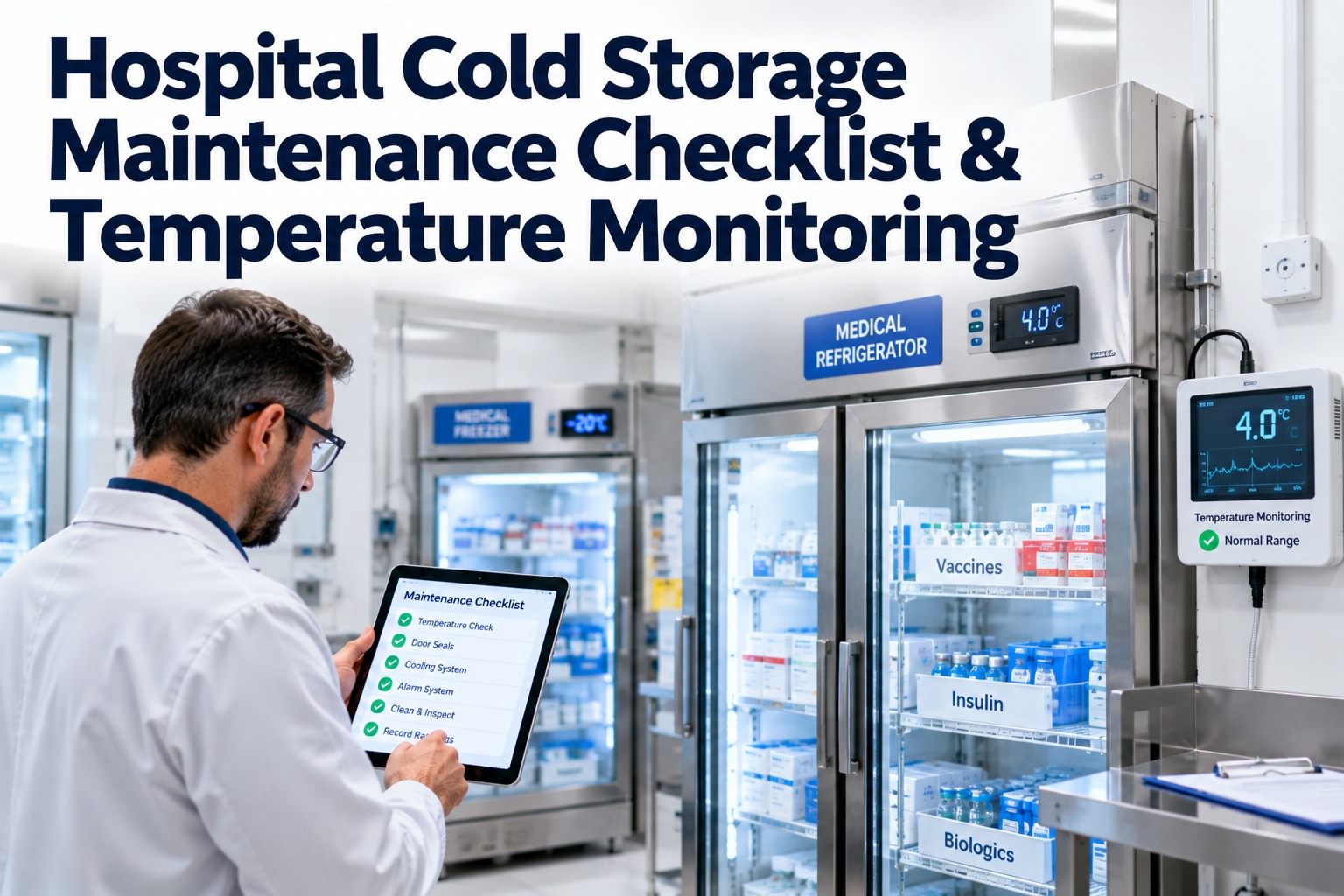
Hospital Cold Storage Maintenance Checklist & Temperature Monitoring

By Willam Jerry on October 26, 2026

hospital-cold-storage-maintenance-checklist-guide

A pharmacy fridge drifts to 9°C overnight and nobody sees the log until morning  by then a tray of vaccines may be gone, and so is the record that would prove what happened. Cold storage is where a quiet equipment fault turns into spoiled medicine, lost lab samples and a compliance finding, all at once. This checklist keeps your refrigerators, freezers and cold rooms inspected, their temperatures logged, and their alarms tested — and OXMAINT AI, the AI-powered maintenance management software, turns every check and every excursion into a tracked, time-stamped work order.

Hospital Cold Storage · Maintenance Checklist & Temperature Monitoring · 2027

Hospital Cold Storage Maintenance Checklist: Protect Every Degree

Vaccines, medications, blood and lab samples all depend on a few degrees holding steady. This is the checklist and monitoring routine that keeps every cold-storage unit in range — and in the OXMAINT AI software, a logged check or an out-of-range reading becomes a work order on its own, with the unit, the temperature and the time already attached.

COLD STORAGE · LIVE
Vaccine Fridge · Pharm-14.2°C
Blood Bank · Lab-23.8°C
Pharmacy Fridge · Pharm-39.1°C
Sample Freezer · Lab-5−24°C
Reagent Fridge · Lab-77.4°C
1 excursion → work order drafted automatically

Why Cold Storage Is the Costliest Thing to Get Wrong

A failed light fixture is an inconvenience. A failed fridge is a loss event — spoiled stock, a reportable excursion, and the question of whether anything stored in it is still safe to use. The fault is often small and silent, which is exactly why a routine checklist plus continuous monitoring matters more here than almost anywhere in the building. Start free and put every cold-storage unit on a monitored schedule in OXMAINT AI.

Product loss
A single excursion can write off a full tray of vaccines or a shelf of temperature-sensitive medication in one night.
Patient risk
A vaccine or blood product that left its range may be ineffective or unsafe — and you may not know unless it was logged.
Silent failures
A door left ajar, a failing compressor or a blocked vent drifts slowly — nothing looks wrong until the log says it is.
The record is the proof
Without a continuous, retrievable temperature log, you can't prove a product stayed safe — or defend it at an audit.

Know the Range Before You Inspect

Every unit has a target band and an alarm point, and they differ by what's stored inside. An inspection means nothing without the right numbers to check against — these are the widely used reference ranges for hospital cold storage. Always defer to your own pharmacy, blood bank and laboratory protocols and the product's own storage requirements. Book a demo to set each unit's target range and alarm thresholds in OXMAINT AI.

Storage type
Typical target range
What it holds
Monitoring
Vaccine / pharmacy fridge
2°C to 8°C (target ~5°C)
Vaccines, refrigerated medication
Continuous + min/max logged
Vaccine / sample freezer
−50°C to −15°C
Frozen vaccines, lab samples
Continuous + min/max logged
Blood bank refrigerator
1°C to 6°C
Red cells, blood products
Continuous + audible alarm
Laboratory / reagent fridge
2°C to 8°C (per reagent)
Reagents, specimens, kits
Continuous or twice-daily log
Walk-in cold room
Per stored product
Bulk pharmacy / supplies
Continuous + mapped sensors

Ranges are widely used references for hospital cold storage and vaccine handling guidance. They vary by product, manufacturer and local protocol — your pharmacy, blood bank and laboratory standards and each product's storage label set the actual targets and alarm points.

The Cold Storage Maintenance Checklist

Work through each group on its own cadence — daily temperature checks, weekly and monthly equipment inspections, and periodic deeper service. Tick each item as it's done; in the OXMAINT AI software the same checklist runs on a mobile device and files itself as a completed, time-stamped record. Start free and run this checklist from any phone in OXMAINT AI.

01Daily — Temperature & VisualEvery day, each shift
02Weekly — Unit & ContentsWeekly
03Monthly — Equipment & CleaningMonthly
04Alarm & Backup TestingMonthly / per protocol
05Periodic — Calibration & ServiceAnnual / per schedule
Excursion TriggerWhen a Reading Becomes a Work Order

A temperature out of range isn't a note for later — it's an immediate action. These are the triggers that should open a work order and start the excursion protocol the moment they occur.

!
A reading outside the unit's target range, at any check
!
A high or low alarm, including an overnight or after-hours event
!
A min/max showing the unit left range between checks
!
A door found open, a power loss, or a failed compressor

A Temperature Logged on Paper Is a Temperature You Can't Act On at 2am.

The gap that spoils product is the one between an excursion and someone noticing it. The OXMAINT AI maintenance management software closes it — continuous readings, an alarm that opens a work order on its own, and a complete log that's there when the auditor asks. Monitoring and maintenance on one platform.

What Compliance Expects on the Record

Passing a pharmacy, blood bank or laboratory inspection is less about the fridge and more about the paperwork behind it — the evidence that every unit was monitored, every excursion handled, and every reading retained. These are the records the OXMAINT AI software builds automatically as the checklist runs. Book a demo to see the cold-storage compliance record build itself in OXMAINT AI.

TEMP LOGS
Continuous and min/max readings per unit, retained and retrievable for the required period.
EXCURSIONS
Every out-of-range event with its time, duration, cause and the action taken on it.
CHECKS DONE
Completed daily, weekly and monthly checklists, time-stamped and signed off.
CALIBRATION
Current sensor calibration certificates and their due dates, per unit.
ALARM TESTS
Dated records that alarms and after-hours alerts were tested and worked.
UNIT INVENTORY
A register of every cold-storage unit with its range, location and service history.

How OXMAINT AI Runs Cold Storage Maintenance

The OXMAINT AI maintenance management software ties monitoring and maintenance together — the temperature that triggers an alarm is the same system that schedules the PM, runs the checklist and keeps the record, so nothing falls through the gap between them. Start free and bring every cold-storage unit onto one platform in OXMAINT AI.

UNIT REGISTER
Every fridge, freezer and cold room on one register with its target range, location and full service history.
ALARM → WO
An out-of-range reading or alarm opens a work order automatically, with the unit, temperature and time attached.
MOBILE CHECKLIST
Daily, weekly and monthly checks run from a phone and file themselves as time-stamped, signed-off records.
PM SCHEDULING
Coil cleaning, defrost, calibration and manufacturer service scheduled automatically, with overdue escalation.
EXCURSION LOG
Every excursion recorded with cause, duration and action — a defensible trail for product-safety decisions.
AUDIT-READY
Temperature logs, alarm tests and calibration certificates retrievable on demand for pharmacy and lab inspections.

Expert Review

This checklist is a general maintenance and monitoring framework, not a clinical storage protocol. The temperature ranges shown (2°C to 8°C refrigeration, −50°C to −15°C freezing, 1°C to 6°C blood bank) are widely cited references for hospital cold storage and vaccine handling, but the actual targets, alarm points, logging frequency, retention periods and excursion procedures for any unit are set by your pharmacy, blood bank and laboratory protocols, the product manufacturer's storage requirements, and applicable regulations and accreditation standards — which take precedence over anything here. Decisions about whether product exposed to an excursion remains safe to use rest with the pharmacist, blood bank or laboratory, not with a maintenance system. OXMAINT AI is the maintenance management software that schedules the checks, receives alarm signals, runs the work orders and retains the records; it supports the cold-chain program your clinical and quality teams own and does not replace it or make product-disposition decisions.

Frequently Asked Questions

How often should hospital cold storage temperatures be checked?
Best practice is continuous monitoring with a data logger, backed by a manual check and a min/max reading at least twice a day — typically at the start and end of each working day. Continuous logging catches the overnight and between-check excursions a twice-daily spot check would miss. The OXMAINT AI maintenance management software records continuous readings and opens a work order the moment one goes out of range. Start free and set continuous monitoring on every unit in OXMAINT AI.
What temperature range should a vaccine or pharmacy refrigerator hold?
Refrigerated vaccines and medications are generally stored between 2°C and 8°C, with around 5°C as the aim; frozen vaccines sit in a separate freezer, often in the −50°C to −15°C band. Blood bank refrigerators typically run 1°C to 6°C. These are references only — the product label and your pharmacy and blood bank protocols set the exact targets and alarm points. Book a demo to configure each unit's range and alarms.
What should happen when there's a temperature excursion?
The excursion should be logged immediately, the unit and affected product identified, and your excursion protocol started — which usually means quarantining the product and referring the disposition decision to pharmacy, the blood bank or the lab. A maintenance system's job is to raise the alarm, open the corrective work order and retain the full record; the decision on whether product is still usable stays with the clinical team. Book a demo to see an excursion open a work order automatically.
What preventive maintenance do medical refrigerators and freezers need?
Typical PM includes cleaning condenser coils, clearing defrost drains, checking door seals and gaskets, defrosting where needed, testing alarms and backup power, and calibrating temperature sensors against a certified reference. Intervals follow the manufacturer's guidance and your own protocols. Running these as scheduled work orders — with overdue escalation — is exactly what the OXMAINT AI software is built to do. Book a demo to put cold-storage PM on an automated schedule.
How does a CMMS help with cold-storage compliance?
It keeps the evidence an inspector asks for in one retrievable place — continuous temperature logs, excursion records with the action taken, completed checklists, alarm-test dates and current calibration certificates, all tied to a register of every unit. Because the records build themselves as the checklist and monitoring run, there's no separate compliance scramble before a pharmacy or laboratory inspection. Start free and build the cold-storage compliance record in OXMAINT AI.

Protect Every Degree, on Every Unit, Around the Clock.

Put your hospital's cold storage on one platform with the OXMAINT AI maintenance management software — continuous temperature monitoring, alarms that open work orders on their own, mobile checklists that file themselves, and a complete, audit-ready record for pharmacy, blood bank and laboratory. Catch the excursion before it costs you the product.
Share This Story, Choose Your Platform!