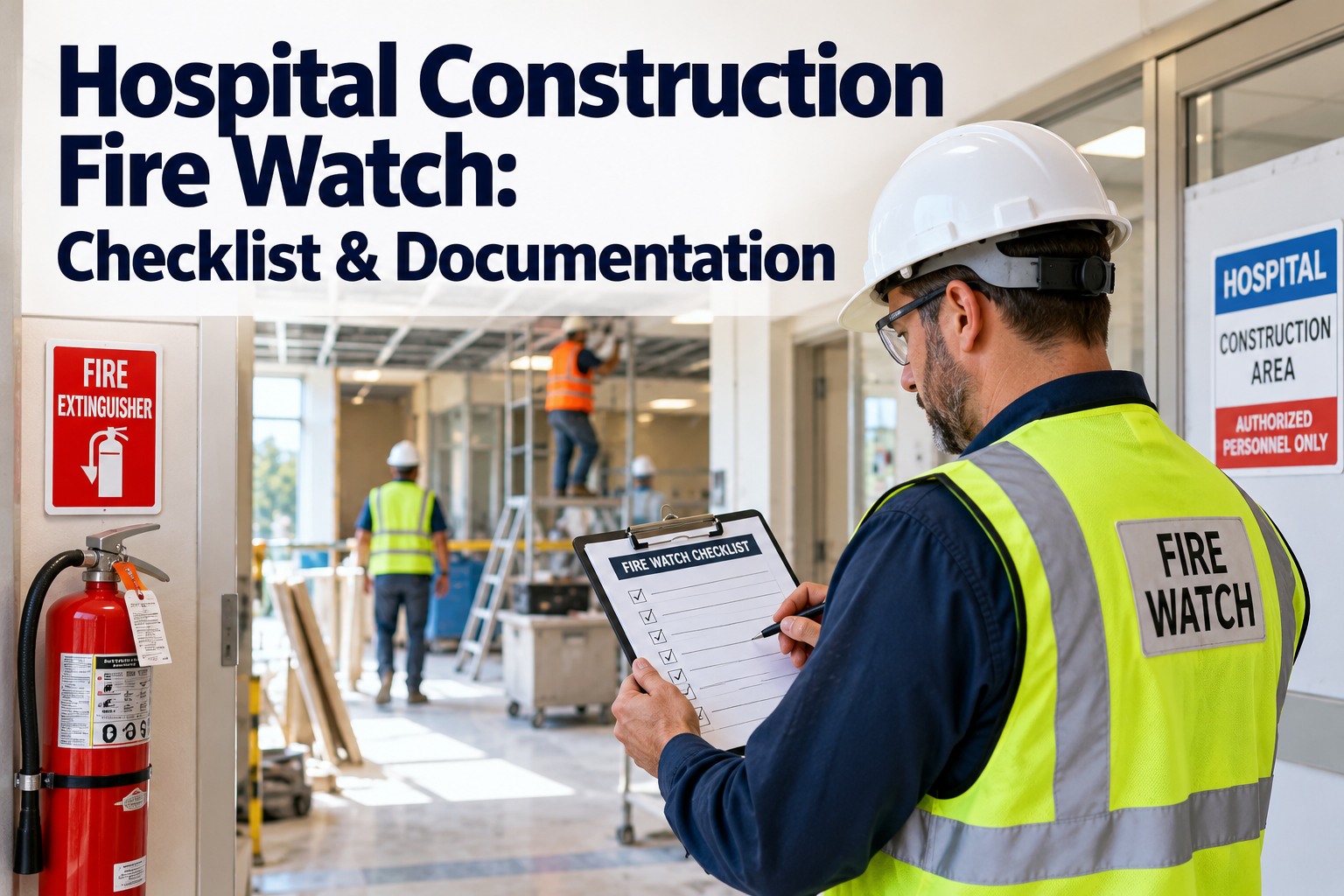
Hospital Construction Fire Watch: Checklist & Documentation

By Willam Jerry on October 9, 2026

hospital-construction-fire-watch-management

The moment construction or renovation takes a sprinkler zone or an alarm loop out of service in a live hospital, the building's automatic fire protection has a hole in it — and a defend-in-place facility cannot run with a hole in its protection. A fire watch fills that gap with trained eyes until the system is back, but only if the patrols actually happen and the log proves it. The OXMAINT AI — the AI-powered maintenance management software — runs the fire-watch schedule, the patrol checklist and the documentation that stands up to a survey.

Healthcare · Construction & Renovation · Fire Watch · Checklist & Documentation · 2026

Hospital Construction Fire Watch: Checklist & Documentation

When protection is impaired or hot work is under way, a documented fire watch is the control that keeps patients safe and the project compliant. OXMAINT AI triggers the watch, schedules the timed patrols, runs the checklist on each round and keeps the log that proves every patrol was walked.

1Trigger → 2Assign watch → 3Patrol & log → 4Close out
Fills the gap
Human watch covers impaired automatic protection
NFPA 241 · ILSM
Construction fire safety and interim life-safety measures
Timed patrols
Rounds walked at a set interval, not when remembered
Documented
A signed, timed log a surveyor can rely on

When a Fire Watch Is Required

A fire watch is not a formality — it is triggered by specific conditions that leave the building more exposed than normal, most of them routine during a construction or renovation project. Knowing the triggers is how a watch starts on time rather than after an inspector asks why it did not; start free and trigger a fire watch automatically on every impairment in OXMAINT AI.

Sprinklers impaired
A zone drained or valved shut for tie-ins leaves that area without suppression.
Fire alarm impaired
Detection or notification offline in a work area removes the automatic warning.
Hot work
Welding, cutting or grinding near combustibles needs a watch during and after.
Life-safety deficiency
An interim life-safety assessment during construction can call for a watch.

The Patrol Cycle

A fire watch works only as a repeating loop — walk, check, record, and round again before too much time passes. The interval is the whole point; a patrol an hour apart is not a watch for the fifty-nine minutes in between; book a demo to see timed patrol rounds enforced in OXMAINT AI.

1
Walk the route
Cover every area in the defined boundary, every round.
→
2
Check for hazards
Heat, smoke, odour, ignition sources and blocked egress.
→
3
Log the patrol
Time, area and findings recorded on the spot.
→
↺
Repeat the interval
Round again at the set interval until protection is back.

The Fire Watch Checklist

A watch runs on a consistent routine — the same checks before it starts, on every patrol, around hot work, and at close-out. Work through the checklist and the gaps become visible before they become findings; start free and run this checklist on every patrol round in OXMAINT AI.

01Before the Watch Begins
02On Every Patrol
03Hot Work Coverage
04Documentation & Close-Out

What the Fire Watch Log Must Capture

The log is the proof — without it, the watch did not happen as far as a surveyor is concerned. Each field exists to answer a question an inspector or an investigation will ask; book a demo to see the patrol log captured automatically in OXMAINT AI.

Log field
What it captures
Why it matters
Date & time
When each round was walked
Proves the interval was kept
Area / route
What was covered
Shows the whole scope was patrolled
Watcher name
Who was on watch
Accountability and training check
Hazards found
Anything observed
Triggers action before it grows
Action taken
The response to a finding
Closes the loop on a hazard
Impairment status
What is out of service
Ties the watch to the reason for it
Hot work permit ref
The linked permit
Connects watch to authorized work
Sign-off
Shift and close-out approval
Makes the record defensible

A Fire Watch Nobody Logged Is a Fire Watch Nobody Can Prove.

Paper patrol sheets go missing, get filled in after the fact, and cannot show a round was actually walked. The OXMAINT AI maintenance management software schedules each patrol, runs the checklist on the round and timestamps the log as it happens — so the watch is both real and provable, start to finish.

How OXMAINT AI Manages Fire Watch

A fire watch program holds up only when the trigger, the patrols and the record are all handled in one place — and that is the job the software does. Here is what the OXMAINT AI maintenance management software brings to construction fire watch; start free and run your fire-watch program in OXMAINT AI.

Trigger to assignment
An impairment or hot work permit raises a fire watch and assigns it, so coverage starts on time.
Timed patrol schedule
Rounds scheduled at the set interval with reminders, so a patrol is never quietly skipped.
Mobile patrol checklist
The watcher runs the checklist on each round from a phone, right where the patrol happens.
Automatic timed log
Each round is timestamped as it is completed, so the log reflects what truly happened.
Corrective-action tracking
A hazard found on patrol becomes a tracked action followed through to closure.
Survey-ready records
Every patrol, finding and impairment kept and searchable for compliance and survey.

Frequently Asked Questions

What is a construction fire watch?
It is a trained person or team who patrols a defined area at set intervals to watch for fire while a hospital's automatic protection is impaired or hot work is under way during construction or renovation.
When does a hospital need a fire watch?
When sprinklers or the fire alarm are out of service, during hot work, and whenever an interim life-safety assessment calls for it on a construction or renovation project.
What standards govern hospital fire watch?
NFPA 241 for construction fire safety, NFPA 51B and OSHA for hot work, and NFPA 101 and 99 with Joint Commission interim life-safety measures for life safety during construction.
What must a fire watcher do?
Patrol the defined area at the set interval with no other duties, watch for heat, smoke and ignition, keep a means to raise the alarm, know the egress and extinguishers, and log every round.
How does a CMMS help manage fire watch?
It triggers the watch on an impairment, schedules the timed patrols, runs the checklist, timestamps the log automatically and keeps the records ready for survey; OXMAINT AI runs the whole fire-watch program.

Keep the Watch Real — and Keep the Proof That It Was.

Run construction fire watch inside the OXMAINT AI maintenance management software — automatic triggering on impairment, timed patrol scheduling, a mobile checklist on every round, an automatic timestamped log, corrective-action tracking and survey-ready records — so a hospital stays protected through construction and every patrol is provable.

Share This Story, Choose Your Platform!