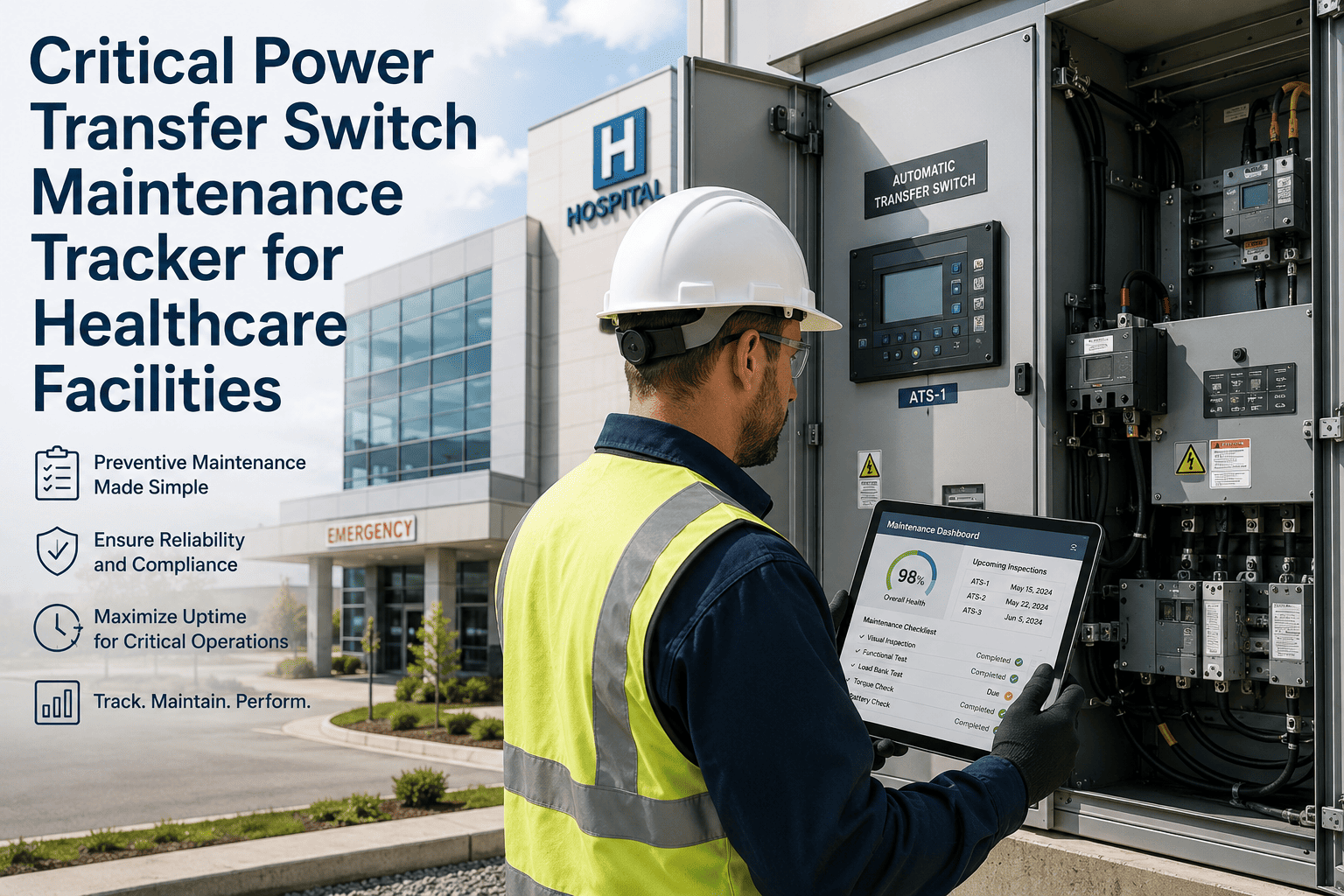
A hospital in the US Midwest lost power to an entire ICU wing for 23 minutes during a summer thunderstorm — not because the generator failed to start, but because the automatic transfer switch had a degraded contact that slowed the transfer to 47 seconds instead of the required 10. Three patients on mechanical ventilators required manual bagging during the gap. The transfer switch had passed its last visual inspection six months prior, but contact condition testing had not been performed in over two years. That single maintenance gap, in a single component, turned a manageable utility outage into a patient safety event and a regulatory investigation. Sign up for Oxmaint to build a maintenance program that prevents this scenario — or book a demo to see how structured EPSS compliance tracking works in practice.
Why Hospital Electrical Maintenance Is Unlike Any Other Facility
Hospitals are the only building type in the United States where an electrical maintenance failure can directly cause patient death within seconds. The operating room cannot pause while a transfer switch is diagnosed. The ICU cannot run on manual workarounds while a UPS battery is replaced. Every component of the hospital electrical system — from the normal power switchgear through the automatic transfer switches to the UPS units serving individual critical care spaces — must be maintained to a standard that assumes the next utility outage could happen during the most critical possible patient care moment.
Three interlocking federal and national standards govern this work. NFPA 99, the Health Care Facilities Code, defines which areas of your facility require emergency power and at what risk category. NFPA 110, the Standard for Emergency and Standby Power Systems, defines exactly how your EPSS must perform, be tested, and be documented. NEC Article 517 governs the electrical installation itself — wiring methods, isolated power panels in wet procedure locations, and the required separation of normal and emergency distribution equipment. All three apply simultaneously. A maintenance program that addresses only one is incomplete by definition. Sign up for Oxmaint to map your compliance tasks to the correct governing standard for every component.
The Essential Electrical System: Three Branches, Three Criticality Levels
The Essential Electrical System in a hospital is not a single backup circuit — it is three distinct branches mandated by NFPA 99, each serving different functions and each with different patient safety implications. Understanding the branch structure determines your maintenance priorities and the consequences of a failure at each point in the system. Book a demo to see how Oxmaint structures asset maintenance records by EES branch.
Powers systems required for safe building evacuation. Not for medical treatment. Failure here creates a life-safety emergency independent of what is happening in clinical areas.
Powers patient care areas where loss of power is directly life-threatening. The highest-stakes branch — failure here during an active procedure is a patient safety catastrophe.
Powers major equipment essential for facility operation where brief interruption is not immediately life-threatening but would significantly disrupt care delivery and compliance.
Generator Maintenance: What NFPA Requires and What Most Facilities Miss
Generator maintenance in hospitals is more prescriptive than in any other building type. NFPA 99 requires 12 tests per year with intervals between 20 and 40 days — a tighter constraint than NFPA 110's general "at least monthly" language, specifically designed to prevent facilities from running two tests close together and then letting 60 days pass. Every test must be a cold start with no manual pre-warming, because a real utility outage will not give the generator a warm-up period. Sign up for Oxmaint to automate interval-aware generator test scheduling with built-in compliance alerts.
Track Every Generator Test, Transfer Switch Check, and UPS Record in One Place
Oxmaint manages NFPA-aligned maintenance schedules, logs test results with timestamps and technician IDs, and generates TJC-ready compliance reports — so your next audit is a five-minute export, not a multi-hour document search.
Transfer Switch Maintenance: The Most Failure-Prone Component in the EPSS
The automatic transfer switch is statistically the most likely component to fail during an actual utility outage — not the generator engine. Every transfer switch contact arcs when it operates, and over hundreds of tests and real events, those contacts pit and oxidize. The result is a switch that passes visual inspection but produces a 47-second transfer instead of a 10-second one when it matters most. Contact condition testing, thermal imaging, and enclosure inspection on a defined maintenance cycle are the only defenses against this failure mode.
Transfer switch contacts must be inspected for pitting, arcing signatures, and heat discoloration on a semi-annual cycle — not just visually checked. Contact resistance measurement identifies degraded contacts before they cause a slow or failed transfer.
Annual thermographic inspection of all ATS bus connections, cable terminations, and control wiring identifies hot spots before they become failures. Thermal anomalies greater than 10°C above ambient indicate a connection requiring immediate attention.
Transfer time must be measured and logged for every automatic transfer switch in the system — not just one representative unit. Facilities with multiple ATS units serving different EES branches must document each one. A trend of increasing transfer time is an early warning of contact degradation.
UPS batteries serving critical care areas must be tested quarterly by controlled discharge to verify runtime capacity. VRLA batteries have a service life of 3 to 5 years — batteries that appear functional on float voltage checks can fail catastrophically during a discharge event when a patient needs them most.
What the Joint Commission Will Ask for During Survey
TJC Emergency Management (EM) and Environment of Care (EC) standards require that hospitals maintain complete, retrievable records for every element of their emergency power program. Inspectors do not evaluate intent — they evaluate documentation. The following records must be available, organized, and producible during survey without a search delay. Sign up for Oxmaint to keep all of these records in a single, searchable compliance repository.
Frequently Asked Questions
NFPA 99 defines where backup power is required in a hospital — categorizing spaces by patient risk level and dictating that Category 1 spaces like ICUs, ORs, and EDs require the highest standard of emergency power protection. It also sets the 12-tests-per-year frequency with 20 to 40 day intervals. NFPA 110 defines how the Emergency Power Supply System must perform and be maintained — covering generator performance specifications, transfer switch requirements, weekly inspection protocols, annual load bank test procedures, and the documentation that must be kept. Both codes apply simultaneously; NFPA 99 tells you what to protect and how often to test, NFPA 110 tells you how the hardware must perform. Sign up for Oxmaint to track compliance tasks mapped to the correct governing standard for each asset.
The 2025 edition of NFPA 110 eliminated the 25% load step from the annual load bank test protocol. Earlier editions required a three-step test: 25% load for 30 minutes, 50% for 30 minutes, and 75% for 60 minutes — totaling 2 continuous hours. The 2025 edition requires only 50% load for 30 minutes followed by 75% load for 60 minutes. Before changing your test procedure, verify which edition your local Authority Having Jurisdiction has adopted — some AHJs continue to enforce earlier editions. NFPA 110 also requires that if utility power fails during a load bank test, the load bank must be automatically replaced with actual building loads, not manually switched. Book a demo to see how Oxmaint tracks load bank test results and AHJ edition requirements.
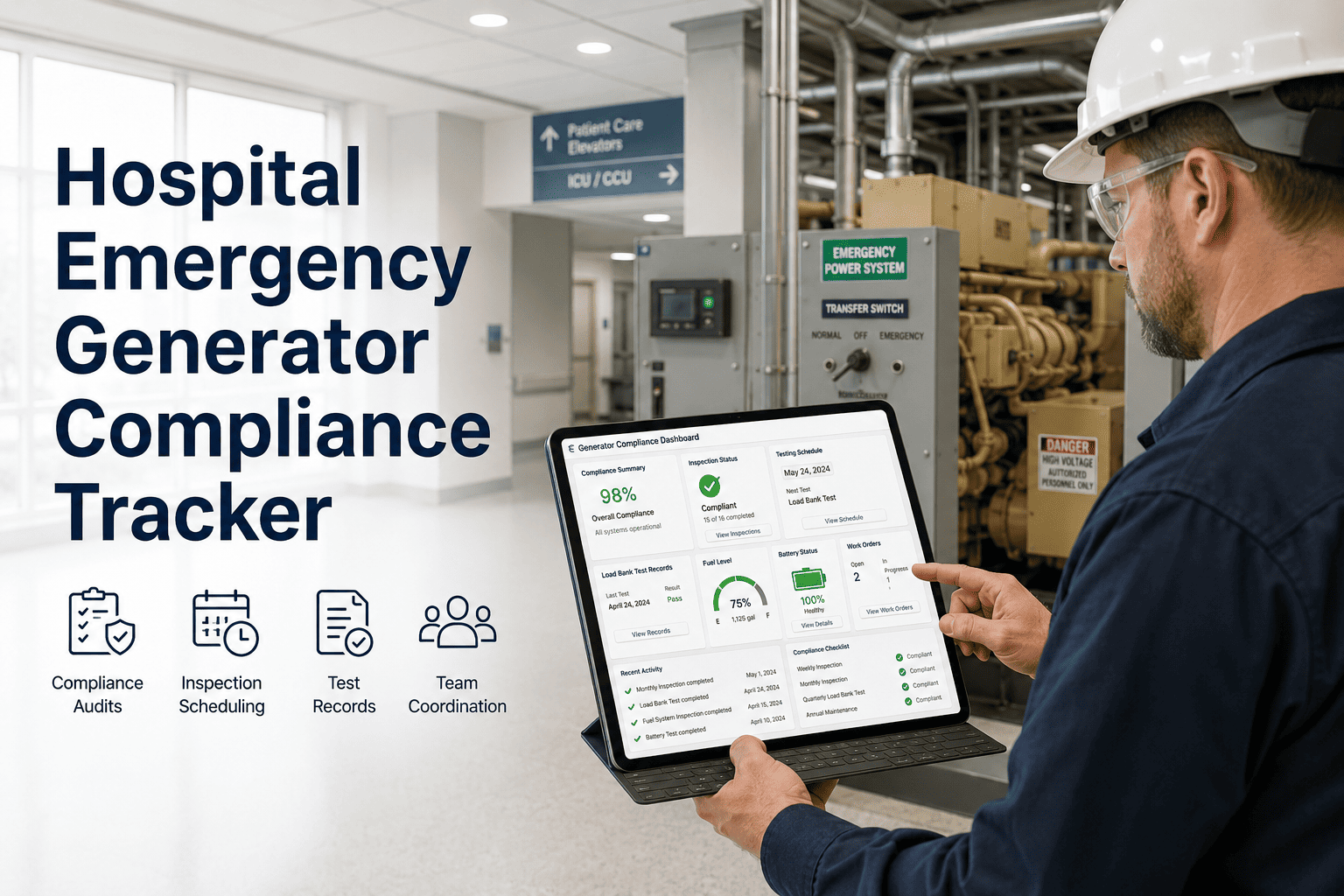
Oxmaint creates a structured, timestamped maintenance record for every generator test, transfer switch verification, UPS battery discharge, fuel quality test, and corrective action in your hospital's emergency power program. Test logs are automatically populated with technician ID, date, duration, load percentage, and transfer time measurements. When a Joint Commission surveyor requests 12 months of generator test logs, the report generates in minutes. Corrective action work orders are linked directly to the inspection finding that triggered them — creating the closed-loop documentation that TJC requires. Interval-aware scheduling alerts your team when a test window is approaching the 40-day maximum, preventing accidental lapses. Sign up for Oxmaint to connect your EPSS assets to the platform today.
The Joint Commission requires that generator test logs and maintenance records be retained for a minimum of 3 years and be available during survey. NFPA 110 requires retention of all records related to EPSS installation, inspection, testing, and recommended repairs — with no specific time limit other than "available to the authority having jurisdiction." Most risk management and legal counsel recommendations extend retention to 7 to 10 years for facilities in states with long statutes of limitation for patient care events. Digital maintenance platforms eliminate the storage and retrieval burden of paper records while ensuring records are never lost to file damage or staff turnover.
The single most common cause of generator start failure in hospitals is a degraded or failed starting battery — not engine mechanical failure. Batteries that pass visual inspection but fail conductance testing are the primary culprit: they hold enough surface charge to show a normal voltage reading but cannot deliver the cranking current required for a cold start. The second most common cause is fuel contamination — diesel fuel stored for more than 18 months develops microbial growth and water accumulation that clogs filters and injectors under full load. Generators that pass monthly light-load tests can fail when asked to carry full hospital load during an extended outage. Both failure modes are prevented by structured weekly battery conductance testing and annual fuel quality sampling. Sign up for Oxmaint to schedule these preventive checks automatically.
Your EPSS Compliance Program Starts with the Right Maintenance Platform
Every generator test, transfer switch verification, UPS battery record, and corrective action your team completes in Oxmaint becomes a structured, auditable compliance record — ready for TJC survey, CMS review, or adverse event investigation at any moment. Build the program now so the next utility outage is managed, not scrambled.