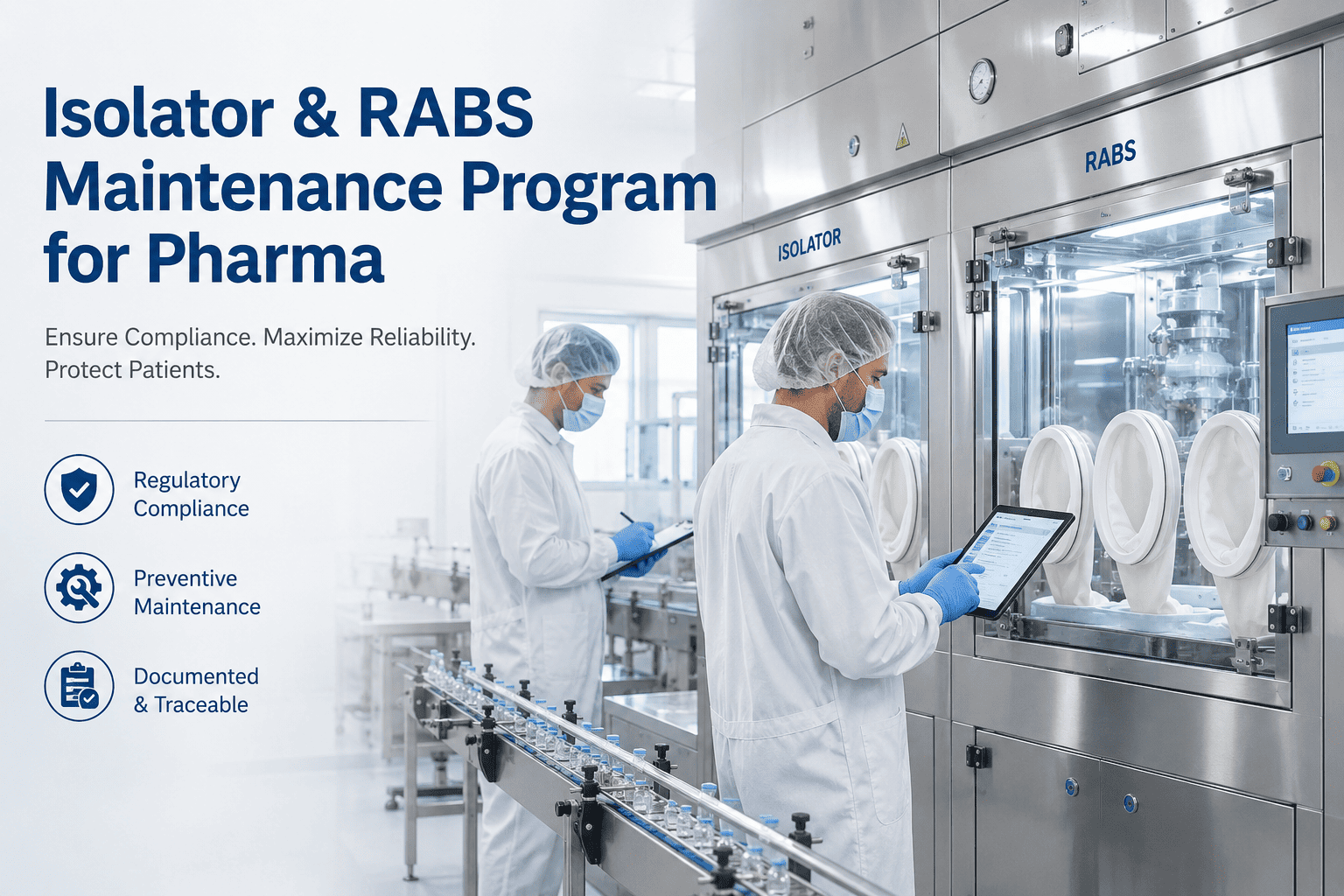
Isolators and Restricted Access Barrier Systems are the last line of defense in aseptic pharmaceutical manufacturing — yet glove failures, missed VHP cycle evidence, and undocumented alarm histories remain among the top reasons facilities receive FDA 483 observations during inspections. OxMaint gives your barrier system maintenance program the documented structure and QA approval workflows that regulators expect and inspections demand.
Isolator vs RABS
Understanding Your Barrier System — Maintenance Requirements by Type
Isolator
ContainmentFully closed — physical separation from environment
Glove SystemIntegrated glove ports — tested before every batch
DecontaminationVHP or H2O2 gas cycle — validated, documented per run
PM ComplexityHigh — bio-decontamination cycle validation required
Regulatory StandardEU GMP Annex 1, FDA guidance on barrier systems
RABS
ContainmentPartial barrier — personnel access via controlled procedures
Glove SystemGlove ports or manual access — intervention-tracked
DecontaminationSurface disinfection — documented per SOP at defined intervals
PM ComplexityMedium — HVAC coupling and door seal maintenance critical
Regulatory StandardEU GMP Annex 1, site-specific validated procedures
Maintenance Program Structure
The 5 Core Elements Every Barrier System Maintenance Program Needs
01
Glove Integrity Testing
Physical glove pressure tests and visual inspections before every batch. Documented results attached to batch record. Glove replacement schedule based on usage cycles, not just calendar intervals. Any glove failure triggers immediate investigation and barrier integrity assessment before production continues.
Frequency: Before every batch + monthly physical inspection
02
VHP Cycle Documentation
Every hydrogen peroxide vapor decontamination cycle must produce documented evidence: cycle parameters, H2O2 concentration, exposure time, aeration completion, and biological indicator results where required by your validation protocol. EU GMP Annex 1 (2022) specifically references VHP cycle traceability as an inspection expectation.
Frequency: Before every production campaign
03
HVAC and Pressure Differentials
Barrier system integrity depends on maintaining designed positive pressure differentials between the aseptic zone and surrounding environment. HVAC performance, HEPA filter integrity, and differential pressure values must be continuously monitored, with maintenance records confirming filter change intervals and HVAC service history.
Frequency: Continuous monitoring, quarterly PM
04
Alarm Log Review and Trending
Every alarm event on the barrier system — pressure drop, door interlock, VHP sensor — must be logged, investigated, and resolved before the next batch. Recurring alarms on the same component are a leading indicator of imminent failure. Alarm trending over 3 to 6 months enables predictive maintenance scheduling.
Frequency: Review before each batch, trend quarterly
05
Validated Work Instructions
Every maintenance task on an isolator or RABS must be performed according to a validated, approved work instruction with revision control. Ad hoc maintenance performed outside of approved SOPs creates process validation gaps and generates regulatory findings. Work instruction compliance must be verified and documented with each PM execution.
Frequency: Required for every maintenance activity
Ready to bring your barrier system maintenance program into a single GMP-compliant platform?
OxMaint structures glove checks, VHP records, alarms, and QA approvals in one digital system.
Book a Demo
Compliance Reference
Barrier System Maintenance — Regulatory Evidence Requirements
| Maintenance Activity | Required Evidence | Regulatory Reference | Review Required |
|---|---|---|---|
| Glove integrity test | Pressure test record, visual check log | EU GMP Annex 1 §8.7 | QA before each batch |
| VHP decontamination cycle | Cycle parameters, BI results, aeration log | EU GMP Annex 1 §8.24 | QA sign-off before production |
| HEPA filter integrity test | DOP/PAO test certificate, date, technician | FDA Aseptic Processing Guide 2004 | QA review after service |
| Door seal inspection | Visual inspection log, seal replacement record | Site SOP, Annex 1 §4.3 | Supervisor sign-off |
| Alarm response documentation | Alarm log, investigation note, resolution action | 21 CFR 211.68, Annex 11 | QA review before next run |
Expert Review
Industry Perspective on Isolator and RABS Maintenance
"
The Annex 1 revision changed the expectation for isolator programs dramatically. Facilities that were previously getting by with periodic glove checks and informal VHP logs are now finding themselves with 483 observations because the new standard explicitly requires documented evidence for every cycle. The facilities already using structured CMMS workflows had nothing to change.
— GMP Compliance Director, EU Licensed Sterile Manufacturer, 15 years in isolator validation
"
RABS programs are often underinvested in maintenance documentation because the physical access design makes people less cautious than a fully closed isolator. But from a regulatory standpoint, every RABS intervention and every maintenance activity must be documented with the same rigor. The barrier design does not reduce the documentation requirement.
— Senior Quality Engineer, Biologics Aseptic Manufacturing, FDA-regulated facility
Questions and Answers
Isolator and RABS Maintenance — What Teams Ask
How often should isolator gloves be tested and replaced?
Glove integrity testing — typically a physical pressure test confirming no leak — should be performed before every production batch at minimum, with additional testing required after any intervention that places abnormal stress on the glove system. Replacement intervals should be defined in your glove management SOP based on a combination of usage cycles and visual inspection results, not simply calendar time. Industry practice typically replaces gloves after 30 to 50 batch exposures or when any physical degradation is observed, whichever comes first. OxMaint tracks glove test results, usage cycles, and replacement history in a single searchable record.
What VHP cycle documentation does EU GMP Annex 1 require?
EU GMP Annex 1 (2022 revision) requires that each VHP or bio-decontamination cycle produce documented evidence demonstrating that the validated cycle parameters were achieved. This includes H2O2 concentration levels, contact time, chamber conditions, and aeration phase completion. Where biological indicators are used as routine cycle verification, the results must be recorded and linked to the batch record. Facilities must also maintain evidence that the VHP generator and cycle parameters are within their validated range, including generator maintenance and sensor calibration records. Book a demo to see how OxMaint links VHP cycle documentation directly to batch records.
What is the maintenance difference between active and passive RABS?
Active RABS incorporates a dedicated air handling system that maintains unidirectional airflow and positive pressure within the barrier, requiring full HVAC maintenance including filter integrity testing, air velocity measurement, and differential pressure monitoring. Passive RABS relies on the cleanroom's ambient air system and has fewer dedicated mechanical components to maintain, but still requires rigorous door seal, interlocking system, and surface decontamination documentation. Both types require the same level of documentation rigor for any maintenance activity that affects barrier integrity, regardless of the difference in mechanical complexity.
Can alarm acknowledgment be used as documentation for barrier system alarms?
No — acknowledging an alarm in the system controller is not adequate documentation. Regulatory expectations require that every alarm be associated with an investigation record that identifies the cause, describes the corrective action taken, and confirms resolution before the next production activity. Alarm acknowledgment logs alone cannot satisfy a request for evidence that the alarm was investigated and the root cause addressed. Repeated alarms that are acknowledged but not formally investigated are among the most common findings in FDA warning letters related to barrier system operations. OxMaint connects barrier system alarm events directly to formal investigation work orders with QA review requirements. Start your free trial and see the alarm-to-work-order workflow in action.
Isolator · RABS · GMP Barrier Systems · Annex 1 Ready
Build a Barrier System Maintenance Program That Satisfies Every Inspection
OxMaint structures glove integrity records, VHP cycle documentation, alarm logs, and QA approvals into a single compliant maintenance program for isolators and RABS.