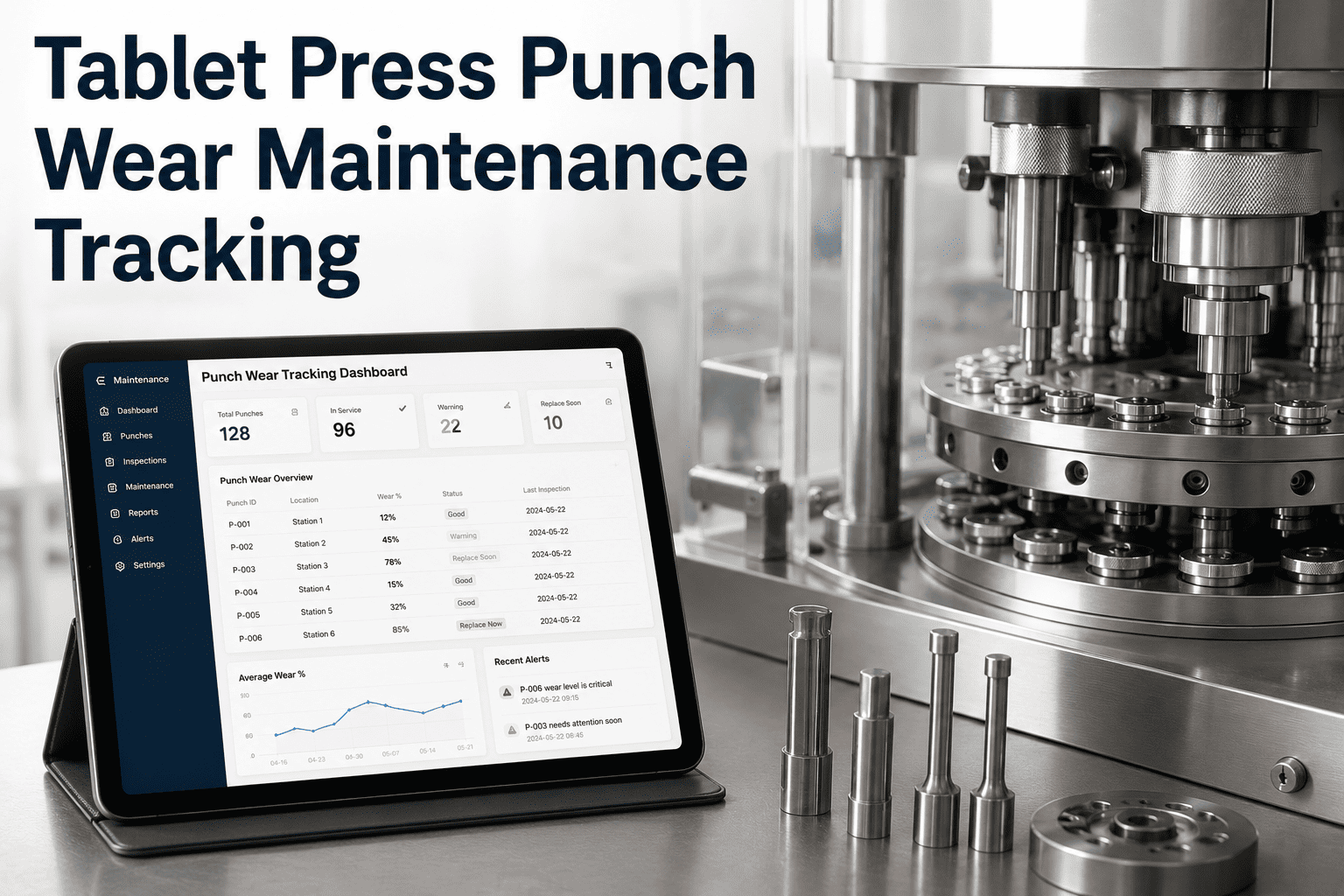
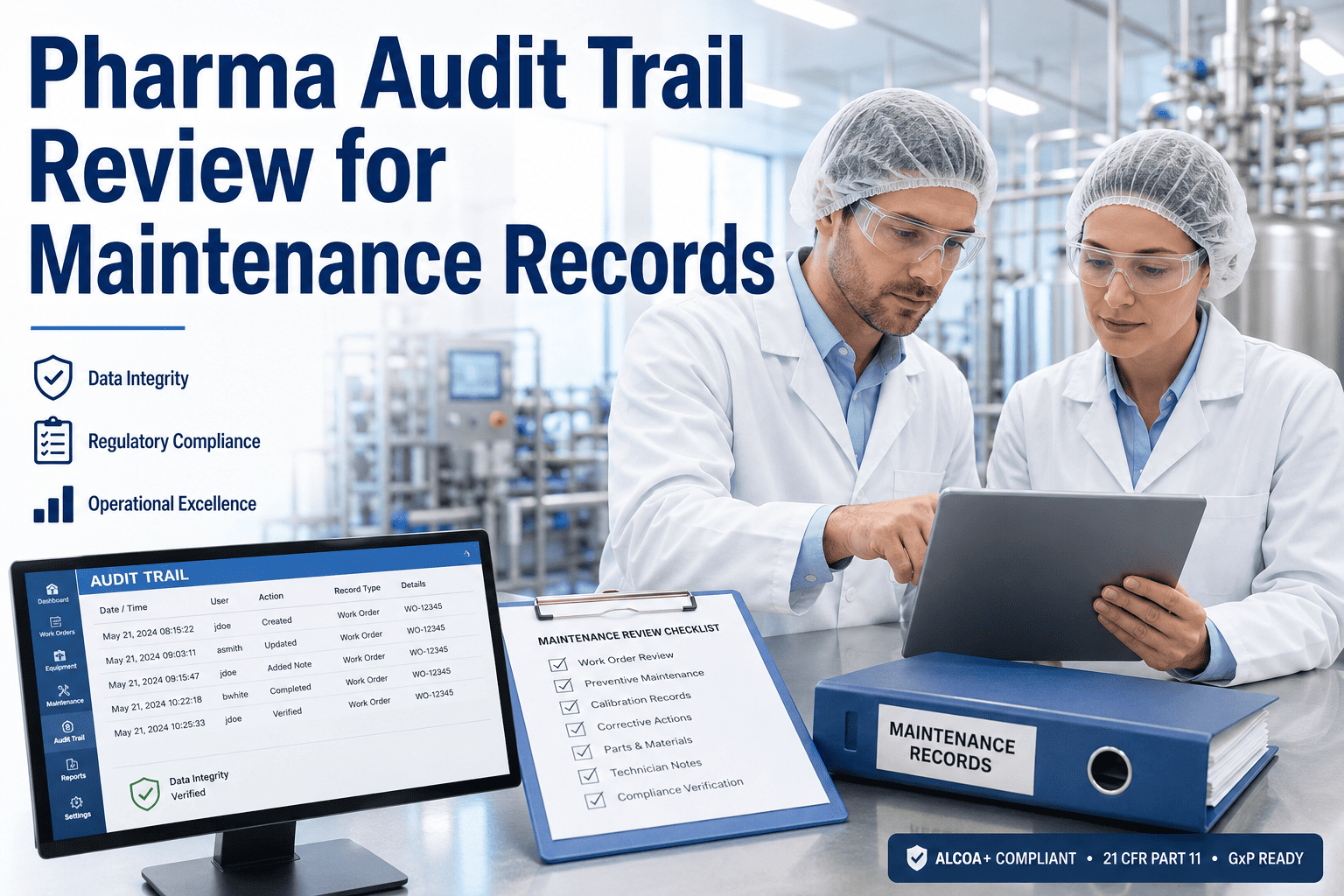
Tablet press downtime costs pharma manufacturers an average of $50,000 per hour in lost production — yet 68% of facilities still rely on manual sampling and post-batch analytics, catching defects only after out-of-spec tablets have already entered production. This guide covers everything your team needs: PM schedules, punch tooling checks, lubrication intervals, and GMP-compliant recordkeeping to keep your compression line running at peak output. If you want digital PM workflows live on your press before next week, start a free trial or book a 30-minute walkthrough with an OxMaint pharma specialist.
Guide · Production Equipment · GMP Compliance
Tablet Compression Machine Maintenance Guide
PM schedules, punch tooling checks, lubrication tasks, and audit-ready GMP records — the complete field guide for pharma maintenance teams.
35%
Reduction in unplanned downtime with AI predictive maintenance
80%
Of tablet press equipment expected to carry AI fault prediction by 2030
±0.5%
Tablet weight accuracy standard on GMP-compliant presses
Why Tablet Press Maintenance Is a Compliance Imperative
Under FDA 21 CFR Part 11 and EU GMP Annex 11, compression force monitoring is no longer optional — it is a regulatory expectation. A single missed PM can cascade into a batch rejection, a QA investigation, and a six-figure compliance incident.
01
Batch Rejection
Worn punches cause weight variation beyond ±0.5% spec, triggering full batch discard and investigation.
02
FDA 483 Observations
Missing or unsigned maintenance records during audits result in 483 findings and potential warning letters.
03
Sticking & Picking
Lubrication gaps and punch face wear cause material adhesion, forcing unplanned stops mid-batch.
04
Cross-Contamination
Inadequate cleaning between product changeovers risks contamination that GMP regulations define as critical.
PM Schedule by Frequency
The most effective preventive maintenance is performed consistently, even informally. Here is the complete task breakdown your maintenance team should execute at every interval.
Daily
- Inspect punch and die surfaces for cracks, chips, or corrosion
- Check compression force readings against validated range
- Clean punch faces and die bores to prevent cross-contamination
- Verify tablet weight, hardness, and thickness samples
- Lubricate turret, cam tracks, and feed frame per SOP
- Log all observations in batch maintenance record (BMR)
Weekly
- Full tooling inspection — measure punch length and cup depth
- Inspect feeder paddles and scraper blades for wear
- Check drive belt tension and alignment
- Calibrate weight sensors and pressure transducers
- Clean and inspect dust extraction system and filters
- Review compression force trend data for drift patterns
Monthly
- Full disassembly and deep clean of turret and punch guides
- Inspect bearings, gears, and mechanical seals for wear
- Replace or recondition worn punches and dies
- Verify pre-compression and main compression force calibration
- Review and update lubrication logs
- Conduct and document OQ-level performance verification
Punch Tooling Condition: Pass / Fail Reference
| Component |
Inspection Point |
Pass Condition |
Fail Action |
| Upper Punch Tip |
Cup depth uniformity |
Within ±0.01 mm of nominal |
Remove from service, recondition or replace |
| Lower Punch Body |
Surface pitting or scoring |
No visible pitting; smooth barrel |
Quarantine, log deviation, order replacement |
| Die Bore |
Internal diameter wear |
Within manufacturer tolerance |
Replace die; document in CMMS work order |
| Punch Head Flat |
Flatness and radius check |
No chipping; radius per TSM/EU standard |
Measure with profilometer; replace if out of spec |
| Keyway / Keyed Punch |
Key engagement |
Full key engagement, no lateral play |
Return to tooling store; log in maintenance record |
Run These Checks Digitally — Zero Paper
OxMaint delivers GMP-ready mobile checklists for every PM interval. Technicians complete inspections on-site, photos attach automatically, and records are audit-ready the moment the task closes.
Lubrication Task Map
Incorrect or missed lubrication is the leading cause of sticking, picking, and premature tooling wear. Each zone requires the correct lubricant type and interval.
Zone A
Punch Barrel & Guides
Food-grade mineral oil, applied each shift. Excess removed to avoid tablet contamination.
Zone B
Cam Tracks & Rollers
High-pressure grease (NLGI 2), weekly application. Inspect tracks for scoring monthly.
Zone C
Turret Bearings
Manufacturer-specified bearing grease, monthly repack. Over-greasing causes heat buildup.
Zone D
Feed Frame Paddles
Dry lubricant only — no oil contact with product zone. Inspect paddles for wear weekly.
Zone E
Main Drive Gearbox
ISO VG 220 gear oil, changed annually or per operating hours specified in OEM manual.
Zone F
Pre-compression Rollers
Light machine oil, applied before each production run. Check roller surface for flat spots.
GMP Documentation Requirements
Under 21 CFR Part 11 and EU GMP Annex 11, every maintenance activity must be recorded with time-stamped, attributable, and legible entries. Paper logs no longer satisfy auditors.
01
Batch Maintenance Record
Each production batch requires a signed maintenance entry confirming press readiness, line clearance completion, and tooling verification before first tablet.
02
Tooling Log
Every punch and die set needs a unique ID, usage cycle count, inspection history, and retirement record. CMMS tooling modules automate this tracking.
03
Calibration Records
Compression force sensors, weight checks, and hardness testers require documented calibration at defined intervals with next-due dates tracked in the system.
04
Deviation & CAPA Log
Any out-of-spec finding during PM must trigger a deviation record with root cause, immediate action, and corrective action — all linked to the original work order.
Expert Review
JR
James Rowe
Pharmaceutical Manufacturing Engineer, 18 Years | Former QA Lead, Contract Manufacturing
"The single biggest compliance gap I see during audits is tooling traceability. Plants track punch sets informally — a shared spreadsheet, a whiteboard — and when an auditor asks for the full lifecycle record of a specific die set, the answer is silence. Digital CMMS tooling logs with unique IDs, cycle counters, and photo history eliminate that risk entirely. It takes one setup to fix a problem that otherwise costs you warning letters."
★★★★★
Frequently Asked Questions
How often should punch and die tooling be replaced on a tablet press?
Tooling replacement depends on compression force, production volume, and formulation abrasiveness — but standard practice is to inspect every punch and die set after each batch and retire any piece showing pitting, dimensional variance beyond ±0.01 mm, or surface cracking. High-abrasive formulations can wear standard D-tooling within 3–5 production cycles. A CMMS with a cycle counter tied to each tooling ID automates retirement before failure occurs, preventing the batch rejections that follow an undetected worn punch.
See how OxMaint tracks tooling lifecycle from the first use to retirement.
What GMP records are required for tablet press maintenance under FDA 21 CFR Part 211?
21 CFR Part 211.68 requires all equipment used in drug production to have written maintenance procedures and logs. For a tablet press, this includes dated and signed entries for every PM task, calibration records for force sensors and weight checking instruments, cleaning and changeover records between products, deviation logs for any out-of-spec findings, and tooling inspection history. Entries must be legible, attributable to a specific operator, and retained for the product's shelf life plus one year. Digital CMMS systems that meet 21 CFR Part 11 generate these records automatically as technicians complete tasks on mobile devices.
Book a demo to see audit-ready documentation in practice.
What causes sticking and picking on a tablet press, and how does maintenance prevent it?
Sticking (material adhering to punch faces) and picking (material pulling out of the tablet surface) are primarily caused by worn punch cup geometry, insufficient magnesium stearate blending, and inadequate lubrication of punch barrels. Preventive maintenance addresses this at the source: daily punch face cleaning removes residue buildup, weekly cup depth measurement catches geometric wear before it affects tablet appearance, and correctly applied zone-specific lubrication ensures punches move freely without excess oil contacting the product zone. Increasing pre-compression dwell time and adjusting tooling design with larger break radii on punch faces also reduces sticking in high-force formulations. Tracking sticking incidents in your CMMS as work order findings builds a pattern record that helps QA identify systemic causes faster.
Can OxMaint integrate with existing MES or ERP systems used in pharma manufacturing?
Yes. OxMaint provides REST API connectors that synchronize maintenance records bidirectionally with SAP PM, Oracle EAM, and MES platforms used in pharmaceutical manufacturing. The most common deployment pattern is OxMaint handling maintenance execution on the plant floor — where mobile usability and GMP documentation matter most — while feeding completed work order data, cost records, and calibration status back to the ERP for corporate reporting and financial integration. Setup typically takes days rather than months, and OxMaint's pharma team provides white-glove onboarding including asset data migration from legacy systems.
Start a free trial to test the integration with your stack before committing.
Make Your Tablet Press Audit-Ready This Week
OxMaint brings GMP-compliant PM schedules, mobile tooling inspection, lubrication logs, and automatic deviation records to your compression line — deployed in days, not months. Give your maintenance team the tool they will actually use.