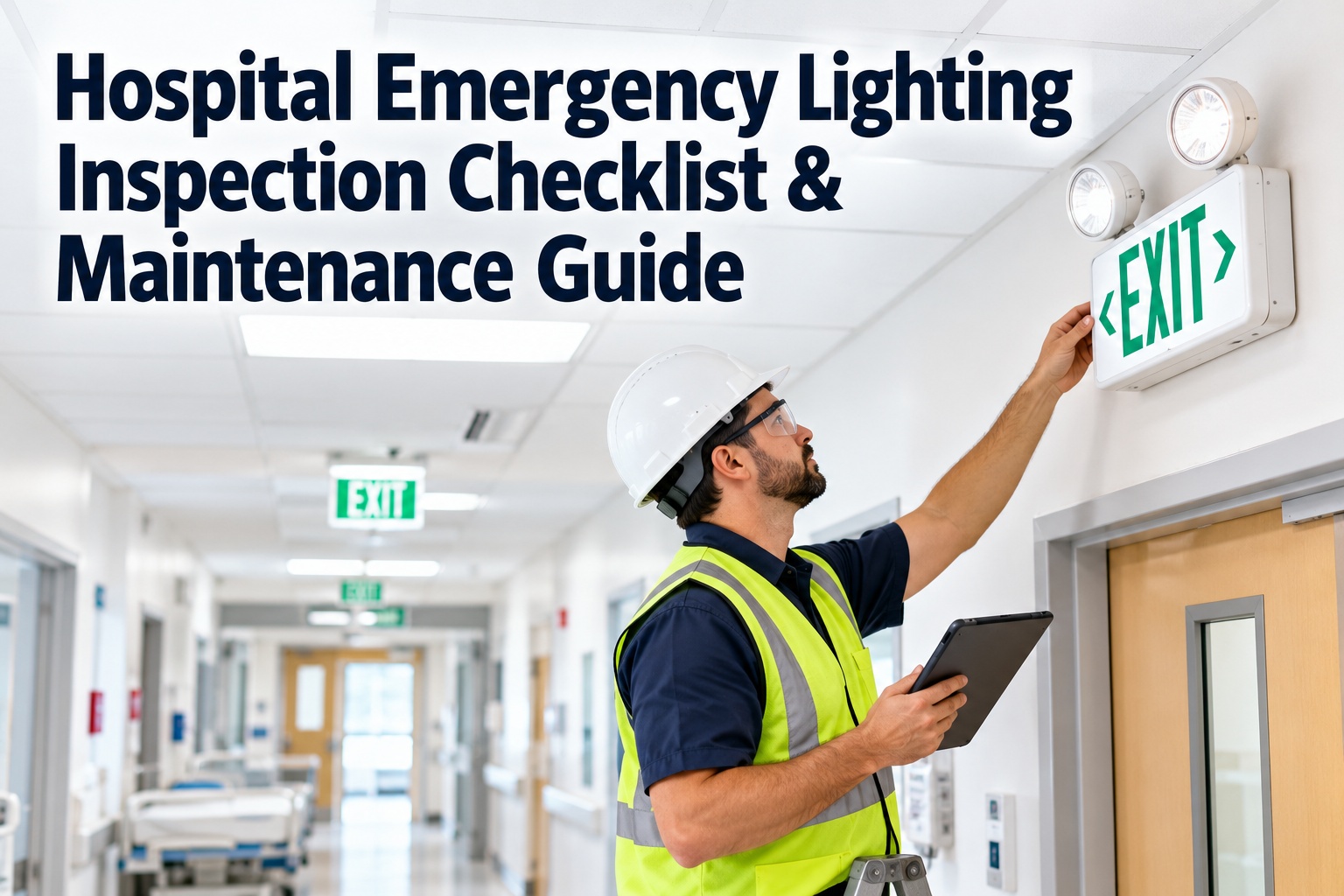
When the power fails in a hospital, the emergency lights have 10 seconds to come on and have to stay on for 90 minutes — long enough to move or protect patients who cannot simply walk out. The catch is that a battery or fitting that failed last week looks identical to a working one until the moment it is needed. Only testing tells them apart, and only a record proves the test happened. The OXMAINT AI — the AI-powered maintenance management software — schedules both mandated tests, runs this checklist on each one and keeps the log a surveyor will ask for.
Backup power, exit signs, battery units and the testing that proves they work — one checklist built around the two tests the code demands. Tick each item, and let OXMAINT AI turn the monthly and annual tests into scheduled, documented work orders.
Emergency-lighting compliance comes down to two tests on two cadences — a quick monthly check that the lights come on, and an annual check that they stay on for the full duration. Miss either and the record has a hole a surveyor will find; book a demo to see both tests scheduled automatically in OXMAINT AI.
Monthly
30 seconds
Functional Test
Cut the normal supply and confirm every emergency light and exit sign illuminates and transfers to battery. A quick pass across the whole facility, every month.
Confirms: the unit switches on
Annual
90 minutes
Duration Test
Run every unit on battery for the full 90-minute rated duration and confirm it stays lit to the end. This is the test that catches a tired battery a 30-second check never would.
Confirms: the battery lasts the distance
Testing intervals follow NFPA 101 (Life Safety Code) §7.9 and your authority having jurisdiction — confirm the exact requirements for your facility. A self-testing/self-diagnostic system can satisfy the functional test automatically where fitted and accepted.
The most common failure — a battery that powers the light for seconds but not the full 90 minutes.
Skipped duration test
Monthly checks done, annual run skipped — so a battery that can't hold up is never caught.
Failed lamp or LED
A burned lamp or dark LED segment that leaves a stretch of the egress path unlit.
Missing records
The test was done but not logged — to a surveyor, an untraceable test did not happen.
The 30-Second Test Is Easy to Skip. The Record Is Impossible to Fake.
A monthly test that lives on a clipboard gets missed, and the one you miss is the one the surveyor asks about. The OXMAINT AI maintenance management software schedules both tests, runs the checklist per unit and timestamps the result — so every emergency light is proven, not assumed, and the log is ready on request.
A testing program holds up only when both tests are scheduled, run per unit and recorded — and that is the job the software does. Here is what the OXMAINT AI maintenance management software brings to emergency-lighting compliance; start free and run your emergency-lighting program in OXMAINT AI.
Monthly & annual scheduling
Both the 30-second and 90-minute tests set on their cadence, so neither is ever quietly skipped.
Per-unit fitting register
Every luminaire and exit sign held as an asset with its own test history and battery age.
Mobile test checklist
Technicians run the checklist from a phone on the round, pass or fail captured per fitting.
Battery-life tracking
Battery age and duration-test results trended, so a weakening battery is flagged before it fails.
Corrective-action workflow
A failed unit becomes a work order that is assigned and followed through to a confirmed fix.
Survey-ready records
Every test, date, duration and result kept and searchable, so Life Safety evidence is always to hand.
Frequently Asked Questions
How often must hospital emergency lighting be tested?
Under NFPA 101 §7.9, a 30-second functional test every month and a 90-minute full-duration test every year. Your authority having jurisdiction may add requirements, so confirm locally.
What is the 90-minute test for?
It confirms the battery can power the light for its full rated duration, not just switch it on. It is the only test that catches a battery that works for seconds but fails long before 90 minutes.
What is the most common failure?
A weak or dead battery. A unit can pass a 30-second check and still fail the duration test, which is why the annual run and battery-life tracking matter so much.
Do self-testing fittings remove the need to test?
Self-testing or self-diagnostic units can perform and log the functional test automatically where fitted and accepted, but the results still have to be recorded and acted on, and the duration test verified.
Prove Every Emergency Light Works — Before the Power Proves It Doesn't.
Run emergency-lighting inspection inside the OXMAINT AI maintenance management software — monthly and annual test scheduling, a per-unit fitting register, a mobile checklist, battery-life tracking, corrective-action workflow and survey-ready records — so backup power, exit signs and batteries are tested on time and the evidence is always ready.