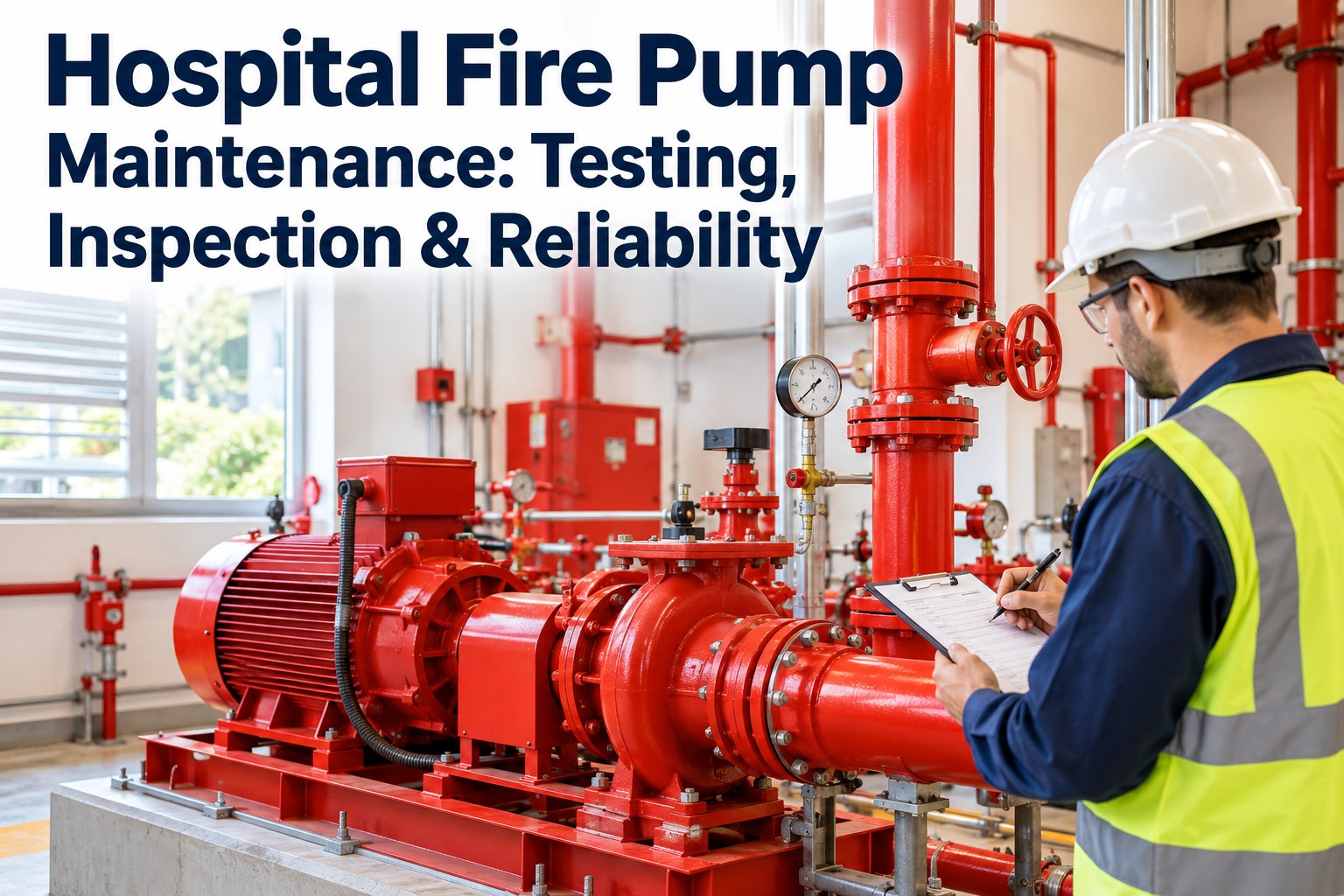
A hospital fire pump is the definition of a critical asset that almost never runs and absolutely must the one time it's called on. When a sprinkler system opens on a fire, the pump is what boosts water pressure enough to actually fight it; if it fails to start or can't hold pressure, the building's whole fire-protection strategy fails with it, in a facility full of patients who can't simply walk out. That's why fire pump maintenance is built on relentless testing, not occasional inspection. This guide covers the testing regime, the checklist and the records that keep a hospital pump reliable. OXMAINT AI — the AI-powered maintenance management software — holds every test interval, captures the readings and keeps the compliance record.
Healthcare · Hospital Fire Pump · Testing, Inspection & Reliability · 2026
Hospital Fire Pump Maintenance
The fire pump only runs when everything else has gone wrong — so it has to be proven, again and again, before that day. The OXMAINT AI maintenance management software schedules every no-flow and flow test, logs the readings, and turns any deficiency into corrective work.
Churn test
Flow test
Driver
Records
Runs once
it may sit idle for years, then has to perform on demand
Tested often
no-flow tests weekly or monthly, a full flow test yearly
Proven curve
the flow test confirms the pump still meets its design output
Documented
a record trail for NFPA 25, the AHJ and the Joint Commission
Why a Hospital Fire Pump Can't Fail
The fire pump sits at the end of a long chain of assumptions — that it will start, reach pressure and hold it, on the worst day the building ever has. In a hospital, the stakes behind that assumption are uniquely high; book a demo to see fire pump testing scheduled in OXMAINT AI.
Patients can't evacuate
A hospital can't be cleared in minutes — fire protection has to hold, and the pump is what powers it.
Sprinklers need the pressure
Without the pump boosting supply, the sprinkler system may not reach the pressure it needs to control a fire.
No second chance
It either works the moment it's needed or it doesn't — there's no catching the failure after the fact.
Compliance is watched
NFPA 25, the AHJ and the Joint Commission all expect documented testing — and a surveyor will ask to see it.
The Fire Pump Testing Regime
Fire pump reliability rests on three tiers of testing, each proving something different. Together they confirm the pump will start, run and perform; start free and schedule all three in OXMAINT AI.
Weekly / Monthly
No-flow (churn) test
The pump is started and run under no-flow for the required period to confirm it starts automatically and runs correctly. Diesel-driven pumps are tested weekly; electric pumps on the schedule set by code and conditions. This is the test that proves the pump will spring to life when the pressure calls for it.
Annual
Flow performance test
Once a year the pump is run across its range — at churn, rated flow and peak flow — and the results compared to its design performance curve. This is the only test that proves the pump still delivers the water and pressure the building was designed around, not just that it turns.
Ongoing
Inspection & preventive maintenance
Between tests, the pump room, driver, controller and fuel or power supply are inspected and maintained on schedule — so a battery, a fuel level or a leak never becomes the reason the pump fails its next call.
The Fire Pump Maintenance Checklist
The regime comes down to a recurring set of checks across the pump room, the test, the driver and the records. The chip on each line shows how often it's due; start free and put every check on a schedule in OXMAINT AI.
Frequency
WWeekly
MMonthly
AAnnual
Follow the code, not just the checklist. Fire pump inspection, testing and maintenance intervals and procedures are governed by NFPA 25, with the pump itself installed to NFPA 20, and are subject to your authority having jurisdiction and Joint Commission requirements. Exact test frequencies and acceptance criteria vary by driver type, edition and local amendments — this checklist is a planning aid, and qualified personnel perform the tests to the applicable standard.
A Missed Weekly Test Is a Gap You Only Discover During a Fire.
Fire pump testing is relentless by design, which is exactly why a run gets skipped when the week gets busy — and the gap stays invisible until the pump is called on. The OXMAINT AI maintenance management software schedules every test, captures the pressures, and flags a missed run or a failed start before it becomes the day's emergency.
Reading the Test Results
The point of all this testing is the data it produces — and a few patterns in that data warn you a pump is slipping before it fails outright. Watch these across the weekly and annual results; book a demo to see pump results trended in OXMAINT AI.
Slow or failed start
Hesitation starting on a pressure fall points to a controller, battery or power problem — the pump may not start when it counts.
Falling discharge pressure
Churn pressure trending down over weeks signals wear or a supply issue — the pump is losing the output it was sized for.
Flow test below curve
An annual test that falls short of the performance curve means degradation — impeller wear, a supply restriction or driver trouble.
Overheating or vibration
A pump running hot or rough during the churn test flags bearing, alignment or cooling problems to address now.
How OXMAINT AI Runs Fire Pump Maintenance
Fire pump reliability depends on the test schedule holding without fail and the results being somewhere a surveyor can see. Here's what the OXMAINT AI maintenance management software brings; start free and keep every pump on a plan in OXMAINT AI.
Relentless scheduling
Weekly, monthly and annual tests each on their own cadence per pump, so a run never quietly slips in a busy week.
Digital test capture
Pressures, run times and conditions logged on a device at the pump, legible and complete every test.
Performance trends
Churn and flow-test results trended per pump, so a slow slide away from the curve shows as a visible slope.
Auto corrective work
A failed start or an out-of-range result becomes a work order at once, with the pump and finding attached.
Compliance trail
A dated test history per pump, ready to show NFPA 25, AHJ and Joint Commission surveyors on request.
Parts & driver tracking
Batteries, fuel and wear parts tracked against the pump, so the driver is never the reason it won't start.
“
The fire pump was everyone's responsibility, which meant it was really no one's — the weekly churn test got done when someone remembered, and the records were a clipboard in the pump room. Putting the tests on a schedule with the pressures logged each week changed that completely. We caught a diesel battery fading on the trend before it ever failed a start, and when the surveyor came through, the whole year of tests was there by date. The pump that has to work once is finally one we've actually proven.
Facilities Director · Regional Medical Center
Frequently Asked Questions
How often must a hospital fire pump be tested?
Under NFPA 25, a no-flow (churn) test is run frequently — diesel pumps weekly, electric pumps on the schedule set by code and conditions — plus a full flow performance test annually. Weekly inspections cover the pump room, driver and controller. Your exact intervals follow NFPA 25, your AHJ and Joint Commission requirements.
Start free and schedule them all.
What is the difference between a churn test and a flow test?
The no-flow or churn test runs the pump without discharging water, to confirm it starts automatically and runs correctly — done weekly or monthly. The annual flow test runs the pump across churn, rated and peak flow and compares the results to its design curve, proving it still delivers the water and pressure the building needs. One proves it starts; the other proves it performs.
Why is the annual flow test so important?
Because a pump can start and run every week and still have quietly lost capacity to impeller wear or a supply restriction. The flow test is the only one that measures actual output against the performance curve the fire-protection system was designed around — it's how you catch degradation that the churn test can't see.
Book a demo to see flow results trended.
What are common fire pump problems to watch for?
A slow or failed automatic start (controller, battery or power), falling churn discharge pressure over time (wear or supply), a flow test coming in below the curve (degradation), and overheating or vibration during the test (bearings, alignment, cooling). Most show first in the test data, which is why logging and trending every run matters.
How does a CMMS help with fire pump compliance?
It schedules every weekly, monthly and annual test per pump so none is missed, captures the pressures and run data digitally, trends results so degradation surfaces early, turns a failed test into a corrective work order automatically, and keeps a dated test history ready for NFPA 25, AHJ and Joint Commission surveyors — replacing a clipboard in the pump room with a defensible record.
Prove the Pump Before the Day It Has to Perform.
Keep hospital fire pumps tested, trended and documented with the OXMAINT AI maintenance management software — relentless test scheduling, digital capture of every churn and flow result, performance trends, automatic corrective work, and a compliance trail ready for any survey. Stop hoping the pump will start and start proving it will.